What 'Government-Grade' Software Actually Means
Quick Answer
"Government-grade" software delivery means building public-sector systems to standards that survive audits, leadership reviews and officer transfers: UX4G-compliant and accessible citizen interfaces, data residency on Indian soil, role-based access control, government-grade cloud, audit-clean phased rollouts with sign-off at each stage, and embedded on-site teams through go-live. It is the procurement and delivery discipline that separates systems that last from launch-day photo ops. Most agencies skip parts of this checklist and that's exactly why their digital programmes quietly return to paper. By Mr. Sumeet Katariya, CEO Accucia Softwares
Key Takeaways
- "Government-grade" is a checklist, not a slogan — and most projects skip parts of it.
- Core requirements: UX4G, data residency in India, RBAC, government-grade cloud, audit-clean rollout, on-site teams.
- These standards are what let leadership defend a programme upstream at every review.
- They're also what makes a system survive an officer transfer instead of dying with it.
What government-grade delivery actually includes
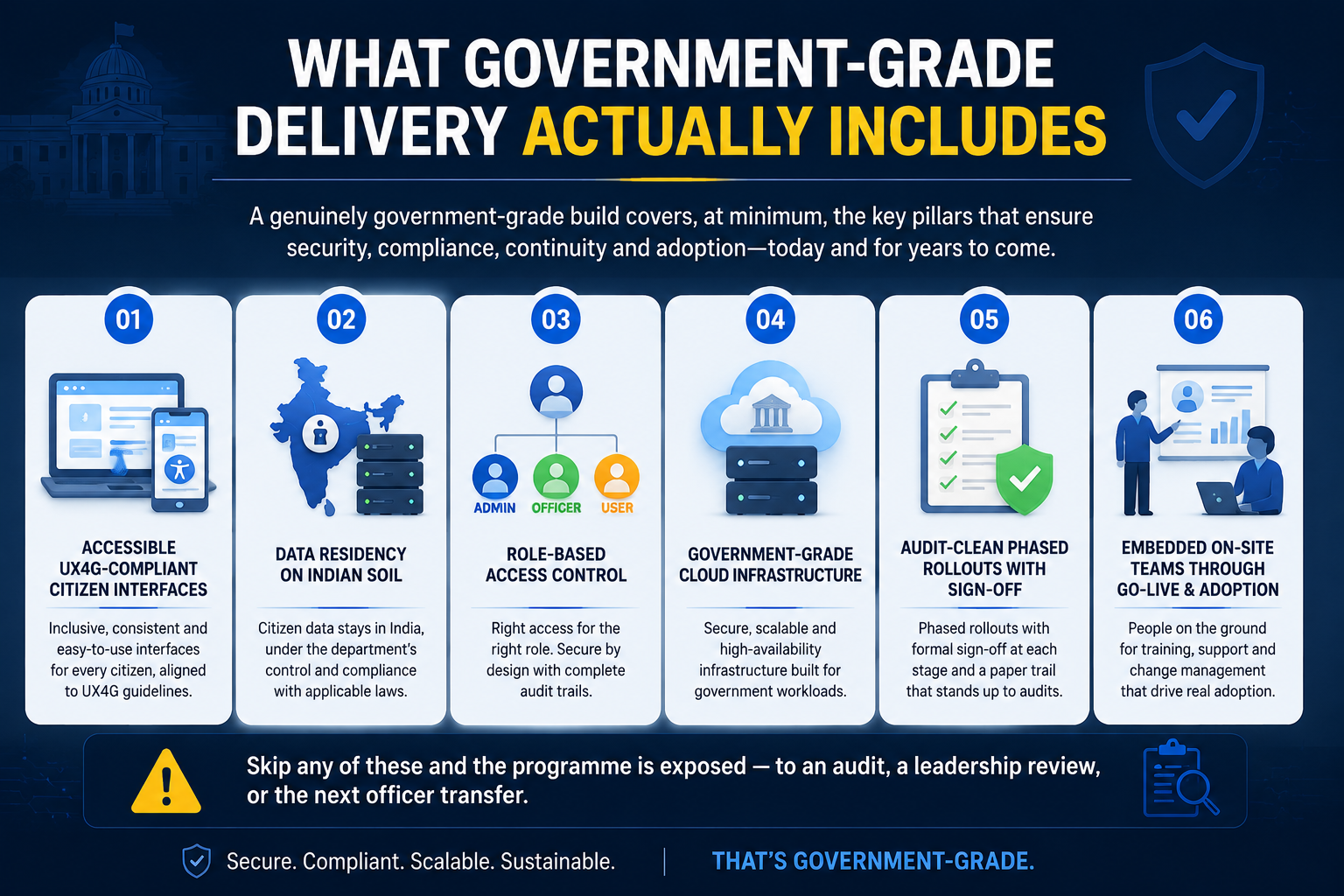
In government software, "government-grade" gets used as a marketing word. It should be a checklist. A genuinely government-grade build covers, at minimum: accessible UX4G-compliant citizen interfaces, data residency on Indian soil, role-based access control, government-grade cloud infrastructure, audit-clean phased rollouts with sign-off at each stage, and embedded on-site teams through go-live and adoption. Skip any of these and the programme is exposed — to an audit, a leadership review, or the next officer transfer.
UX4G compliance and accessibility
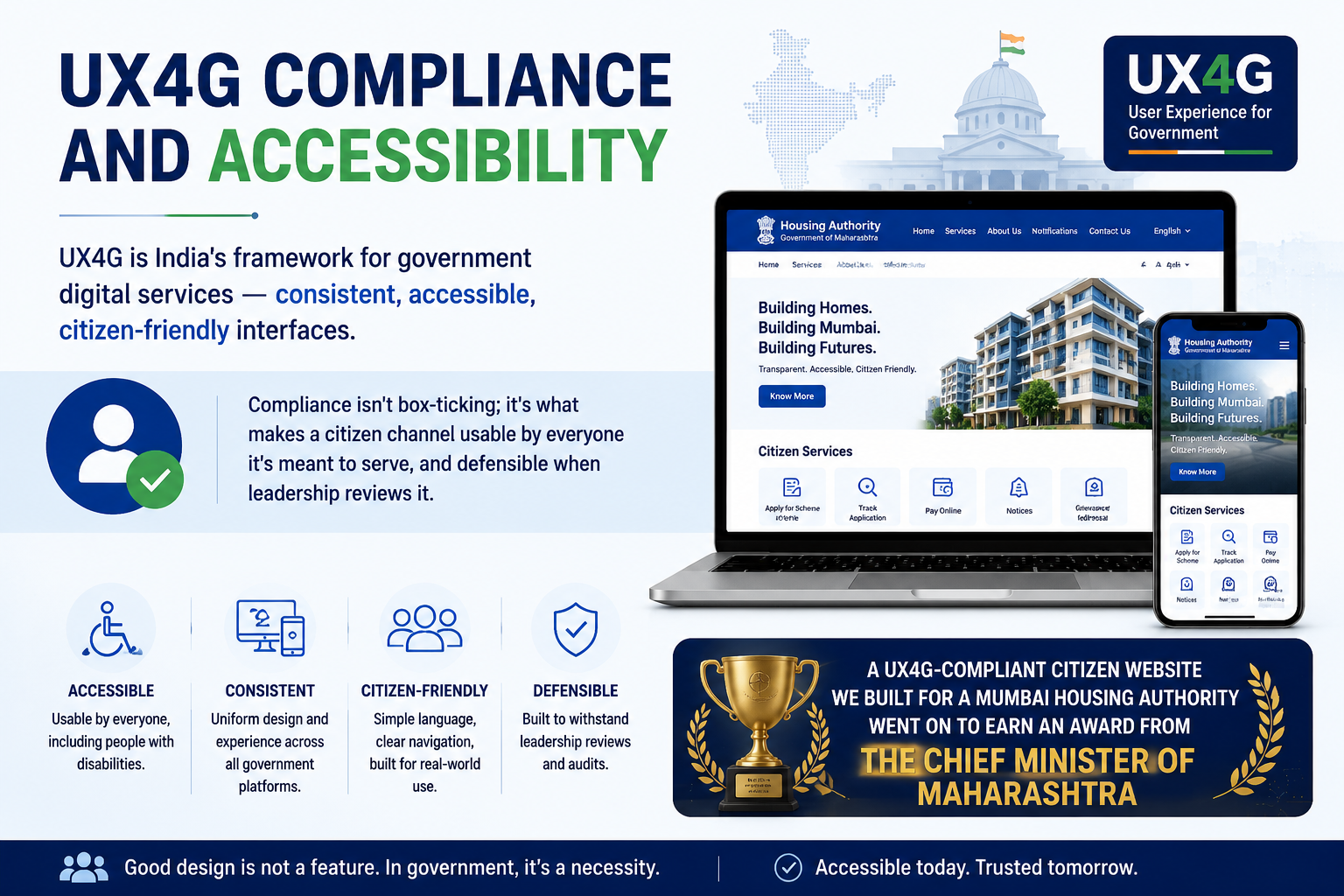
UX4G is India's framework for government digital services — consistent, accessible, citizen-friendly interfaces. Compliance isn't box-ticking; it's what makes a citizen channel usable by everyone it's meant to serve, and defensible when leadership reviews it. A UX4G-compliant citizen website we built for a Mumbai housing authority went on to earn an award from the Chief Minister of Maharashtra.
Data residency on Indian soil
For citizen data, where the data lives matters as much as how it's secured. Government-grade delivery keeps sensitive data on Indian soil, under controls the department can demonstrate. This is non-negotiable for most public-sector and regulated work, and should be confirmed in writing before any contract is signed.
Role-based access control and security
Not everyone should see everything. Role-based access control ensures each user — and each AI assistant, where used — sees only what their role permits, with audit trails for every action. This is the difference between a system that's secure by design and one that's a breach waiting to happen.
Audit-clean, phased rollouts with sign-off
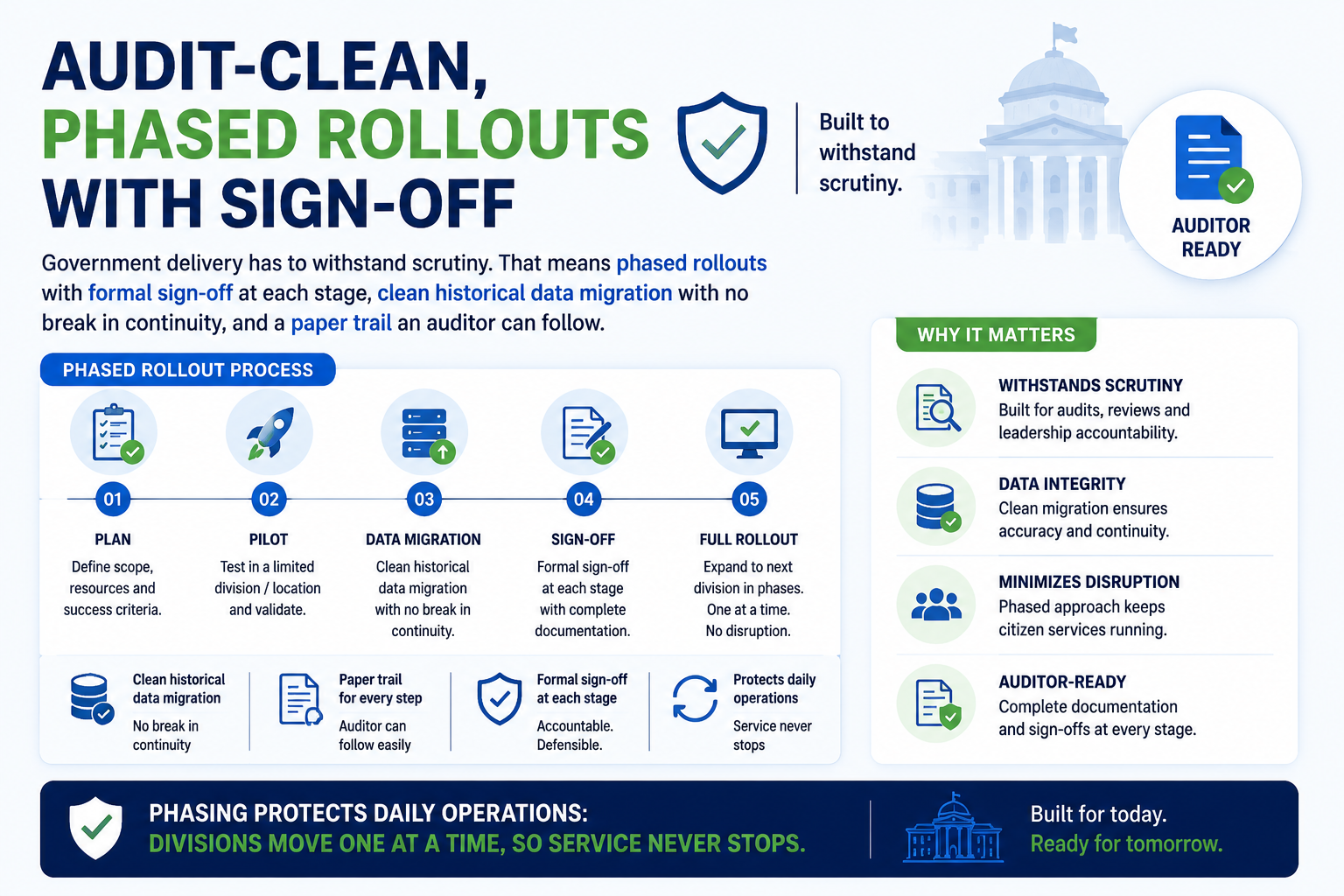
Government delivery has to withstand scrutiny. That means phased rollouts with formal sign-off at each stage, clean historical data migration with no break in continuity, and a paper trail an auditor can follow. Phasing also protects daily operations: divisions move one at a time, so service never stops.
Embedded on-site teams and change management
Technology is the easy part. Adoption across divisions, districts and officer changes is where programmes live or die. That's why government-grade delivery includes people on the ground — for one authority, two of our team stationed on-site through rollout, handling training and change management. It's the discipline private-sector "deliver and disappear" vendors skip, and the reason public systems built this way actually stick.
Frequently Asked Questions
What does "government-grade" software mean?
Building to standards that survive audits, leadership reviews and officer transfers: UX4G compliance, data residency in India, role-based access, government-grade cloud, audit-clean phased rollouts, and on-site delivery.
What is UX4G?
India's design and accessibility framework for government digital services — ensuring consistent, accessible, citizen-friendly interfaces.
Why does data residency matter for government software?
Sensitive citizen data should remain on Indian soil under controls the department can demonstrate. It's a core compliance and trust requirement.
Why do on-site teams matter in government delivery?
Adoption and continuity across divisions and officer transfers depend on people, not just software. On-site teams carry a programme through the changes that would otherwise stall it.
Build Government-Grade Systems That Last →