Maharashtra Government WhatsApp Citizen Services: The 2026 Channel Shift
Quick Answer
The single largest hidden operational cost in Maharashtra government departments is citizens walking in for routine queries that could be resolved via WhatsApp, AI chatbots, or mobile apps. Departments that shift 30-40% of citizen interactions to digital channels reclaim 20+ hours of officer time per week and reduce premises footfall by 60%+. The architecture: WhatsApp Business API for routine status queries, AI chatbot trained only on approved internal documents for self-service answers, mobile app for appointment booking with QR-code entry, and an analytics dashboard exposing which queries should be self-service vs human-handled. One major Mumbai government housing authority (anonymised per NDA) reduced daily walk-ins from over 2,000 to under 700 in under 45 days using this exact pattern.
Every Maharashtra government department has the same hidden operational cost.
It's not the software budget. It's not the staffing budget. It's the citizen walk-in volume — thousands of people every week showing up in person to ask routine questions that could be answered in 30 seconds on WhatsApp.
In one major Mumbai government housing authority (anonymised per NDA), the daily walk-in volume was over 2,000 citizens per day. Security desk overwhelmed. Reception staff entering the same data for the same repeat visitors. Officers being interrupted constantly. Citizens climbing two floors to learn an official is out of office.
In under 45 days, we cut daily walk-ins from over 2,000 to under 700 — using three digital channels that every Maharashtra department should plan for 2026. Here's the architecture, the playbook, and the case study.
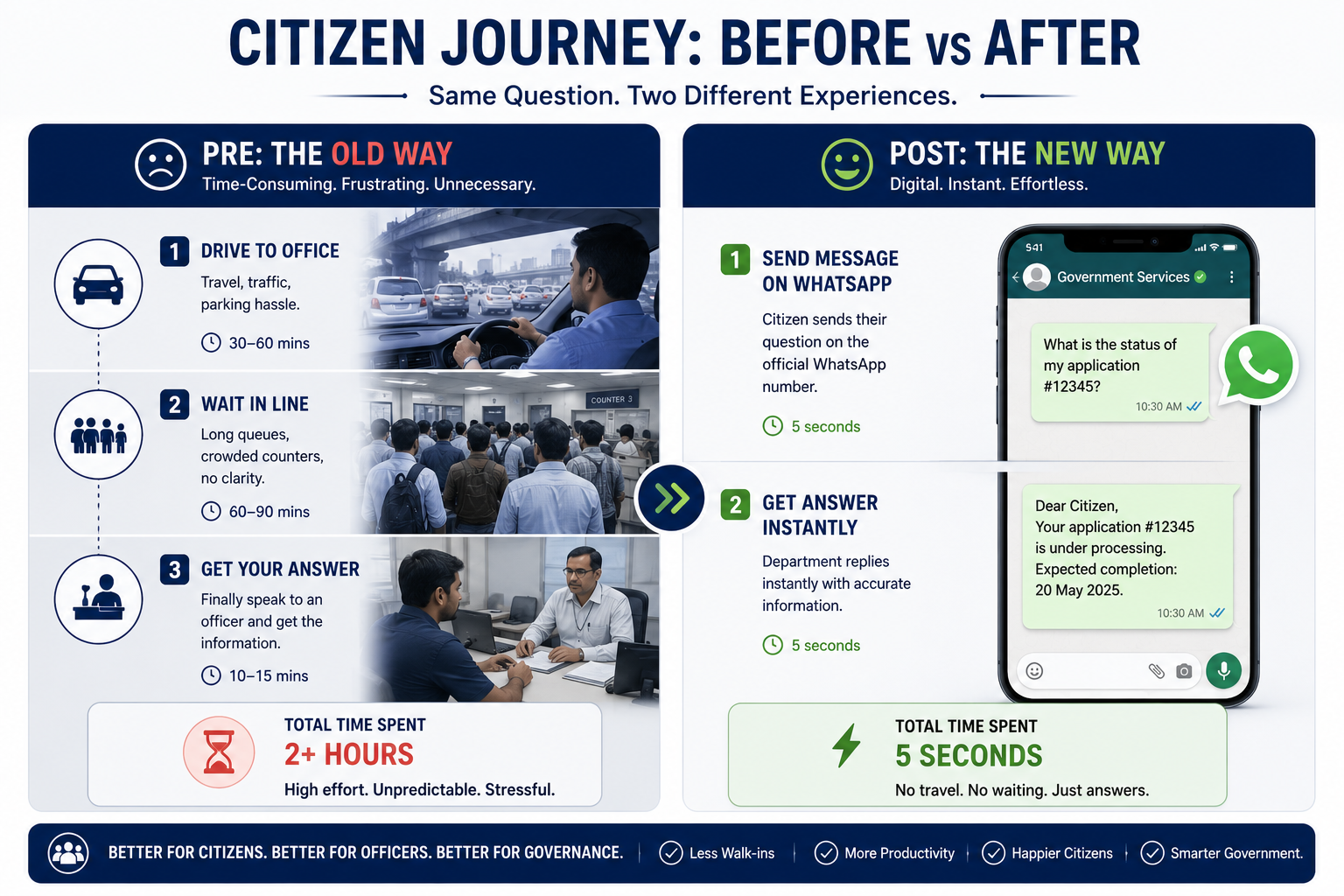
The Maharashtra Office Walk-In Crisis (Bigger Than Most IT Officers Realise)
When we audit Maharashtra state departments and municipal bodies, the walk-in volume metric is the one IT Officers and HODs are most often surprised by.
Most departments don't track daily walk-ins. They track formal applications, registered queries, and processed files. But the citizens walking in to ask 'where is my file' or 'when will I get a response' or 'can I speak to the officer handling my case' — those don't show up in any metric. They show up in officer interruptions and security desk congestion.
In the Mumbai government housing authority case, the breakdown was:
- 35% of walk-ins: routine status queries ('where is my application')
- 25% of walk-ins: information requests answerable from public documents
- 20% of walk-ins: appointment requests (no system to book online)
- 15% of walk-ins: official seeking who was out-of-office that day
- 5% of walk-ins: substantive issues genuinely needing in-person resolution
95% of the walk-in volume was structurally avoidable. The remaining 5% was where human officers actually added value.
Three Digital Channels Every Maharashtra Department Should Now Plan
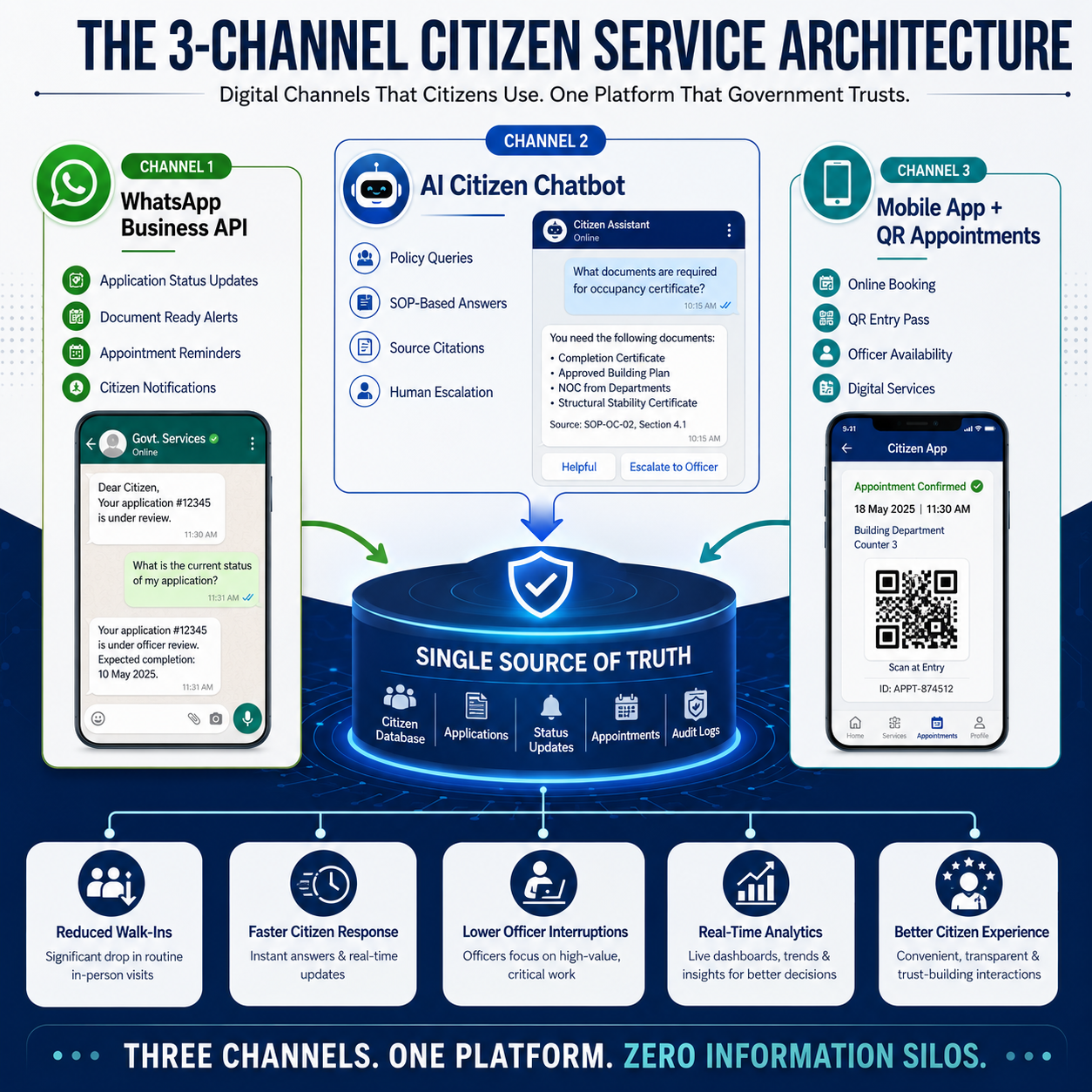
Channel 1: WhatsApp Business API Integration
WhatsApp is the highest-trust digital channel in Maharashtra. Every citizen has it. Every citizen reads notifications. Every citizen prefers a WhatsApp message over a phone call.
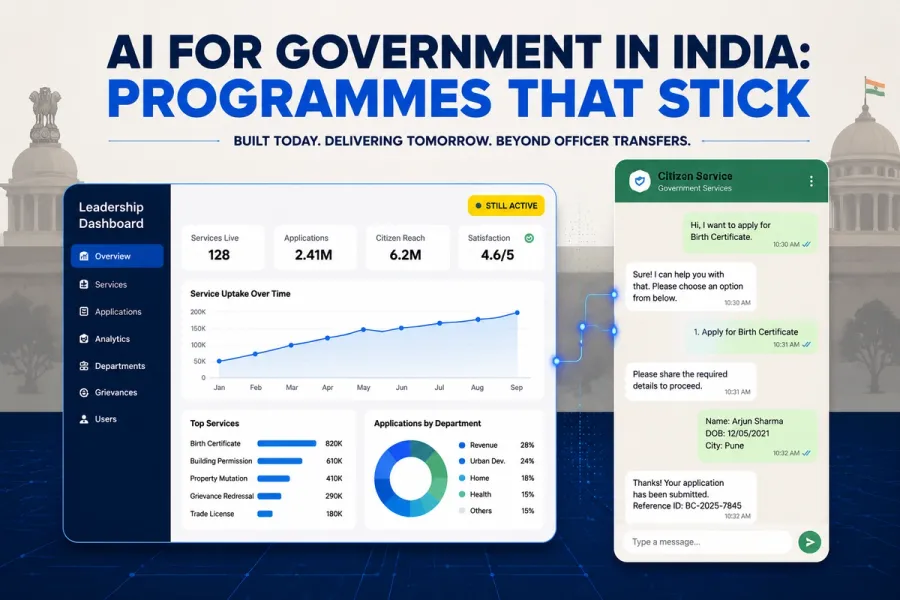
The right architecture: WhatsApp Business API (official, not unofficial workarounds), integrated directly with departmental applications. Citizens opt in once. The department pushes routine status updates, policy announcements, appointment reminders, and document-ready notifications. Citizens can reply to query status without ever leaving WhatsApp.
For one Pune metropolitan authority engagement (anonymised), WhatsApp API integration extended across multiple internal applications — a capability most government IT vendors couldn't deliver, but proved critical for reliability and audit defensibility.
Channel 2: AI Chatbot Trained Only on Approved Internal Documents
For questions citizens ask in writing on the website or app, an AI chatbot can answer 90% of routine queries in seconds.
The architectural rules (non-negotiable for government deployments):
- Trained only on approved internal SOPs, policy documents, and signed-off material
- Every answer cites its source document
- No public internet retrieval — zero hallucination risk on departmental matters
- Three-level role-based access (citizen-facing tier separated from internal tier)
- Audit log of every citizen interaction
- Fallback to human officer when confidence is low or query is outside scope
This is the architecture behind the PMRDA-style citizen chatbot pattern (anonymised: 'a Pune metropolitan authority') that handles citizen queries on the website in seconds while remaining audit-defensible.
Channel 3: Mobile App + QR-Code Appointment Booking
For the legitimate in-person visits that remain (the 5% with substantive issues), citizens should be able to book an appointment online and enter via QR-code scan — skipping the queue, getting a defined time slot, knowing the relevant officer is available.
The pattern includes integration with the officer's mobile app so they can mark themselves out-of-office in real-time — and visitors get notified at the gate, not after climbing two floors.
The Analytics Layer: Which Queries Should Be Self-Service vs Human-Handled
The four channels (WhatsApp + AI chatbot + mobile app + QR appointments) generate data. The data tells the IT Officer which query types are still being escalated to humans (and could be moved to self-service) vs which genuinely need human judgement.
Monthly the dashboard surfaces: 'You're still handling X queries via human officers that 92% of similar departments have moved to AI chatbot.' That insight drives the next round of self-service expansion.
This analytics-driven iteration is what turns a one-off digital channel rollout into a continuous reduction in operational tax.
Anonymised Case Study: 2,000+ → Under 700 Walk-ins in 45 Days
One major Mumbai government housing authority (name withheld per NDA) was handling over 2,000 citizen and stakeholder walk-ins per day — captured on a manual paper register.
No way to see who was inside the premises. No way to track repeat visitors. Security staff re-entering the same details for the same citizens day after day.
What we built in under 45 days:
- App and tablet-based visitor management platform at security and reception points
- Auto-populate on repeat visits (mobile number pulls full history)
- Integration with the authority's mobile app (officials mark themselves out-of-office, visitors notified at gate)
- QR-code entry via the website for pre-booked appointments
- AI-powered analytics dashboard showing live footfall, department-level load, repeat-visitor patterns
Results after 45 days:
- Daily walk-ins dropped from over 2,000 to under 700
- Security desk time collapsed (auto-populate eliminated re-entry)
- Citizens now book online and enter via QR code
- Leadership sees live footfall, department-by-department, on one screen
- Repeat-visitor patterns now trigger proactive resolution rather than queues
The HOD's words after launch: 'Team Accucia delivered this fabulous application in less than 45 days, which is definitely appreciated.'
This is what the 3-channel shift looks like in production — under 45 days, at Maharashtra government scale, zero compromise on security or data quality.
FAQ: Maharashtra Government Citizen Channel Shift
What does WhatsApp Business API cost for a Maharashtra government department?
WhatsApp Business API has per-conversation pricing. For a typical Maharashtra state authority with 5,000-20,000 daily citizen interactions, monthly cost runs ₹50,000 to ₹2.5 lakh depending on volume and conversation type. Implementation cost (integration with departmental systems) typically ₹8-15 lakh one-time. ROI is rapid — typically inside 3-4 months from officer time saved.
What's the hallucination risk on AI chatbots for citizen-facing government services?
Near-zero if architected correctly. The non-negotiable: train the chatbot only on approved internal documents, require source citations on every answer, configure fallback to human officer when confidence is below threshold. Departments that follow this architecture see hallucination rates below 1% in production. Departments that train on public internet content see hallucinations of 10-30% — unacceptable for government use.
What citizen adoption rates can we expect for WhatsApp and mobile app channels?
In the Mumbai government housing authority case, citizen channel adoption hit 60%+ within 60 days of launch. Maharashtra citizens are highly digitally engaged — the limiting factor is awareness (do they know the channel exists?), not capability. Departments should plan an awareness campaign at launch.
Does this approach meet DISHA, ABDM, and Maharashtra-specific compliance requirements?
Yes. WhatsApp Business API is compliant with data residency requirements. AI chatbots architected with citation-first design and three-level RBAC exceed typical compliance bars. Audit trails for every citizen interaction satisfy MahaIT and departmental audit requirements.
Will this work for other Indian states, central government, or municipal corporations?
Yes. The architecture is governance-agnostic. We've applied variations to municipal corporations, regional development authorities, and central government departments. Maharashtra is our deepest deployment to date, but the pattern transfers.
What To Do Next
For Maharashtra IT Officers, HODs, and Commissioners in 2026:
- Audit your current daily walk-in volume — most departments don't track this and are surprised by the number
- Plan the 3-channel shift (WhatsApp + AI chatbot + mobile app) as a single integrated rollout, not three separate initiatives
- Demand citation-first AI architecture and three-level RBAC as non-negotiable
- DM 'CITIZEN CHANNEL' on LinkedIn for our 1-page channel readiness audit
Reduce Walk-Ins. Increase Service.