Don't Replace Your ERP. Give It an AI Brain.

MCP integration that adds AI to the software you already run.

MCP is an open standard that lets AI assistants securely connect to, read from, and act on live business systems — your ERP, CRM, database or custom app. Instead of rebuilding your software with AI inside it, an MCP layer sits on top and gives any AI model controlled access to your real data and operations.

Don't Replace Your ERP. Give It an AI Brain. services by Accucia Softwares — Pune, India
730+
Projects Delivered
500+
Clients Worldwide
15+
Years Engineering
25+
Industry Verticals
Overview

What is MCP (Model Context Protocol)?

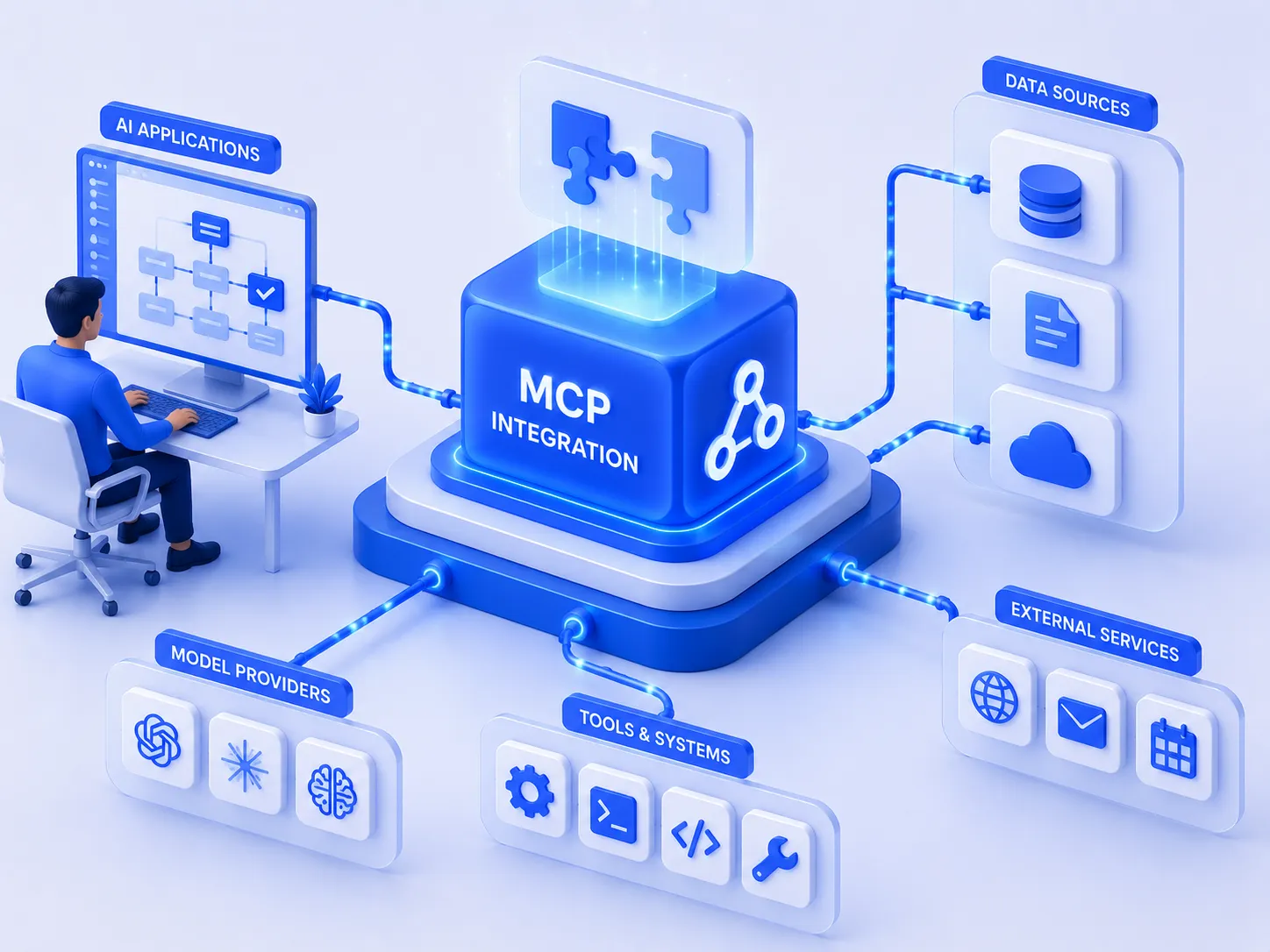
MCP is an open standard that lets AI assistants securely connect to, read from, and act on live business systems — your ERP, CRM, database or custom app. Instead of rebuilding your software with AI inside it, an MCP layer sits on top and gives any AI model controlled access to your real data and operations.

Think of it as a universal adapter between your systems and AI.

Key areas

MCP server layer

Tool / resource definitions

Auth & permission mapping

Client connection

Why MCP matters now

Gartner expects 40% of enterprise apps to embed task-specific AI agents in 2026. MCP is how that happens without throwing away systems you've already paid for. It has rapidly become the common standard for connecting AI to enterprise data — and crucially, this is a genuine, uncontested edge for Accucia.

What We Do

Six capabilities your business gains without replacing the software you already run

Build an MCP Server for Your System

We build an MCP server for your ERP, CRM or app that exposes the right data and actions — so any MCP-compatible AI model can connect to your live business system.

Natural-Language Query & Action

"Which AMC contracts expire this month?" "Create a quotation for this client." Your team asks in plain language; the AI queries and acts on your real, live data.

Permissioned Access per User Role

The AI only sees and does what each user's role allows. Every action is scoped by your existing permissions — not a separate access system to manage.

No Rip-and-Replace

Your existing software keeps running exactly as before. MCP adds an AI layer on top — no data migration, no six-month re-platforming project, no disruption.

Agent Enablement

Once MCP is in place, AI agents and copilots can safely operate your systems — taking actions, reading data and completing workflows within defined limits.

Audit & Observability

Every MCP call is logged and reviewable. You have a full audit trail of every query and action the AI performed — who asked, what happened, when.

How an MCP Integration is Structured

01

MCP server layer

Wrapping your system's services and data — the core integration point.

02

Tool / resource definitions

The specific reads and actions the AI may perform, precisely scoped.

03

Auth & permission mapping

Tied to your existing roles and identity — no new access system required.

04

Client connection

ChatGPT, Claude, your own copilot or agents connect to the server.

05

Audit & observability

Every call logged and reviewable — full visibility into every AI action taken.

MCP Use Cases

By function

Sales — quotes, pipeline queries Finance — invoice, contract, AMC lookups Operations — status, scheduling, inventory Support — account & order actions Management reporting on demand

By industry

  • Real estate — in-ERP services via MCP
  • Manufacturing — production & inventory ERP
  • Elevator & field service — AMC, breakdowns, quotations
  • Logistics — job & fleet data
  • Healthcare & finance — permissioned record access

MCP Technology Stack

Protocol: Model Context Protocol · Models: model-agnostic (GPT, Gemini, Claude) · Build: Python, Node.js/TypeScript MCP servers · Security: OAuth, audit logging

Our MCP Integration Process

From readiness review to daily adoption — six stages to make your existing software AI-capable

1

MCP Readiness Review

Assess your system's APIs and data, identify the highest-value first use cases, and confirm what's safe and practical to expose to AI.

2

Scope the Tools

Define the specific reads and actions to expose — what the AI may query, what it may act on, and where human approval is required.

3

Build the MCP Server

Implement the MCP server with tool and resource definitions, map permissions to your existing roles and identity, and connect to your system's APIs and data.

4

Connect & Test

Connect the AI client or agent and test against real queries and actions — validating accuracy, safety and permission boundaries with your team.

5

Deploy

Production rollout with audit logging, monitoring and observability so every call is tracked and the system stays within policy.

6

Embed On-Site & Expand

We stay until your team is actually using the AI assistant daily — then expand by adding more tools and capabilities as adoption grows.

Why Accucia for MCP Integration?

Already shipped in production — not a concept

We've Already Shipped MCP

We've delivered MCP integrations into live ERP projects — including a real-estate ERP where in-ERP services were exposed to AI assistants via MCP. This is delivered work, not a concept.

Integration-First

Keep your investment, add the intelligence on top. No rip-and-replace, no migration, no disruption to the systems your business already runs on.

Adoption-First

We stay on-site after go-live and measure utilisation. If your people aren't using the AI assistant daily, the engagement isn't done.

Uncontested Positioning

MCP delivery is a genuine, uncontested edge — we've shipped it in production while competitors aren't yet advertising this capability.

Security & Auditability Built In

Access is permissioned per user, every call is logged, encryption in transit and at rest, and on-prem / private-cloud options for sensitive and government data.

Model-Agnostic

Once your system is MCP-enabled, any MCP-compatible model — Claude, GPT, Gemini or your own copilot — can use it. You're not locked into one AI vendor.

Shipped in Production

Real-estate ERP — MCP integration

We exposed the client's in-ERP services to AI assistants via MCP, enabling natural-language query and action on live ERP data.

"You don't need a new system. You need your current one to think."

Engagement Models

Fixed-Price First Integration

A defined first MCP integration delivered at a fixed price.

Time & Materials for Expansion

Add more tools and capabilities as adoption grows.

Dedicated Team

An embedded team for broader MCP and AI integration programmes.

A first MCP integration on a defined set of services ships in weeks, not months

Frequently Asked Questions

Everything you need to know about MCP and connecting AI to your existing software

An open standard that lets AI assistants securely connect to, read from and act on live business systems like your ERP or CRM.

No — MCP adds an AI layer on top of your existing software; nothing gets ripped out.

Yes — access is permissioned per user and fully auditable; the AI only does what each role is allowed to.

Most ERPs, CRMs and custom apps with an API or database can be MCP-enabled. We assess yours in a short review.

A first integration on a defined set of services typically ships in weeks, not months.

Model-agnostic — ChatGPT, Claude, your own copilot or custom agents.

Yes — for data-sensitive and government deployments.

An API connects two systems for fixed functions; MCP exposes your system to AI so a model can flexibly query and act using natural language, within permissions.

See if Your ERP is MCP-Ready — Book a 20-min Review

You don't need a new system. You need your current one to think. Tell us which system you want to make AI-capable and we'll assess what's possible in one conversation.

Chat With Us