The Continuity Trap in Government Digital Programmes
Quick Answer
> The continuity trap is the pattern where a government digital programme stalls the moment the officer championing it is transferred — because the knowledge, decisions and momentum lived with that person, not the system. The fix is transfer-proof design: SOPs and workflows built directly into the platform, full operational state visible on a day-one dashboard for the incoming officer, and on-site teams that carry continuity across officer changes. Programmes built this way survive transfers; programmes built around an individual quietly return to paper. By Mr. Sumeet Katariya, CEO Accucia Softwares
Key Takeaways
- Digital programmes stall when the driving officer is transferred — knowledge walks out with them.
- The fix is transfer-proof design, not heroics from the next officer.
- Build SOPs and workflows into the platform, not into one person's head.
- Give the incoming officer a day-one dashboard of the full state of operations.
- On-site teams carry continuity through the transition.
What is the continuity trap?
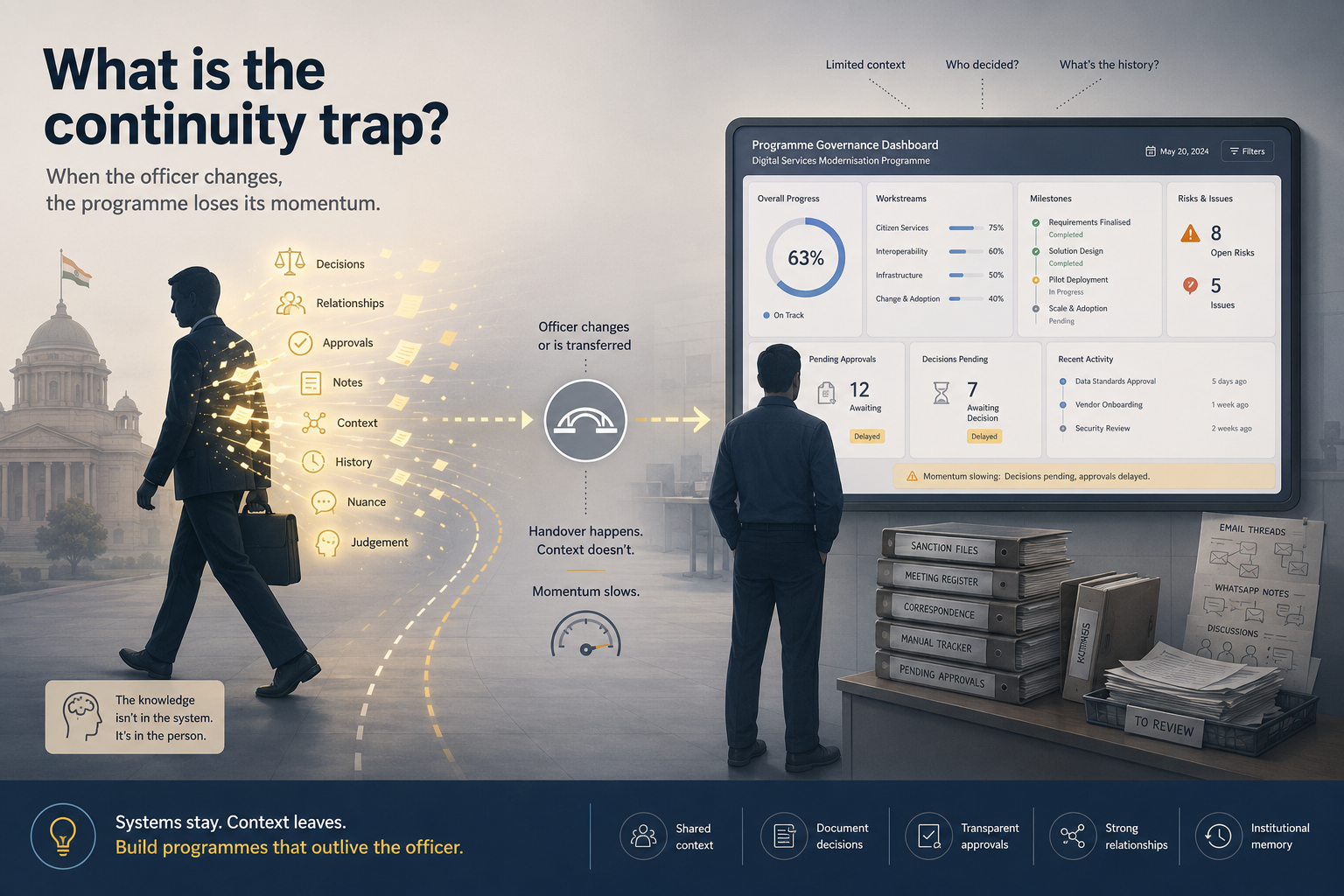
In government, the single biggest threat to a digital programme isn't budget or technology — it's the transfer. An officer champions a digital initiative, drives adoption, holds the context. Then they're transferred, and the programme stalls. Not because the software stopped working, but because everything that made it work — the decisions, the relationships, the why — lived in that officer's head. That's the continuity trap.
Why knowledge walks out with the officer
Government runs on people who carry deep institutional context. When a programme is built around an individual rather than into the system, that context is fragile by design. The incoming officer arrives without it, faces a system they didn't choose, and — rationally — reverts to the familiar: paper, registers, and the way things were done before. The digital launch becomes a press-release memory.
Building transfer-proof systems
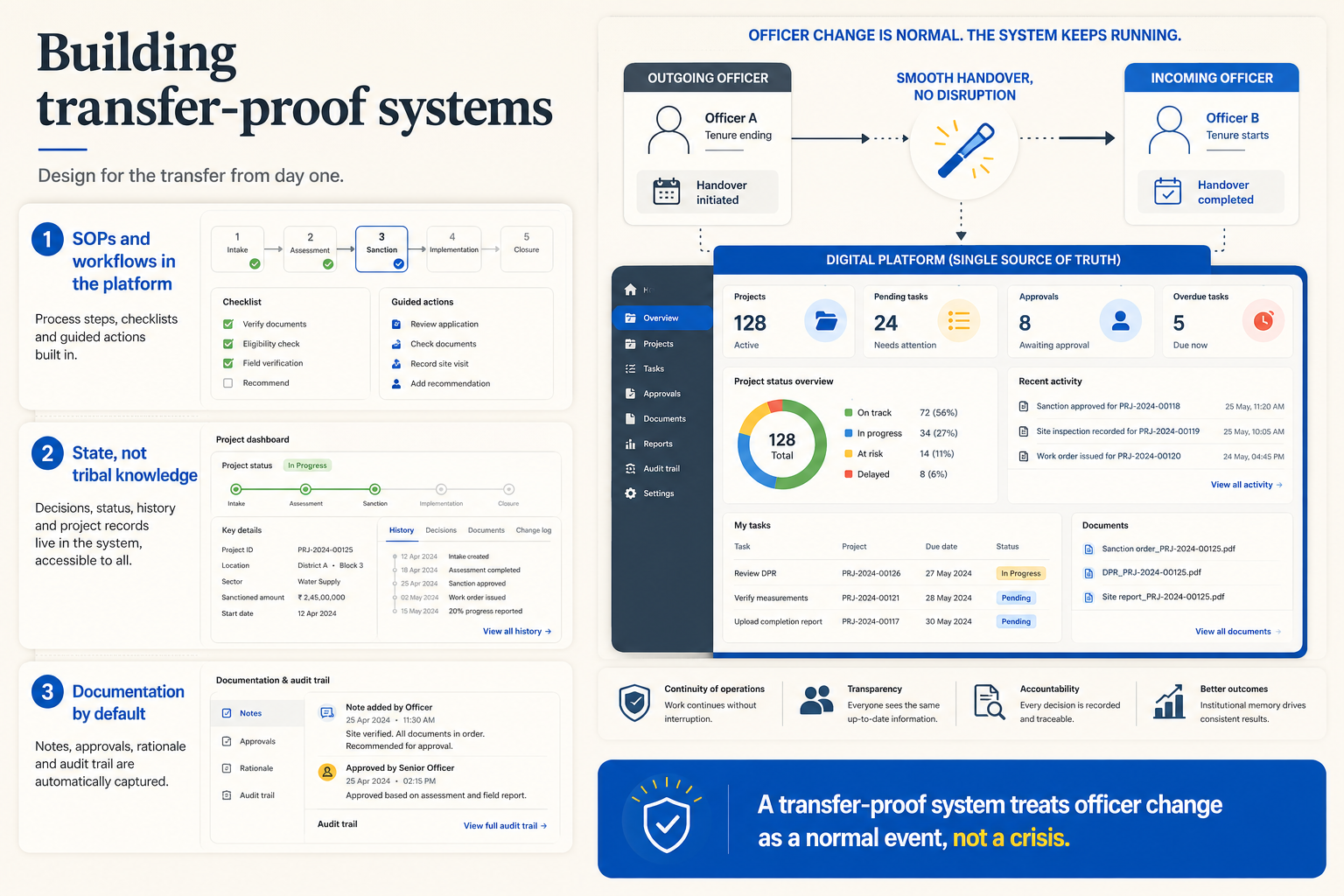
The antidote is to design for the transfer from day one:
- SOPs and workflows in the platform. The process is encoded in the system and guides the right action, so it doesn't depend on anyone remembering it.
- State, not tribal knowledge. Decisions, status and history live in the system, where the next officer can see them.
- Documentation by default. The system captures the why, not just the what.
A transfer-proof system treats officer change as a normal event, not a crisis.
The day-one dashboard for the incoming officer
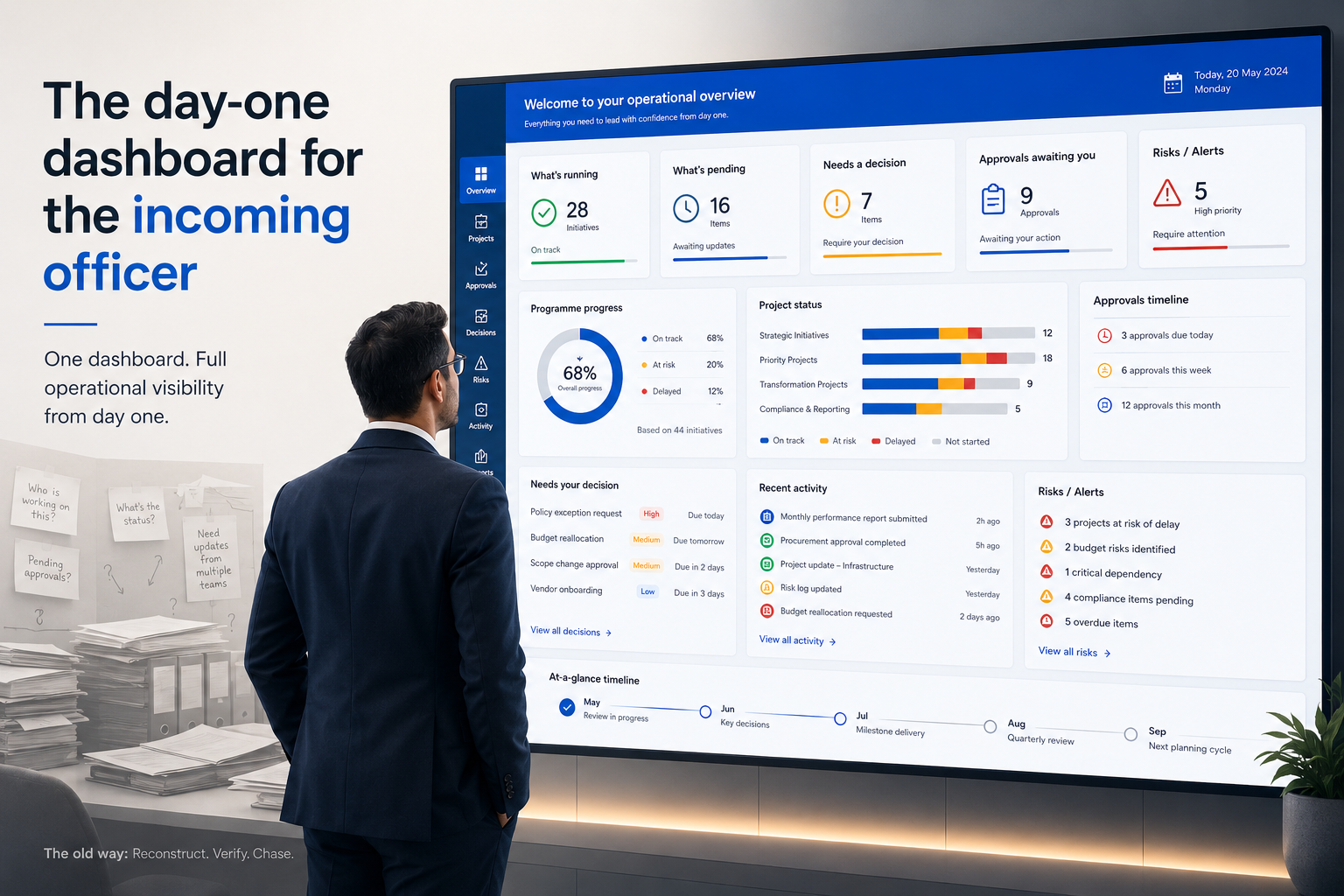
The clearest test of continuity: when a new officer arrives, can they open one dashboard and see the full state of operations — what's running, what's pending, what needs a decision? If yes, the programme survives the transfer. If they have to reconstruct it by asking around, the continuity trap is already closing. We design for the former: the incoming officer should be productive on day one, not month three.
On-site teams that carry continuity
Technology alone doesn't carry institutional memory across a transition — people do. Embedded on-site teams hold continuity through officer changes: they retain the context, support the incoming officer, and keep adoption from slipping during the handover. For one authority, on-site delivery staff supported continuity across 10–15 connected projects, through exactly these kinds of changes.
Frequently Asked Questions
Why do government digital programmes stall after an officer transfer?
Because the process, decisions and context lived with the departing officer, not in the system. The incoming officer inherits a tool without the institutional memory to run it.
How do you make a government system transfer-proof?
Build SOPs and workflows into the platform, keep operational state and history in-system, and give the incoming officer a day-one dashboard of the full picture. Back it with on-site continuity.
Does this need on-site support?
Yes. People carry institutional memory across a transition; embedded teams keep continuity and adoption intact during the handover.
What's the test for whether a programme will survive a transfer?
Whether a new officer can open one dashboard and see the complete state of operations on day one — without reconstructing it from colleagues.
Keep operations moving, even when officers change.