The Complete Custom Software Development Process: Idea to Launch (2026 Guide)
Quick Answer
The custom software development process has 7 core stages: (1) Discovery & Requirement Gathering, (2) Planning & Feasibility Analysis, (3) UI/UX Design, (4) Development, (5) Quality Assurance & Testing, (6) Deployment & Launch, and (7) Post-Launch Support & Maintenance. A typical project takes 3–9 months depending on complexity, and each stage feeds directly into the next to reduce rework and ensure the final product matches business goals. By Mr. Sumeet Katariya, CEO Accucia Softwares
Building custom software isn't just about writing code it's a structured journey that turns a business idea into a working, scalable product. Whether you're a startup building your first MVP or an enterprise replacing legacy systems, understanding the custom software development process helps you plan budgets, timelines, and expectations accurately.
At Accucia Softwares, we follow a proven 7-stage framework that takes projects from initial concept to a fully deployed, supported product. This guide breaks down each stage in detail, so you know exactly what happens, when, and why.
Custom Software Development Process: 7 Stages Explained
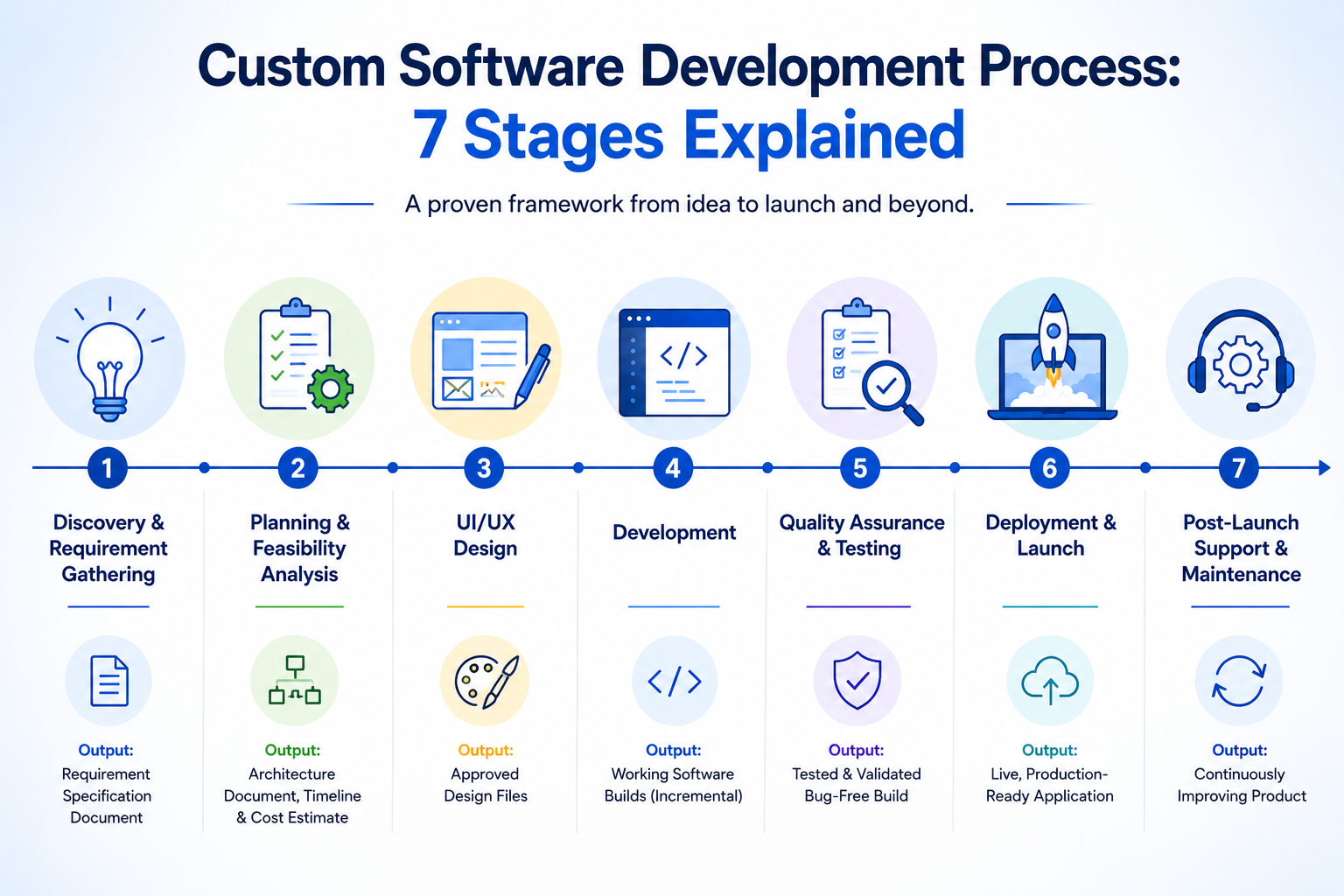
1. Discovery & Requirement Gathering
This is the foundation stage. The development team meets stakeholders to understand:
- Business goals and the problem the software needs to solve
- Target users and use cases
- Technical constraints (existing systems, integrations, compliance needs)
- Budget and timeline expectations
Output: A requirement specification document (RSD) or product brief that becomes the reference point for every later stage.
2. Planning & Feasibility Analysis
Once requirements are clear, the team evaluates technical feasibility and creates a project roadmap:
- Technology stack selection (based on scalability, security, and cost)
- Architecture planning (monolith vs microservices, cloud vs on-premise)
- Resource allocation and sprint planning
- Risk assessment and mitigation strategy
Output: Technical architecture document, project timeline, and cost estimate.
3. UI/UX Design
Design translates requirements into a visual and interactive blueprint:
- Wireframes mapping out screen flow and navigation
- High-fidelity mockups reflecting brand and usability standards
- Interactive prototypes for stakeholder review and user testing
Output: Approved design files ready for development handoff.
4. Development
This is where the product is actually built, typically using Agile sprints:
- Backend development (databases, APIs, business logic)
- Frontend development (user interface, interactions)
- Third-party integrations (payment gateways, CRMs, etc.)
- Regular sprint reviews and demos with the client
Output: Working software builds delivered incrementally, sprint by sprint.
5. Quality Assurance & Testing
Testing runs parallel to and after development to catch issues before launch:
- Functional testing (features work as intended)
- Performance and load testing (handles real-world traffic)
- Security testing (vulnerability scans, penetration testing)
- User acceptance testing (UAT) with real stakeholders
Output: A stable, bug-free build validated against the original requirements.
6. Deployment & Launch
Once testing is complete, the software goes live:
- Server/cloud environment setup and configuration
- Data migration (if replacing an existing system)
- Final go-live checks and rollback plan
- User training and documentation handover
Output: A live, production-ready application in the hands of real users.
7. Post-Launch Support & Maintenance
Launch isn't the finish line — ongoing support keeps the software reliable and current:
- Bug fixes and performance monitoring
- Feature updates based on user feedback
- Security patches and compliance updates
- Scaling infrastructure as usage grows
Output: A continuously improving product with long-term stability.
How Long Does the Custom Software Development Process Take?
Timelines vary by project complexity: a simple MVP can take 6–10 weeks, a mid-sized business application typically takes 3–6 months, and enterprise-grade systems with complex integrations can take 6–12 months or longer. Discovery and planning alone can take 1–3 weeks for larger projects.
Why Following a Structured Process Matters
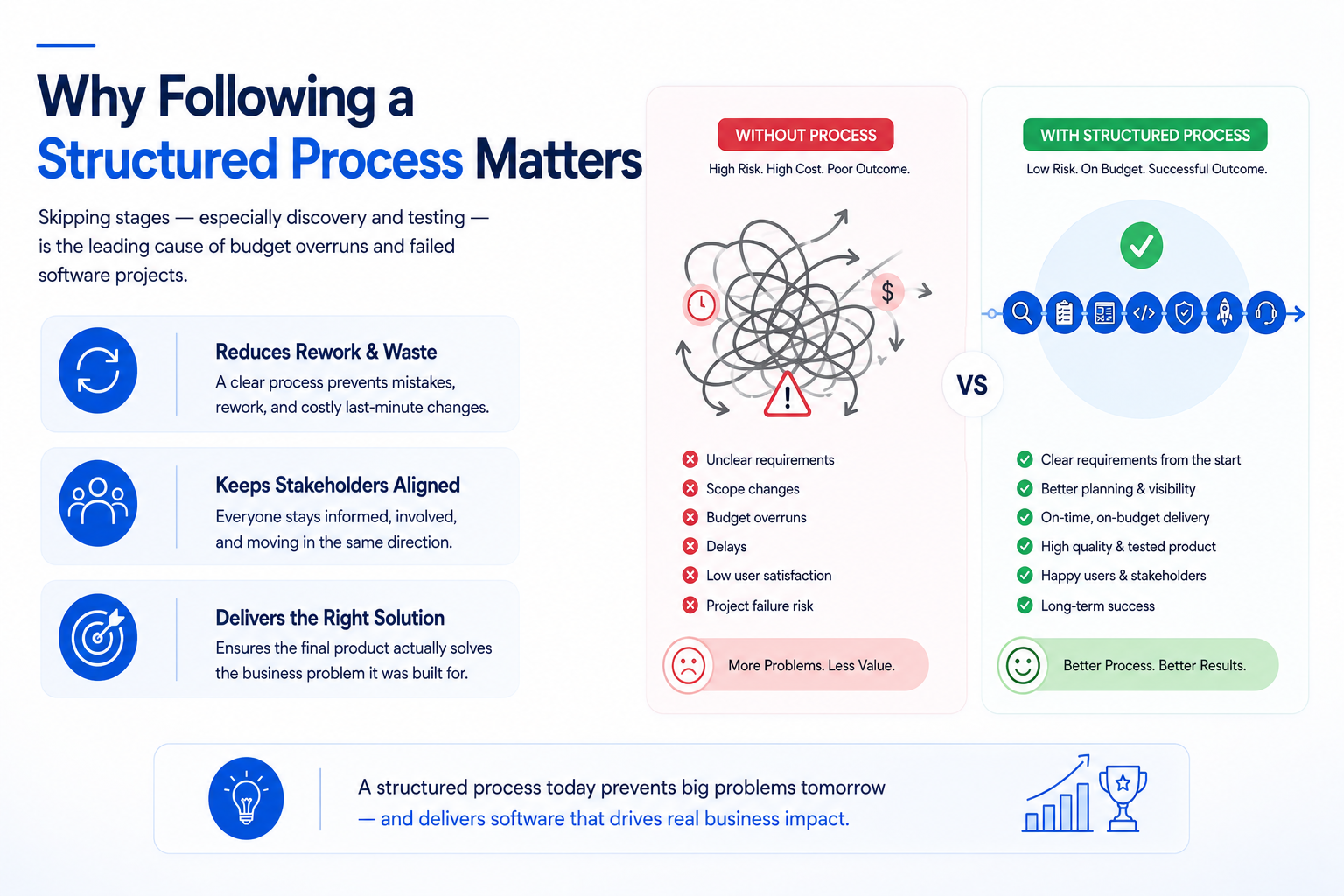
Skipping stages — especially discovery and testing — is the leading cause of budget overruns and failed software projects. A structured process reduces rework, keeps stakeholders aligned, and ensures the final product actually solves the business problem it was built for.
Frequently Asked Questions
What are the main stages of custom software development?
Discovery, planning, design, development, testing, deployment, and post-launch support — seven stages that take a project from idea to a fully supported live product.
How much does custom software development cost?
Cost depends on complexity, but most projects range from a few thousand dollars for a simple MVP to six figures for enterprise systems. Request a detailed quote based on your requirement specification document.
Do I need to be involved throughout the whole process?
Yes — client involvement is critical during discovery, design approval, sprint reviews, and UAT to make sure the product matches your expectations at every stage.
Can the process be shortened?
Agile sprints and MVP-first approaches can speed up time-to-market, but discovery, design, and testing stages should never be skipped, as they prevent costly rework later.
Custom software development is a structured, stage-by-stage process — not a one-off coding task. From discovery through post-launch support, each phase builds on the last to reduce risk and deliver software that truly fits your business. Ready to start your project? Accucia Softwares can guide you through every stage, from idea to launch.
Ready to build your software? Let's talk.