What Does a Software Development Partner Actually Do? (Beyond Just Writing Code)
Quick Answer
A software development partner is a long-term technology collaborator that helps businesses design, build, scale, and maintain software products. Unlike a software vendor that simply delivers a predefined scope of work, a software development partner takes responsibility for business outcomes and supports the entire software lifecycle
A software development partner is a long-term technology collaborator that handles the full lifecycle of building, scaling, and maintaining software — not just the coding. Unlike a freelancer or a vendor who delivers a fixed scope, a software development partner takes co-ownership of your product's success, from strategy and architecture to deployment, iteration, and growth.
In short: a vendor asks "what do you want built?" — a partner asks "what problem are you trying to solve, and is software even the right answer?"
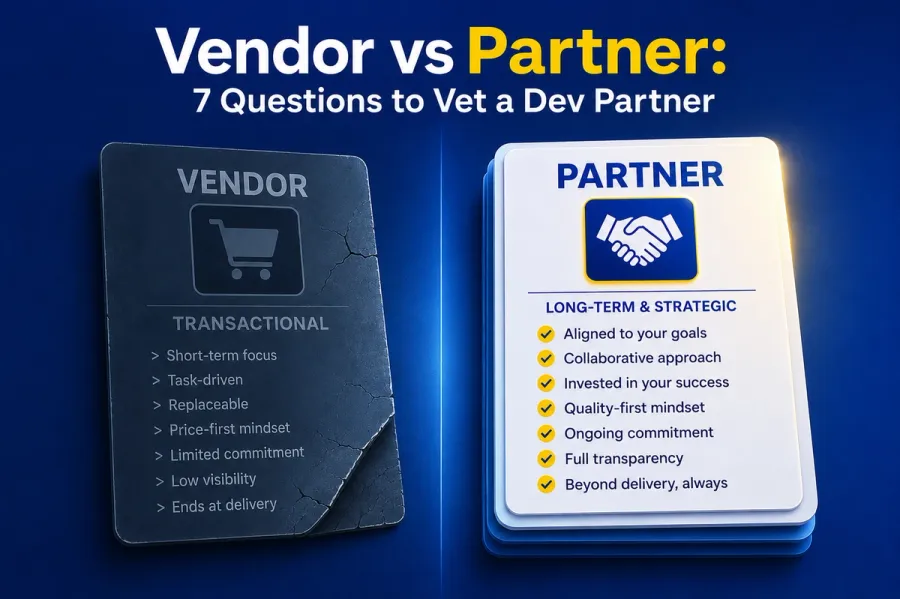
The Difference Between a Software Vendor and a Software Development Partner
Most businesses confuse the two. Here's the clearest way to understand the distinction:
Software Vendor
Software Development Partner
Relationship
Transactional
Collaborative
Focus
Delivering a spec
Delivering outcomes
Involvement
During the project
Before, during, and after
Accountability
Scope completion
Business results
Communication
Status updates
Strategic conversations
A vendor delivers what you asked for. A partner challenges whether you're asking the right question.
7 Things a Software Development Partner Does That Go Far Beyond Coding
1. Product Strategy and Discovery
Before a single line of code is written, a software development partner helps you answer foundational questions:
- Who is the end user, and what problem are they paying to solve?
- Is a custom-built solution the right approach, or does an off-the-shelf tool solve it better?
- What is the minimum viable product (MVP) that can validate the idea fastest?
- What does success look like in 6, 12, and 24 months?
This discovery phase — typically 2 to 4 weeks — saves months of expensive rework. Many businesses skip it when working with vendors. A partner insists on it.
2. Technical Architecture and System Design
How your software is designed on day one determines how expensive and painful it is to scale on day 500. A software development partner makes architectural decisions with your long-term business goals in mind:
- Cloud infrastructure selection (AWS, Azure, GCP)
- Monolith vs. microservices vs. serverless architecture
- Database design and data modeling
- API strategy and third-party integrations
- Security design and compliance requirements (GDPR, HIPAA, ISO 27001)
Poor architecture is the single most common reason software projects fail or become unmaintainably expensive. This is where a partner earns their value.
3. Building and Staffing the Right Team
A software development partner doesn't just assign developers — they assemble the right combination of skills for your specific product:
- Frontend and backend engineers
- UX/UI designers
- QA engineers and testers
- DevOps and cloud infrastructure specialists
- Product managers and business analysts
They also scale the team up or down based on project phase. This is impossible with a fixed freelance hire.
4. Agile Delivery and Iterative Development
A software development partner manages the development process itself — not just the output. This means:
- Breaking work into 2-week sprints with clear deliverables
- Running regular demos so you see working software, not just status reports
- Prioritizing the product backlog based on business value
- Adapting quickly when requirements change (and they always do)
You stay in control of direction. They handle execution. Progress is visible, measurable, and continuous.
5. Quality Assurance and Testing
Shipping fast matters. Shipping broken software costs more. A software development partner builds quality into the process — not as an afterthought:
- Automated unit and integration testing
- Performance and load testing
- Security vulnerability assessments
- User acceptance testing (UAT) with real stakeholders
- Continuous integration pipelines that catch bugs before they reach production
6. Deployment, DevOps, and Ongoing Operations
When the software is built, the work doesn't end. A software development partner manages:
- CI/CD pipelines (continuous integration / continuous deployment)
- Cloud infrastructure setup and monitoring
- Uptime, performance, and reliability SLAs
- Security patching and dependency updates
- Scaling infrastructure as your user base grows
This is operational maturity most in-house teams at early-stage companies can't afford to maintain independently.
7. Long-Term Evolution and Product Roadmap
The best software development partnerships last years, not months. As your business evolves, your partner:
- Conducts regular technology reviews to identify technical debt
- Recommends when to rebuild vs. refactor
- Introduces new technologies (AI/ML, mobile, integrations) when they add real value
- Aligns the product roadmap with changing business strategy
They become embedded in your growth story — not just a past vendor you worked with once.
When Do You Need a Software Development Partner vs. a Freelancer or Agency?
Choose a freelancer when: You have a well-defined, small, standalone task (a landing page, a WordPress plugin, a script).
Choose a software agency when: You need a project delivered on a fixed timeline and budget with a defined scope.
Choose a software development partner when:
- You're building a product that will evolve over time
- Your software is core to your business model
- You need a team, not just one or two people
- You want someone who will challenge your thinking, not just take instructions
- You're planning to scale — users, revenue, or features
What Should You Look for in a Software Development Partner?
When evaluating a software development partner, ask these questions:
- Do they ask about your business goals before your technical requirements? If the first conversation is about tech stack, walk away.
- Can they show you live products they've built and maintained for 2+ years? Anyone can ship v1. Partners are still there for v5.
- Do they have a defined discovery and scoping process? Vague proposals lead to scope creep and budget overruns.
- How do they handle disagreements? A good partner pushes back with evidence, not just compliance.
- What does their post-launch support look like? Delivery without support is not a partnership.
Frequently Asked Questions About Software Development Partners
What is a software development partner? A software development partner is a long-term technology collaborator that works alongside your business to design, build, scale, and maintain software products. They go beyond writing code to include strategy, architecture, QA, deployment, and ongoing product evolution.
How is a software development partner different from a software vendor? A vendor completes a fixed scope of work for a price. A software development partner takes co-ownership of outcomes — they're accountable not just for delivering features but for whether those features achieve your business goals.
How much does a software development partner cost? Costs vary by team size, location, and engagement model. Dedicated team partnerships typically range from $15,000 to $80,000+ per month. The cost is offset by faster time-to-market, lower rework, and no hiring overhead.
When should a startup work with a software development partner? Startups benefit most from a software development partner when they have a validated idea, initial funding, and need to move fast without making expensive architectural mistakes. Pre-revenue, a freelancer or no-code tool may be more appropriate.
Can a software development partner replace an in-house engineering team? Yes — many businesses use software development partners as their entire technology function. Others use them to augment an in-house team. The model depends on your strategic priorities, budget, and how central technology is to your business.
What industries use software development partners? Software development partnerships are common across fintech, healthtech, edtech, SaaS, e-commerce, logistics, and enterprise software. Any industry where custom software drives competitive advantage benefits from the model.
The Bottom Line: A Software Development Partner Is a Business Decision, Not Just a Technical One
Hiring a software development partner is one of the highest-leverage decisions a business leader can make. Get it right, and you have a team that compounds your competitive advantage over time. Get it wrong — or settle for a vendor pretending to be a partner — and you'll spend the next two years paying to undo their work.
The question isn't just "can they code?" The question is: "Will they still be solving problems with us two years from now?"
That's the real job of a software development partner.
Looking for a software development partner, not just a vendor? Let's talk.