Vendor vs Partner: 7 Questions to Vet a Dev Partner
Quick Answer
The difference between a software vendor and a software partner is what happens after delivery: a vendor's responsibility ends when the code is handed over, while a partner stays on-site through rollout and remains accountable until the team is actually using the system. You can tell them apart in one meeting by asking who will be physically present during the first 45 days after go-live, and by requesting the 6-month utilisation rate of their last three builds. Features and price don't predict success what happens on day 91 does. By Mr. Sumeet Katariya, CEO Accucia Softwares
Key Takeaways
- A vendor's job ends at delivery; a partner's ends when your team can't work without the system.
- The difference shows up after the PO is signed — so test for it before you sign.
- The single sharpest question: "What happens on day 91?"
- Three phrases are reliable red flags; watch for them.
- Longevity (5+ year clients) is the clearest proof a firm actually stays.
What's the difference between a vendor and a partner?
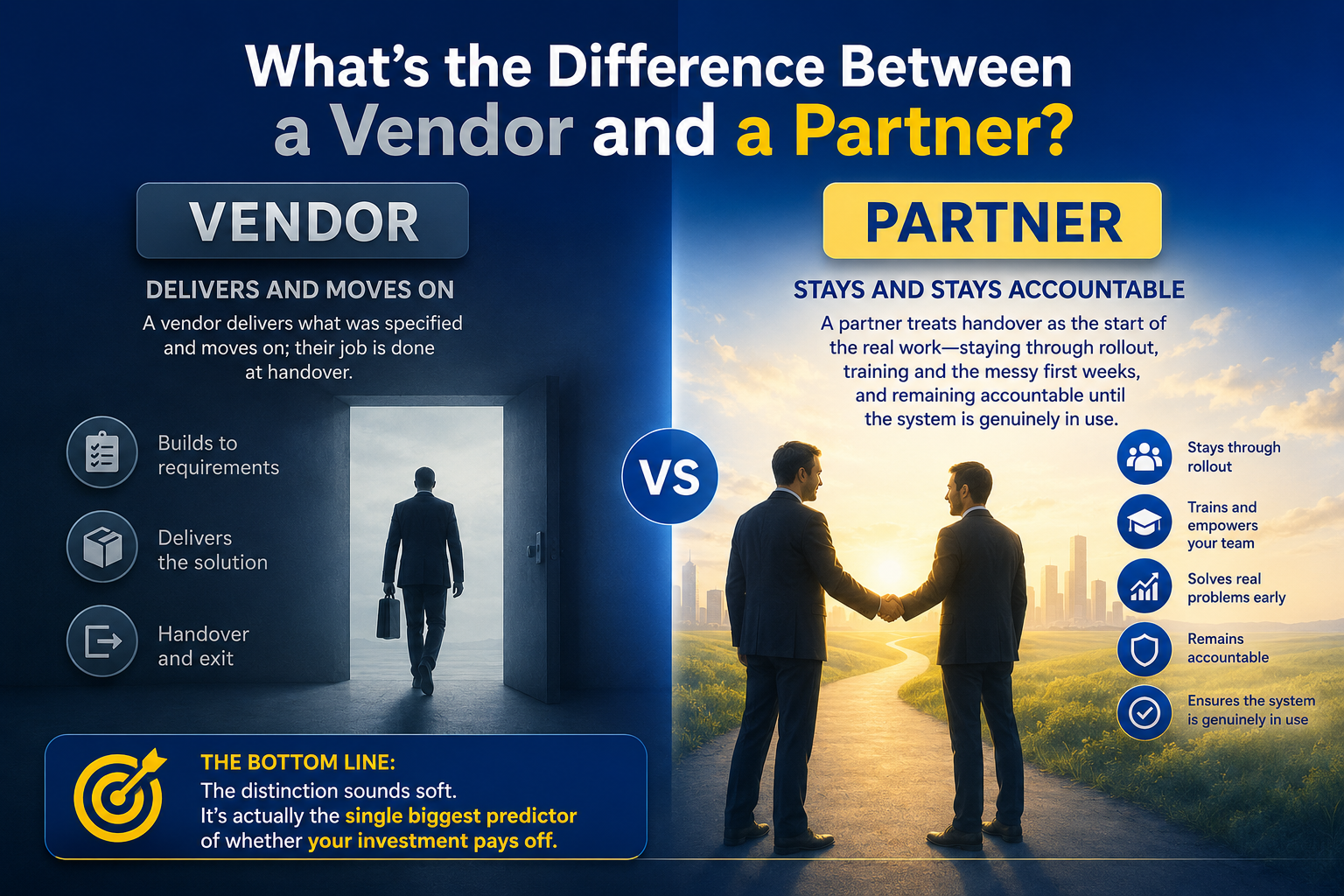
Both can build software. The difference is accountability after the build. A vendor delivers what was specified and moves on; their job is done at handover. A partner treats handover as the start of the real work staying through rollout, training and the messy first weeks, and remaining accountable until the system is genuinely in use.
That distinction sounds soft. It's actually the single biggest predictor of whether your investment pays off.
Why the difference shows up after the PO is signed
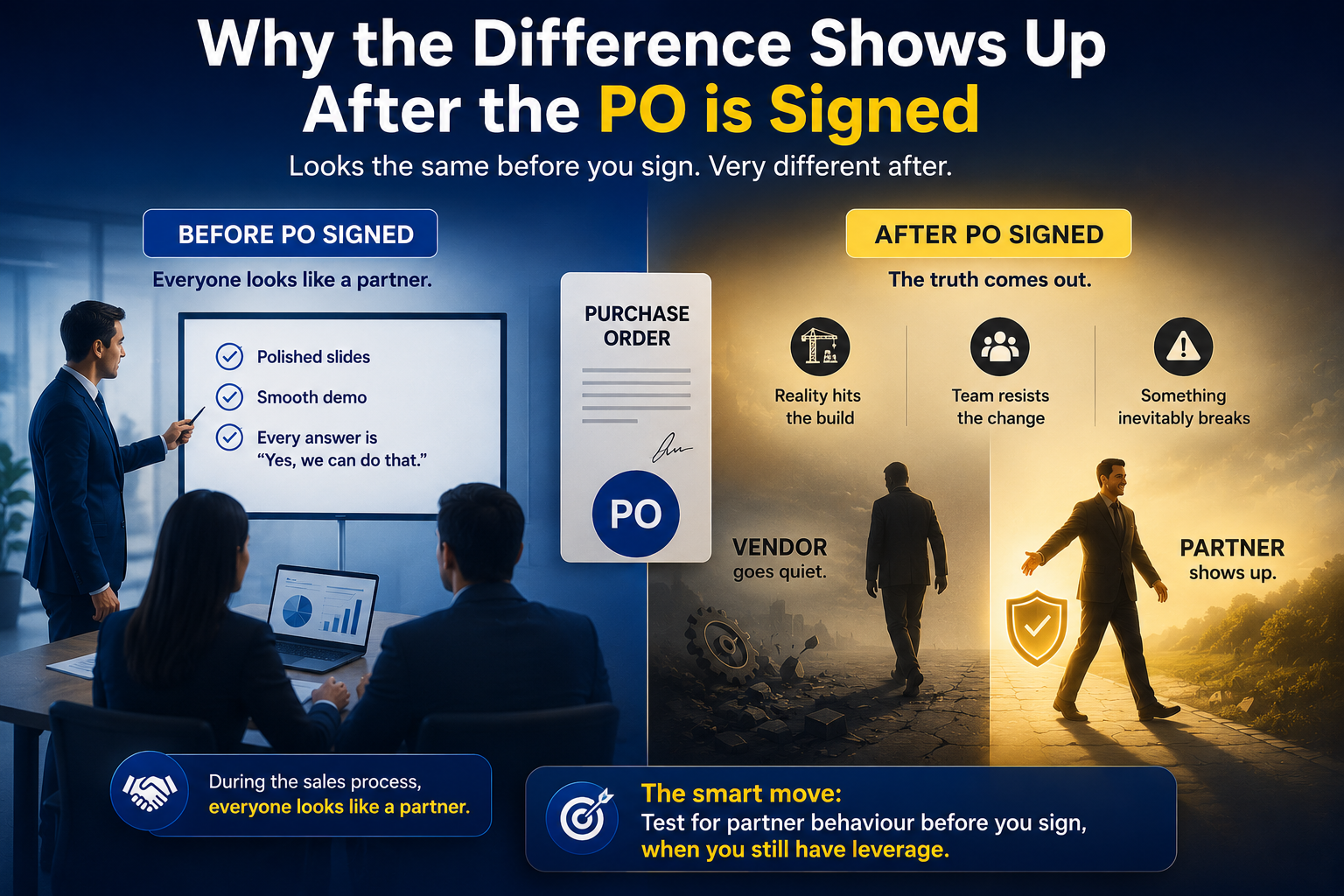
During the sales process, everyone looks like a partner. The slides are polished, the demo is smooth, and every answer is "yes, we can do that." The truth only emerges after the purchase order when reality hits the build, the team resists the change, and something inevitably breaks. That's the moment a vendor goes quiet and a partner shows up.
So the smart move is to test for partner behaviour before you sign, when you still have leverage.
The 7 questions (and what good answers sound like)
- Who is on-site during the first 45 days after go-live? Good answer: named people, a real plan. Bad answer: "remote support."
- What was the 6-month utilisation rate of your last three builds? Good answer: a number. Bad answer: a blank stare.
- Who owns the code and the data? Good answer: you do.
- What happens when a key person on our team leaves? Good answer: it's documented in the system.
- How do you handle change management? Good answer: it's a defined part of delivery.
- Show me a client you've kept for 5+ years. Good answer: several.
- What will you tell us NOT to build? Good answer: a clear opinion. This one separates partners from order-takers.
3 phrases that should make you walk out
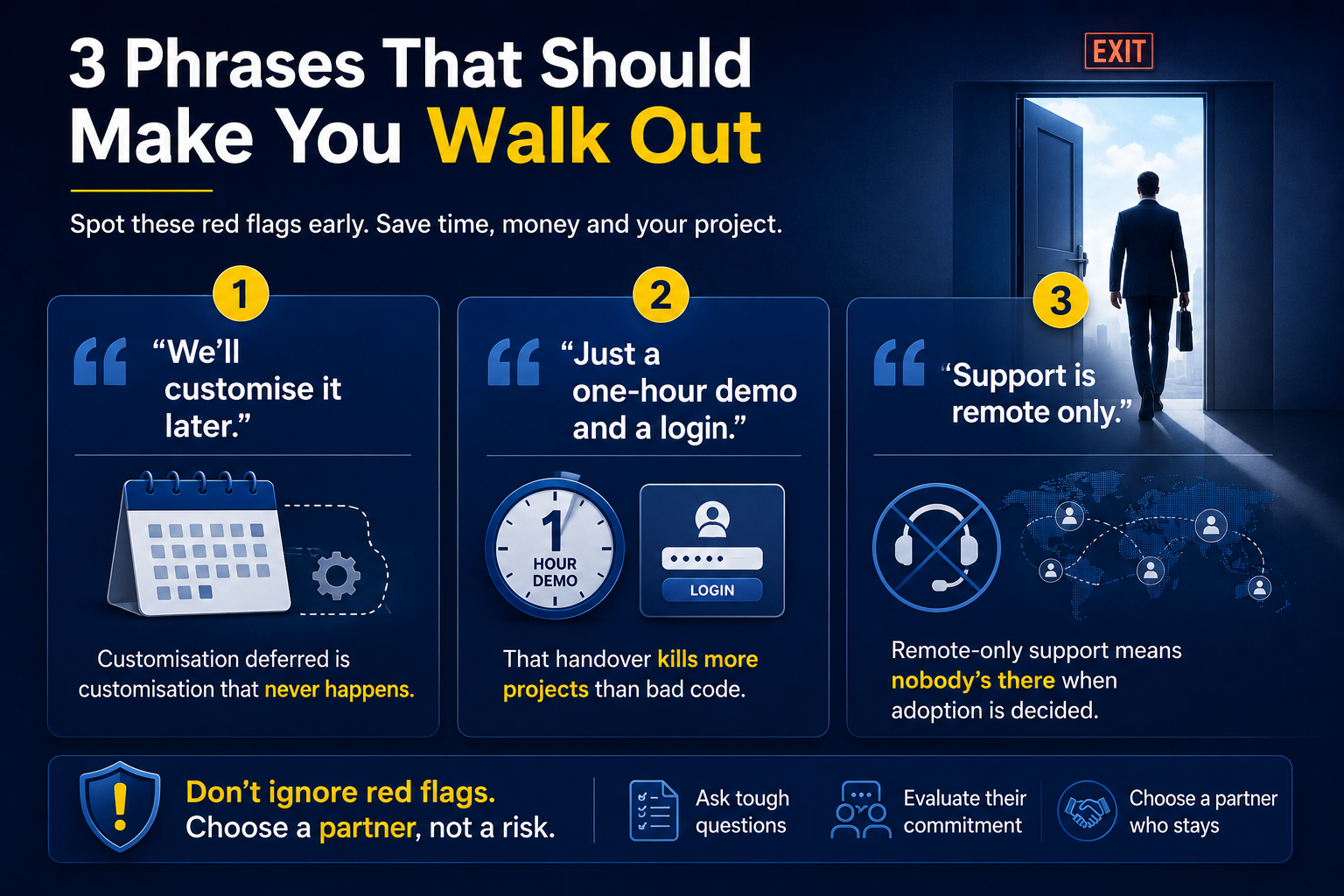
- "We'll customise it later." Customisation deferred is customisation that never happens.
- "Just a one-hour demo and a login." That handover kills more projects than bad code.
- "Support is remote only." Remote-only support means nobody's there when adoption is decided.
How to test for on-site adoption commitment
Ask the firm to walk you through their last go-live hour by hour. A partner can describe exactly who was where, doing what, and how they handled the first wave of problems. A vendor describes a deployment and a ticketing queue. The texture of the answer tells you everything.
The one question that predicts success
If you ask only one thing, ask: "What happens on day 91?" If the answer is "we hand over to your team" or "support via tickets," you're buying a deployment. If it involves staying embedded, measuring whether the old workflow actually stopped, and iterating you're buying a partner. Gartner expects a large share of agentic AI projects to be cancelled by 2027, almost entirely due to adoption failure. Day 91 is where that gets decided.
Why this is our whole model
We'd rather lose a deal than win it by promising a deployment we both know won't get adopted. One client searched two years before choosing us; another has stayed 7+ years across multiple countries. That's not a sales pattern it's what happens when you don't deliver and disappear.
Frequently Asked Questions
What's the difference between a software vendor and a partner?
A vendor's responsibility ends at delivery; a partner stays through rollout and remains accountable until your team is actually using the system.
What's the single best question to ask a software vendor?
"What happens on day 91?" It reveals whether they sell deployments or stay as a partner through adoption.
What are the red-flag phrases to watch for?
"We'll customise it later," "just a one-hour demo and a login," and "support is remote only."
Why does client longevity matter when choosing a partner?
Long-standing client relationships are the clearest proof that a firm actually stays and keeps systems running — not just delivers and moves on.
Choose a partner, not just a vendor.