Your competitor hired an AI-native CTO. Your ops team uses WhatsApp to approve purchase orders.
Quick Answer
The real technology gap for mid-market businesses is not about AI adoption. It is about systems that still do not talk to each other. Your inventory does not sync with accounts payable. Your CRM has thousands of contacts and zero automated follow-ups. The mid-market digital transformation that actually moves the needle is not the one with “AI” in the headline. It is the one that turns your 14-step approval process into 3.
The Conference Agenda vs. the Plant Floor
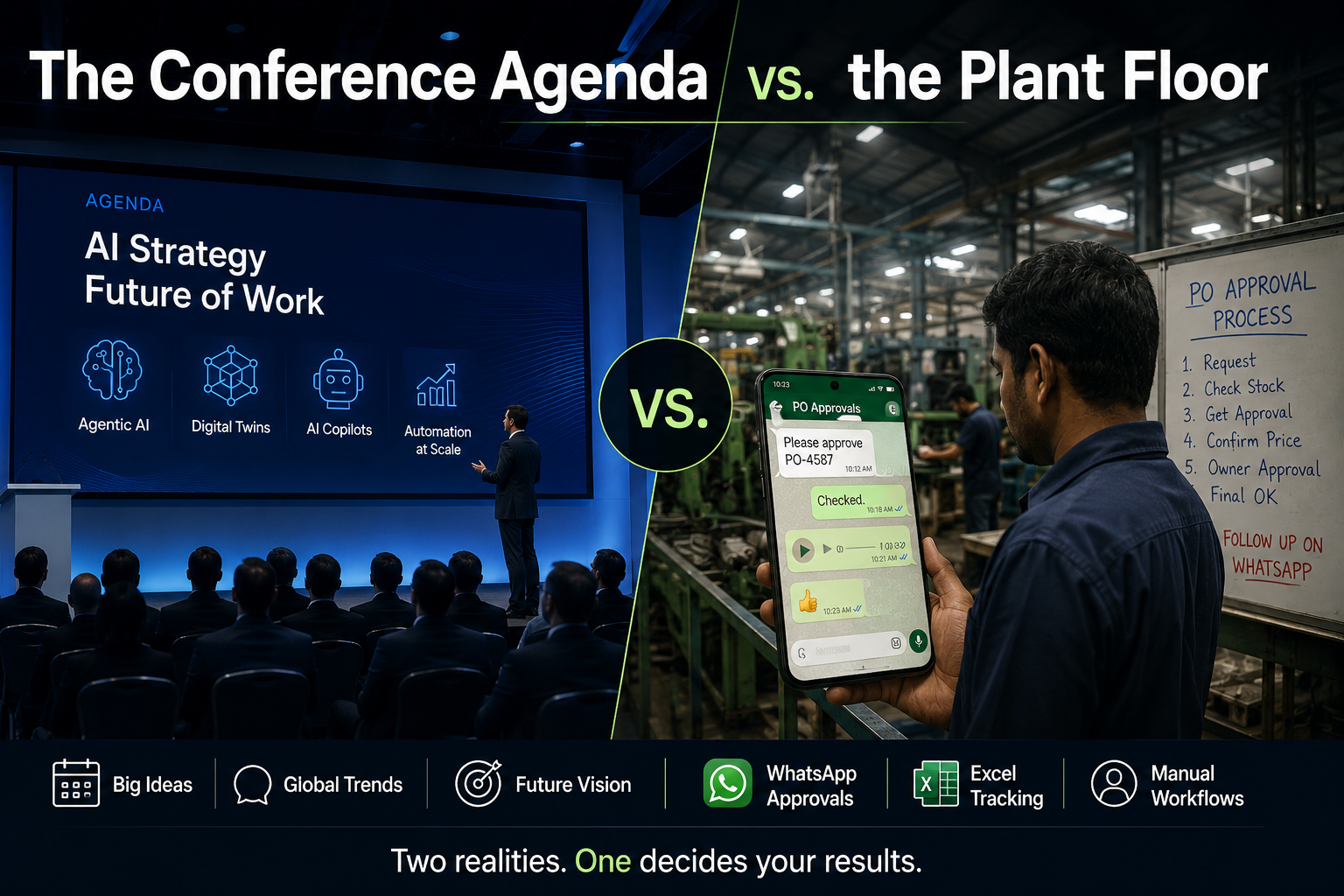
Last week, a tech publication ran a headline about a company appointing its first “AI-Native Chief Technology Officer.” The same week, a client — a manufacturer doing ₹200 crore annually — forwarded me a WhatsApp screenshot. Their purchase order approval chain. Four people, three groups, two voice notes, and a thumbs-up emoji.
That is mid-market India in 2026.
The tech press covers agentic AI and Chief AI Officers. The companies I walk into are figuring out why their dispatch team maintains a separate Excel sheet because the ERP “doesn’t show the right numbers.”
Both realities are true. Only one determines whether you hit your quarterly targets.
The Gap Nobody Talks About
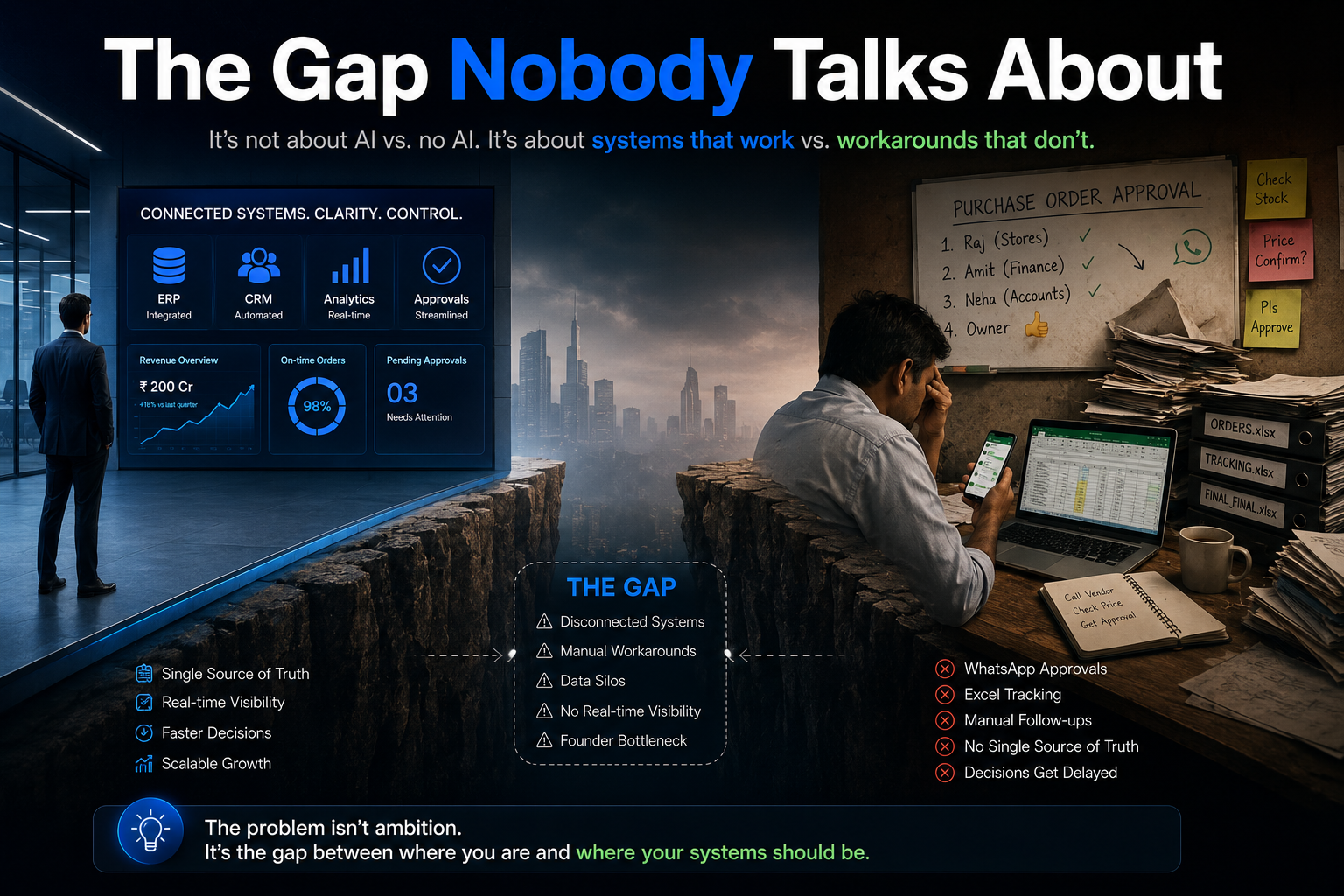
Eight years and 730+ projects across eight sectors have taught me this. The mid-market technology gap is not between companies that use AI and companies that do not. It is between companies where systems work together and companies where the founder is the system.
I call it the owner trap.
The founder becomes the approval bottleneck for 60% of operational decisions. Not because they want control. Because nothing in the stack is connected well enough to delegate. Every purchase order, every vendor payment, every inventory adjustment routes through one person’s phone. On WhatsApp.
The ERP exists. It was purchased three years ago. The team uses it for invoicing and ignores it for everything else. The “real tracking” happens in Excel. The CRM has 3,400 contacts and zero automated follow-ups. The AI strategy, if you ask? “We should probably look into that.”
This is not a technology problem. It is a plumbing problem dressed up as a strategy gap.
What the Tech Industry Sells vs. What Mid-Market Teams Need
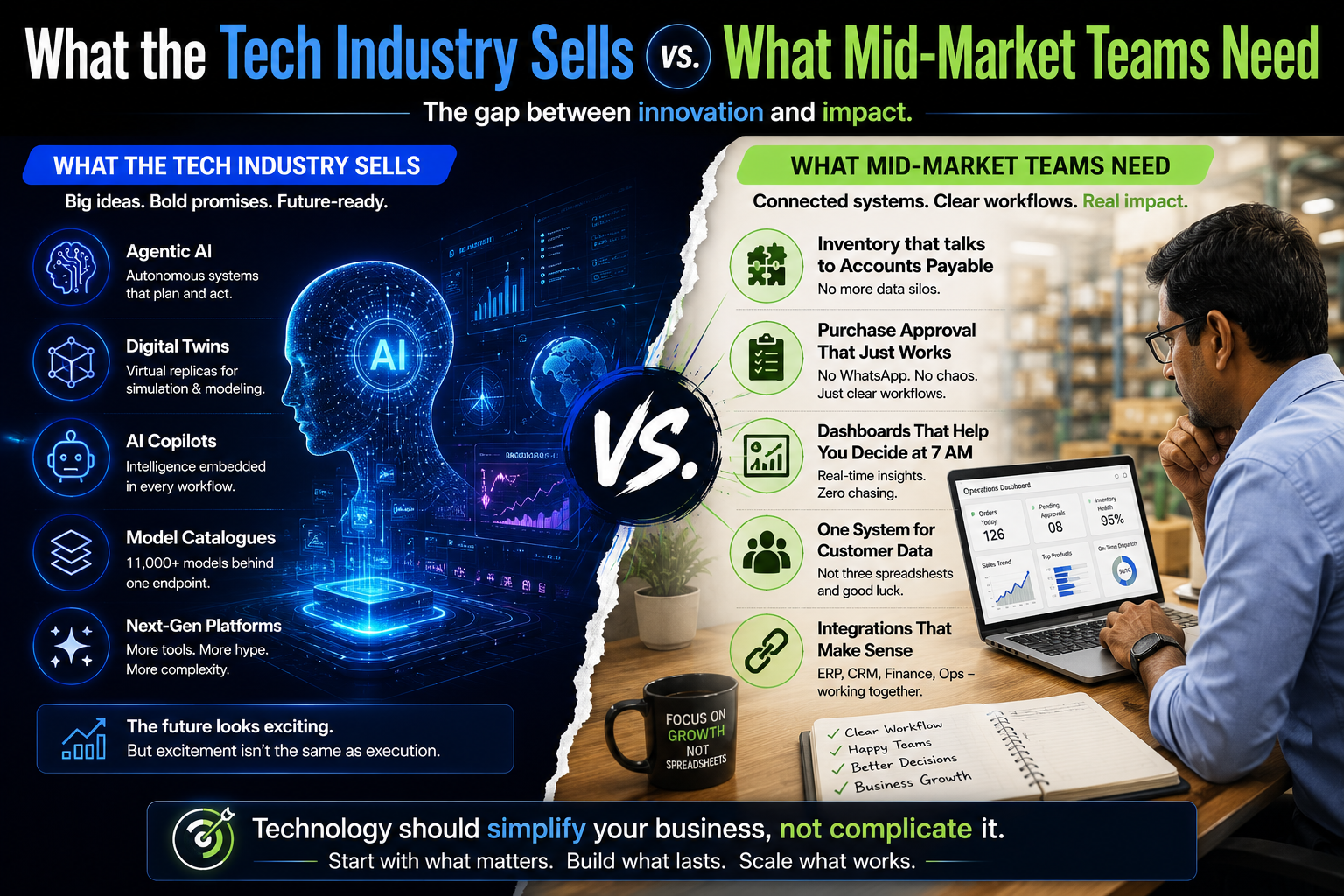
The technology industry sells the top floor before the foundation is poured.
The loudest conversations in enterprise tech right now: agentic AI — autonomous systems that plan and execute without human input. Digital twins — virtual replicas of physical assets for simulation. AI copilots — embedded intelligence in every workflow. Model catalogues — Microsoft’s Foundry alone lists 11,000+ models behind one endpoint.
What a mid-market operations team actually needs: inventory that talks to accounts payable, a purchase approval that does not require four WhatsApp messages, a dashboard the owner can check at 7 AM without calling the accountant, and one system for customer data instead of three spreadsheets.
The gap between these two lists has never been wider.
The Vendor Consolidation Signal
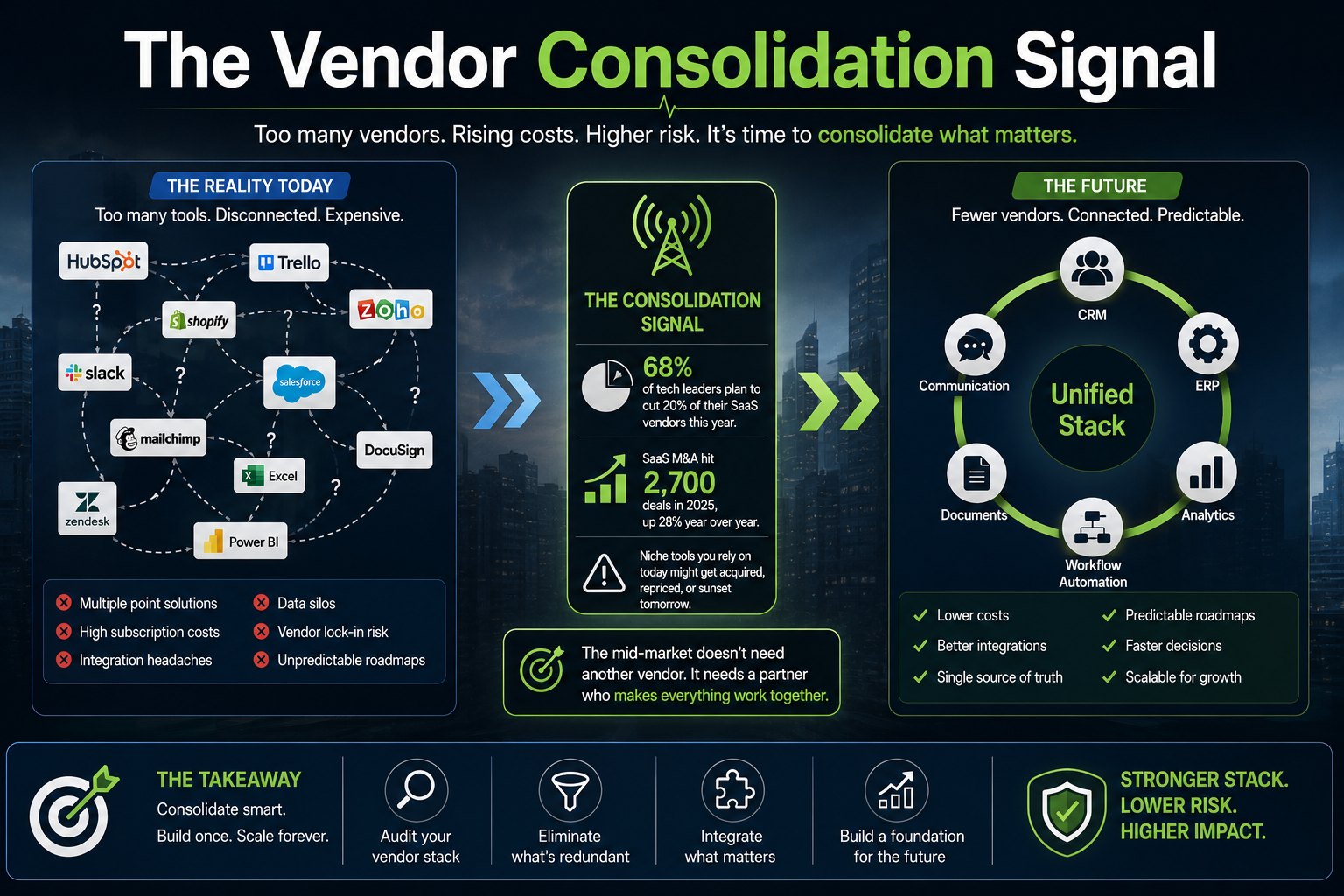
68% of tech leaders plan to cut 20% of their SaaS vendors this year. SaaS M&A hit 2,700 deals in 2025, up 28% year over year. That niche tool your logistics team depends on? It might get acquired and repriced for enterprise customers next quarter.
The mid-market does not need another vendor. It needs a builder who understands what stays, what goes, and how to make the remaining pieces work together.
The Transformation That Actually Moves the Needle
The project that delivers the highest ROI is almost never the most technically impressive one.
A Mumbai real estate company came to us wanting AI-driven lead scoring. We delivered it in 10 days using MCP and Claude. But the project that changed their daily operations? Rebuilding the approval workflow from 14 steps across three departments to 3 steps in one dashboard.
Nobody writes blog posts about approval workflows. But approval workflows determine whether the company scales or stalls.
The pattern repeats: the CRM overhaul that gives sales visibility into what marketing generates, the admin panel that lets the operations head release a payment without calling the founder, the dashboard that replaces the Monday morning “send me the numbers” meeting, the ERP integration that stops the warehouse team from maintaining a shadow spreadsheet.
Not exciting projects. Effective ones.
Why “Deploy and Disappear” Fails the Mid-Market
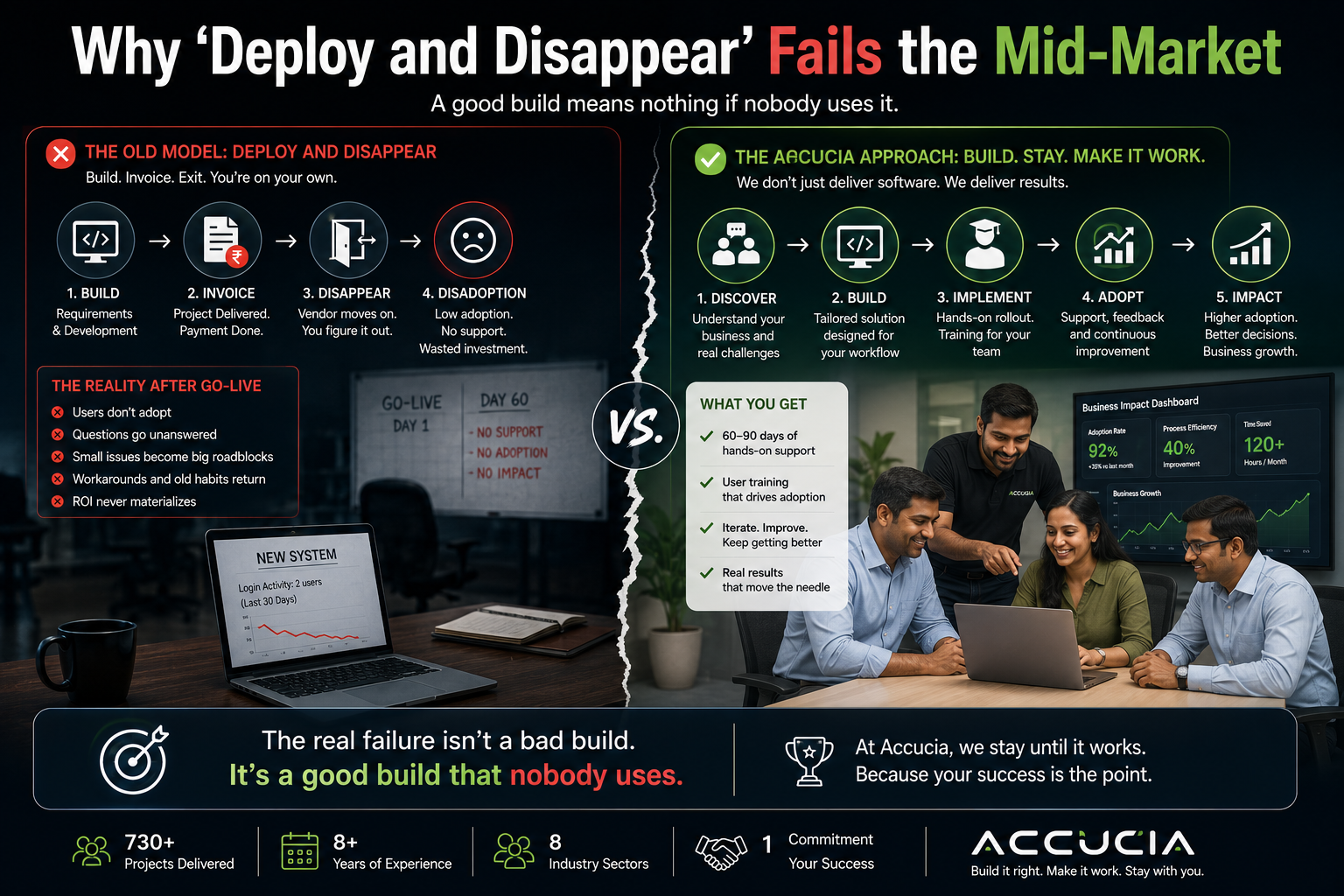
Indian IT stocks lost ₹7 lakh crore in market cap because investors realised the old model — deploy, invoice, disappear — does not survive in an AI-accelerated world. Effort-based billing punishes efficiency. It creates a structural incentive to overcomplicate delivery and underinvest in adoption.
At Accucia, we build tailored platforms — CRMs, ERPs, admin panels, dashboards, AI automation — for founders whose business has outgrown the way it used to run. But building is 40% of the work. The rest is implementation, training, adoption, and iteration.
The real failure mode is not a bad build. It is a good build that nobody uses 60 days after go-live.
The Honest Assessment
If you run a mid-market company, here is a quick diagnostic:
Count the WhatsApp groups used for operational approvals. More than two? Your workflows are improvised, not systemised. Ask your ops team where they track inventory. If the answer includes “Excel,” your ERP is a billing tool, not an operations tool. Open your CRM. Count the contacts. Now count the automated follow-ups. If the ratio is 3,400 to zero, you have an expensive address book. Count the decisions that require your personal approval. More than half? You are the bottleneck.
None of these require an AI-native CTO. They require someone who has been inside enough mid-market operations to know where the friction sits. Someone who builds, trains, and stays.
That is what we do at Accucia. 730+ projects. 8 years. 8 sectors. Not because we chase trends. Because we finish what we start.
FAQ
What is the mid-market technology gap?
The distance between what the tech industry markets — AI copilots, agentic systems, digital twins — and what mid-market operations teams actually need: connected systems, streamlined approvals, and dashboards that replace manual reporting. The gap is not about awareness. It is about execution.
Why do mid-market companies struggle with digital transformation?
Three reasons. The founder is the approval bottleneck because systems are not connected enough to delegate. The company bought an ERP or CRM but never completed adoption. And the vendor who built the system left after go-live, so nobody is there to iterate when the team hits friction.
How should a mid-market company prioritise technology investments?
Start with operational plumbing, not AI strategy. Identify workflows that still run on WhatsApp or Excel. Map approval chains that require the founder. Fix integrations between existing systems before adding new tools.
What does “deploy and disappear” mean in IT services?
A vendor builds the system, invoices, and moves on. The problem: mid-market teams need 60 to 90 days of hands-on support after go-live to change habits and reach actual adoption.
How does Accucia Softwares approach mid-market projects differently?
Accucia builds tailored platforms for founders whose businesses have outgrown the way they used to run. The difference is what happens after the build. Accucia stays through implementation, training, adoption, and iteration. 730+ projects over 8 years, same approach: build it right, make sure the team uses it, stay until they do.
Stop Deploying. Start Adopting.