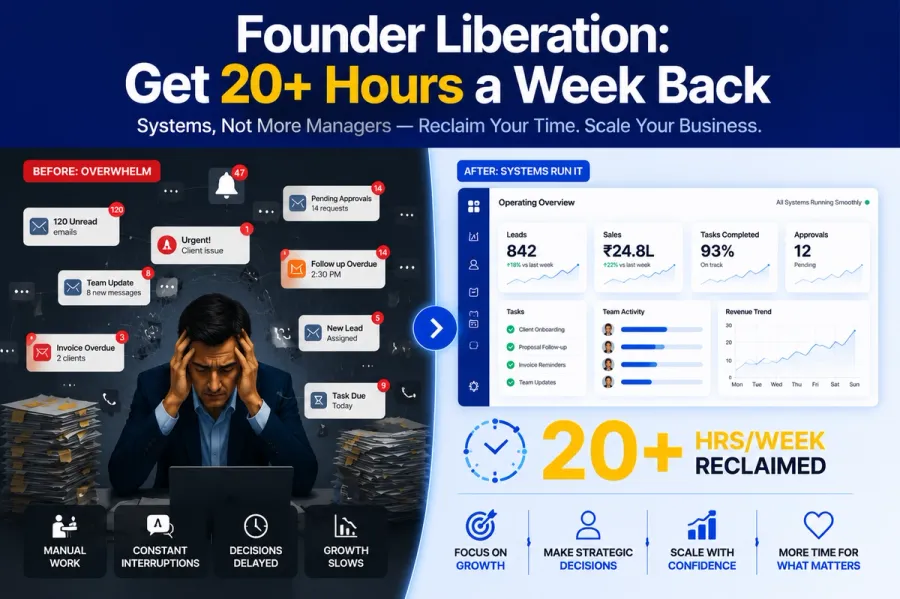
How Poor Business Systems Are Killing Your Growth
Many businesses believe that slow growth is due to market conditions, competition, or lack of demand. But in reality, the biggest problem lies inside the business itself—poor systems.
If your team is constantly chasing updates, managing work through WhatsApp, Excel sheets, or manual processes, your business is not scaling—it is struggling to keep up.
In 2026, growth is not just about working harder. It’s about building smarter systems that support your business at every stage.
❓ What Are Poor Business Systems?
Poor business systems refer to outdated, disconnected, or manual processes that fail to support efficient operations.
These include:
- Managing data in spreadsheets instead of centralized systems
- Lack of automation in daily operations
- No real-time tracking of tasks or performance
- Poor communication across teams
- Manual reporting and follow-ups
In simple terms, poor systems create confusion, delays, and inefficiencies that directly impact your growth.
📉 How Poor Systems Are Killing Your Business Growth
1. Lost Productivity and Time
When employees spend hours on repetitive tasks, follow-ups, or searching for information, productivity drops significantly.
👉 Result: More effort, less output
2. Missed Opportunities
Without proper systems, leads are not tracked, follow-ups are missed, and potential customers are lost.
👉 Result: Revenue leakage
3. Lack of Visibility and Control
Business owners often don’t have real-time insights into operations, making it difficult to make informed decisions.
👉 Result: Decisions based on guesswork
4. Poor Customer Experience
Delayed responses, inconsistent service, and lack of coordination lead to unhappy customers.
👉 Result: Loss of trust and retention
5. Scalability Issues
Manual systems may work at a small scale but fail when the business grows.
👉 Result: Growth becomes chaotic instead of structured
⚠️ Signs Your Business Systems Are Holding You Back
If you notice any of these signs, your systems need immediate attention:
- You rely heavily on Excel or manual tracking
- Your team depends on calls and messages for updates
- You don’t have clear reports or dashboards
- Tasks are often delayed or forgotten
- You struggle to track performance
💡 What to Do Instead: Build Smart, Scalable Systems
1. Implement Automation
Automate repetitive tasks like follow-ups, reporting, and notifications to save time and reduce errors.
2. Use Centralized Software Systems
Adopt ERP, CRM, or custom software solutions to manage all operations in one place.
👉 Benefits:
- Better data management
- Improved team coordination
- Real-time access to information
3. Enable Real-Time Tracking
Track tasks, employees, and performance in real time to improve accountability and efficiency.
4. Use Data for Decision-Making
Leverage analytics and dashboards to make informed business decisions instead of relying on assumptions.
5. Focus on Scalability
Choose systems that can grow with your business, not limit it.
📊 Real Impact of Smart Business Systems
Businesses that adopt modern systems and automation experience:
- Up to 30–40% increase in productivity
- Faster decision-making
- Improved customer satisfaction
- Better team collaboration
- Higher revenue growth
🤖 How Accucia Softwares Helps Businesses Fix This Problem
At Accucia Softwares, we understand that every business is unique. That’s why we build customized digital solutions that eliminate inefficiencies and enable growth.
We help businesses:
- Replace manual processes with automation
- Develop custom ERP and CRM systems
- Build scalable mobile and web applications
- Integrate AI-powered tools for smarter operations
Our goal is simple: to transform your business into a system-driven, growth-focused organization.
Upgrade systems. Unlock growth.