Enterprise RAG Explained: AI Answers From Your Own Documents, With Citations
Quick Answer
Enterprise RAG (Retrieval-Augmented Generation) is an AI architecture in which the model retrieves relevant passages from a company's own approved documents and data before generating an answer, and cites the sources it used. Unlike a generic chatbot, an enterprise-grade RAG system answers only from vetted internal content, enforces role-based access so users see only what they are entitled to, and links every answer back to the record it came from. This is what makes AI answers trustworthy enough for operational and regulated use. By Mr. Sumeet Katariya, CEO, Accucia Softwares Pvt. Ltd.
Every leadership team that has tested a general-purpose chatbot on company matters has hit the same wall. The answer sounds confident. It reads beautifully. And it may be wrong. For a founder, one hallucinated number in a board deck is the end of the experiment, and fair enough.
RAG is the architecture that fixes this, and it has quietly become the standard for serious enterprise AI. Here is what it is, why the "with citations" part is the whole game, and what a proper deployment costs.
The problem RAG solves
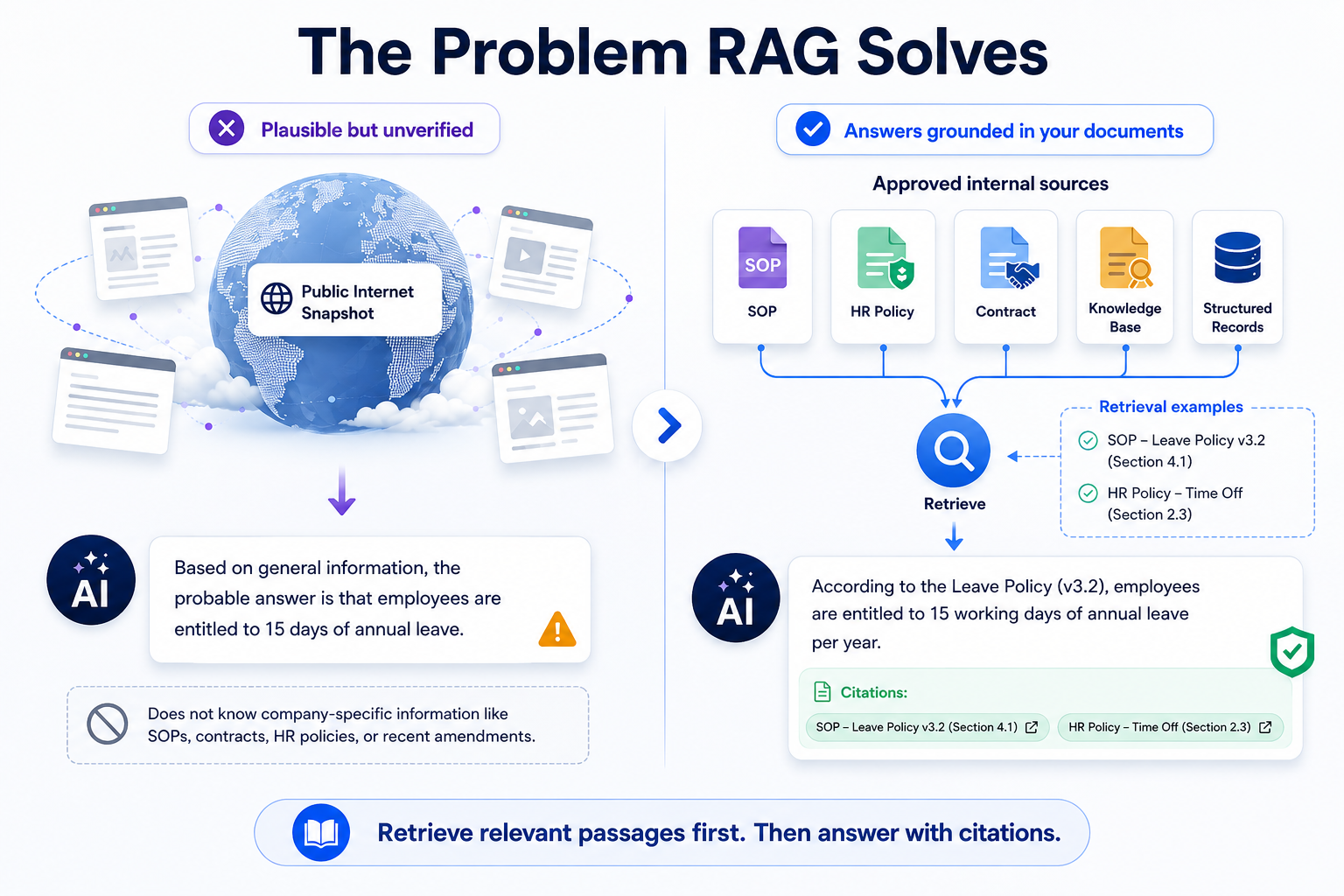
A large language model on its own knows what it learned in training: a snapshot of the public internet, frozen at some point in the past. It knows nothing about your SOPs, your rate contracts, your HR policies, or the amendment your team negotiated last quarter.
Ask it anyway and it does what models do. It produces the most plausible-sounding answer available. In casual use that is charming. In business, plausible-but-unverified is a liability with good grammar.
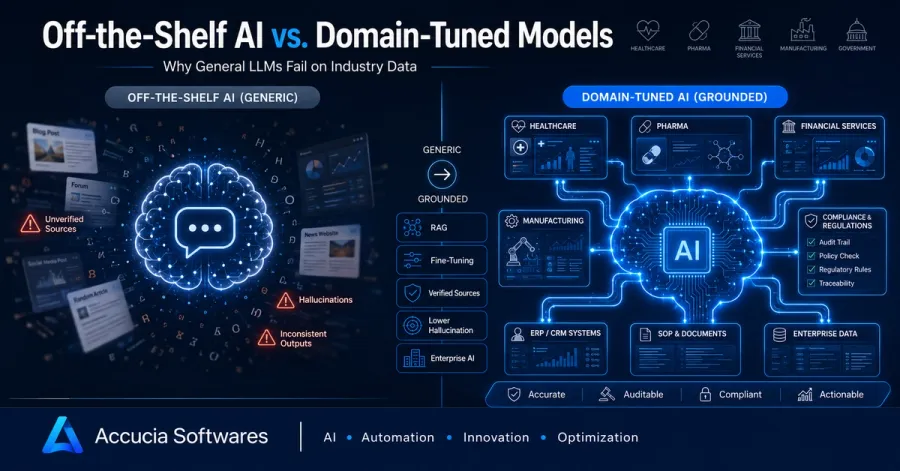
Retrieval-Augmented Generation changes the order of operations. Before the model writes a word, the system retrieves the most relevant passages from your approved content: document repositories, knowledge bases, policy libraries, structured records. Then it instructs the model to answer from those passages only, quoting where each claim came from.
The model stops being an oracle. It becomes something far more useful: a very fast, very patient reader of your own paperwork.
The three requirements that make RAG enterprise-grade
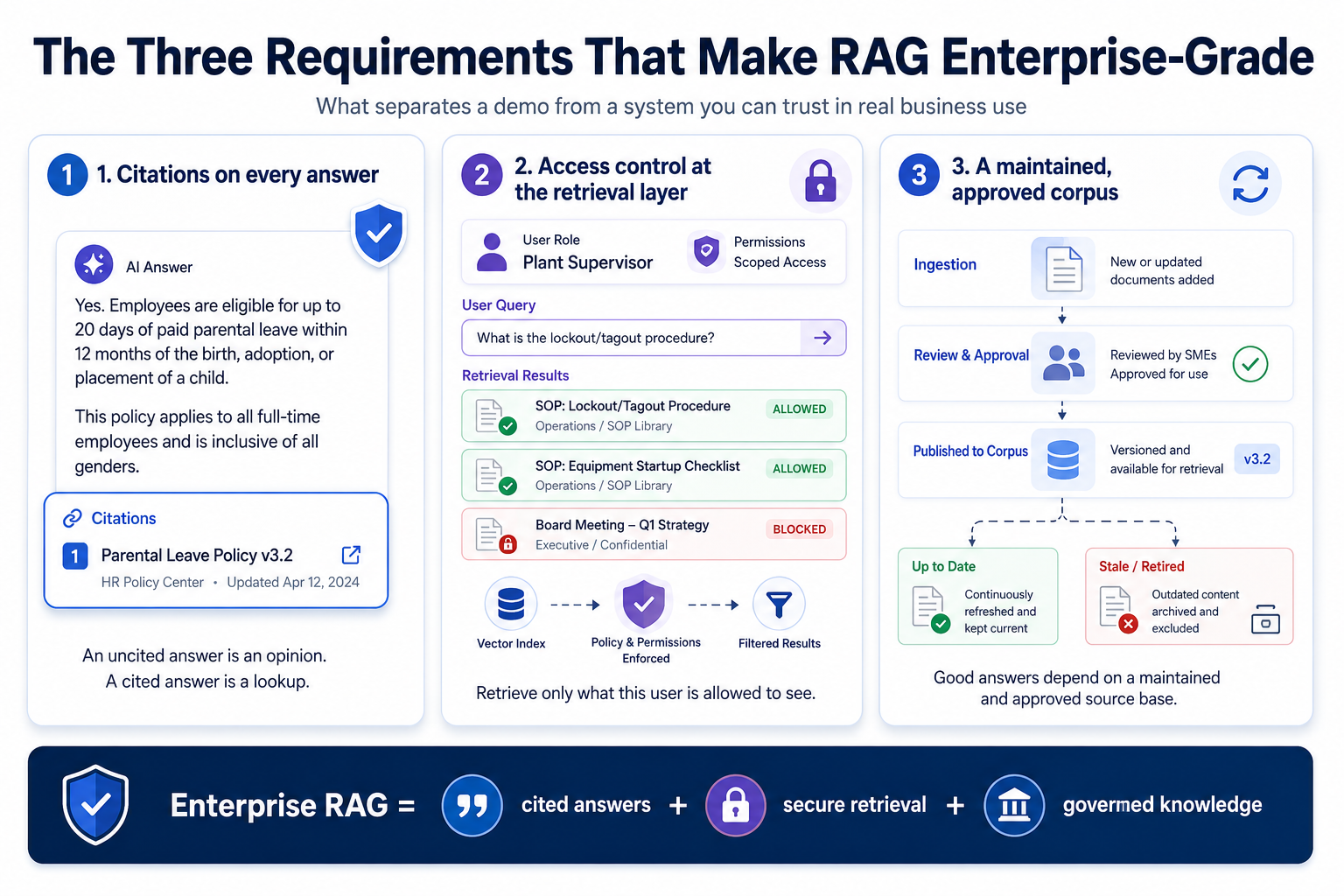
Plenty of vendors will happily sell you a RAG demo. Three properties separate a demo from a system you can put in front of auditors, regulators, and your own board.
1. Citations on every answer
Each response links to the exact source document and passage. Users verify in one click. This is what converts scepticism into daily habit, and in regulated industries it is what makes an answer defensible. The way we put it to clients: an uncited answer is an opinion, a cited answer is a lookup.
2. Access control at the retrieval layer
The system must retrieve only from content that this specific user is entitled to see. The plant supervisor gets SOP answers. They do not get board-meeting minutes. Enforcing permissions at retrieval, rather than bolting them on later, is the difference between an AI assistant and a data leak with a chat interface.
3. A maintained, approved corpus
RAG answers are only as good as what it retrieves from. Enterprise deployments need a defined pipeline for what enters the knowledge base, who approves it, and how stale content gets retired. Unglamorous work. Also the place where most self-built attempts die, usually about four months in, when nobody owns the corpus anymore.
Proof that the architecture works
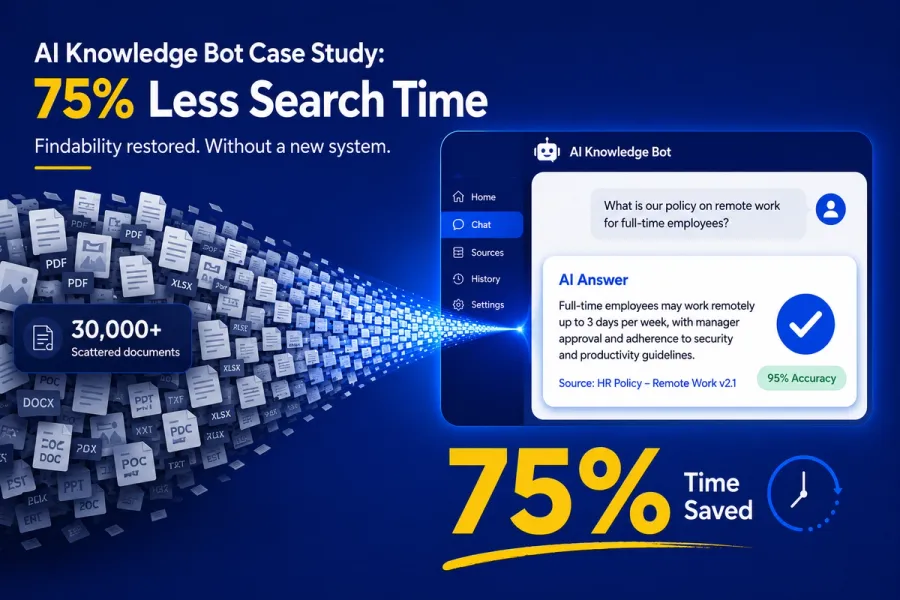
None of this is theoretical. In the deployment we detailed in our pharma case study, a large Indian pharmaceutical company runs a RAG assistant restricted to approved internal content, embedded inside the app employees already use. The production results: 75% reduction in time-to-answer, 95% measured accuracy, payback in 8 months.
Notice that the accuracy number exists because the corpus was controlled and answers were benchmarked. Not because the model was special. Any current frontier model would have done. The engineering around it is what produced 95%.
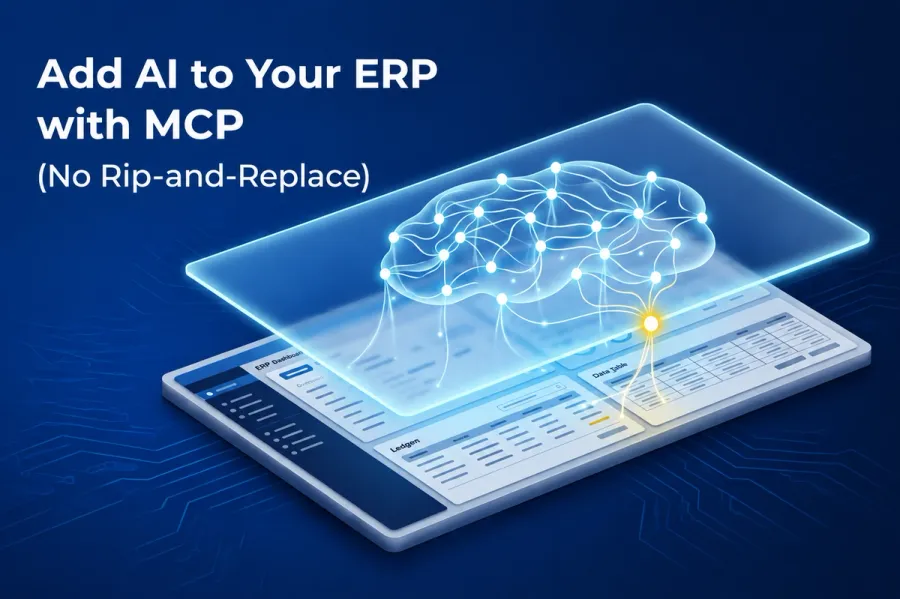
The same architecture, pointed at live systems rather than documents, is what MCP enables for ERPs and CRMs. Documents and databases are two halves of the same strategy: answer from what we actually know, and show your working.
What enterprise RAG costs
Global benchmarks put simple RAG deployments at $15K to $25K, production-grade systems at $40K to $80K, and on-premise or compliance-heavy builds at $80K to $300K. In the Indian mid-market, Accucia Softwares Pvt. Ltd. scopes production RAG builds as fixed-price projects typically starting around ₹15 lakh, entered through a ₹2 to 5 lakh AI Readiness Audit that inventories your content sources and picks the highest-payback starting corpus.
Budget honestly for the operating layer too. Monitoring, evaluation sets, corpus updates and tuning run as a monthly retainer. A RAG system is a living asset. Companies that treat it as a one-time handover watch its accuracy decay quietly, and then blame the technology.
Accucia's view
Accucia's view is that "AI with citations" should be a procurement requirement, not a feature request. If a vendor demos an assistant that cannot show where its answer came from, or cannot restrict what different roles can retrieve, then the demo is the product, and it will not survive contact with your auditors or your COO. The mid-market advantage right now is that production-grade RAG has become genuinely affordable. The leaders who deploy it on their own SOPs, contracts and systems this year will simply run faster than competitors still waiting for AI to mature. It matured. The remaining question is engineering discipline.
Frequently Asked Questions
What does RAG stand for and how does it work?
RAG stands for Retrieval-Augmented Generation. Before answering, the system retrieves relevant passages from a company's approved documents and data, then generates its answer from those passages only, citing the sources used. It combines a language model's fluency with the reliability of your own records.
How is enterprise RAG different from ChatGPT?
A general-purpose chatbot answers from its training data, which is the public internet, and cannot cite your internal sources. Enterprise RAG answers exclusively from your approved corpus, enforces role-based access, and links every answer to its source document.
Does RAG stop AI hallucinations?
It reduces them dramatically by grounding answers in retrieved content, and citations let users verify every claim. Combined with evaluation benchmarks and monitoring, production deployments reach measured accuracy levels, 95% in our pharma deployment, that untethered chatbots cannot match.
What does an enterprise RAG deployment cost in India?
Production-grade builds typically start around ₹15 lakh fixed-scope, with a ₹2 to 5 lakh AI Readiness Audit as the entry point and a monthly retainer for monitoring and corpus maintenance. Compliance-heavy or on-premise deployments cost more.
What data can a RAG system connect to?
Document repositories, SOPs, policy libraries, contracts, knowledge bases, and through an MCP layer, live structured systems such as ERPs and CRMs. Access controls determine what each user's queries can retrieve.
Build Enterprise AI You Can Trust