Off-the-Shelf AI vs. Domain AI: Why General LLMs Fail
Quick Answer
A general-purpose large language model (LLM) is trained on broad internet text, so it speaks fluently but reasons shallowly about your industry. A domain-tuned model is grounded in your sector's data, terminology, and rules. On specialised tasks, domain-tuned approaches are reported to cut error rates by roughly 30–50% versus general models, and reduce hallucinations by grounding answers in verified sources. For regulated, high-stakes work, the accuracy and compliance gap is the difference between a useful tool and a liability.
What is the difference between an off-the-shelf LLM and a domain-tuned model?
An off-the-shelf LLM is a general-purpose model — ChatGPT, Gemini, Claude, Llama and similar — trained on a vast, broad slice of the public internet. It is excellent at general language: summarising, drafting, answering common questions. It knows a little about almost everything.
A domain-tuned model is that same class of technology, adapted to a specific field. Adaptation happens through two main techniques, usually combined:
• Retrieval-Augmented Generation (RAG) — the model is connected to your own verified knowledge base (policies, product manuals, regulations, patient or claims data) and instructed to answer only from those sources.
• Fine-tuning — the model's weights are further trained on curated, sector-specific examples so it learns the vocabulary, format, and reasoning patterns of your domain.
The result is a system that does not just sound right — it is right more often on the questions your business actually asks.
Why does a general LLM fail on your industry data?
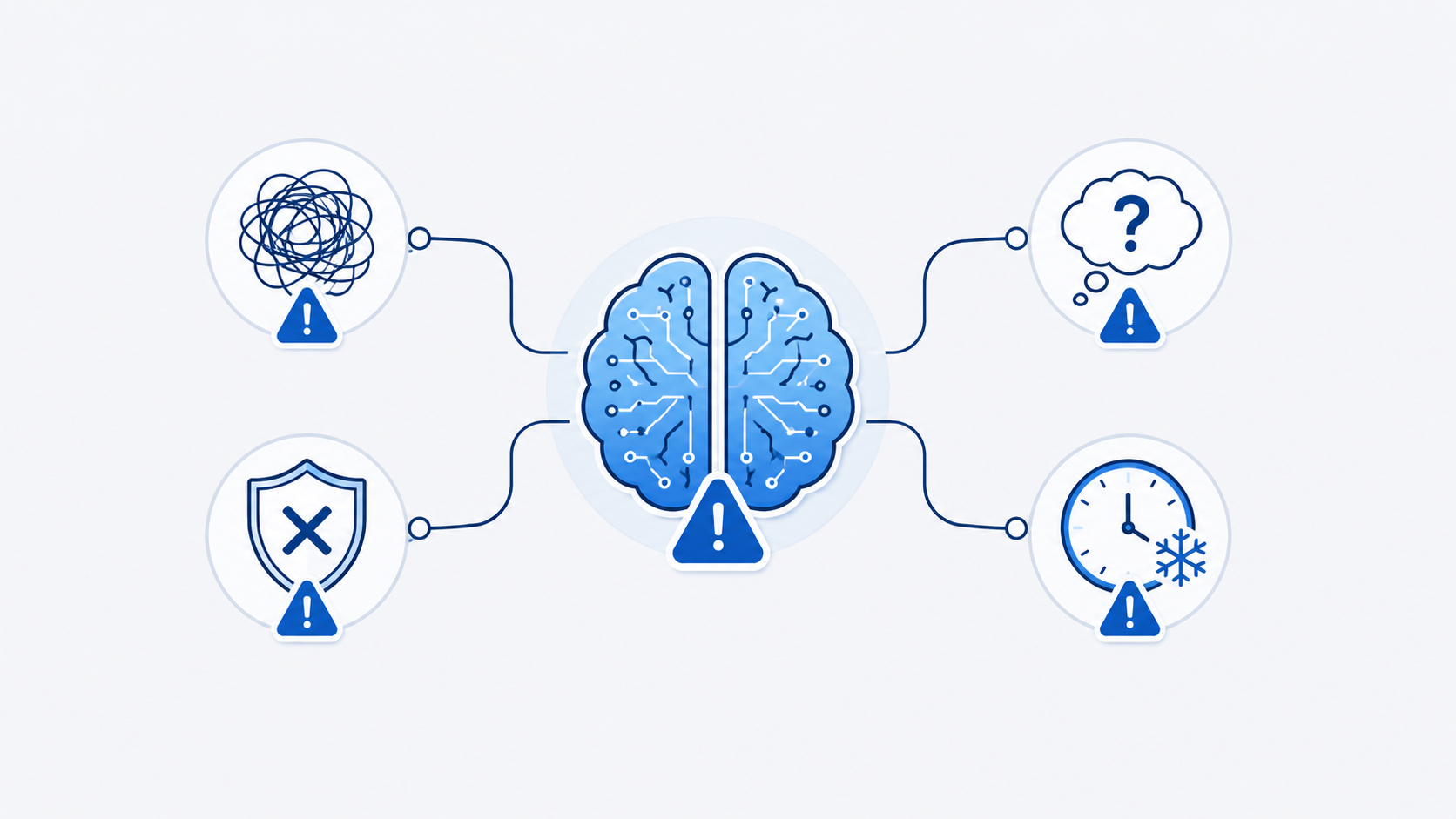
A general model fails in predictable ways once it leaves everyday topics. Four reasons matter most:
1. It misreads specialised vocabulary
“Discharge” means one thing in a hospital and another in a manufacturing plant. “Exposure” is a clinical term, a financial-risk term, and a logistics term. A general model guesses from context; a domain-tuned model is anchored to the right meaning every time.
2. It hallucinates when it lacks grounding
When a general model does not know an answer, it often produces a confident, plausible, wrong one. Across enterprise deployments that retrieve from unstructured documents with naive methods, hallucination rates average around 20%. In high-stakes sectors, a 1-in-5 fabrication rate is unacceptable.
3. It has no awareness of your compliance and audit requirements
A general model does not know your regulator, your retention rules, or which answers must be traceable to a source. Domain systems are built with audit trails and source citations so every output can be defended.
4. Its knowledge is generic and frozen
Public models are trained on yesterday's internet, not your live operations. They cannot see your current pricing, your latest SOP, or this morning's inventory unless they are explicitly connected to it.
The accuracy gap, by the numbers
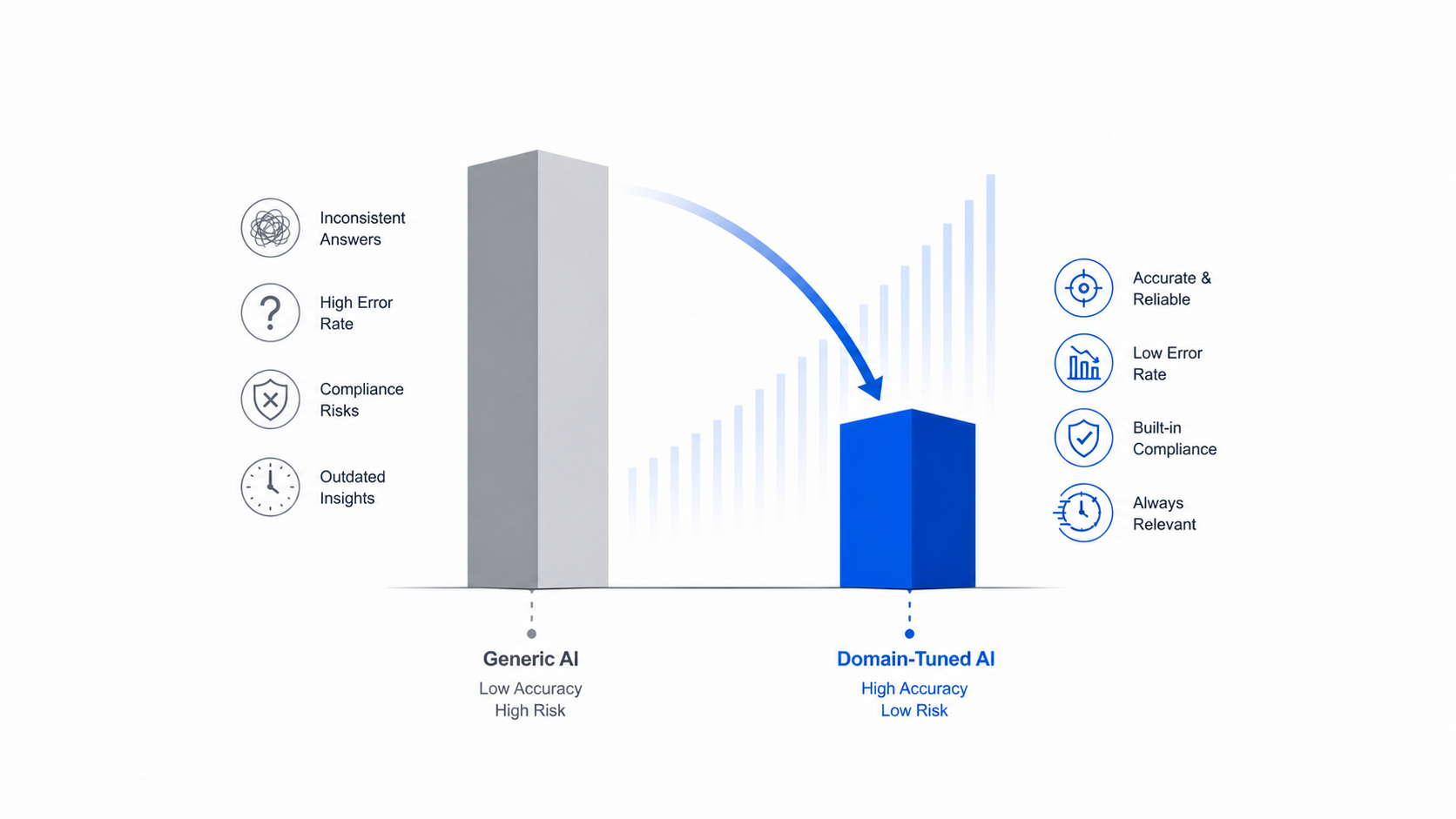
Independent reporting and vendor benchmarks through 2025–2026 consistently show domain-tuned approaches outperforming general models on specialised work. The figures vary by method and dataset, but the direction is unambiguous.
Sector / task
Reported impact of domain tuning
Source
Financial analysis
Specialised financial LLMs cut error rates by 30%+ vs. general models
Brim Labs / Arya.ai
Legal research
Up to 40% faster research; ~30% less processing time; ~45% lower cost per task
Brim Labs / Metric Coders
Healthcare Q&A
Med-PaLM 2 matched or exceeded physician-level accuracy on USMLE-style questions
Brim Labs
Enterprise RAG
Grounding cut a model's table-hallucination rate from 21% to 4.5%
iTrex / Monte Carlo
General enterprise use
Contextual grounding reduces hallucinations by 30–50%
Kernshell
Adoption intent is following the evidence: in one 2025 survey, 73% of financial institutions said they plan to adopt domain-specific language models, citing compliance and risk mitigation as the main drivers. Analysts at Gartner expect the share of enterprise applications embedding task-specific AI to climb from under 5% today toward 40% by the end of 2026.
Off-the-shelf vs. domain-tuned: a side-by-side comparison
Dimension
Off-the-shelf LLM
Domain-tuned model
Best for
General drafting, brainstorming, broad Q&A
Specialised, high-stakes, repeatable workflows
Accuracy on your data
Variable; degrades on jargon and edge cases
Consistently higher on in-domain tasks
Hallucination risk
Higher; ~20% average in naive RAG setups
Lower; grounded in verified sources
Compliance & audit
No native traceability
Source citations and audit trails built in
Data freshness
Frozen at training cutoff
Connected to live, current systems
Setup effort
Minimal; use immediately
Requires data, integration, and tuning
Cost profile
Low to start; rises with poor accuracy
Higher upfront; lower cost of errors
When is an off-the-shelf LLM the right choice?
Domain tuning is not always the answer. An off-the-shelf model is the sensible, lower-cost option when:
• The task is general — drafting an email, summarising a public article, brainstorming names.
• The cost of a wrong answer is low and a human reviews the output anyway.
• You are still experimenting and have not yet defined a repeatable, high-value workflow.
The honest rule: match the tool to the stakes. Use general models for low-risk, general work. Invest in domain tuning where errors are expensive, the language is specialised, or a regulator is watching.
How does domain tuning actually work?
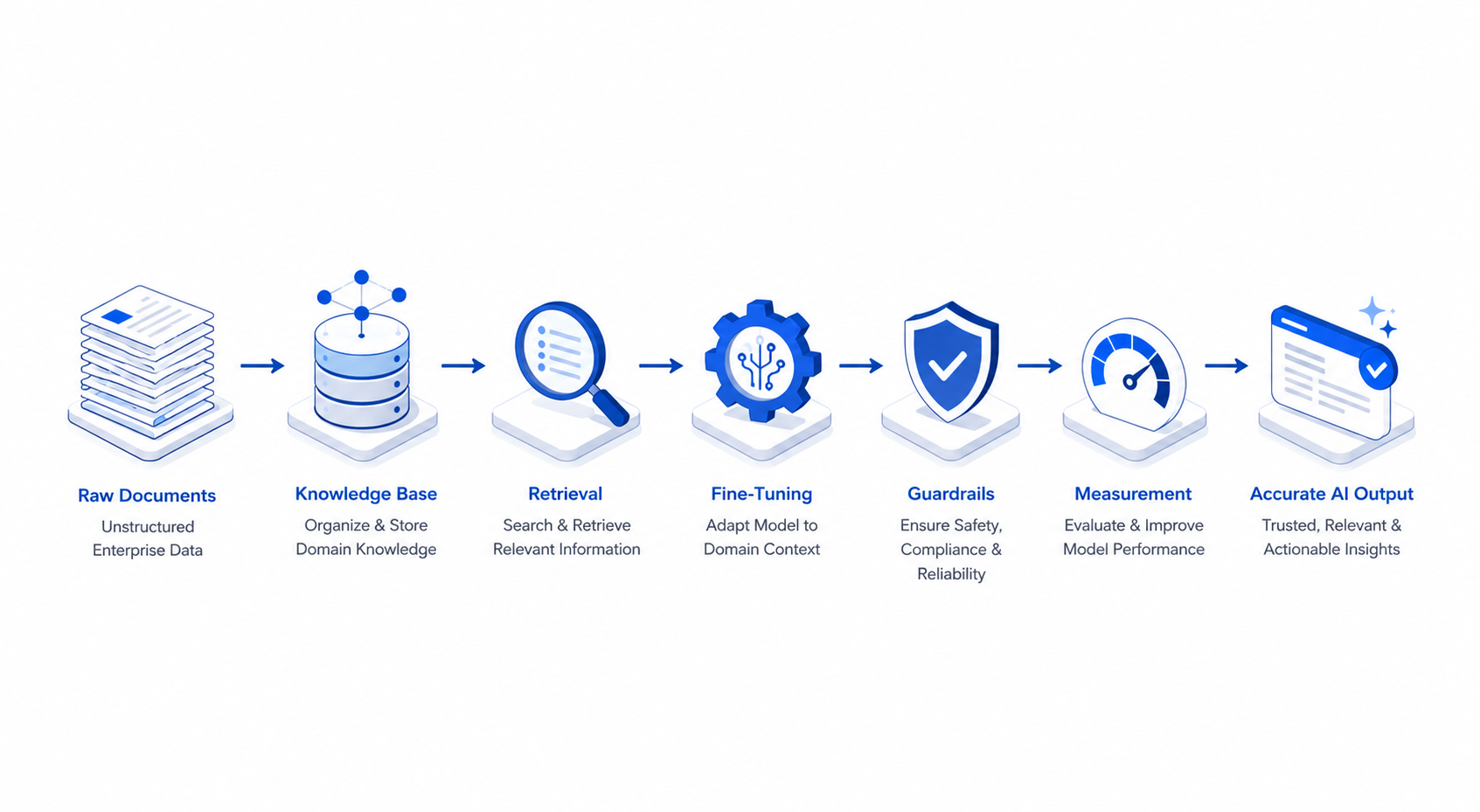
Most production systems Accucia builds combine retrieval and fine-tuning, because each fixes a different problem. The typical path:
1. Consolidate the knowledge. Gather the documents, records, and rules that define correct answers in your domain, and clean them.
2. Add retrieval (RAG). Connect the model to that knowledge so answers are pulled from verified sources, not invented — and every answer can cite where it came from.
3. Fine-tune where it pays. Train on curated examples so the model adopts your terminology, tone, and output format for repeated tasks.
4. Add guardrails. Build in audit trails, source citations, and a confident “I don't know” rather than a fabricated guess.
5. Measure and iterate. Track accuracy against a labelled test set and keep improving — the work does not end at deployment.
Reporting suggests RAG and fine-tuning together outperform either alone — grounding stops fabrication, while tuning sharpens domain fluency.
What this means for your sector
The pattern is the same across the industries Accucia works in — the stakes simply change the urgency:
• Healthcare & pharma — clinical terminology and patient safety leave no room for a plausible-but-wrong answer. Grounding and traceability are non-negotiable.
• Financial services & BFSI — compliance, risk, and audit demands make a 30%+ error reduction a direct line to lower exposure and faster reviews.
• Manufacturing — SOPs, maintenance logs, and quality data are specialised and constantly changing; a model must read live operational data, not last year's internet.
• Logistics & retail — high query volumes reward automation, but only if the answers are accurate enough to act on without a human re-checking each one.
• Government — accountability and the public record require every answer to be sourced and defensible.
How to decide: a four-question test
Before you build, ask:
1. How expensive is a wrong answer? The higher the cost of error, the stronger the case for domain tuning.
2. How specialised is the language? Heavy jargon and edge cases favour a tuned model.
3. Is a regulator or auditor involved? If yes, you need source citations and audit trails by design.
4. Does the answer depend on live, private data? If yes, you need retrieval connected to your systems, not a frozen public model.
Two or more “yes” answers usually mean an off-the-shelf model alone will not be enough.
Frequently asked questions
Is a domain-tuned model just a fine-tuned ChatGPT?
Not exactly. Fine-tuning is one technique, but most reliable enterprise systems pair it with retrieval (RAG) so the model answers from your verified data and can cite its sources. The combination is what drives accuracy and trust.
Will a bigger general model eventually beat a domain-tuned one?
Bigger models keep improving, but they still lack your private, live data and your compliance context. For specialised, high-stakes tasks, grounding a model in your domain consistently outperforms a larger but generic one.
How much data do we need to tune a model?
Less than most teams expect for RAG — a clean, well-organised knowledge base can deliver strong results without retraining the model at all. Fine-tuning needs curated examples, but quality matters far more than raw volume.
Is our data safe?
It can be. A properly designed system keeps your data within your controlled environment, with access controls and audit logging. Data governance should be designed in from day one, not added later.
How long until we see results?
Grounded systems that connect to existing knowledge bases often show measurable accuracy gains within the first few months. The fastest returns come from picking one high-value, well-defined workflow rather than trying to automate everything at once.
Key takeaways
• General LLMs are broad but shallow; they misread jargon, fabricate under uncertainty, and ignore your compliance rules.
• Domain-tuned approaches cut error rates by roughly 30–50% on specialised tasks and reduce hallucinations through grounding.
• Match the tool to the stakes: general models for low-risk work, domain tuning where errors are costly or regulated.
• The strongest systems combine retrieval (for grounding and citations) with fine-tuning (for domain fluency).
• Start with one high-value workflow, measure accuracy against a test set, and iterate.
About Accucia
Accucia builds tailored platforms — apps, CRMs, ERPs, dashboards, AI automation — for mid-to-large enterprise founders whose business has outgrown its current systems. 730+ projects delivered across 8 sectors. We stay through adoption, not just delivery.
Considering AI for a specialised, high-stakes workflow? Talk to Accucia about grounding a model in your own data — and getting accuracy you can defend.
Build AI That Understands Your Business