AI Readiness Audit for Mid-Market Enterprises: Scope, Cost, Deliverables
Quick Answer
An AI Readiness Audit is a fixed-scope, two-week engagement that maps a company's systems, data quality, and workflows to identify where AI will produce measurable payback, before any build spending. It typically costs ₹2 to 5 lakh for a mid-market enterprise and delivers a prioritised use-case list with expected ROI, a data and integration readiness assessment, and a fixed-price proposal for the highest-payback first deployment. It exists so companies stop funding AI pilots that die in demos and start funding AI systems with a number attached. By Mr. Sumeet Katariya, CEO, Accucia Softwares Pvt. Ltd.
The most expensive words in enterprise AI are "let's just try something." They launch pilots without baselines, builds without adoption plans, and budgets without payback math. They are also why so many leadership teams are now on their second or third AI disappointment, and starting to suspect the whole category is hype.
We changed how we open every AI engagement because of this. Not with a proposal. With an audit. This article explains exactly what it is, what it costs, and what you walk away with, so you can hold any vendor to this standard. Including us.
Why audit-first beats pilot-first
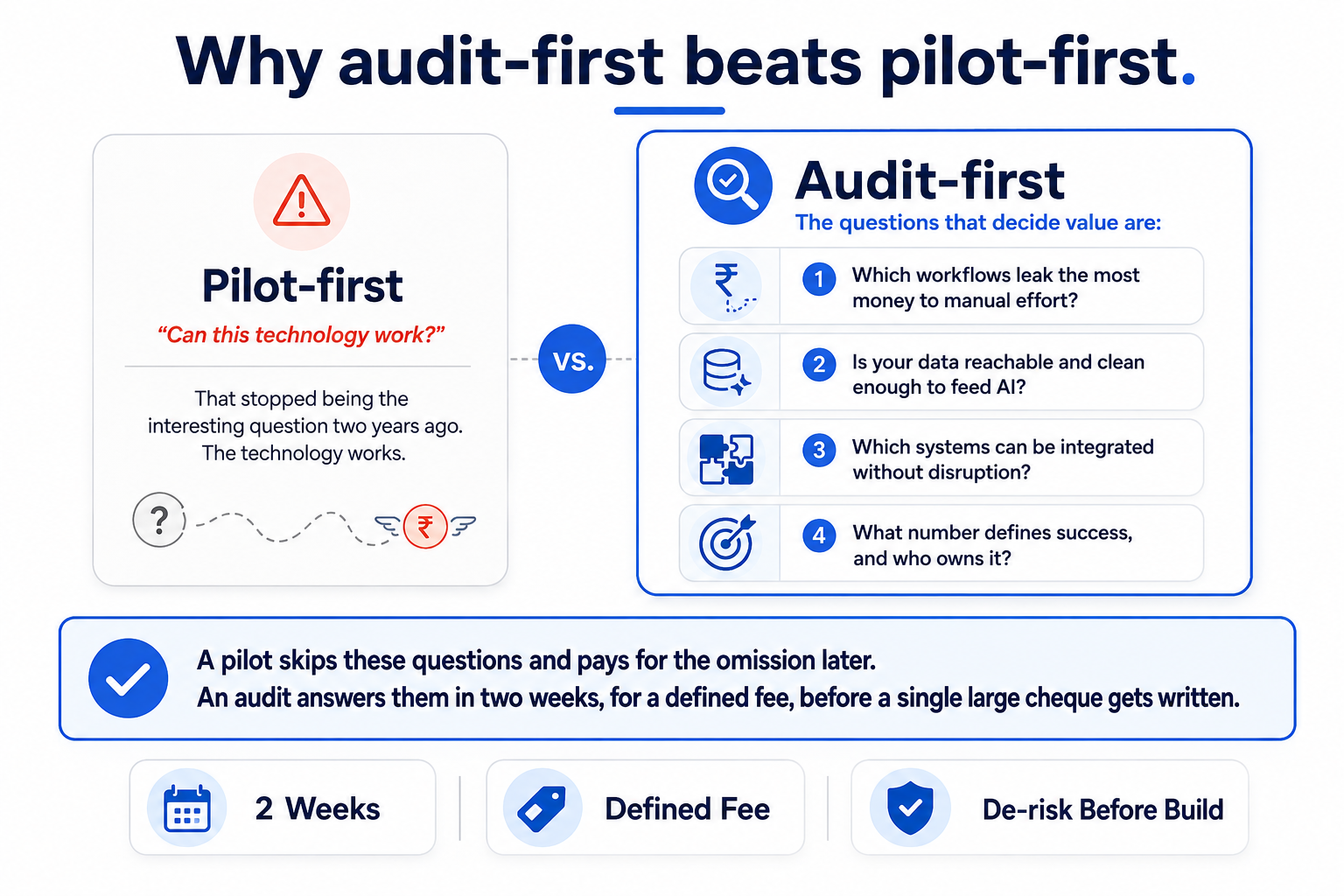
A pilot answers the question "can this technology work?" That question stopped being interesting two years ago. The technology works. The questions that decide whether you get value are different ones:
- Which of your workflows leaks the most money to manual effort?
- Is your data actually reachable and clean enough to feed AI?
- Which systems can be integrated without disruption, and which cannot?
- What number will define success, and who owns it?
A pilot skips those questions and pays for the omission later. An audit answers them for a defined fee, in two weeks, before a single large cheque gets written. We laid out the pilot failure pattern in Why Most Enterprise AI Pilots Die in the Demo. Every one of those failure modes is discoverable in advance. The audit is simply the discipline of discovering them on purpose.
What the audit examines
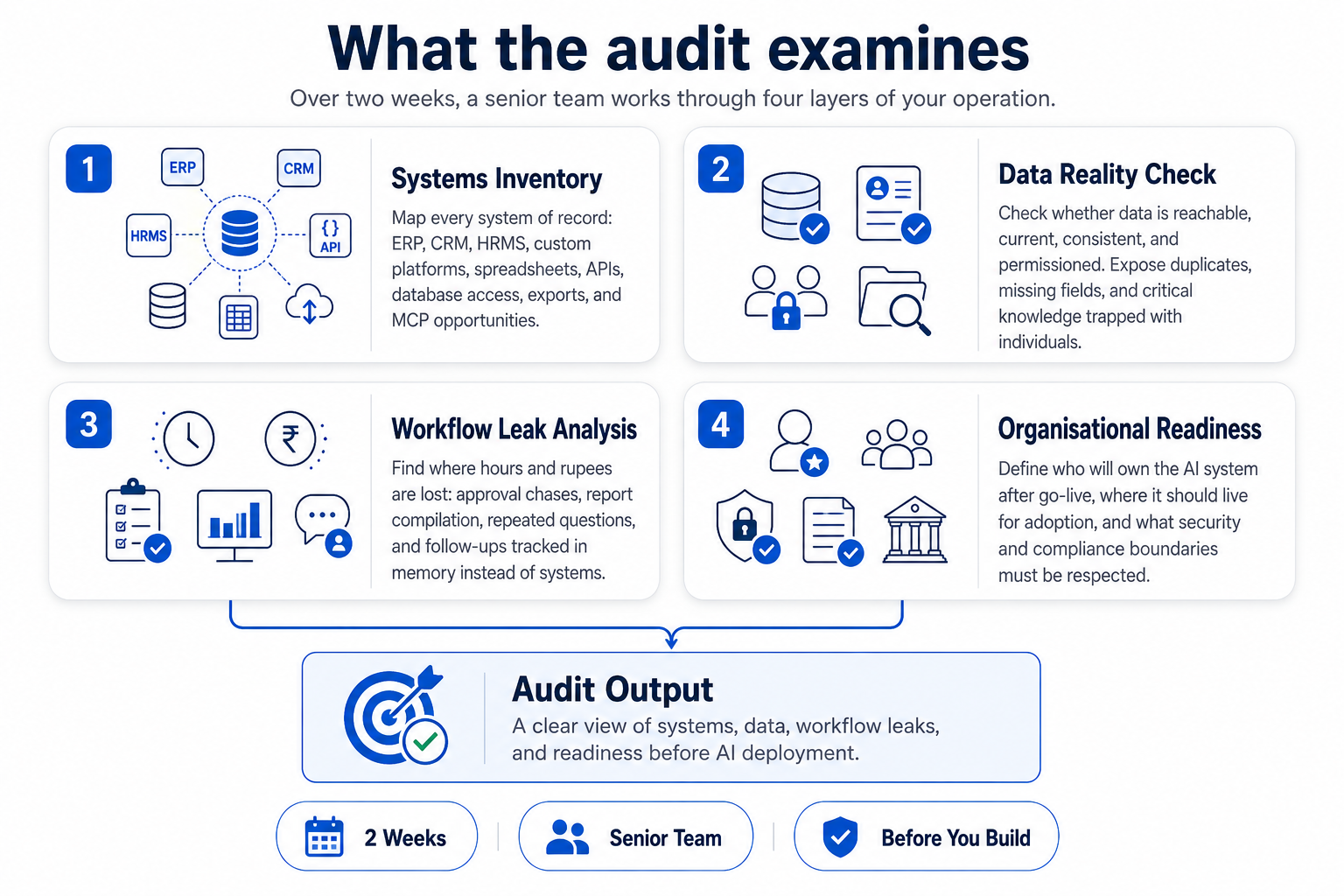
Over two weeks, a senior team works through four layers of your operation.
1. Systems inventory
Every system of record. ERP, CRM, HRMS, custom platforms, and the spreadsheet empire nobody admits to in the first meeting but everybody mentions by day three. For each one we map the integration surfaces: APIs, database access, export paths, and where an MCP layer could sit.
2. Data reality check
Not "do you have data." Everyone has data. The questions are whether it is reachable, current, consistent, and permissioned. This is where AI ambitions meet ground truth: duplicate customer masters, fields nobody fills, critical knowledge that lives in one senior employee rather than any system.
3. Workflow leak analysis
Where do the hours actually go? Approval chases. Report compilation. The same questions asked of the same senior people every week. Follow-ups tracked in memory and lost there. Each leak gets sized in hours and rupees, because AI use cases should be ranked by payback, not by how impressive they sound in a boardroom.
4. Organisational readiness
Who would own the AI system after go-live? Where should it live so people actually use it? (Embedded inside an existing app, if our pharma deployment is any guide.) And what security and compliance boundaries will the CIO rightly enforce?
What you walk away with
The deliverable is not a slide deck of possibilities. It is a decision package with four parts:
- A ranked use-case list. Typically 5 to 8 candidates, each tied to the leak it closes, sized in rupees per year.
- The one-number recommendation. The single first deployment we would stake the relationship on, with its expected payback period.
- A data and integration readiness map. What can be connected now, what needs cleanup first, and what the cleanup costs.
- A fixed-price proposal for that first deployment: scope, timeline, and the metric it will be judged on.
You can execute the proposal with us or with anyone else. The audit's value is that whoever builds next is building against a measured target instead of a hope.
What it costs, and why the small number matters
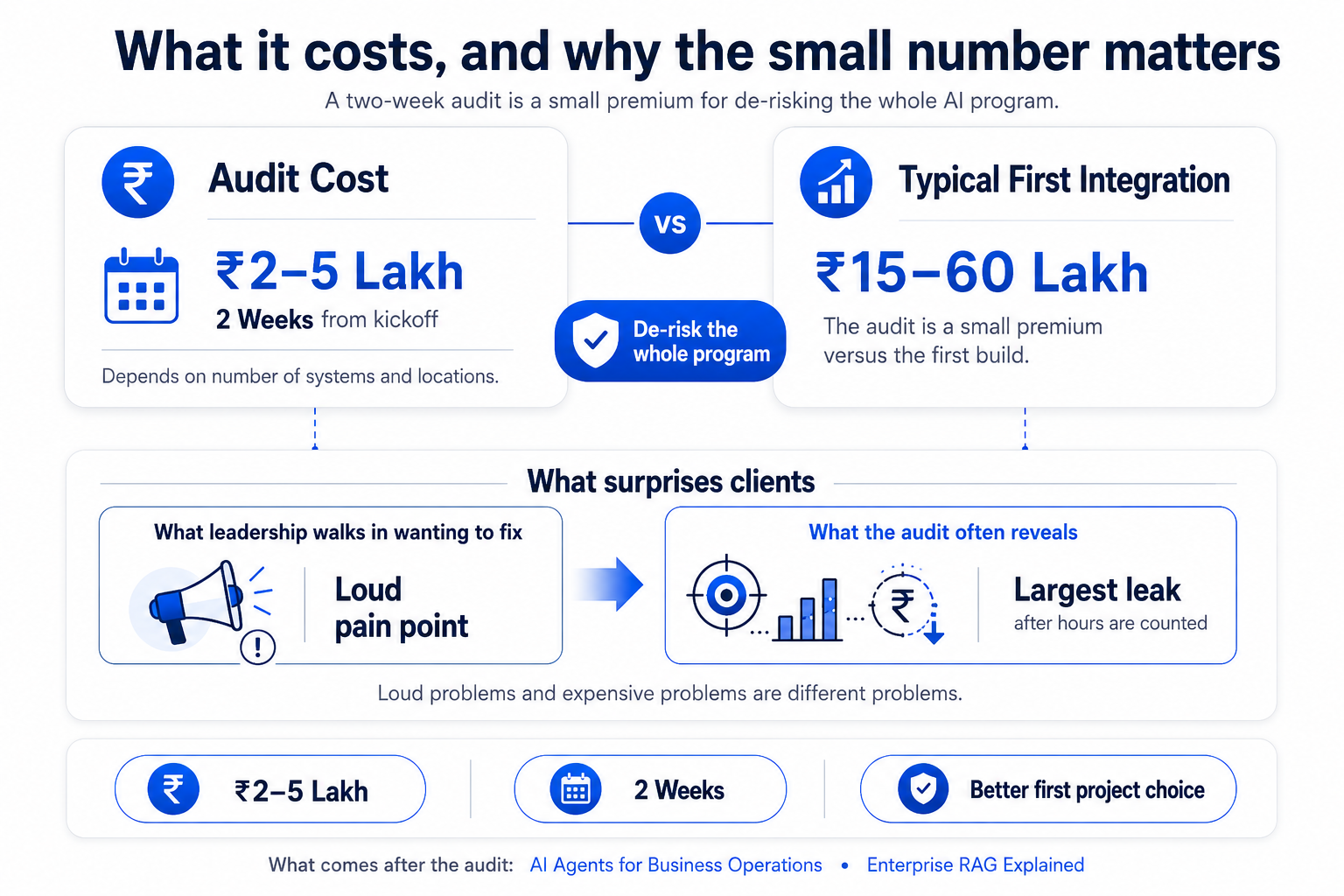
The audit is priced at ₹2 to 5 lakh depending on the number of systems and locations, and runs two weeks from kickoff. Against a typical first integration of ₹15 to 60 lakh, that is a small premium for de-risking the whole program.
Here is the part that surprises clients: the audit routinely changes the first project choice. The pain point leadership walks in wanting to fix is rarely the largest leak once the hours are counted. Loud problems and expensive problems are different problems.
For what comes after the audit, the cost bands and operating models for agents and RAG are covered in AI Agents for Business Operations and Enterprise RAG explained.
Accucia's view
Accucia's view is that no mid-market company should sign a large AI build without a paid audit first. Ours or anyone's. A vendor who resists a small, fixed-scope discovery phase is telling you exactly how they will handle the big one. The audit also keeps us honest: it commits every proposal we write to a client-specific number, in the shape of "₹18 lakh a year of manual order-entry cost, the agent removes 70% of it, payback in 11 months," instead of technology adjectives. Mid-market promoters buy payback periods. So should you.
Frequently Asked Questions
What is an AI Readiness Audit?
A fixed-scope, two-week engagement that maps a company's systems, data quality and workflow leaks to identify where AI will produce measurable payback, delivered as a ranked use-case list, a readiness map, and a fixed-price proposal for the highest-payback first deployment.
How much does an AI Readiness Audit cost in India?
Typically ₹2 to 5 lakh for a mid-market enterprise, depending on the number of systems and locations. It runs two weeks from kickoff.
What deliverables does the audit produce?
A ranked list of 5 to 8 AI use cases sized in rupees per year, a single recommended first deployment with expected payback, a data and integration readiness map, and a fixed-price build proposal with an agreed success metric.
Do we need to commit to a build after the audit?
No. The deliverables are vendor-neutral. You can execute with any partner. The purpose is to make sure the next rupee spent on AI is aimed at a measured target.
Who should commission the audit?
The founder, COO, CIO or CTO of a mid-to-large enterprise (30 to 500+ employees) that runs on an ERP, CRM or custom systems and suspects manual effort is leaking money. Especially after a previous AI pilot went nowhere.
Start with an AI Readiness Audit. Build what actually pays back.