OpenAI Frontier vs The AI Agent Reality for Mid-Market — What Actually Works in 2026
Quick Answer
OpenAI Frontier — launched in May 2026 — is an enterprise AI agent platform designed for organisations deploying AI agents "like human employees." It's the biggest enterprise AI announcement of the year, accompanied by OpenAI's acquisition of consultancy Tomoro (~150 AI engineers) and Google's parallel launch of the Gemini Enterprise Agent Platform. For mid-market businesses, the practical reality is sharper than the headlines: most AI pilots still fail before reaching operational maturity. Frontier doesn't change that. What changes outcomes is 5 prerequisites: clean data, documented workflows, role-based access control, a real change-management plan, and a delivery partner that stays through adoption. Mid-market teams that lock those first will get value from any AI model. Teams that skip them will fail with Frontier just like they failed with the last AI agent vendor.
OpenAI's Frontier launch this month is the biggest enterprise AI announcement of 2026.
Every mid-market CIO will be asked about it by Friday. Most will give the same vague "we're evaluating it" answer they gave when the last AI agent platform launched 6 months ago.
Here's the honest answer most consultants won't give you — drawn from 3+ years of actually building AI inside live mid-market enterprises across healthcare, pharma, real estate, manufacturing, and government.
What Actually Was Announced (Last 2 Weeks)
The May 2026 enterprise AI calendar has been the busiest in industry history. The key launches:
- OpenAI Frontier — a new enterprise platform for building, deploying, and managing AI agents "like human employees." Designed for organisations doing real operational work at scale.
- OpenAI acquiring Tomoro — adding roughly 150 AI engineers and deployment specialists to OpenAI's own enterprise services arm. Model providers are now directly competing with consultancies they used to partner with.
- Google Gemini Enterprise Agent Platform — launched the same week as Frontier, with 8th-generation TPUs and specific retail, financial services, and healthcare agent templates.
- US government AI model testing agreements with Microsoft, Google, and xAI — May 5, 2026. Pre-launch evaluation of frontier models before public release. Indirect signal: enterprise procurement standards for AI are tightening.
- OpenAI B2B Signals — quarterly research on enterprise AI adoption, first report shows "frontier" companies use 3.5× more AI per employee than typical firms. Largest gaps in advanced agentic workflows and coding tasks.
- Anthropic restrictions on Claude subscribers using third-party agent tools, reflecting pressure from computational costs of autonomous workflows.
The pattern: model providers are moving deeper into implementation services, agentic AI is being positioned as infrastructure, and vendor lock-in concerns are rising.
What the Industry Headline View Says
The mainstream tech press consensus on Frontier is straightforward:
- Agentic AI has moved from pilot to infrastructure
- Gartner predicts 40% of enterprise apps will include task-specific AI agents by end of 2026
- The window to build competitive advantage by moving early is "compressing fast"
- Mid-market businesses should adopt now or fall behind
It's not wrong. It's incomplete.
What the On-the-Ground Reality Is
Microsoft's own researchers warned earlier this month that AI agents remain unreliable for long-running workflows. Most enterprise AI pilots still fail before reaching production. 76-81% of enterprises in the latest CIO surveys are worried about AI vendor lock-in.
In our work building AI inside actual mid-market businesses, the failure pattern is consistent:
- The model isn't the cause of failure — the model works
- The data isn't ready — fragmented across 8-15 systems, no clean source of truth
- The workflow isn't documented — the agent doesn't know what "good" looks like
- The access controls weren't designed — HR, finance, and customer data accessible to anyone with the AI prompt
- The team wasn't prepared — change management was a launch event, not a 6-week embedded process
- The vendor delivered and disappeared — adoption support was an AMC email instead of on-site iteration
Frontier doesn't fix any of these. Neither does Gemini Enterprise Agents. Neither does Claude. The model is the easy 20% of the work. The prerequisite 80% is what determines whether your AI deployment reaches 6-month utilisation or quietly retires to the press release archive.
The 5 Prerequisites No One Is Talking About
This is what we lock in before any AI code is written — for every Accucia client engagement, whether the model is OpenAI, Anthropic, Google, or open-source.
Prerequisite 1: Clean, structured operational data
If your data lives across 14 different SaaS systems with inconsistent schemas, no AI agent will produce reliable output. The Frontier marketing doesn't say this; the engineering reality is unforgiving. Step one is always a data audit — what's structured, what's free-text, what's in screenshots, what's in WhatsApp.
Prerequisite 2: Documented workflows the agent can actually execute
AI agents don't know what your business considers "complete." If your team has six different versions of "approved" depending on context, the agent will pick the wrong one. Workflows need to be documented at the decision level, not just the activity level, before an agent can be trusted.
Prerequisite 3: Role-based access controls before agents touch your systems
The fastest way to a security incident in 2026 is an AI agent with broader access than the human who triggered it. Three-level RBAC needs to be in place before any agent goes live — and tested before production. We learned this on the the pharma client engagement (95% accuracy, zero security incidents, 8-month payback) and it's the rule we enforce on every AI build since.
Prerequisite 4: A change management plan for the team affected
The team that resists the AI in week one is usually the team that loved it by month four — if implementation was done right. That means embedded training, two or three rounds per role, with the AI co-pilot positioned as a tool that takes the boring work, not as a replacement.
Prerequisite 5: A delivery partner who stays through adoption
The 6 weeks post-launch is when AI deployments either stick or quietly fail. Vendors who deliver and disappear leave the team to debug edge cases the AI wasn't trained for. Vendors who stay on-site, iterate, and tune the model based on real usage are the ones whose AI is still running 12 months later.
What's Working Today Inside Mid-Market
Two case studies from our current work that show what 2026 mid-market AI actually looks like:
the pharma client — AI knowledge bot (anonymised numbers but exact metrics):
- 75% reduction in employee time spent searching for SOPs and policy documents
- 95% answer accuracy across all departments
- 8-month full investment payback
- 40% faster new-hire onboarding
- Zero security incidents since launch (three-level access control held)
What worked: bot embedded inside the existing pharma mobile app (zero new tool for the team to learn), trained only on approved internal documents with mandatory source citations, deployed with 6 weeks of on-site adoption support.
Mumbai real estate retainer — Custom ERP + AI chatbot + MCP server for Claude (active engagement):
- First AI chatbot module delivered in beta in 10 days, not 10 weeks
- Voice-note input so leadership can query operations hands-free from the back of a car
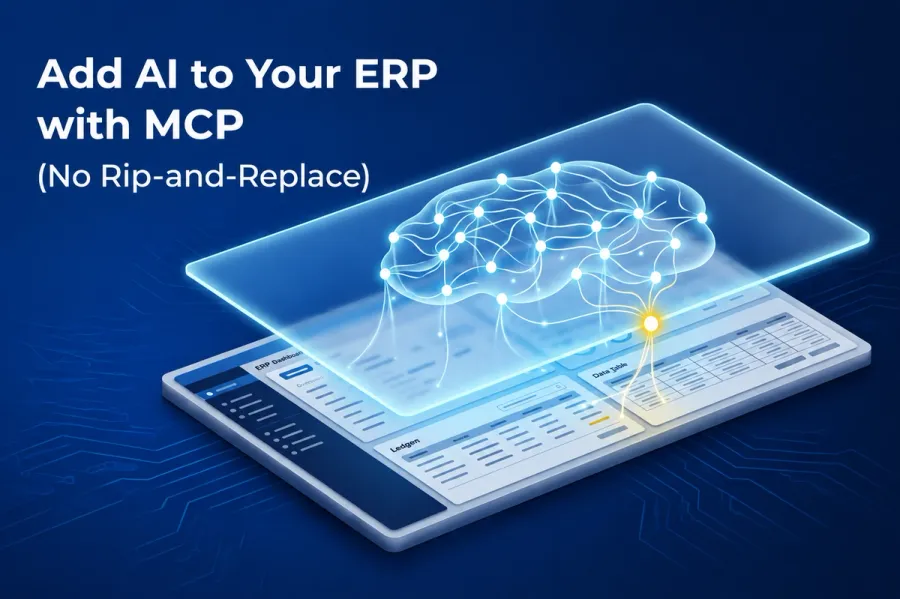
- MCP (Model Context Protocol) server in active development — leadership will soon run data analysis and business projections directly inside Claude on their own live ERP data, without engineering involvement
- 6 months on-time monthly module delivery, zero slippage
- 8-10 dedicated Accucia engineers on the retainer
What works: AI built as a layer on top of the custom ERP, not as a standalone product. The AI knows the business workflow because we built the workflow.
Neither client uses OpenAI Frontier today. Neither needs to. The model layer is interchangeable. The implementation layer is the product.
The 7 Questions to Ask Before Signing Any AI Agreement in 2026
If you're evaluating an AI vendor in the next 90 days — Frontier, Gemini, Anthropic, or anyone else — these are the questions that separate vendors who will deliver from vendors who will demo:
- "What's your AI adoption rate at month 6, not week 1?" — Vendors love demos. Demand the 6-month utilisation number.
- "Will the AI work if we switch model providers in 18 months?" — Vendor lock-in is the 2026 enterprise risk. Plan exit paths.
- "Will the agent answer only from documents we approve?" — Public-internet retrieval is non-negotiable for compliance.
- "Will every answer cite its source?" — Audit-grade transparency is the line between credible AI and a hallucination machine.
- "Who from your team will be physically in our office during the first 45 days?" — Adoption fails when implementation isn't on-site.
- "What's your prerequisite checklist before we start?" — Vendors skipping prereqs are selling you a pilot that will never go live.
- "Who do I call at month 12 when something breaks?" — Ask before you sign. The answer tells you everything.
FAQ: OpenAI Frontier for Mid-Market
What is OpenAI Frontier and how is it different from ChatGPT Enterprise?
Frontier is OpenAI's enterprise platform for building, deploying, and managing AI agents — agents designed to take multi-step autonomous actions across business systems. ChatGPT Enterprise is a chat-based assistant for individual employees. Frontier is positioned as infrastructure for AI workforce automation; ChatGPT Enterprise is a productivity tool.
Is OpenAI Frontier the right choice for mid-market businesses (30-500 employees)?
For most mid-market businesses, the better question isn't "Frontier or Gemini" — it's "have we done the prerequisite work to deploy any AI agent successfully?" Frontier solves the model and orchestration layer. It doesn't solve data fragmentation, workflow documentation, access controls, or change management. Lock those first; the model choice becomes secondary.
What does OpenAI Frontier cost for enterprise customers?
OpenAI hasn't published public pricing for Frontier as of May 2026. Initial reports indicate enterprise contracts in the high-six-figure to low-seven-figure annual range. Mid-market businesses should factor in implementation services (typically 2-4× the platform cost) and ongoing fine-tuning.
Can mid-market businesses build similar AI agent capability without Frontier?
Yes. Our current real-estate retainer engagement uses Claude + an MCP server for live data access, achieving most of what Frontier promises at a fraction of the cost. The right architecture matters more than the brand on the model.
How long does mid-market AI deployment actually take?
Discovery + prerequisites: 4-8 weeks. First module live: 10 days (with the right partner and prereqs in place) to 12 weeks (most realistic for full feature). Full adoption: 6 months from go-live. Most mid-market businesses should plan a 6-month total timeline from contract signing to production AI in regular use.
What To Do Next
If you're evaluating AI vendors in 2026:
- Run the 7-question vendor evaluation before any contract signing
- Audit your data, workflow documentation, and access controls — the prerequisites — before any pilot
- Demand a 6-month utilisation rate commitment from any vendor
- DM "AI READY" on LinkedIn for our 12-question AI maturity self-assessment
Want a conversation, not a checklist? Accucia takes 30-minute discovery calls on enterprise AI weekly. Mr. Sumeet Katariya (CEO) personally takes most of them. No model bias — we'll talk through what fits your business, whether that's OpenAI Frontier, Anthropic, Google, or an open-source stack on your own infrastructure.
Before you deploy AI, audit the operational layer first.