AI Agents vs Chatbots: Which Technology Gives Better ROI for Businesses in 2026?
AI Agents vs Chatbots: Which Technology Gives Better ROI for Businesses in 2026?
As businesses accelerate digital transformation, artificial intelligence is becoming central to improving efficiency, customer experience, and operational performance. Two of the most widely adopted AI technologies are chatbots and AI agents. While both are designed to automate interactions and tasks, their capabilities, impact, and return on investment (ROI) differ significantly. In 2026, choosing the right solution is no longer about automation alone—it is about measurable business value.
Understanding the differences between AI agents and chatbots is essential for organizations aiming to invest in technology that delivers long-term growth and competitive advantage.
Understanding Chatbots and AI Agents
Chatbots are rule-based or AI-powered conversational tools designed to respond to predefined queries. They are commonly used in customer support, lead generation, and basic internal assistance. Chatbots follow scripted flows or limited AI models and typically require human intervention when conversations become complex.
AI agents, on the other hand, are autonomous, goal-oriented systems capable of understanding context, making decisions, and executing actions across multiple systems. They can interact with CRMs, ERPs, analytics platforms, and other enterprise tools to complete tasks end-to-end without constant human input.
This fundamental difference directly impacts ROI.
ROI of Chatbots in 2026
Chatbots continue to deliver value in specific, well-defined use cases. They reduce customer support costs by handling frequently asked questions, improve response times, and operate 24/7 without additional staffing. For businesses with high-volume, repetitive interactions, chatbots remain a cost-effective solution.
However, the ROI of chatbots is often limited by their inability to handle complex workflows. When customer queries go beyond predefined scenarios, human escalation becomes necessary, which increases operational costs. Chatbots also offer limited insights, as they primarily react rather than proactively optimize processes.
In 2026, chatbots provide quick cost savings but may struggle to deliver long-term strategic value.
ROI of AI Agents in 2026
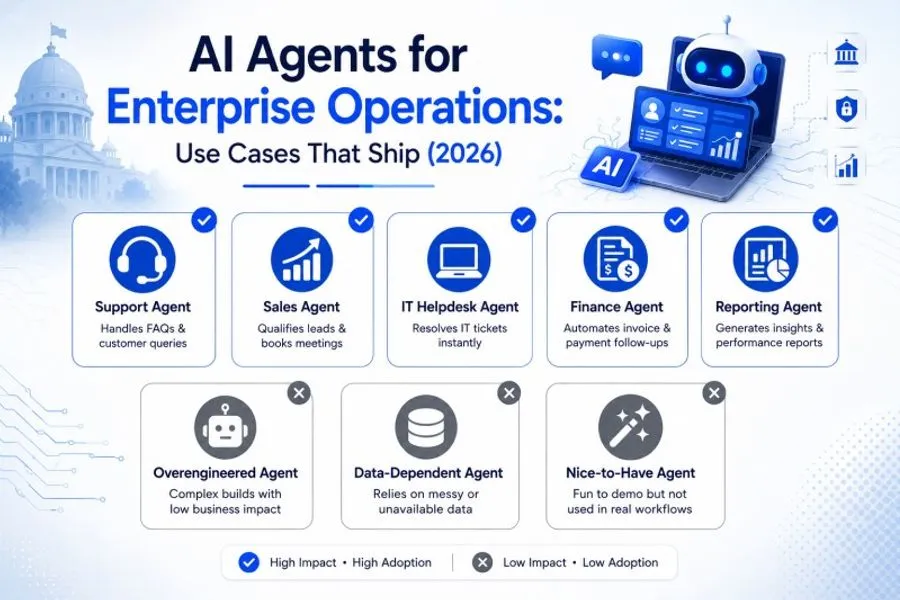
AI agents represent a significant shift in how businesses automate operations. Unlike chatbots, AI agents can analyze data, understand intent, and take action across systems. They can autonomously manage tasks such as updating CRM records, generating reports, optimizing workflows, triggering alerts, and making data-driven recommendations.
From a business perspective, AI agents deliver higher ROI by reducing manual work across departments, improving decision-making accuracy, and accelerating execution. They are capable of learning over time, which means their performance and value increase as they process more data.
In customer-facing roles, AI agents go beyond answering questions—they resolve issues, personalize interactions, and proactively engage customers. In internal operations, they streamline processes, reduce errors, and improve productivity without increasing headcount.
Comparing ROI: AI Agents vs Chatbots
The ROI difference becomes clear when considering scale and complexity. Chatbots are best suited for narrow, repetitive tasks with predictable outcomes. AI agents, however, thrive in complex environments where decisions, integrations, and continuous optimization are required.
While AI agents require a higher initial investment, they deliver significantly greater long-term returns by replacing multiple manual processes and improving operational efficiency at scale. Chatbots offer faster implementation and lower upfront costs but limited expansion potential.
In 2026, businesses focused on sustainable growth and operational intelligence will find AI agents to be the stronger investment.
Choosing the Right Technology for Your Business
The choice between chatbots and AI agents depends on business goals. Organizations seeking quick wins in customer support or basic automation may benefit from chatbots. Businesses aiming to optimize workflows, reduce operational costs, and gain strategic insights will see better ROI from AI agents.
Many forward-thinking organizations are adopting a hybrid approach—using chatbots for simple interactions while deploying AI agents for complex decision-making and automation.
Conclusion
In 2026, the question is no longer whether to adopt AI, but which AI technology delivers measurable business value. Chatbots remain useful for basic automation, but AI agents are redefining ROI by driving efficiency, intelligence, and scalability across business operations.
At Accucia Softwares, we help organizations assess, implement, and scale AI solutions that align with their business objectives. Whether it’s chatbots, AI agents, or a combination of both, the right strategy can transform automation into a powerful growth engine.
If your business is evaluating AI investments for the future, understanding the ROI potential of AI agents versus chatbots is the first step toward smarter decision-making.
Unlock Higher ROI with AI Automation
See how intelligent AI agents can transform your operations.