
Why 95% of Enterprise AI Pilots Fail (And What the Top 5% Do Differently)
Quick Answer
95% of enterprise generative AI pilots fail to deliver measurable ROI, according to MIT's 2025 “GenAI Divide” report. The cause is rarely the AI model — it's a missing workflow foundation: messy data, no clear ownership, and tools bolted onto broken processes instead of integrated into them. The 5% that succeed fix the underlying process first, then layer AI on top, with a named owner and a production-grade rollout plan from day one. By Mr. Sumeet Katariya, CEO Accucia Softwares
The Real Number Behind the Hype
Enterprises poured an estimated $30–40 billion into generative AI pilots in 2024 and 2025. According to MIT's NANDA initiative, which studied 300 public AI deployments alongside 153 leader interviews, 95% of those pilots delivered no measurable return on investment (MIT NANDA, “The GenAI Divide: State of AI in Business 2025,” July 2025).
That number isn't an outlier. RAND Corporation's research on enterprise AI projects found 80.3% fail to deliver the business value they promised — 33.8% are abandoned before they ever reach production, 28.4% reach production but underdeliver, and 18.1% run in production without ever recovering their investment. A 2026 survey of 650 enterprise technology leaders found a similar gap at the agentic AI layer: 78% have at least one AI agent pilot running, but only 14% have scaled an agent to organization-wide use.
Three different studies, three different years, the same conclusion: getting an AI pilot to work is the easy part. Getting it into production is where enterprises stall.
Why AI Pilots Fail — It's Not the Model
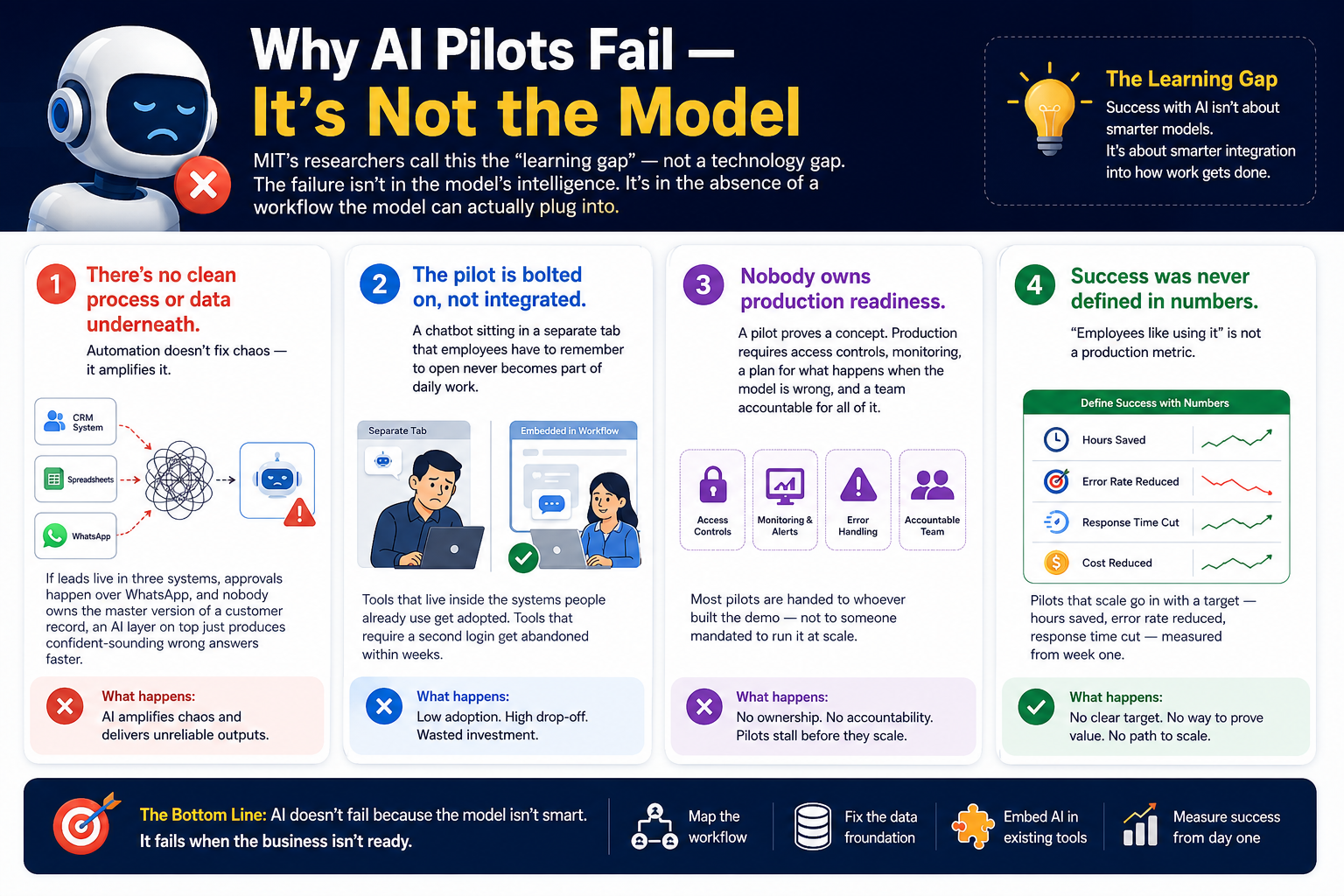
MIT's researchers call this the “learning gap” — not a technology gap. The failure isn't in the model's intelligence. It's in the absence of a workflow the model can actually plug into. Four patterns show up repeatedly:
1. There's no clean process or data underneath. Automation doesn't fix chaos — it amplifies it. If leads live in three systems, approvals happen over WhatsApp, and nobody owns the master version of a customer record, an AI layer on top just produces confident-sounding wrong answers faster.
2. The pilot is bolted on, not integrated. A chatbot sitting in a separate tab that employees have to remember to open never becomes part of daily work. Tools that live inside the systems people already use get adopted. Tools that require a second login get abandoned within weeks.
3. Nobody owns production readiness. A pilot proves a concept. Production requires access controls, monitoring, a plan for what happens when the model is wrong, and a team accountable for all of it. Most pilots are handed to whoever built the demo — not to someone mandated to run it at scale.
4. Success was never defined in numbers. “Employees like using it” is not a production metric. Pilots that scale go in with a target — hours saved, error rate reduced, response time cut — measured from week one.
What Separates the 5% That Scale
Failed Pilots (the 95%)
Scaled Deployments (the 5%)
Built as a side project or hackathon demo
Built with a named business owner and budget
Sits in a separate tool or tab
Embedded inside systems teams already use daily
Trained once on a data dump
Trained continuously on live, governed data
No access controls defined
Role-based access controls from day one
Success measured by “did people try it”
Success measured by hard numbers: time, accuracy, cost
Workflow left as-is, AI added on top
Workflow re-mapped first, AI added to fit it
One person understands how it works
Documented, supportable by the whole team
A Real Example: From Pilot to Production in 10 Days
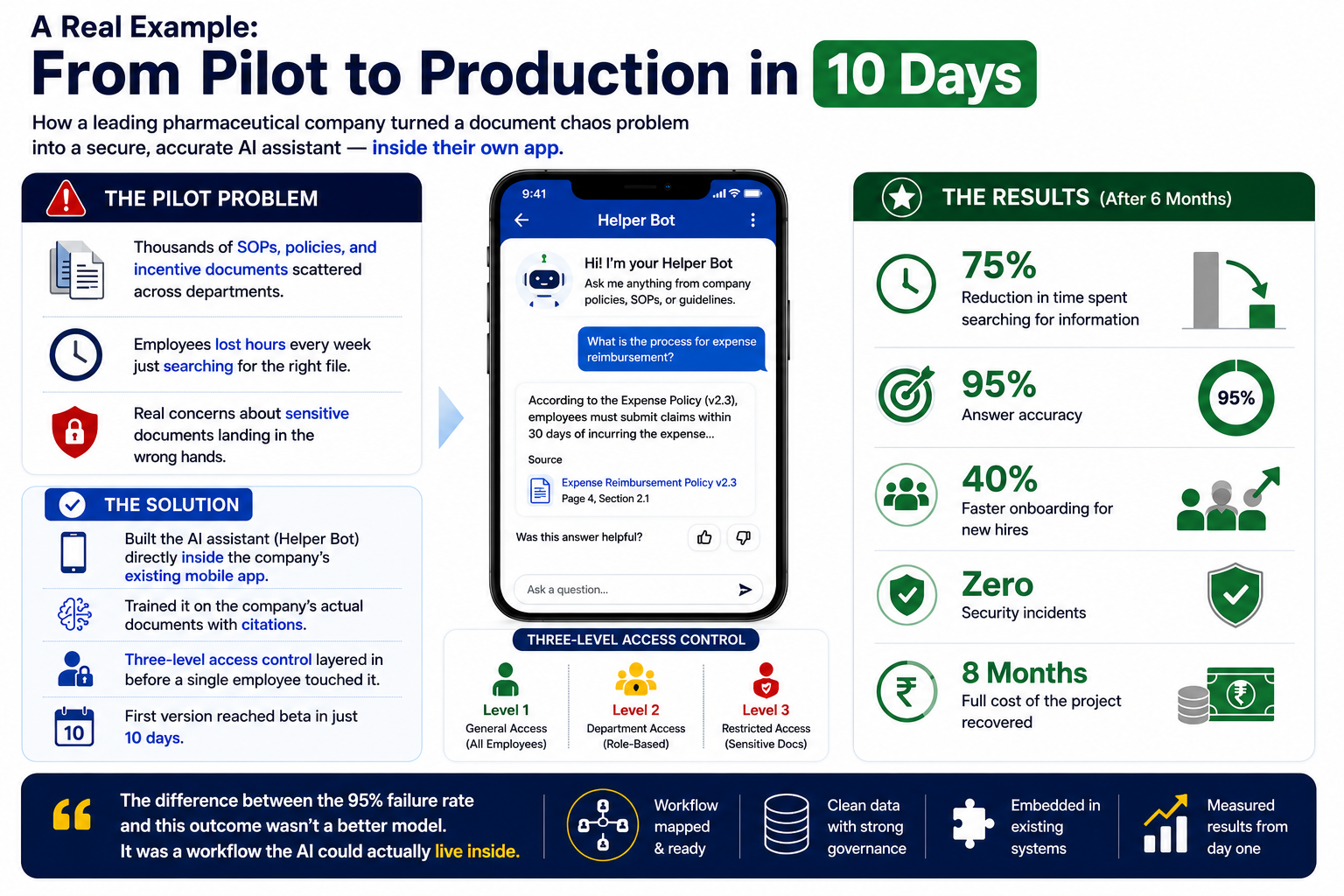
This isn't theoretical. JB Pharmaceuticals came to Accucia with a familiar version of the pilot problem: thousands of SOPs, policies, and incentive documents scattered across departments, with employees losing hours every week just searching for the right file — and real concerns about sensitive documents landing with the wrong people.
Instead of a standalone chatbot experiment, Accucia built the JB Helper Bot directly inside JB Pharma's existing mobile app, trained it on the company's actual documents with citations, and layered in three-level access control before a single employee touched it. The first version reached beta in 10 days — not because the AI was simple, but because the workflow it needed to sit inside was already mapped and ready.
The results, six months in: a 75% reduction in time spent searching for information, 95% answer accuracy, 40% faster onboarding for new hires, zero security incidents, and the full cost of the project recovered in 8 months.
The difference between that outcome and the 95% failure rate MIT documented wasn't a better model. It was a workflow the AI could actually live inside.
What the survivors have in common
Across the AI systems we have put into production, including a pharma deployment now running at 75% query-time reduction and 95% accuracy, the survivors share four traits:
- Live connection, not exports. The AI reads current systems through a governed layer. This is exactly what MCP exists for.
- Citations on every answer. Users can check the source record in one click. Verifiability is what turns scepticism into daily habit.
- Embedded where work already happens. Inside the ERP, the CRM, the app the team opens every morning. No new habit required, so the habit survives.
- One number, agreed in advance. Hours saved. Queries resolved. Days to close. If nobody defined the number, nobody can defend the budget, and the pilot dies at renewal even if users liked it.
And one organisational trait that underwrites the rest: someone stayed. Production AI is a living system. Query logs reveal what people actually need, and coverage gets tuned for months after go-live. Vendors who hand over and disappear produce pilots. Partners who stay produce systems. It is why "we stay" is written into how Accucia Softwares Pvt. Ltd. engages, and why some of our client relationships are in year seven.
The 4-Step Framework: Getting an AI Pilot Into Production
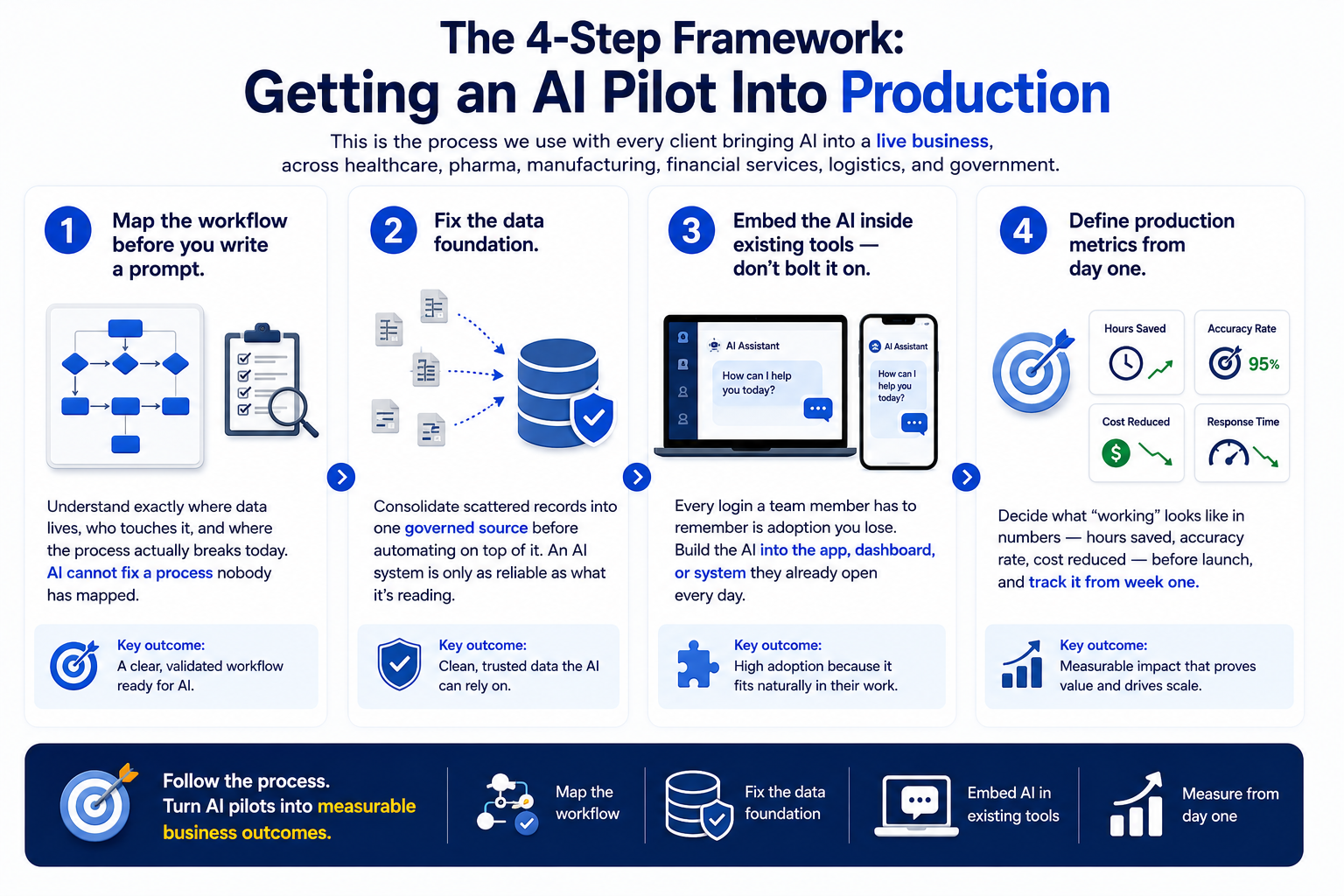
This is the process Accucia uses with every client bringing AI into a live business, distilled from delivering AI-driven systems across healthcare, pharma, manufacturing, financial services, logistics, and government.
- Map the workflow before you write a prompt. Understand exactly where data lives, who touches it, and where the process actually breaks today. AI cannot fix a process nobody has mapped.
- Fix the data foundation. Consolidate scattered records into one governed source before automating on top of it. An AI system is only as reliable as what it's reading.
- Embed the AI inside existing tools — don't bolt it on. Every login a team member has to remember is adoption you lose. Build the AI into the app, dashboard, or system they already open every day.
- Define production metrics from day one. Decide what “working” looks like in numbers — hours saved, accuracy rate, cost reduced — before launch, and track it from week one.
Accucia's view
Accucia's view is that "AI pilot" is usually a confession of missing architecture. If the plan does not specify live data access, permissions, citations, where the AI is embedded, and the one number it must move, then it is not a pilot. It is a demo with a budget. Our advice to any leadership team burned before: do not fund another pilot. Fund a two-week AI Readiness Audit, pick the single highest-payback workflow, and ship one production agent with a number attached. Survivors scale. Demos do not.
Frequently Asked Questions
Why do most enterprise AI pilots fail?
Most AI pilots fail because they're built on top of unclean data and broken processes rather than integrated into a redesigned workflow. MIT's 2025 research found 95% of generative AI pilots deliver no measurable ROI, with the root cause being poor integration into existing operations, not weak AI models.
What percentage of AI projects actually succeed?
Estimates vary by study. MIT found only 5% of generative AI pilots deliver significant business value. RAND found roughly 20% deliver the promised value. A 2026 industry survey found only 14% of AI agent pilots scale to organization-wide use. Across studies, the range of successful AI projects sits between 5% and 20%.
How long does it take to get an AI pilot into production?
It depends on how much workflow mapping and data cleanup is needed before the AI layer goes on. When the groundwork is already in place, a focused AI module can reach a working beta in as little as 10 days, as with Accucia's JB Pharma chatbot deployment. Pilots that skip the groundwork often stall for months.
What's the biggest mistake companies make with AI pilots?
Treating the pilot as a technology test rather than a workflow redesign. Companies frequently add an AI tool on top of an existing broken process, expecting the AI to compensate for messy data and undefined ownership. It rarely does.
Ready to Scale AI? Let's Talk.