The IT Adoption Gap: Why Indian IT Firms Won't Talk About What Happens After Month Two
Quick Answer
The IT adoption gap is the period between a software project going live and the client’s team actually using it. Most enterprise software projects hit peak usage in week two, then collapse to under 25% adoption by week eight. Nobody talks about it because the Indian IT services model bills for delivery, not for adoption — and by the time usage drops, the delivery partner has moved to the next project.
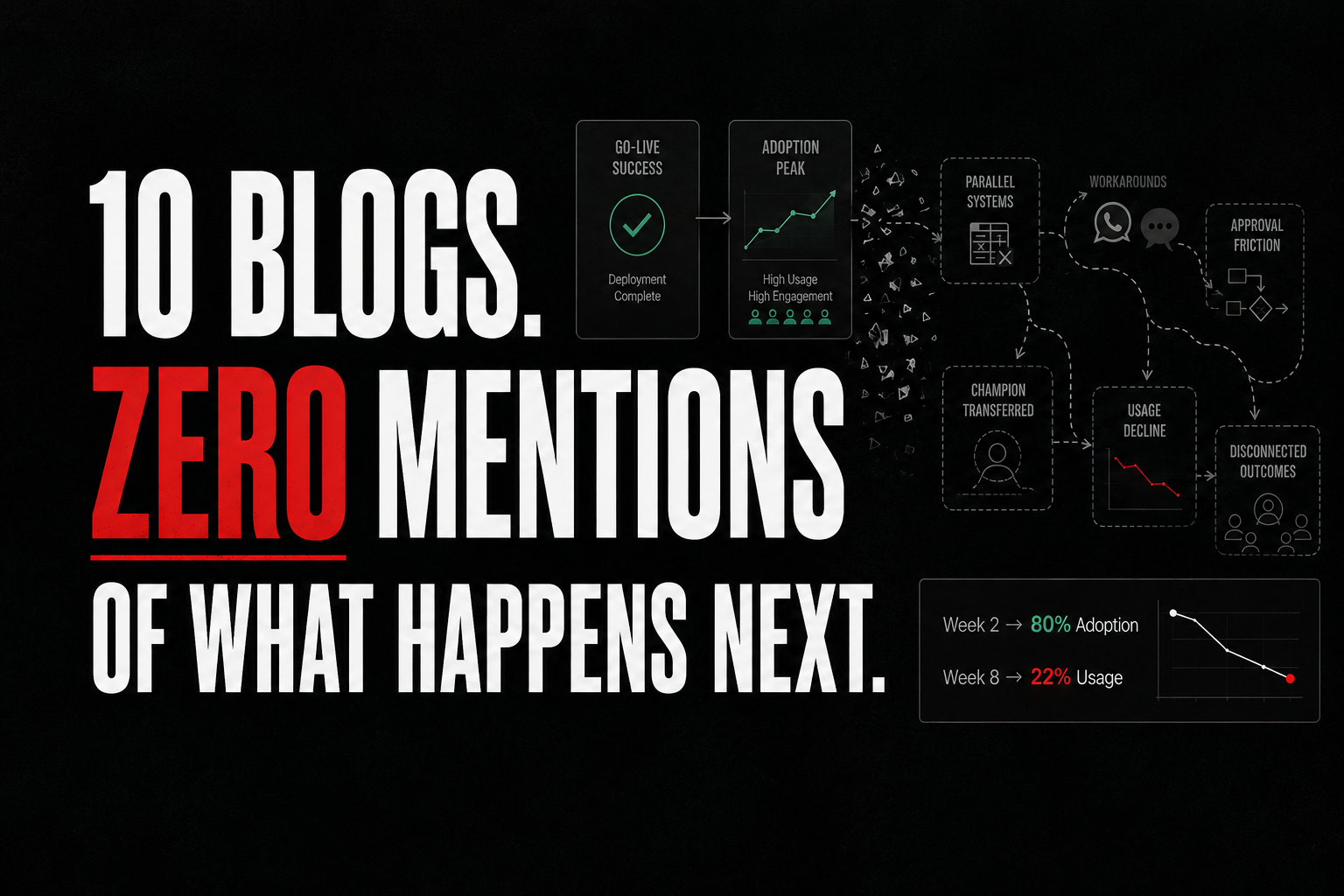
10 Blogs. Zero Mentions of What Happens Next.
I spent last Friday reading competitor blogs. Ten Indian IT firms — some claiming “3,000+ projects,” others “1,500+ implementations” — published content about AI capabilities. Readiness assessments. Agentic AI frameworks. Dedicated development teams.
Every single one stopped the story at go-live.
Not one mentioned what happens when the ops team builds a parallel Excel sheet because the new system takes four clicks instead of two. Not one addressed the project champion getting transferred to another department, leaving nobody to own the rollout. Not one acknowledged the usage data that every honest delivery team has seen: 80% adoption in week two, 22% by week eight.
This is the IT adoption gap. It is the most expensive problem in enterprise software. And the Indian IT services industry is structurally designed to ignore it.
The Business Model That Creates the Problem
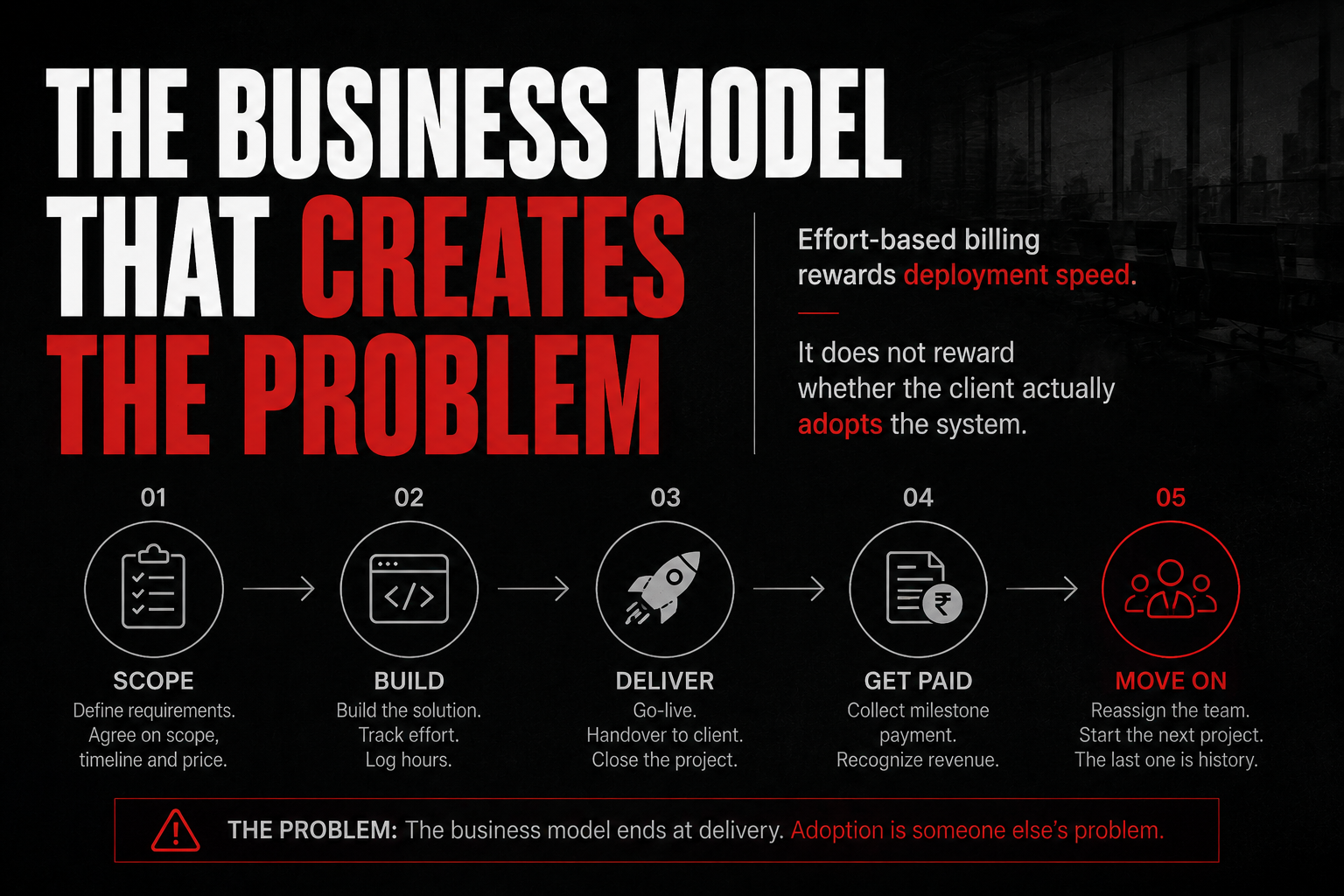
Here is how most Indian IT firms operate. They scope a project. They build it. They deliver it. They collect the milestone payment. They move the team to the next project.
This is not incompetence. It is the model. Effort-based billing rewards deployment speed. It does not reward whether the client’s accounts payable team actually stops using the old system.
The market is starting to notice. When Nifty IT crashed and wiped out Rs 7 lakh crore in value, the analysis was straightforward: investors believe AI will kill the “deploy and disappear” model. The firms that bill for effort — build it, hand it over, leave — are the ones at risk.
The firms that stay through adoption are not at risk. They are more valuable, not less.
What the Adoption Gap Actually Looks Like
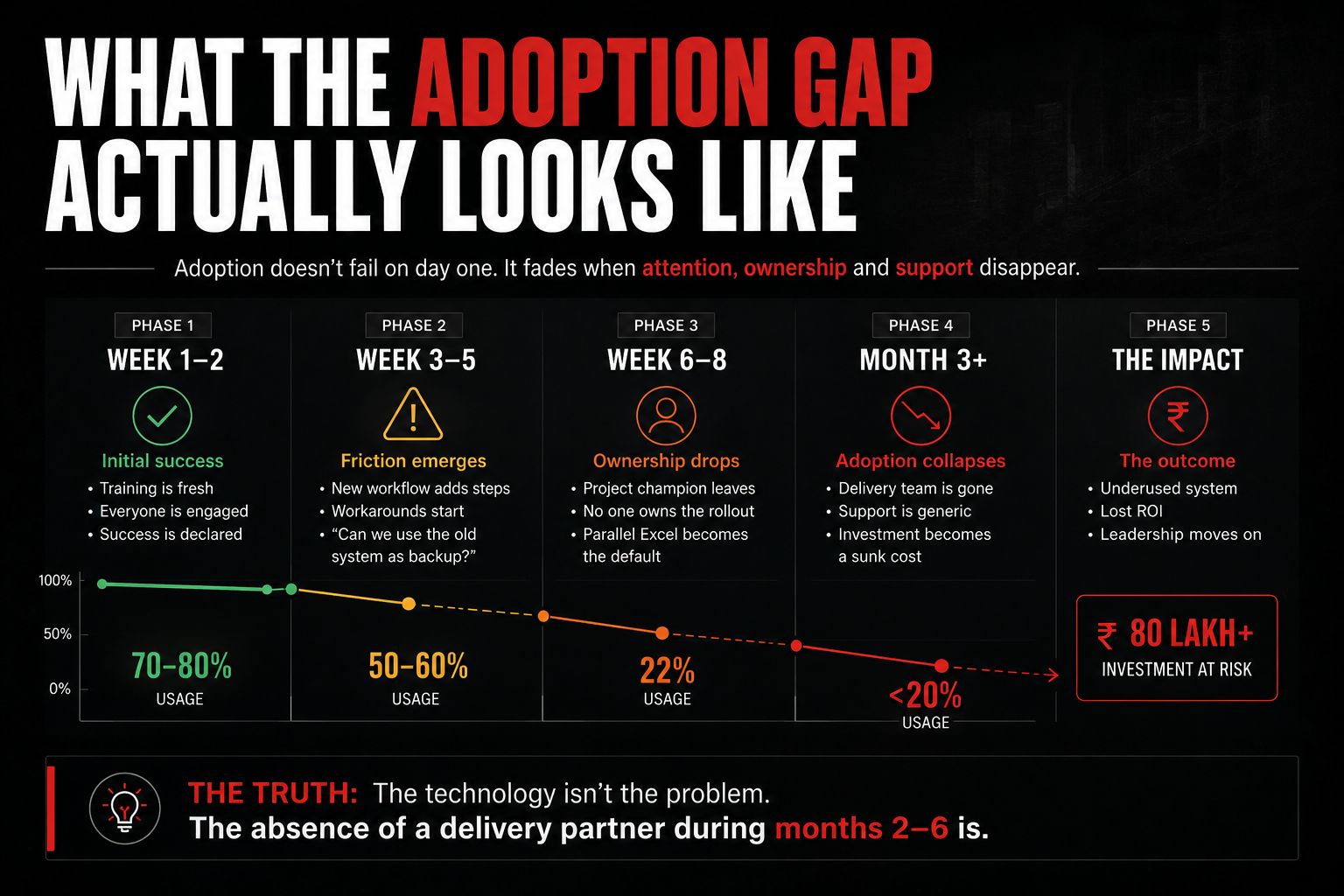
I have seen this across 730+ projects over eight years, in eight sectors. The pattern is predictable.
Week 1-2: Usage hits 70-80%. Training is fresh. Everyone declares success.
Week 3-5: The ops team discovers the new approval workflow adds two steps. Someone finds a workaround using WhatsApp. A senior manager asks, “Can we still use the old system, just as backup?”
Week 6-8: The project champion gets transferred. Nobody owns the rollout. Usage drops to 22%. The parallel Excel sheet becomes the de facto system.
Month 3+: The delivery partner’s team has been reassigned. The client submits a support ticket. It gets routed to a junior resource who was not on the original project. The Rs 80 lakh investment is a line item nobody wants to discuss.
The technology is never the problem. The absence of a delivery partner during months two through six — that is the problem.
Why Staying Is Not a Cost Centre
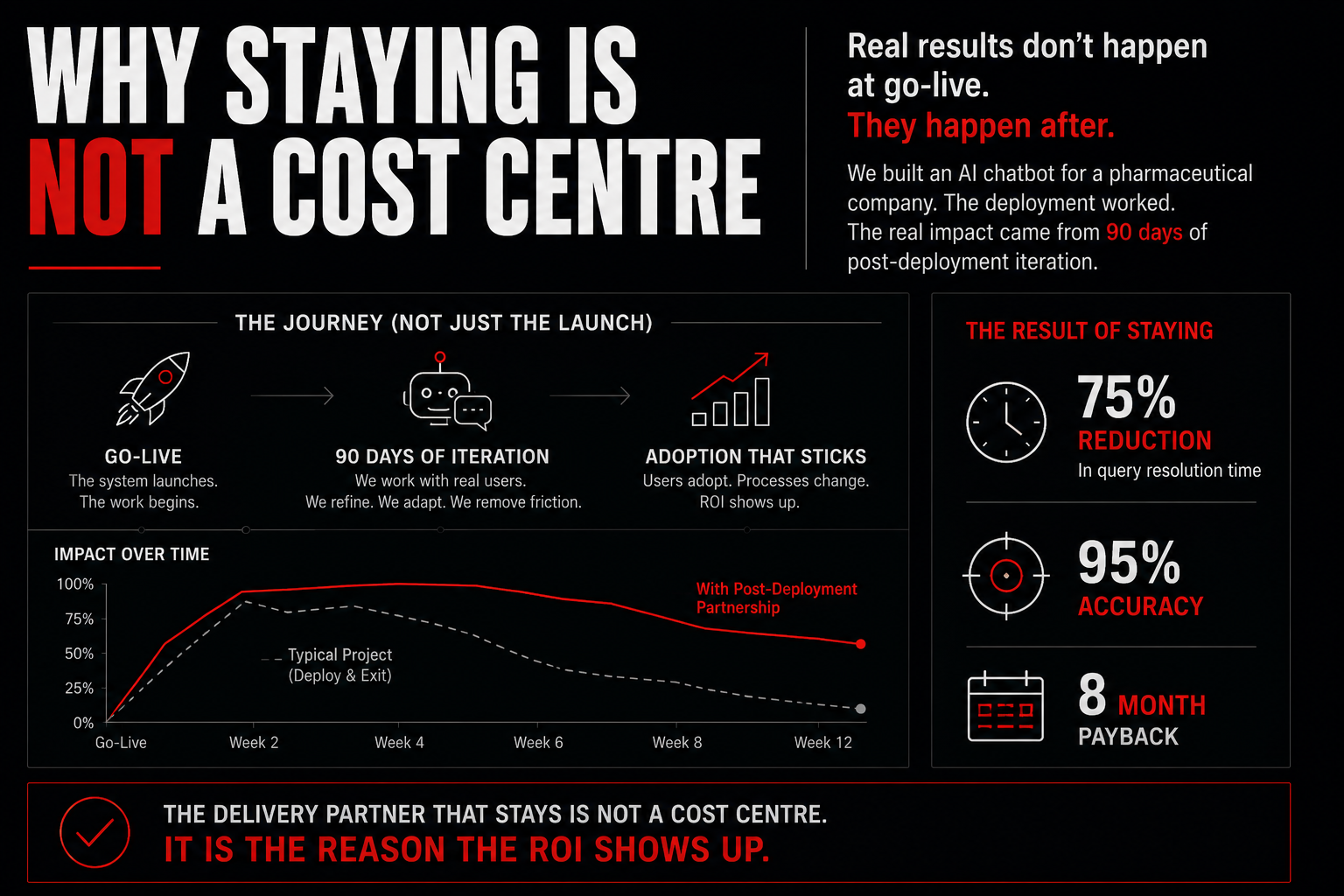
The standard objection: “Post-deployment support is expensive. We already paid for the build.”
Here is what that objection misses.
We built an AI chatbot for a pharmaceutical company. The initial deployment worked. But the real results came from 90 days of post-deployment iteration — adjusting response patterns based on how staff actually used the system, not how the requirements document said they would.
The result: 75% reduction in query resolution time. 95% accuracy. Eight-month payback.
None of those numbers existed at go-live. Every one was produced during the period most delivery partners would have already left.
The delivery partner that stays is not a cost centre. It is the reason the ROI shows up.
The Pattern Nobody Publishes About
I track competitor content every week. Firms publish project counts: 500+, 1,000+, 1,500+, 3,000+. They publish capability lists: AI readiness assessments, engineering-led approaches, digital solutions.
None of them publish adoption rates 90 days after go-live.
The effort-based billing model does not create an incentive to track post-deployment outcomes. If your revenue comes from deploying the next project, you do not measure whether the last one stuck.
At Accucia, we stay. Through month two. Through the first officer transfer. Through the first “the old system was easier” conversation. That is the difference between a project that shows up as an asset on the balance sheet and one that shows up as a write-off.
We learned this discipline from government delivery, where the adoption gap is not just expensive — it is public. A CM-recognised government website built under UX4G compliance standards does not get the luxury of quiet failure. Citizen usage is audited, not assumed. That standard is what we bring to every enterprise project.
What to Ask Your Current IT Partner
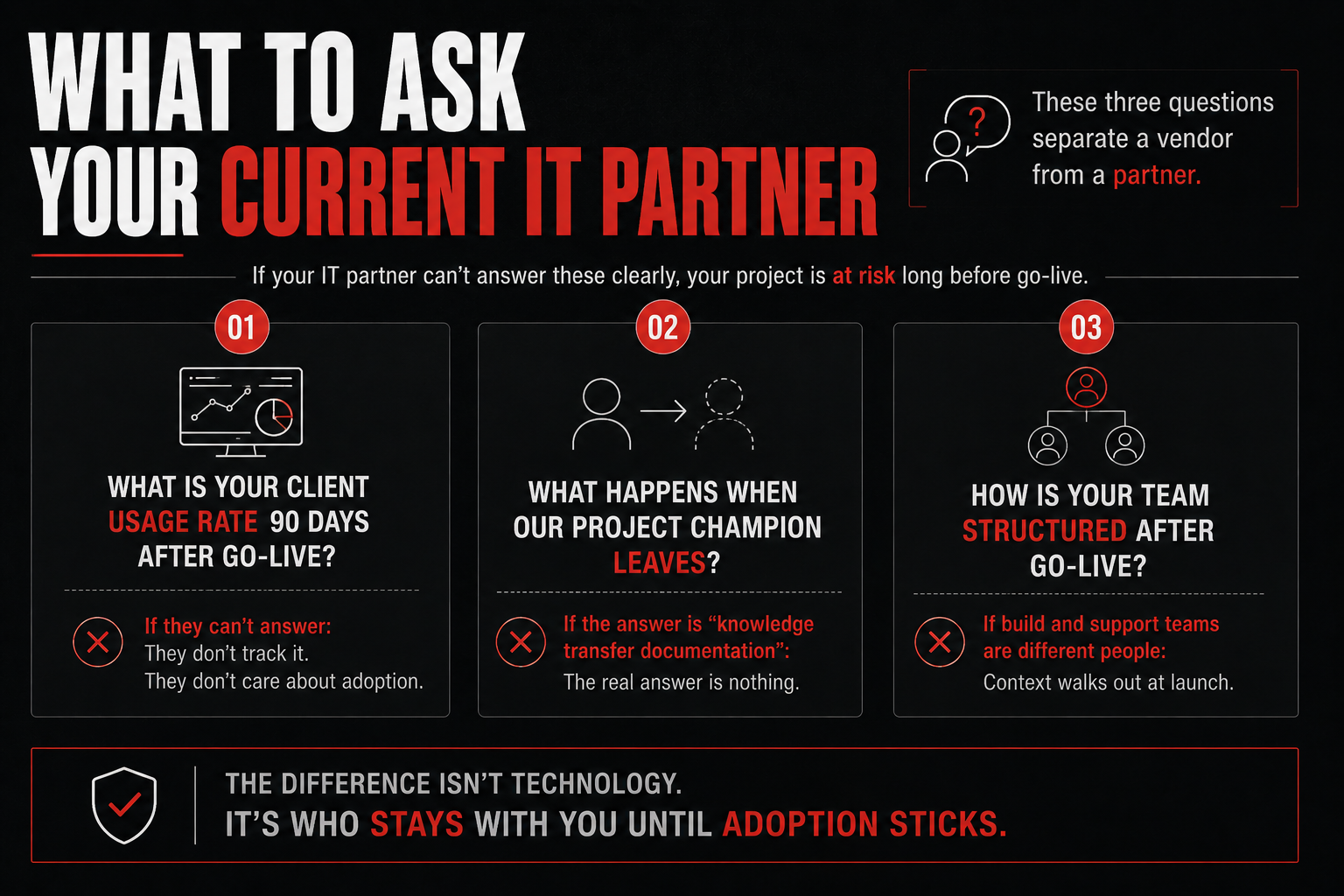
If you are evaluating an IT services firm, ask three questions most firms cannot answer:
What is your client usage rate 90 days after go-live? If they do not track this, they do not care about adoption.
What happens when our project champion leaves? If the answer involves “knowledge transfer documentation,” the real answer is nothing.
How is your team structured after go-live? If the build team and the support team are different people, the context that makes adoption work walks out at launch.
These are the questions that separate a vendor from a partner.
Frequently Asked Questions
What is the IT project adoption gap?
The drop in actual system usage between go-live and the 60-90 day mark. Most enterprise software projects peak in week two, then decline as the delivery partner exits and internal resistance surfaces. The gap between intended and actual usage is where most project ROI is lost.
Why do Indian IT firms avoid talking about post-deployment adoption?
Effort-based billing generates revenue from new deployments, not from ensuring previous ones are used. Tracking adoption would reveal that many delivered projects fail to achieve intended outcomes — which conflicts with marketing narratives built on project counts and capability lists.
How does Accucia Softwares handle the adoption gap?
We stay through the adoption period. Across 730+ projects over eight years, our model includes structured post-deployment iteration — working with actual end users to adjust workflows and address friction. Our pharma AI chatbot achieved its headline metrics (75% query time reduction, 95% accuracy) entirely during 90 days of post-deployment work.
What is the cost of ignoring the adoption gap?
The full project investment. A system built but not adopted is a sunk cost. For a mid-market firm spending Rs 50 lakh to Rs 1 crore, the adoption gap turns the entire investment into a write-off — plus 6-12 months of opportunity cost.
How can companies measure whether their IT project has an adoption gap?
Track three metrics from go-live: daily active users as a percentage of intended users, parallel systems still in use (Excel sheets, WhatsApp groups, manual processes), and support tickets segmented by “how do I do this” versus “this is broken.” If active usage drops below 50% within 60 days, you have an adoption gap.
Choose Partners. Not Vendors.