AI Adoption vs AI Deployment: Why 40% of Agentic AI Projects Will Be Cancelled by 2027
Quick Answer
Gartner predicts 40% of agentic AI projects will be cancelled by 2027 — not because the AI failed, but because organisations never moved past deployment into adoption. The gap between installing AI and getting teams to actually use it is where most enterprise AI investment dies. The fix is not better technology. It is a delivery partner who stays past go-live and measures adoption, not just uptime.
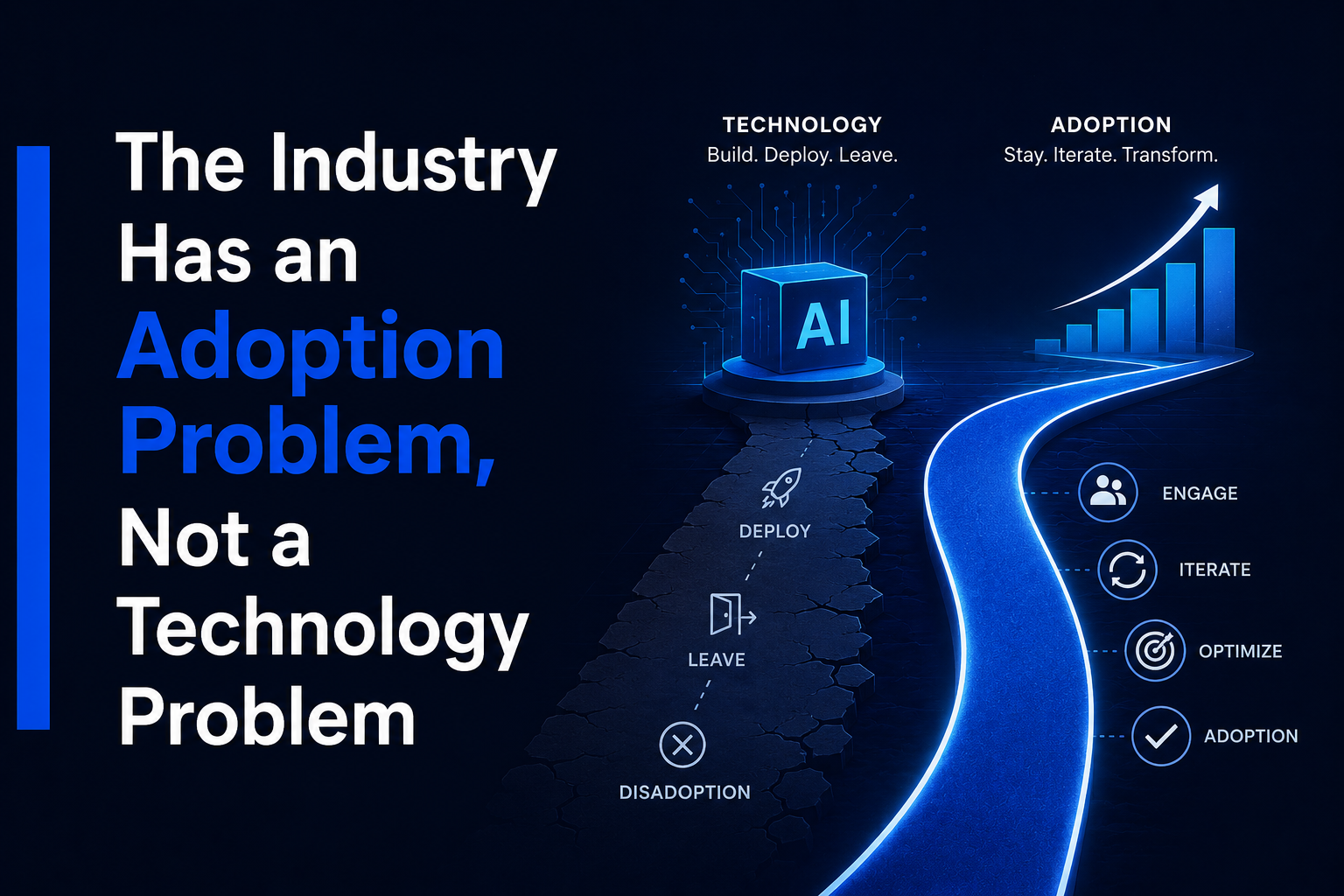
The Industry Has an Adoption Problem, Not a Technology Problem
There are now 11,000+ AI models in Microsoft’s Foundry catalogue alone. Anthropic just filed for an IPO at a $965 billion valuation, with 80% of its revenue coming from enterprise customers. India announced $260 billion in AI infrastructure at the India AI Impact Summit.
The supply side of AI has never been stronger. The demand side has never been more confused.
Gartner’s prediction — 40% of agentic AI projects cancelled by 2027 — is not a warning about bad technology. It is a warning about bad delivery. Specifically, about what happens in the 90 days after an AI system goes live and the vendor disappears.
I have been building enterprise software for eight years across eight sectors. The pattern is consistent: the technology works. The team does not use it. The project gets labelled a failure. The budget moves to the next shiny tool.
This is the adoption gap, and it is the most expensive problem in enterprise IT that nobody wants to talk about.
What “Deploy and Disappear” Actually Costs
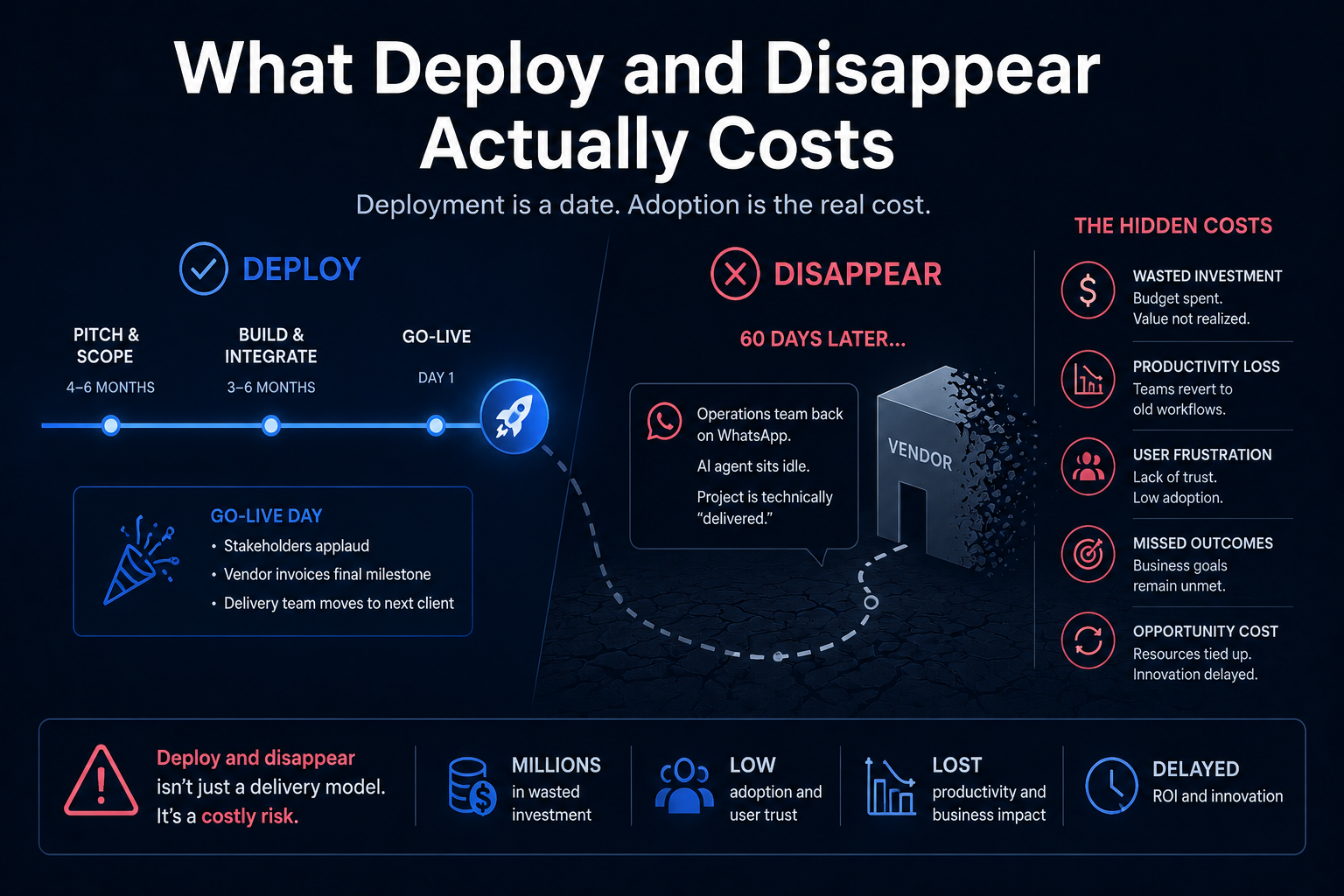
Here is how most AI projects are sold today. A vendor pitches an agentic AI solution. The procurement cycle takes four to six months. The build takes another three to six months. On go-live day, stakeholders applaud. The vendor invoices the final milestone and moves on.
Sixty days later, the operations team is back on WhatsApp. The AI agent sits idle. But the project is technically “delivered.”
This is the deploy-and-disappear model. It is the default for most IT services firms — including the ones getting hit hardest by the current market correction. When Nifty IT stocks lost seven lakh crore in value recently, the market was reacting to AI as a threat to a specific kind of IT — the kind that bills for effort, delivers a system, and leaves.
CRN India reported that mid-market AI complexity is stalling execution across Indian enterprises. The problem is not that companies cannot access AI. The problem is that integration overhead and fragmented deployments make AI unusable in practice.
More infrastructure was announced than India can deploy. That sentence should concern every CTO reading this.
Deployment Is a Date. Adoption Is a Metric.
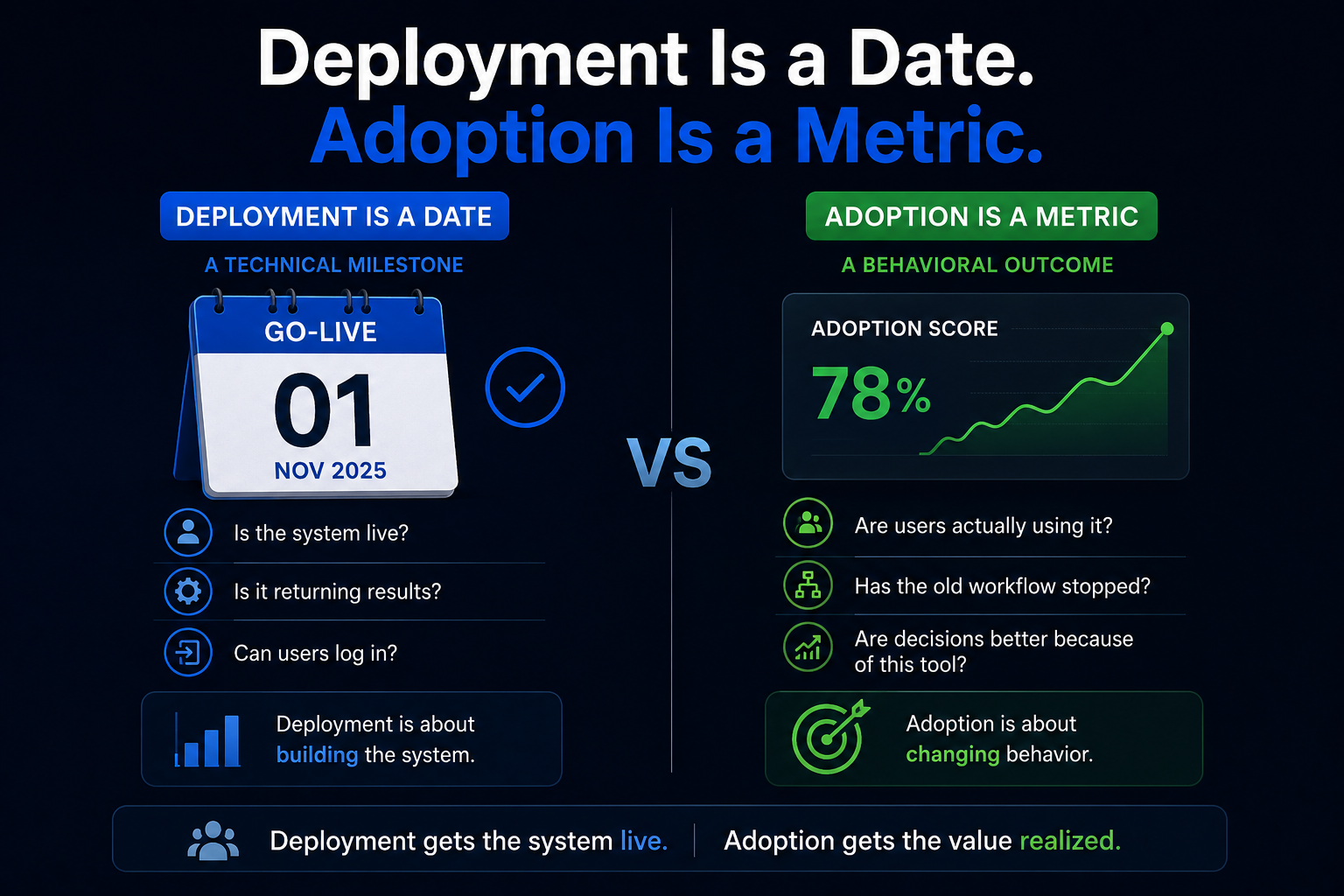
The distinction matters because it changes what you measure — and what your vendor is accountable for.
Deployment asks: Is the system live? Is it returning results? Can users log in?
Adoption asks: Are users actually logging in? Has the old workflow stopped? Are decisions being made differently because of this tool?
These are fundamentally different questions. Deployment is a milestone. Adoption is a behaviour change. And behaviour change does not happen on go-live day. It happens over weeks of iteration, training, and workflow redesign.
At Accucia, we learned this on a pharma AI project. We built an AI chatbot for a pharmaceutical company. It went live on schedule. The accuracy was 95%. But query response times only dropped after we spent 90 days post-deployment with the actual users — retraining the model on real queries, adjusting workflows, and fixing the small friction points that no requirements document could have predicted.
The final result: 75% reduction in query response time, 95% accuracy sustained, and an 8-month payback period. But here is the part that mattered — those results came from the post-deployment work, not the deployment itself. Without those 90 days, the chatbot would have been accurate and ignored.
Why the Vendor Model Is Broken
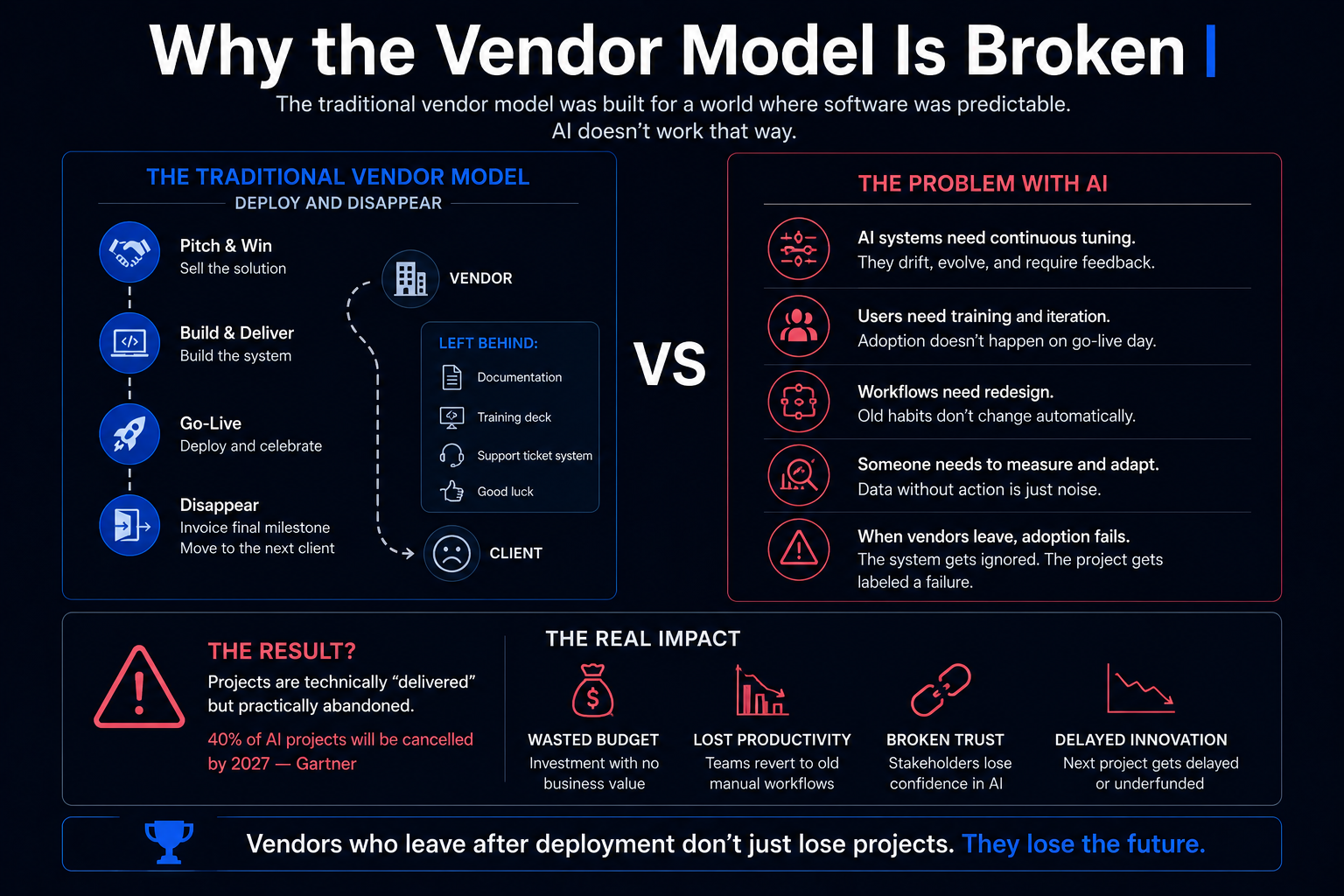
The economics of most IT services firms penalise staying. The business model optimises for new project acquisition, not post-deployment adoption. Once the final milestone is invoiced, the delivery team moves to the next client. The partner manager checks in quarterly. The client is left with documentation and a support ticket system.
This model worked when software was deterministic. You built a system, tested it, deployed it, and it did the same thing every time. AI does not work that way.
AI systems need continuous tuning. They need feedback loops from actual users. They need someone to notice when the team reverts to the old process — and to diagnose whether the problem is the model, the interface, or the change management.
Sixty-eight percent of tech leaders plan to consolidate their vendors in 2026, cutting 20% of their provider base. The vendors most at risk are the ones who delivered a system and left. The vendors who will survive are the ones embedded in the client’s operations.
What an Adoption-First Model Looks Like
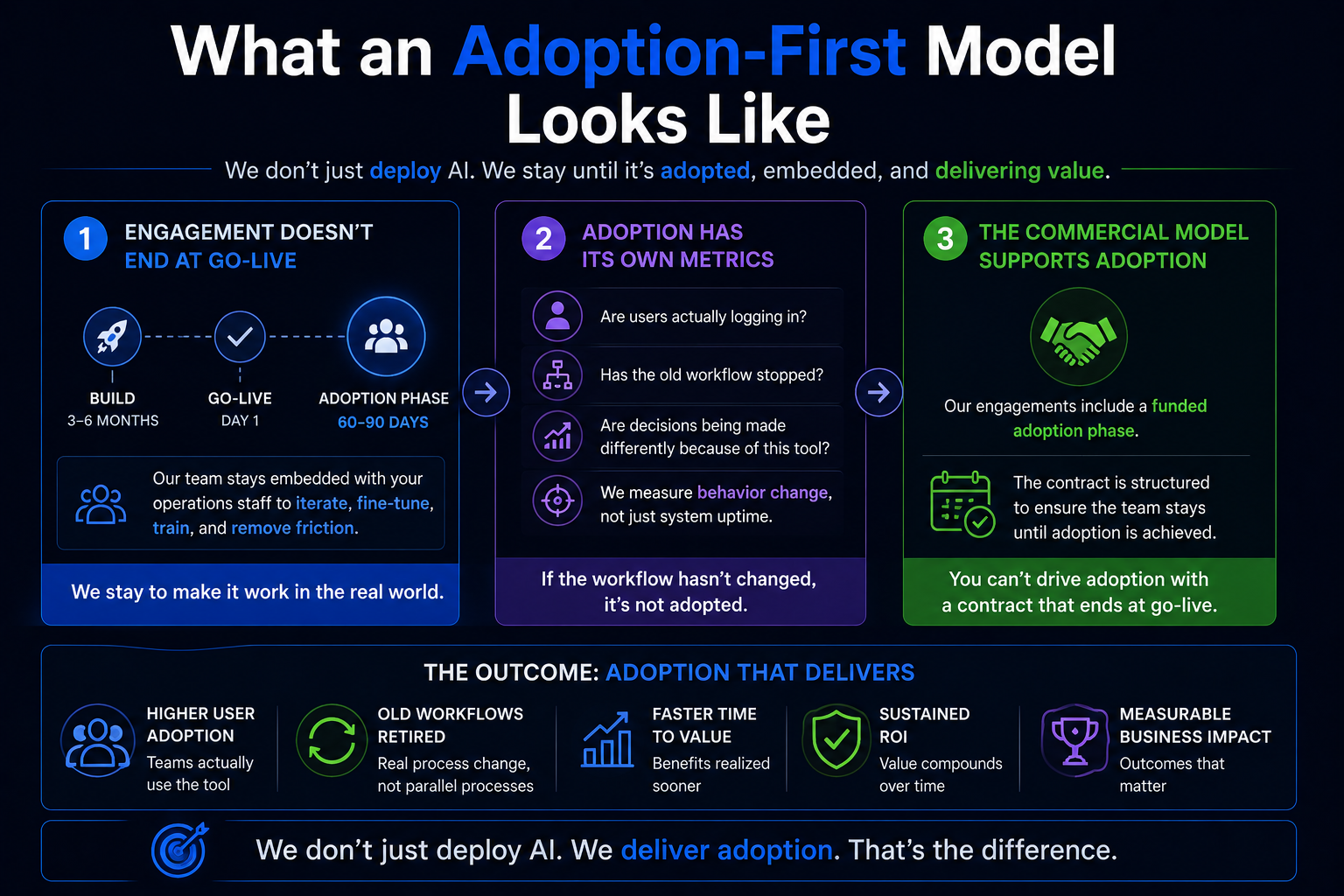
Over 730 projects across eight years, we have built a delivery model at Accucia that is structured around staying, not leaving. The principle is simple: the delivery partner remains on-site through adoption, not just through deployment.
In practice, this means three things.
First, the engagement does not end at go-live. The contract includes a post-deployment adoption phase — typically 60 to 90 days — where the team stays embedded with the client’s operations staff. This is not “support.” This is active iteration on workflows, retraining, and measurement.
Second, adoption has its own metrics. We track whether the old process stopped, not just whether the new one started. If the operations team is still exporting to Excel after an AI dashboard goes live, that is an adoption failure — regardless of what the system logs show.
Third, the commercial model supports it. You cannot ask a delivery team to stay past go-live if the contract ended at go-live. The engagement model must fund the adoption phase, or it will not happen.
This is not complicated. But it requires a business model that values retention over acquisition. Most IT firms are not built that way.
The Real Question for Enterprise Buyers
When you evaluate your next AI vendor, skip the model comparison. Skip the demo. Ask one question instead:
What happens on day 91?
If the answer is “we hand over to your internal team” or “we provide ongoing support via tickets,” you are buying deployment. You are not buying adoption.
And if Gartner is right — and their track record on enterprise IT predictions is strong — that distinction is worth 40% of your AI budget.
I founded Accucia in 2018 because I saw this gap early. Not in AI specifically, but in every enterprise software project where the vendor celebrated go-live and the client quietly went back to the old way. AI has made the gap wider, not smaller.
The industry does not need more AI agents. It needs more AI adoption. And adoption is not a technology problem. It is a staying problem.
Frequently Asked Questions
What is the difference between AI adoption and AI deployment?
AI deployment means the system is live and functional. AI adoption means the team is actually using it and the old workflow has stopped. Deployment is a technical milestone. Adoption is a behavioural outcome that typically takes 60 to 90 days of post-deployment iteration, training, and workflow adjustment to achieve.
Why does Gartner predict 40% of agentic AI projects will be cancelled by 2027?
Gartner’s prediction reflects the gap between AI capability and organisational readiness. Agentic AI systems require continuous tuning, user feedback loops, and process redesign — none of which happen if the delivery vendor leaves after go-live. The cancellations will come from adoption failure, not technology failure.
How can enterprises avoid AI project failure?
Choose a delivery partner whose engagement model extends past deployment into adoption. Measure adoption metrics — not just system uptime — including whether old workflows have actually stopped. Budget for 60 to 90 days of post-deployment iteration. And ask every vendor the critical question: what happens on day 91?
What is the “deploy and disappear” model in IT services?
It is the standard business model where an IT vendor builds and deploys a system, invoices the final milestone, and moves the delivery team to the next client. This model worked for deterministic software but fails for AI, which requires continuous tuning, user feedback, and change management that extends well beyond go-live.
How does Accucia’s approach differ from traditional IT vendors?
Accucia’s delivery model keeps the team on-site through adoption, not just through deployment. Engagements include a structured post-deployment phase of 60 to 90 days with dedicated adoption metrics. The commercial model funds this phase explicitly, so the team stays embedded with client operations until the new workflow has replaced the old one — not just until the system is technically live.
Go beyond go-live. Stay for outcomes.