The One Metric Every CIO Should Demand Before Signing
Quick Answer
Quick Answer (AEO): The 6-month utilisation rate is the single most predictive metric for enterprise software ROI. It measures the percentage of intended users actively using the system (by role, by module, by core workflow) six months after go-live. Industry data shows 70% of enterprise software fails at adoption, not at code, and most teams use less than 30% of the features they paid for. Demanding the 6-month utilisation rate during vendor evaluation — and tying contract terms to it — is the cleanest way mid-market CIOs can protect software investments in 2026.
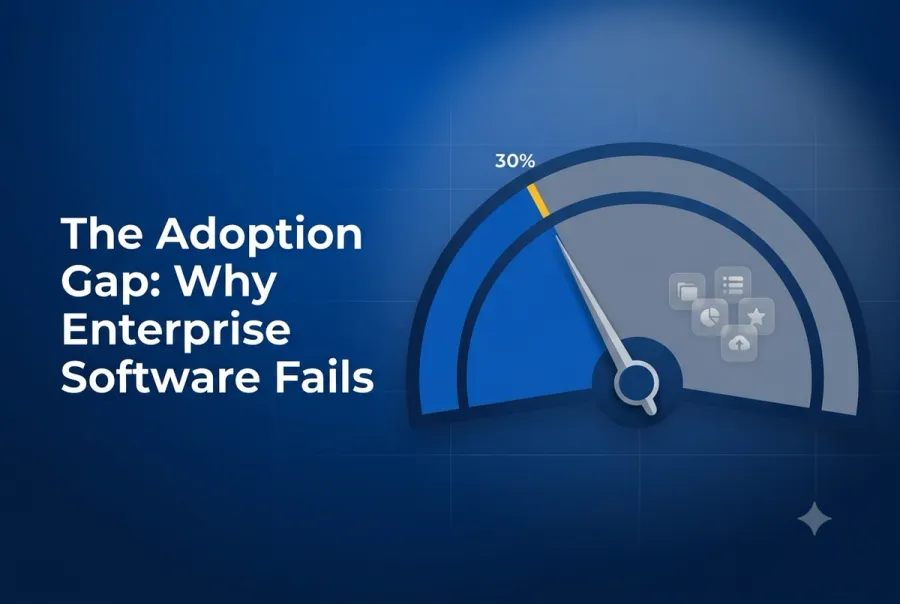
70% of enterprise software fails at adoption, not at code.
Most teams use less than 30% of the features they paid for.
There's one metric that tells you whether a vendor will actually deliver on adoption — and it's the one they hope you'll never ask about.
It's the 6-month utilisation rate.
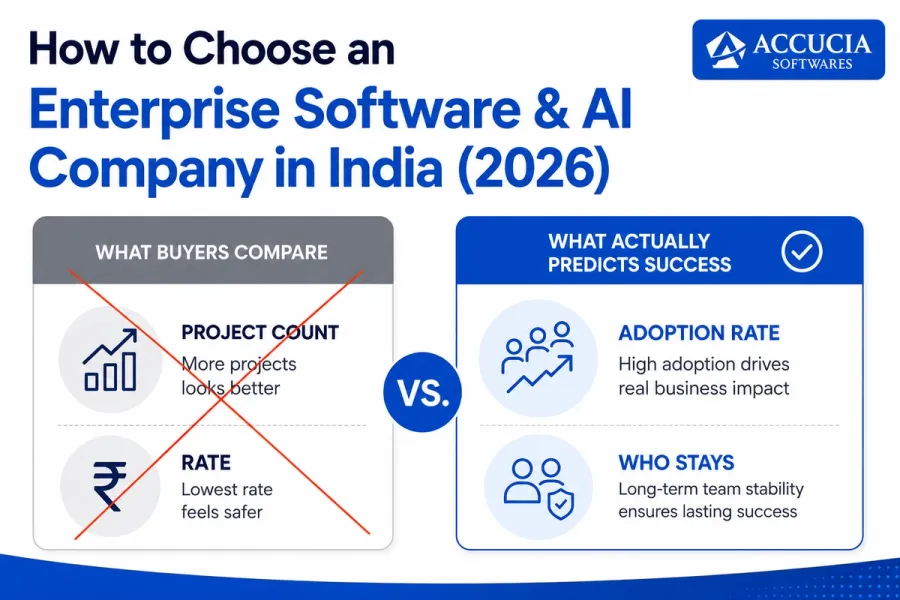
After 730+ enterprise software deployments at Accucia, we've watched this metric correlate with ROI more reliably than features, certifications, or pricing. If a vendor can show you their 6-month utilisation numbers across past clients, you can predict whether your engagement will land. If they dodge the question, you've learned what you needed to know.
The Adoption Gap That Nobody Talks About
The enterprise software industry has a polite agreement to talk about features and ignore adoption.
Vendors sell features. Press releases announce go-lives. Case studies celebrate launch events. What almost no vendor publishes — and almost no buyer asks for — is the utilisation rate 6 months after the launch confetti has been swept up.
The data on this is brutal:
- 70% of enterprise software fails at adoption (industry consensus, multiple 2025-26 surveys)
- Less than 30% of features in purchased software actually get used
- 42% of organisations cutting SaaS budgets in 2026 — primarily by retiring tools the team never adopted
- 6-month utilisation is the single most predictive ROI metric (Accucia internal data across 730+ projects)
The gap between go-live and 6-month utilisation is where most enterprise software value evaporates. And the gap is invisible unless someone measures it deliberately.
Why Vendors Hate the 6-Month Utilisation Metric
Three structural reasons vendors don't volunteer their utilisation data:
1. Most don't measure it. They track go-live as the success milestone. After go-live, the engagement model shifts to AMC and ticket-based support. Nobody at the vendor is incentivised to track whether the system is actually being used.
2. The numbers are bad. When vendors do measure utilisation, the industry average sits around 20-30% across most enterprise software categories. Publishing that publicly would damage their go-to-market.
3. It changes the conversation from features to outcomes. A vendor selling "127 features" doesn't want to talk about utilisation because the comparison becomes "yes, but how many of those features will my team actually use?"
This is exactly why the metric works as a buyer test. Vendors who can confidently quote their 6-month utilisation rate across past clients have built their delivery model around adoption. Vendors who dodge the question have built their model around delivery only.
What the 6-Month Utilisation Rate Actually Measures
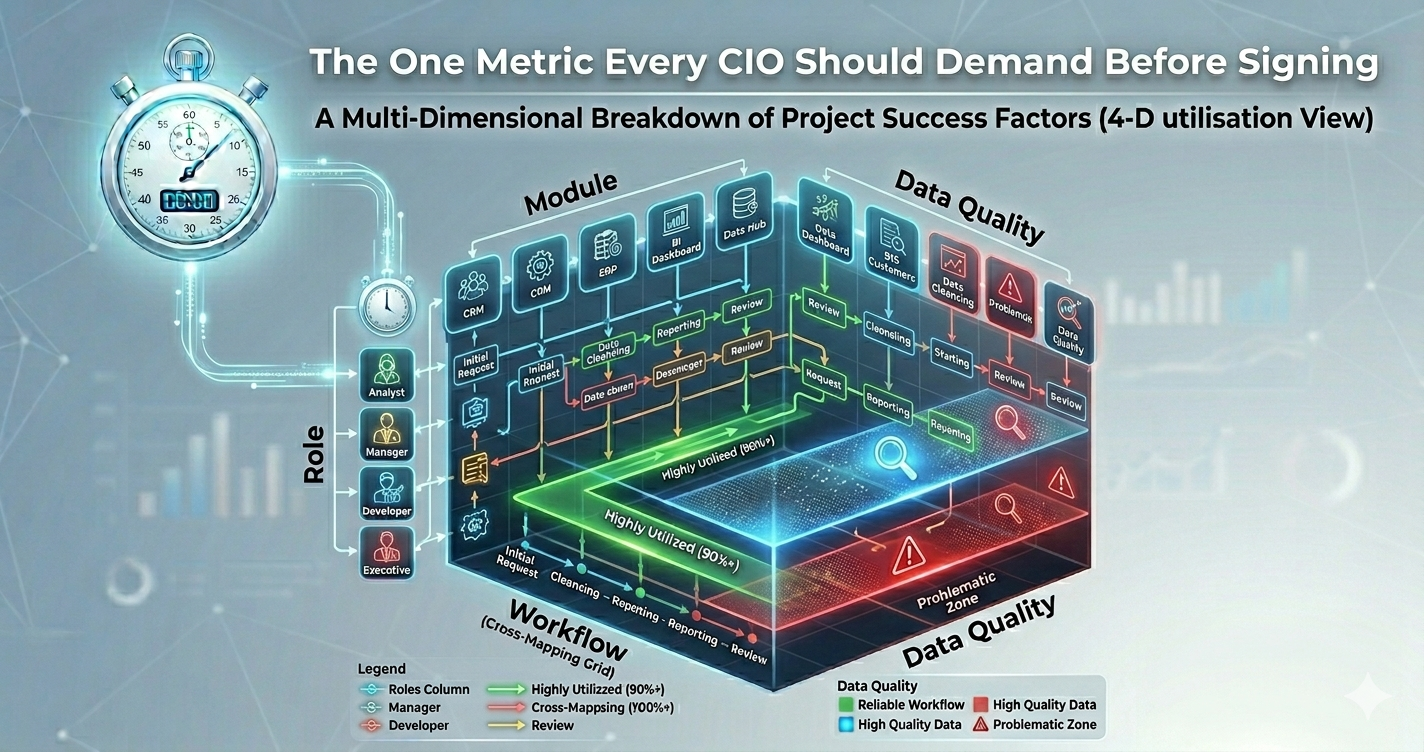
Done properly, the metric breaks down into four dimensions:
1. By role
What percentage of intended users are actively using the system in their role? Not licences purchased — licences actually engaged with weekly. A 95% role-utilisation rate means almost everyone the system was designed for is using it. A 35% rate means two-thirds of your team is back on workarounds.
2. By module
If you bought an ERP with 8 modules, how many of those modules are in active daily use? Most off-the-shelf enterprise software ships with way more modules than any single business needs. The utilisation-by-module metric exposes how much shelfware you're maintaining.
3. By core workflow
The most important cut. For each of the 5-10 business-critical workflows the software was supposed to support, what percentage of those workflow executions happen through the system vs around the system (still on Excel, WhatsApp, paper)? This is where adoption either lives or dies.
4. By data quality
Even when teams use a system, they often enter sparse or inaccurate data because the system doesn't fit. A utilisation rate of "90% of users logging in" means nothing if 70% of the data they enter is empty or wrong. Real utilisation measures whether the system has reliable data the business can run on.
How to Demand the 6-Month Utilisation Rate During Procurement
The vendor evaluation question is direct: "What's your 6-month utilisation rate across your last three enterprise deployments — broken down by role, module, and core workflow?"
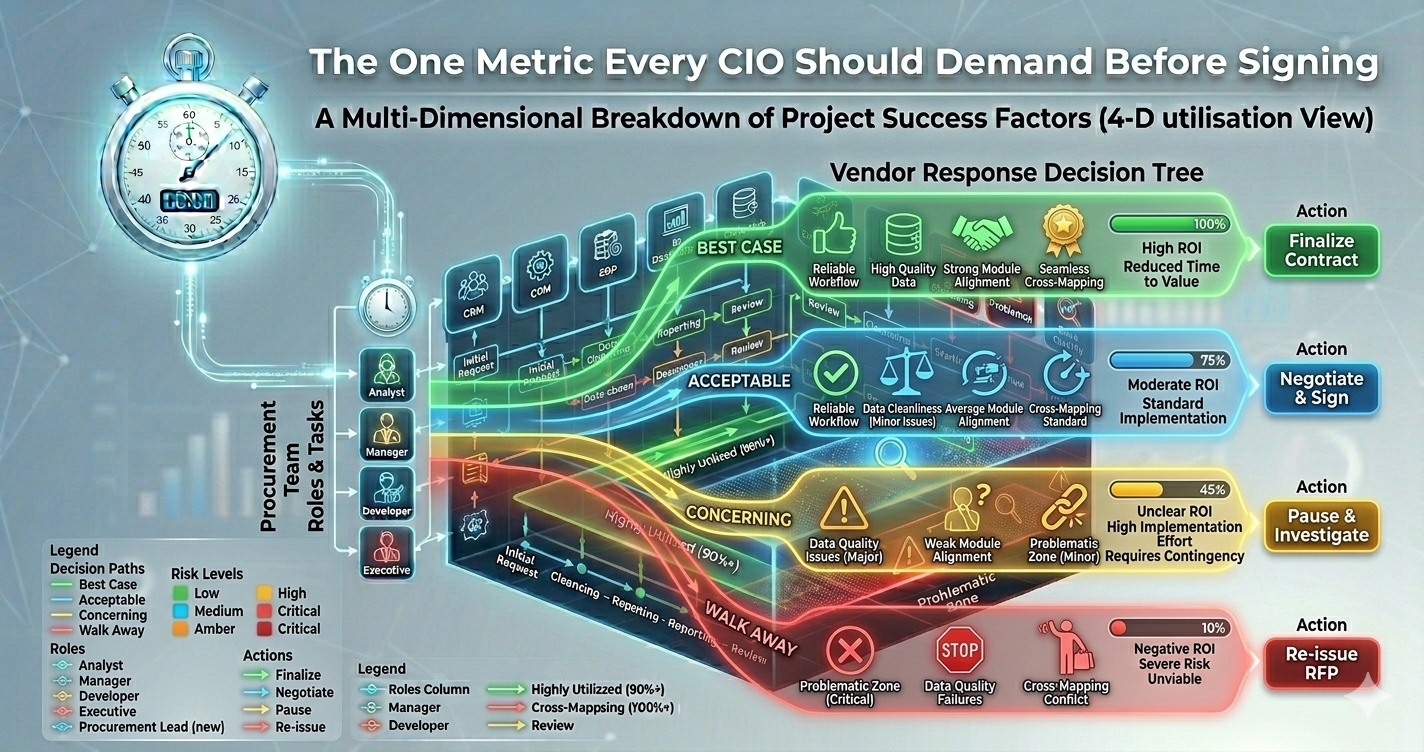
The four possible answers tell you everything:
Best case — They have the data and share it. A vendor that confidently quotes "85% role utilisation, 6 of 8 modules in daily use, 92% of priority workflows through the system" is showing you their delivery model is built around adoption. This is the vendor to seriously evaluate.
Acceptable — They don't have it, but they're willing to track it. Some smaller vendors don't have the operational reporting in place but are willing to bake adoption tracking into your contract. This shows the right orientation even if the data isn't there yet.
Concerning — They have go-live data but not utilisation data. This vendor measures success at launch, not at month six. They'll deliver, then disappear. Expect adoption failure.
Walk away — They dodge the question or change the subject. This vendor knows their numbers are bad. Save yourself the procurement cycle.
How to Tie Contract Terms to the 6-Month Utilisation Rate
The procurement move that changes vendor behaviour:
- Define utilisation thresholds in the contract (e.g., 75% role-utilisation by month 6, 80% by month 12)
- Hold back 15-20% of payment until the utilisation thresholds are hit
- Specify the measurement methodology in writing — by role, by module, by workflow, with data quality minimums
- Require monthly utilisation reports from month 3 onwards
- Define remediation — what the vendor commits to if utilisation falls short (extended on-site support, additional training, no extra charge)
A vendor that won't agree to utilisation-based contract terms is telling you their delivery model can't sustain adoption. That's useful information before you sign, not after.
What a High-Utilisation Vendor Looks Like
After 730+ projects at Accucia, we've seen one pattern repeat across the engagements that hit 85%+ utilisation at month 6:
- Discovery before code. The vendor maps the actual workflow before writing a line of code.
- Figma prototypes before development. Clients see and click their software before it's built. Surprises eliminated.
- On-site through adoption. The vendor physically stations team members at the client site for the first 4-6 weeks post-launch. Not visits. Stationing.
- Multiple training rounds. Not one launch demo. 2-3 rounds per role, with different formats — live, video, embedded into the tool itself.
- Iteration post-launch. The first 6 weeks after go-live are when adoption either holds or fails. Bug fixes, workflow tweaks, and UX adjustments happen weekly, not quarterly.
- Day-127 phone call. The vendor is still picking up the phone when your branch manager has a question on day 127 that doesn't feel "priority enough to log." Because that question is where adoption lives or dies.
This is the engagement model that produces high utilisation. It costs more than "remote AMC + quarterly visits." It also actually ships.
FAQ: 6-Month Software Utilisation Rate
What is a "good" 6-month utilisation rate for enterprise software?
For mid-market enterprise software, anything above 70% role-utilisation by month 6 is considered strong. Above 85% is excellent and rare. Industry average sits closer to 25-35%. Anything below 50% indicates the engagement is on track to fail.
How is the 6-month utilisation rate measured?
Four dimensions: role-utilisation (% of intended users actively engaged weekly), module-utilisation (% of purchased modules in daily use), workflow-utilisation (% of priority workflows running through the system vs around it), and data-quality (% of entries that are complete and accurate). Most measurement tools track only the first dimension; the other three need explicit instrumentation.
Why don't vendors publish their 6-month utilisation rates?
Three reasons: most don't measure it, the numbers are usually bad (industry avg 25-35%), and publishing would shift the buyer conversation from features to outcomes. A vendor that volunteers utilisation data is showing they've built their delivery model around adoption — that's the credibility signal.
Can the 6-month utilisation rate be gamed by vendors?
Yes, if the measurement methodology isn't specified in the contract. A vendor can claim "95% utilisation" by counting any user who logs in once a month. To prevent gaming: define utilisation as "weekly active use of role-relevant modules with complete data entry." Specify in writing during procurement.
What if my software is already past go-live — can I still measure utilisation?
Yes, and you should. Most mid-market businesses don't realise their utilisation has cratered until renewal time. Running a utilisation audit at month 3, 6, 9, and 12 gives you the data to either fix adoption (with vendor or implementation partner help) or renegotiate the contract at renewal.
What To Do Next
If you're scoping enterprise software in 2026:
- Add the 6-month utilisation question to every vendor evaluation conversation
- Tie 15-20% of contract payment to utilisation thresholds, defined in writing
- Schedule utilisation audits at month 3, 6, 9, and 12 — internally or through a third party
- DM "UTILISATION" on LinkedIn for our 1-page contract template that includes utilisation thresholds
If your existing software is past go-live and you're not sure what's actually being used:
Run an immediate utilisation audit. Accucia does these on a fixed-fee basis for mid-market businesses — typically 2 weeks, four-dimensional measurement, with a remediation plan if utilisation is below benchmark.
Stop buying features. Start measuring adoption.