Software Consolidation: Why You Need Less, Not More
Quick Answer
> Software consolidation is the process of reducing the number of disconnected applications a business runs by replacing or unifying them onto a single platform with one source of truth. It matters because the average mid-market company now runs on 100+ apps and uses only a fraction — scattering data, multiplying manual work and inflating cost. A disciplined consolidation (audit, map, keep/cut/connect) typically cuts SaaS spend meaningfully and gives the whole team numbers they can finally trust. In 2026 it's also the prerequisite for AI: an AI layer on a fragmented stack just amplifies the chaos. By Mr. Sumeet Katariya, CEO Accucia Softwares
Key Takeaways
- The average mid-market company runs 100+ apps and uses a fraction of them.
- More tools didn't add speed — they scattered the data.
- The fix is consolidation: one platform, one source of truth.
- The method is simple: audit, then keep / cut / connect.
- Consolidation is also the foundation that makes AI work.
What is software consolidation?
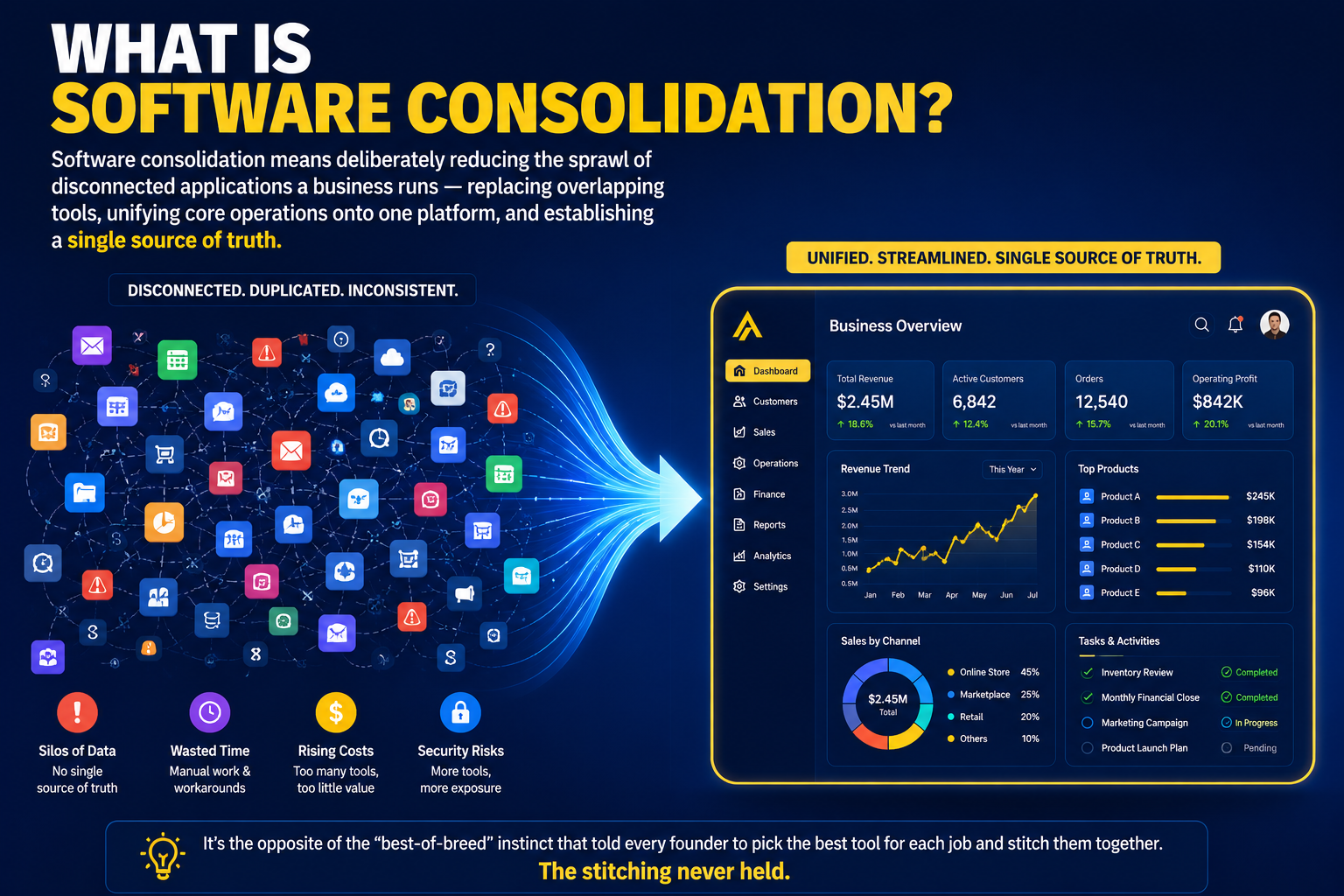
Software consolidation means deliberately reducing the sprawl of disconnected applications a business runs — replacing overlapping tools, unifying core operations onto one platform, and establishing a single source of truth. It's the opposite of the "best-of-breed" instinct that told every founder to pick the best tool for each job and stitch them together. The stitching never held.
The hidden cost of SaaS sprawl
The average mid-market company now runs on more than 100 SaaS applications, and uses only a small share of them daily. The rest is operational tax: subscriptions nobody remembers approving, integration debt that compounds every quarter, login fatigue, security exposure, and the slow erosion of any single source of truth. The CFO can't say what 40% of the SaaS budget is for — and the team quietly runs the real business on spreadsheets and chat because that's the only thing everyone agrees on.
Signs you're collecting tools instead of solving problems
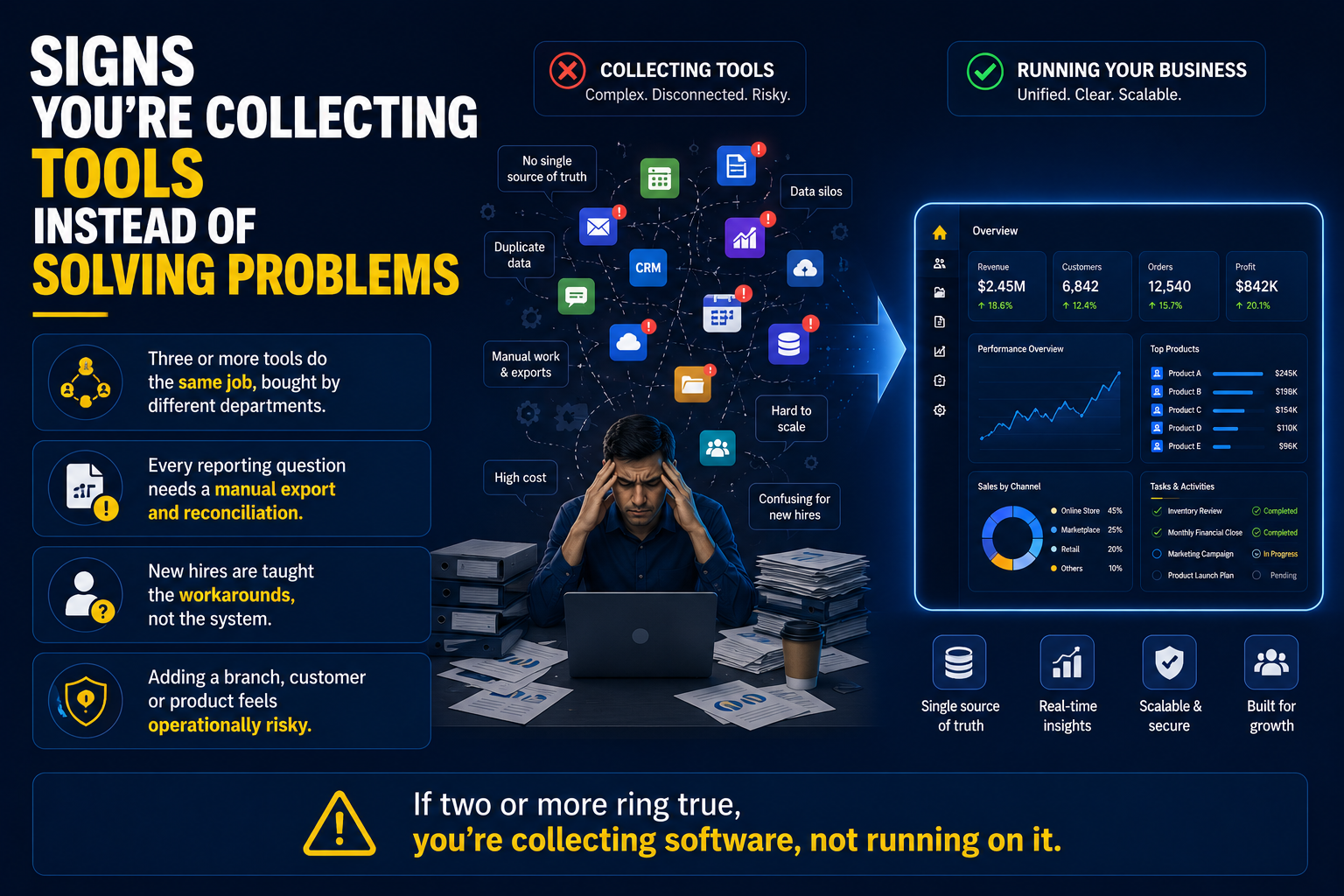
- Three or more tools do the same job, bought by different departments.
- Every reporting question needs a manual export and reconciliation.
- New hires are taught the workarounds, not the system.
- Adding a branch, customer or product feels operationally risky.
If two or more ring true, you're collecting software, not running on it.
The single-source-of-truth framework
Consolidation isn't about becoming sparse — it's about becoming coherent. The target state is one platform that captures data at the point of action, one dashboard leadership opens instead of asking three managers for three numbers, one source of truth for customer, financial and operational data, and one delivery partner who stays through adoption. Coherent, not minimal.
How to run a consolidation: keep, cut, connect
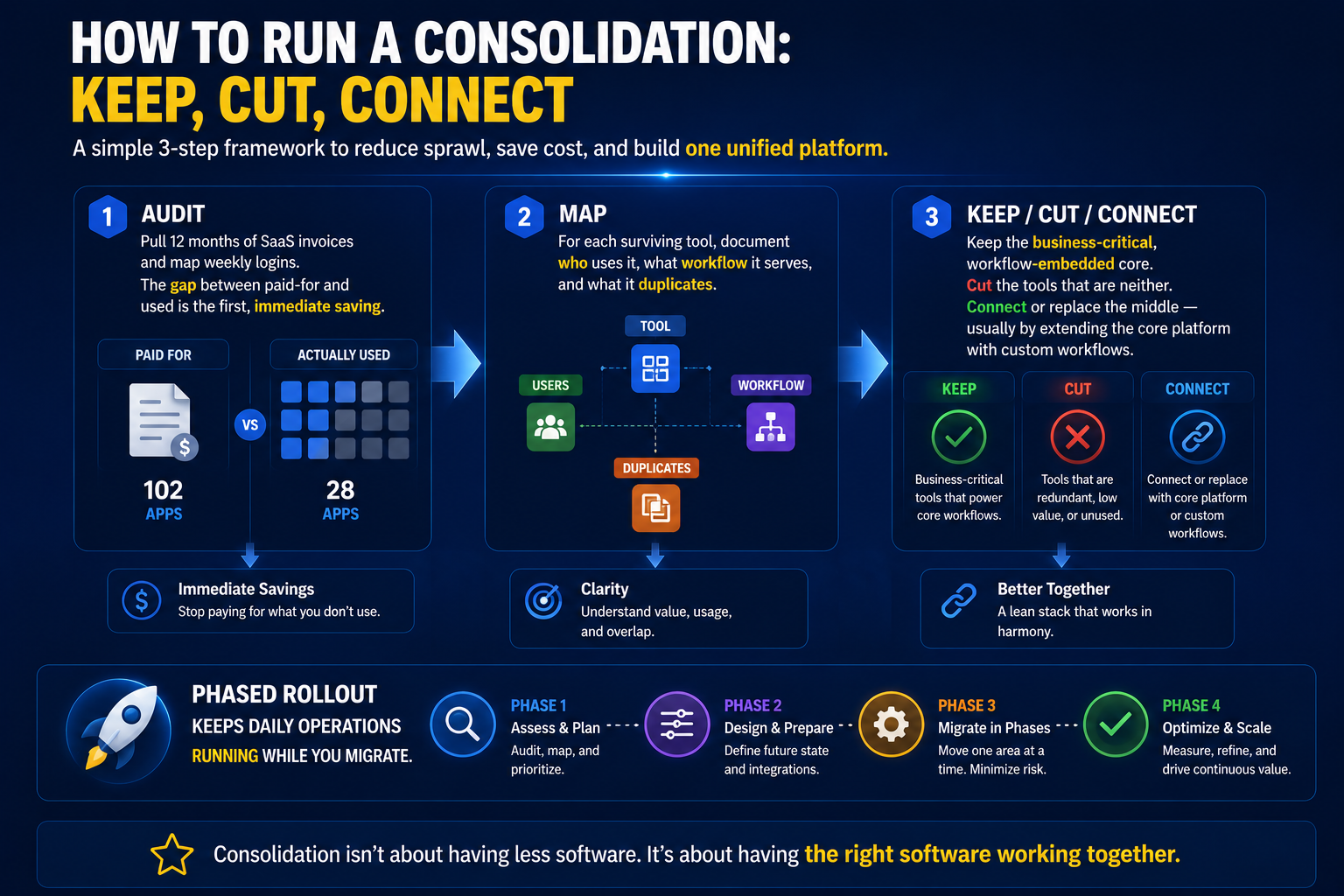
- Audit. Pull 12 months of SaaS invoices and map weekly logins. The gap between paid-for and used is the first, immediate saving.
- Map. For each surviving tool, document who uses it, what workflow it serves, and what it duplicates.
- Keep / cut / connect. Keep the business-critical, workflow-embedded core. Cut the tools that are neither. Connect or replace the middle — usually by extending the core platform with custom workflows.
Phased rollout keeps daily operations running while you migrate.
When to build custom vs integrate
Buy for commodity capability (email, accounting, basic CRM). Build or extend for anything workflow-specific to your business — the parts where your operation genuinely differs from the template. That's where most of the operational tax sits, and where consolidation pays back the most.
The AI angle: why 2026 is the moment
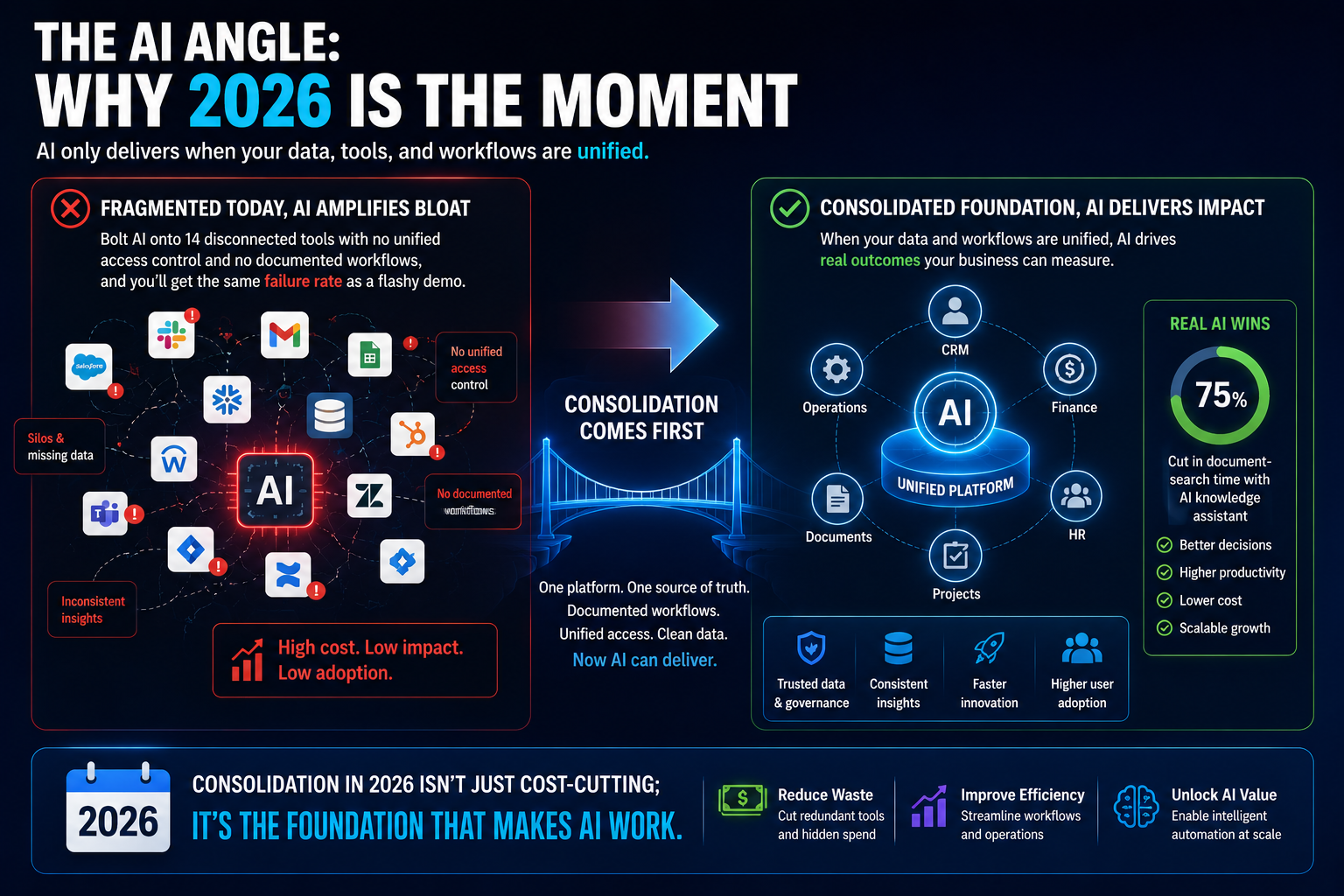
AI amplifies bloat if your data is fragmented. Bolt AI onto 14 disconnected tools with no unified access control and no documented workflows, and you'll get the same failure rate as a flashy demo. The AI wins we're proudest of — like a knowledge assistant that cut document-search time 75% — worked because the consolidation came first. Consolidation in 2026 isn't just cost-cutting; it's preparing the foundation that makes AI work.
Frequently Asked Questions
How do I start consolidating software?
Map every tool to a job-to-be-done, then keep, cut, or connect each one. Begin with an invoice-and-login audit — it surfaces immediate savings.
Single platform or best-of-breed?
A unified core with selective integrations usually beats dozens of disconnected point tools for mid-market businesses, on both cost and data coherence.
Won't consolidation disrupt daily operations?
Not if it's phased. Migrate one area at a time so operations keep running throughout.
How does consolidation relate to AI?
It's the prerequisite. AI on a fragmented stack amplifies chaos; AI on a consolidated, single-source-of-truth platform delivers.
Ready to simplify your software stack?