Multi-Agent AI Systems Explained: A Founder's Guide (2026)
Quick Answer
A multi-agent system is a group of specialized AI agents each responsible for one task, such as research, drafting, or review that work together, in sequence or in parallel, toward a single business objective. Unlike one AI assistant trying to do everything, each agent stays narrow and hands off to the next. By Mr. Sumeet Katariya, CEO Accucia Softwares
What Is a Multi-Agent System?
A multi-agent system runs several purpose-built AI agents against one workflow instead of asking a single model to handle every step. One agent plans, one retrieves data, one drafts, one checks the output against rules — and an orchestrator agent sequences the handoffs. Each agent has a narrow job description and a clear boundary for what it can and cannot do.
This is a structural shift, not a bigger model. A single AI agent tries to reason across an entire task end to end, which works for narrow use cases and breaks down as the task spans multiple systems, data sources, or approval steps. A multi-agent system decomposes that same task into pieces small enough that each agent can be tested, monitored, and replaced on its own.
Multi-Agent Systems vs. Single-Agent AI vs. Traditional Automation
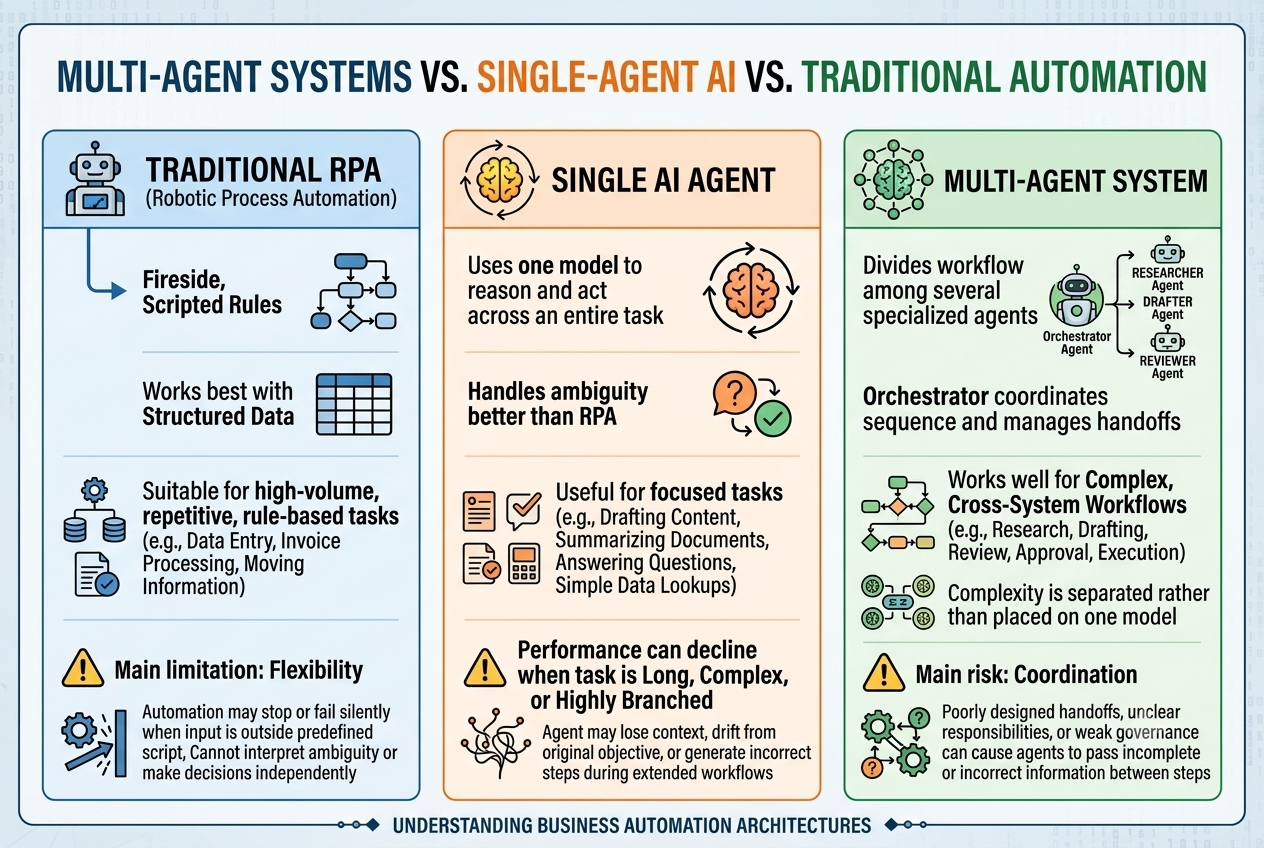
Traditional RPA, single AI agents, and multi-agent systems solve different types of business problems.
Traditional RPA
Traditional robotic process automation follows fixed, scripted rules and works best with structured data. It is suitable for high-volume, repetitive, and rule-based tasks such as data entry, invoice processing, or moving information between systems.
Its main limitation is flexibility. When an input falls outside the predefined script, the automation may stop working or fail silently because it cannot interpret ambiguity or make decisions independently.
Single AI Agent
A single AI agent uses one model to reason and act across an entire task. It can handle ambiguity better than traditional RPA and is useful for focused tasks such as drafting content, summarizing documents, answering questions, or performing simple data lookups.
However, performance can decline when the task becomes long, complex, or highly branched. The agent may lose context, drift away from the original objective, or generate incorrect steps during extended workflows.
Multi-Agent System
A multi-agent system divides a workflow among several specialized agents. Each agent is responsible for one specific step, while an orchestrator coordinates the sequence and manages handoffs.
This approach works well for complex, cross-system workflows such as research, drafting, review, approval, and execution. Because each agent has a narrow scope, complexity is separated rather than placed on one model.
The main risk is coordination. Poorly designed handoffs, unclear responsibilities, or weak governance can cause agents to pass incomplete or incorrect information between steps.
Why Multi-Agent Systems Are the 2026 Inflection Point
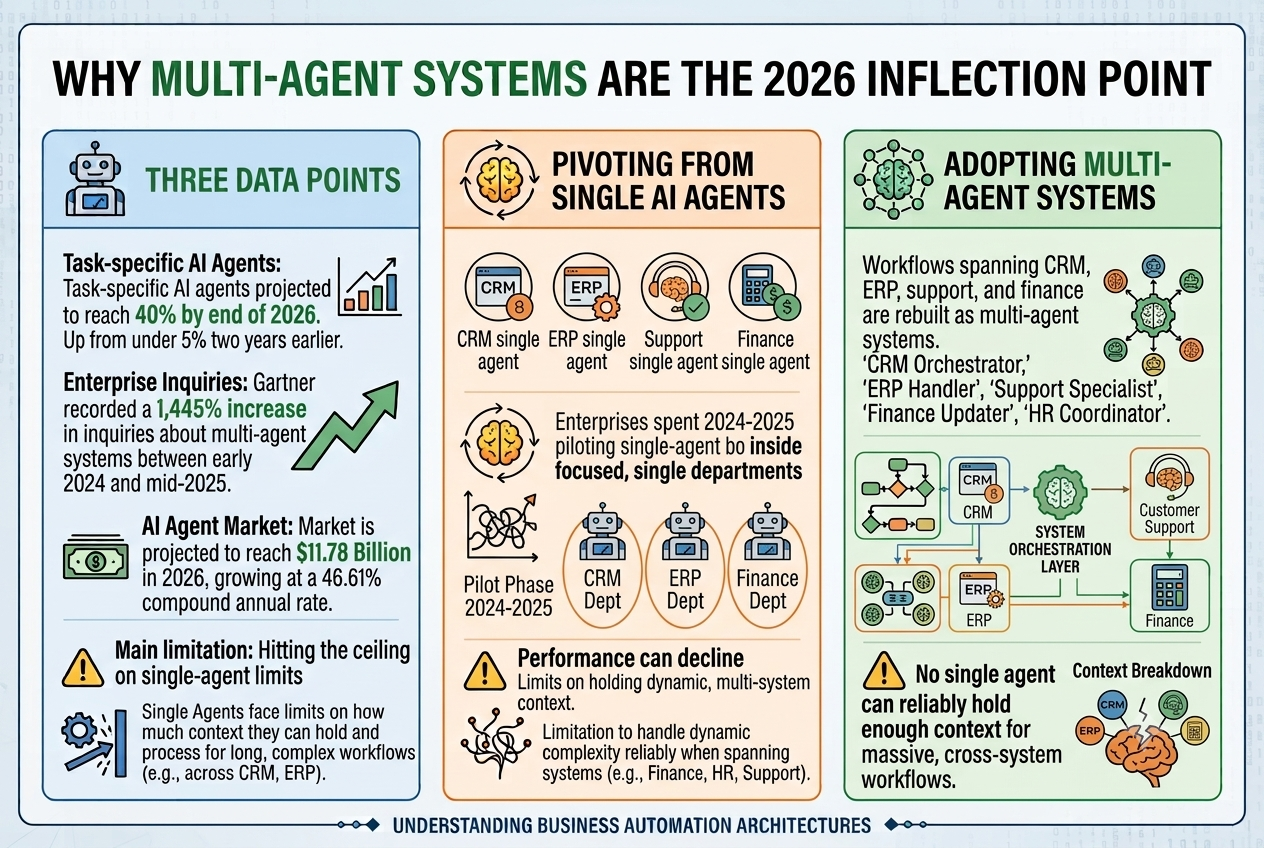
Three data points explain why this moved from research topic to enterprise budget line in the space of two years:
- Enterprise applications with task-specific AI agents are projected to reach 40% by the end of 2026, up from under 5% two years earlier.
- Gartner recorded a 1,445% increase in enterprise inquiries about multi-agent systems between early 2024 and mid-2025.
- The AI agent market is projected to reach $11.78 billion in 2026, growing at a 46.61% compound annual rate.
The pattern behind the numbers: enterprises spent 2024–2025 piloting single AI agents inside one department. In 2026, the workflows that justified the pilot — the ones spanning CRM, ERP, support, and finance systems — are the ones now being rebuilt as multi-agent systems, because no single agent can hold that much context reliably.
How Multi-Agent Systems Work, in Plain Terms
Strip away the framework names and every production multi-agent system has the same four parts:
- Orchestrator agent — breaks the task into steps and routes work to the right specialist.
- Specialist agents — each handles one function: research, drafting, data lookup, compliance check, customer response.
- Shared state / memory — the context that carries forward so agent three knows what agent one decided.
- Handoff and audit logic — rules for when one agent passes control to the next, and a log of what happened at each step.
Two frameworks dominate current builds: CrewAI, built for role-based collaboration where agents behave like a small team (researcher, writer, reviewer); and LangGraph, built for stateful, production-grade workflows with retry logic and audit trails. The choice depends on whether the priority is fast prototyping or long-running production stability — not on which is newer.
When Does Your Business Actually Need One?
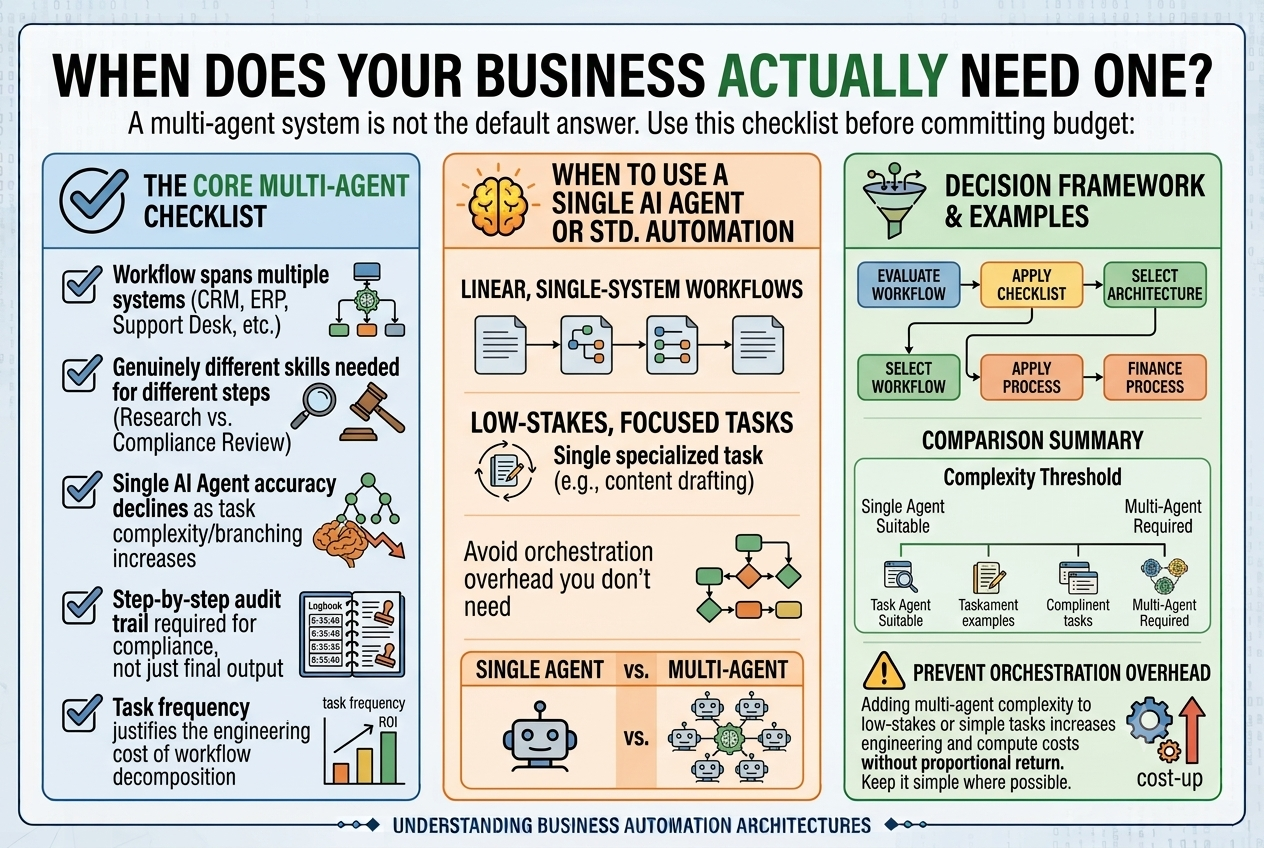
A multi-agent system is not the default answer. Use this checklist before committing budget:
- The workflow spans more than one system or data source (CRM + ERP + support desk, for example).
- Different steps genuinely need different skills — research is not the same job as compliance review.
- A single AI agent you already deployed is losing accuracy as the task gets longer or more branching.
- You need an audit trail per step for compliance, not just a final output.
- The task runs often enough that the engineering cost of decomposition pays for itself.
If the task is linear, single-system, and low-stakes, a single agent or standard automation is the right call — do not add orchestration overhead you do not need.
Governance: What to Ask Before You Deploy
2026's enterprise conversation has shifted from whether agents work to whether they can be trusted at scale. Before deployment, get straight answers to:
- Can we see why an agent made a specific decision, step by step?
- What is the human checkpoint before an agent takes an irreversible action?
- What data and systems can each agent access, and what is explicitly blocked?
- Is there a rollback path if one agent in the chain produces a bad output?
- Who owns the system after go-live — not just who built it?
That last question is where most multi-agent deployments stall. The build is the easy half; adoption, monitoring, and iteration after go-live decide whether it survives contact with a real enterprise workload.
Frequently Asked Questions
What is a multi-agent system?
A multi-agent system is a set of specialized AI agents that each handle one part of a task — such as research, drafting, or review — and coordinate through an orchestrator to complete a shared objective, rather than one model attempting the entire task alone.
How is a multi-agent system different from a single AI agent?
A single AI agent reasons and acts across an entire task end to end. A multi-agent system splits that same task across several narrowly scoped agents, which keeps each agent's job small enough to test, monitor, and replace independently.
What frameworks are used to build multi-agent systems?
CrewAI and LangGraph are the two most common. CrewAI suits role-based team-style collaboration; LangGraph suits stateful, production-grade workflows that need retry logic and audit trails.
When should an enterprise use a multi-agent system instead of one agent?
When the workflow spans multiple systems or data sources, requires genuinely different skills at each step, or needs a per-step audit trail for compliance. For linear, single-system tasks, a single agent is usually sufficient.
Are multi-agent systems safe for regulated industries?
They can be, provided governance is built in from the start: explainability at each decision point, human checkpoints before irreversible actions, scoped data access per agent, and a rollback path. Governance is the deciding factor, not the technology itself.
Where Accucia Fits
Accucia builds tailored platforms — apps, CRMs, ERPs, dashboards, AI automation — for mid-to-large enterprise founders whose business has outgrown its current systems. 730+ projects delivered across 8 sectors. We stay through adoption, not just delivery.
Ready to build smarter AI systems?