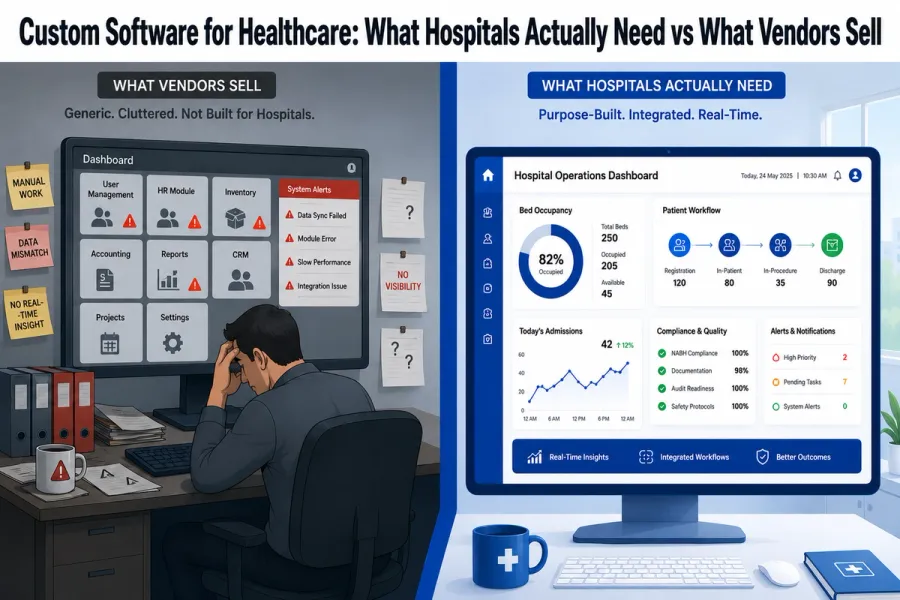
Lotus Imaging Clinic Case Study: 6 Clinics, One Platform
Quick Answer
A multi-location healthcare provider can unify operations by replacing disconnected, clinic-by-clinic tools with a single platform that holds patient records, scheduling and reporting in one source of truth cutting manual coordination and making each new location plug-and-play. In this case, Lotus Imaging Clinic in Panvel a six-clinic imaging network reduced manual communication by 80% after unifying onto one platform, and turned expansion from a months-long scramble into a repeatable process. By Mr. Sumeet Katariya, CEO Accucia Softwares
Key Takeaways
- Six clinics running as six islands were unified onto one platform with a single source of truth.
- Manual coordination dropped by ~80%; leadership got a real-time view of every location.
- Opening the next clinic became plug-and-play instead of a fresh integration project.
- The win wasn't "more software" it was fit plus on-site adoption.
The situation: six clinics, six islands
When we met Lotus Imaging Clinic in Panvel, each of its six clinics effectively ran its own business. Records lived in separate systems. Schedules were reconciled by phone. There was no single place a manager could open to see how the group was performing today. Growth which should have been a good problem meant more chaos, not more revenue.
This is the most common pattern we see in multi-location healthcare in India: capable clinicians, real demand, and operations held together by spreadsheets, WhatsApp groups and individual memory.
One platform, built around how clinics actually run
The build unified all six locations onto a single platform designed around the group's real workflows. Not a generic clinic-management product the team would have to bend themselves around, but a system shaped by how their patients, referrals, reports and handoffs actually move.
The delivery followed the discipline we apply on every engagement, because it is the part that decides everything:
- Workflow-first design. We studied how each department actually operated before a single screen was designed. What leadership describes and what the front desk does at 9 a.m. are rarely the same process, and the gap between them is where most software adoption fails.
- One source of truth. Patient flows, operational data and inter-clinic coordination moved into the platform. The calls and threads that used to be the coordination layer simply became unnecessary. Nobody banned them. They just stopped having a job.
- Implementation, not handover. Training, adoption support and iteration continued after go-live until the system held under real daily use across all six locations.
The problem in numbers
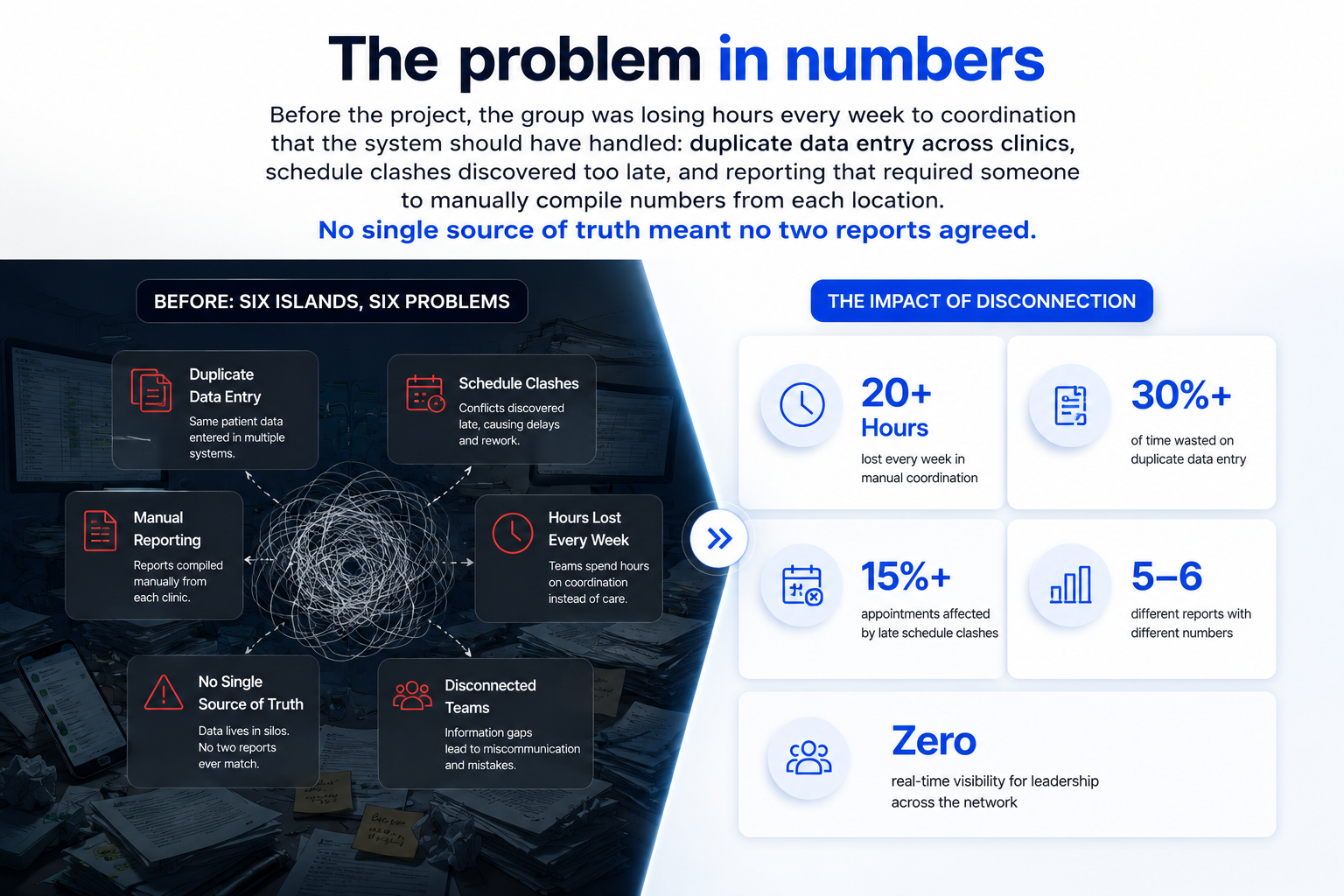
Before the project, the group was losing hours every week to coordination that the system should have handled: duplicate data entry across clinics, schedule clashes discovered too late, and reporting that required someone to manually compile numbers from each location. No single source of truth meant no two reports agreed.
The approach: workflow-first unification
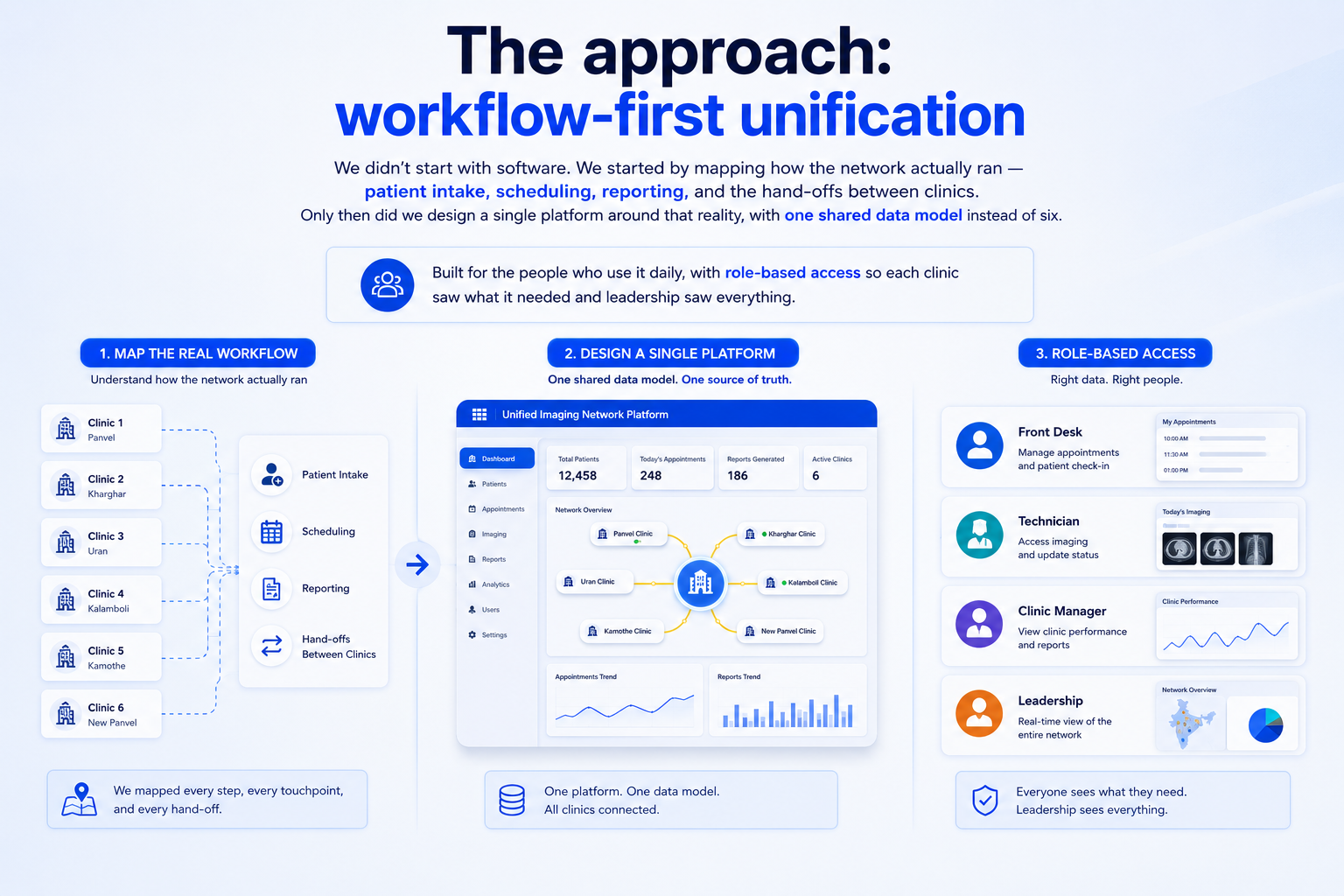
We didn't start with software. We started by mapping how the network actually ran patient intake, scheduling, reporting, and the hand-offs between clinics. Only then did we design a single platform around that reality, with one shared data model instead of six.
Crucially, we built for the people who would use it daily, with role-based access so each clinic saw what it needed and leadership saw everything.
The lesson for any multi-location business
Swap "clinics" for branches, showrooms, sites or offices, and the pattern holds without modification. Multi-location pain is rarely a location problem. It is a connective-tissue problem. The fix is not more coordination effort. The fix is a platform that makes coordination unnecessary.
We have now shipped this pattern across retail, manufacturing and services in a body of 730+ projects, and it also happens to be the foundation that makes later intelligence possible. A chain running on one platform is one MCP connection away from leadership asking questions of the whole operation in plain English.
The build
The unified platform brought together patient records, centralised scheduling and live cross-location reporting with role-based access and a clean, shared data foundation. Rollout was phased, clinic by clinic, so daily operations were never disrupted, and our team was on-site through go-live to handle training and the inevitable small fixes that decide whether a system sticks.
The outcome
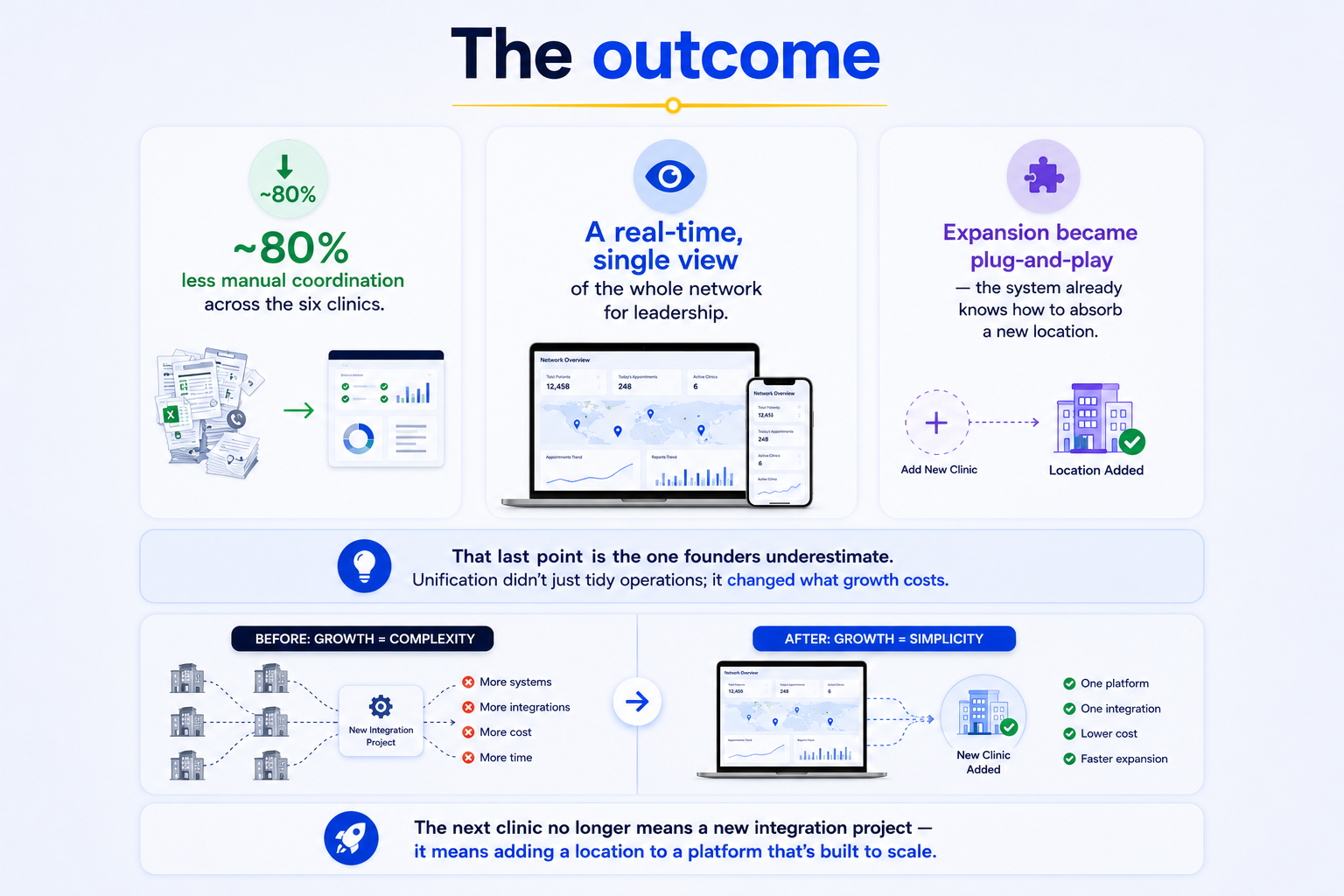
- ~80% less manual coordination across the six clinics.
- A real-time, single view of the whole network for leadership.
- Expansion became plug-and-play — the system already knows how to absorb a new location.
That last point is the one founders underestimate. Unification didn't just tidy operations; it changed what growth costs. The next clinic no longer means a new integration project it means adding a location to a platform that's built to scale.
What this means for any multi-location operator
The lesson isn't specific to imaging. Any business running multiple locations on disconnected tools faces the same ceiling: growth multiplies chaos until operations are unified. The fix is rarely "buy a bigger tool." It's a platform built around your actual workflow, rolled out with people on the ground until the team adopts it.
Accucia's view
Accucia's view is that expansion readiness is a systems property, not an ambition. If adding your next location would mean more WhatsApp groups rather than a rollout checklist, the operation is telling you something, and the right time to listen is before the next opening rather than after. Healthcare chains feel this at the sharp end because patient experience punishes coordination failures immediately. But the 80% number above is available, in some denomination, to every multi-location business still coordinating by phone.
Frequently Asked Questions
What software do multi-clinic networks need?
A unified platform with shared patient records, role-based access, centralised scheduling and live cross-location reporting built around the network's real workflow rather than a generic template.
How long does unification take?
Typically a phased rollout, location by location, so daily operations continue uninterrupted while each clinic migrates.
Will clinical and front-desk staff actually use it?
Only if adoption is planned. On-site rollout, training and role-based design are what make a healthcare platform stick instead of being abandoned.
Does unifying clinics help with expansion?
Yes — that's often the biggest payoff. Once locations share one platform, opening another becomes a repeatable, plug-and-play process rather than a one-off integration.
Transform Your Operations