Custom Software for Healthcare: What Hospitals Actually Need vs What Vendors Sell
Quick Answer
Hospitals need healthcare software that integrates with their existing Electronic Health Record (EHR) systems, complies with regional data regulations (HIPAA, DPDPA, HL7/FHIR standards), and fits the real workflows of clinical and administrative staff — not generic features built for an average hospital that does not exist. The four things hospitals need but rarely get from off-the-shelf vendors: 1. Deep EHR integration — not just API access, but bi-directional sync with the specific EHR already in use. 2. Role-specific mobile workflows — doctors, nurses, pharmacists, and billing teams each need different screens. 3. Compliance built-in — not a checkbox, but audit trails, consent management, and data residency controls. 4. Post-go-live support — most software projects fail at adoption, not at build.
A hospital in Pune spent ₹2.4 crore on a vendor EHR platform. Eighteen months after go-live, 60% of nursing staff were still logging patient data in WhatsApp groups.
That is not a rare story. It is the default outcome when hospitals buy software built for the average hospital a hospital that does not exist.
Here is what actually happens in the gap between what vendors sell and what hospital operations require.
What Vendors Sell: The Feature Catalogue
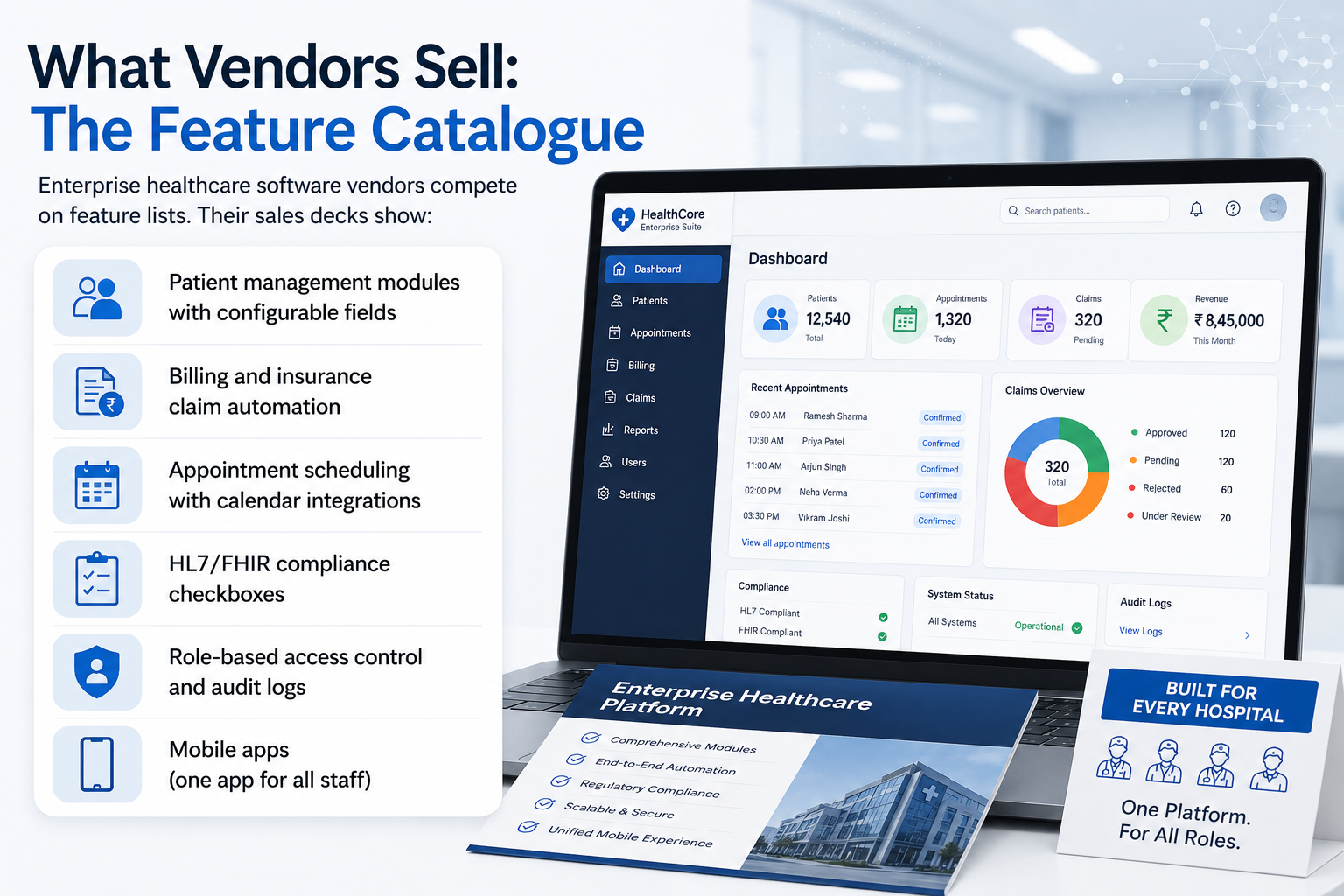
Enterprise healthcare software vendors compete on feature lists. Their sales decks show:
• Patient management modules with configurable fields
• Billing and insurance claim automation
• Appointment scheduling with calendar integrations
• HL7/FHIR compliance checkboxes
• Role-based access control and audit logs
• Mobile apps (one app for all staff)
These are real features. The problem is not what they include. The problem is what they assume.
They assume your hospital's patient intake process looks like their template. That your pharmacist needs the same mobile screen as your cardiologist. That your billing team runs the same insurance workflows as the 200 other hospitals using the same software. That your IT team has the bandwidth to manage a 400-page configuration manual.
Most of the time, none of those assumptions are true.
What Hospitals Actually Need: The Operations Reality
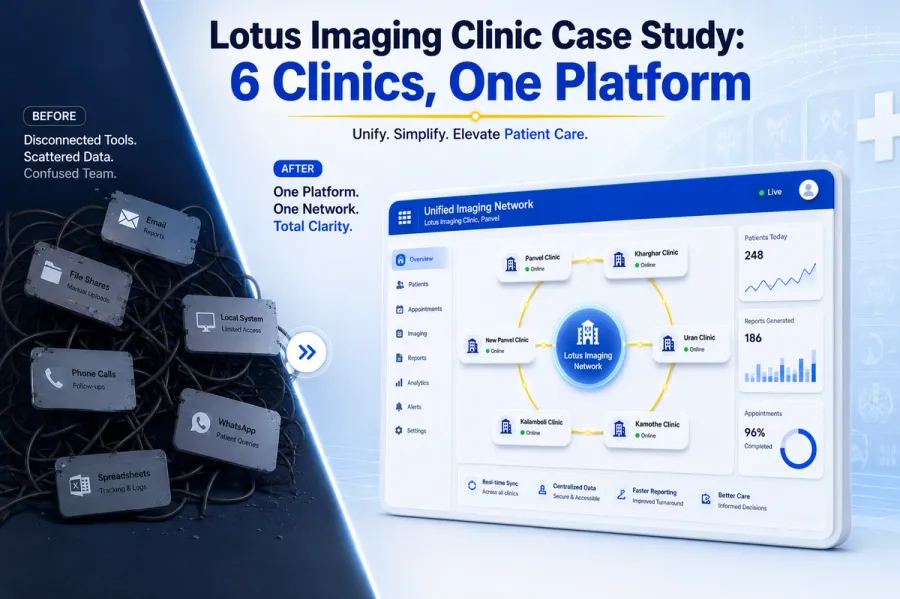
How This Software Simplified Patient Records Across Multiple Clinics
Specific EHR Integration — Not Just API Access
Most hospitals already have an EHR. The real need is not a new EHR — it is software that integrates deeply with the one already running. Bi-directional sync. Real-time updates. No double entry.
Vendors offer APIs. Hospitals need someone to actually build the integration to their specific EHR version, test it against their patient volumes, and maintain it when the EHR vendor releases an update.
Role-Specific Workflows, Not One-Size Screens
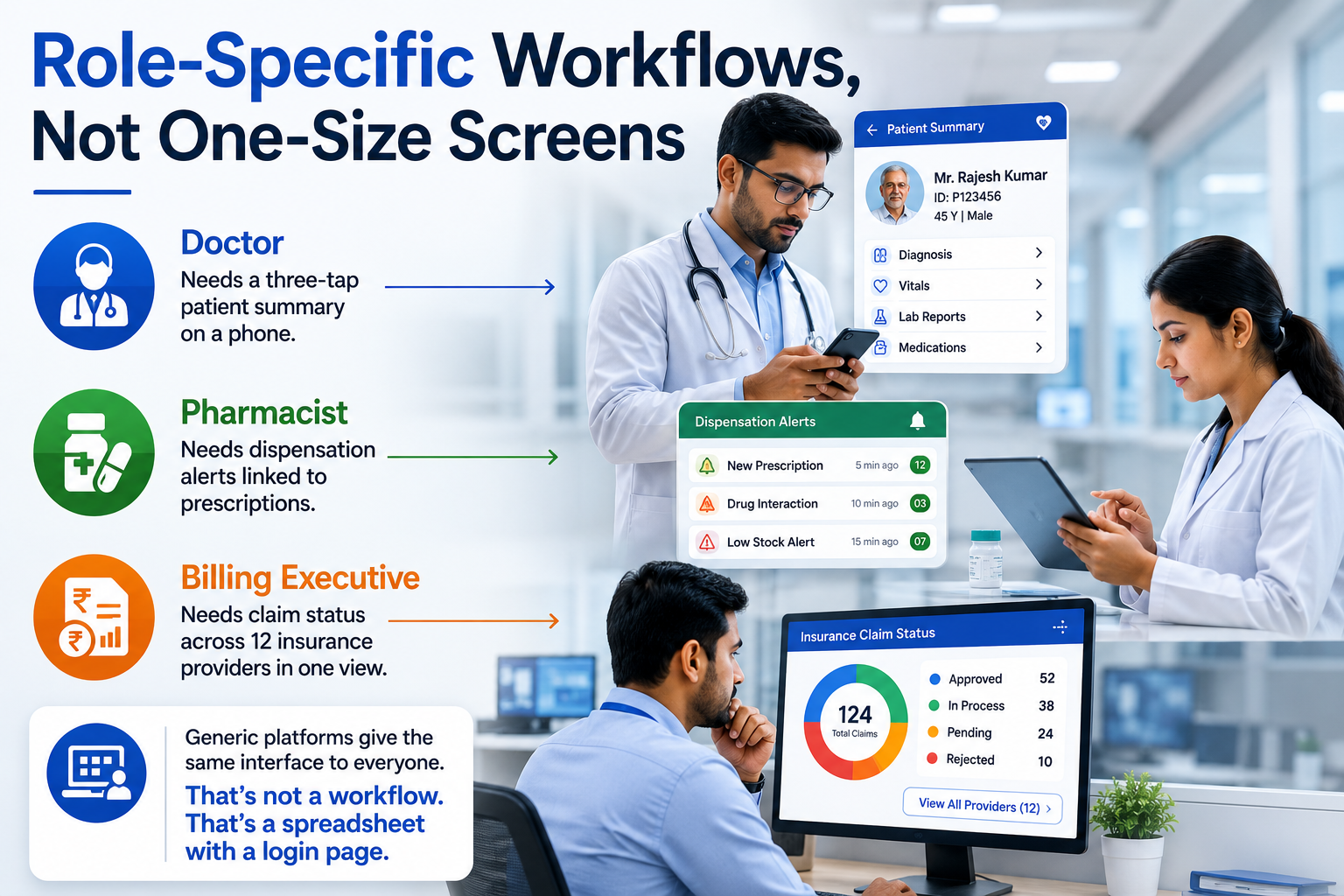
A doctor on ward rounds needs a three-tap patient summary on a phone. A pharmacist needs dispensation alerts linked to prescriptions. A billing executive needs claim status across 12 insurance providers in one view.
Generic platforms give everyone the same interface with different permissions switched on. That is not a workflow. That is a spreadsheet with a login page.
Compliance That Is Built In, Not Bolted On
HIPAA for US-facing hospitals. DPDPA for Indian patient data. Internal Ministry of Health reporting requirements. Consent management that legal will actually sign off on.
Vendor compliance features are built to pass a checklist, not to survive a government audit. Hospitals need audit trails that work in practice — not ones that require a consultant to export and format before submission.
Dashboards for Hospital Management, Not for Vendor Demos
Hospital administrators need real-time visibility: bed occupancy, OT utilisation, staff attendance, stock levels, pending collections. In one screen. Updated live.
Vendor dashboards are designed to look good in sales presentations. They pull from five different modules, require 20 minutes of filter configuration, and crash during board meetings.
Post-Go-Live Support — The Part Nobody Talks About
Software projects in healthcare do not fail at build. They fail at adoption.
Nurses revert to paper because the tablet interface is slower than their old process. Doctors skip the new prescription module because it adds four clicks. Billing staff maintain a parallel Excel sheet because the system doesn't handle their payer mix correctly.
The vendor is gone after go-live. Their support team is a ticket queue in a country with a 12-hour time zone difference.
The Gap at a Glance
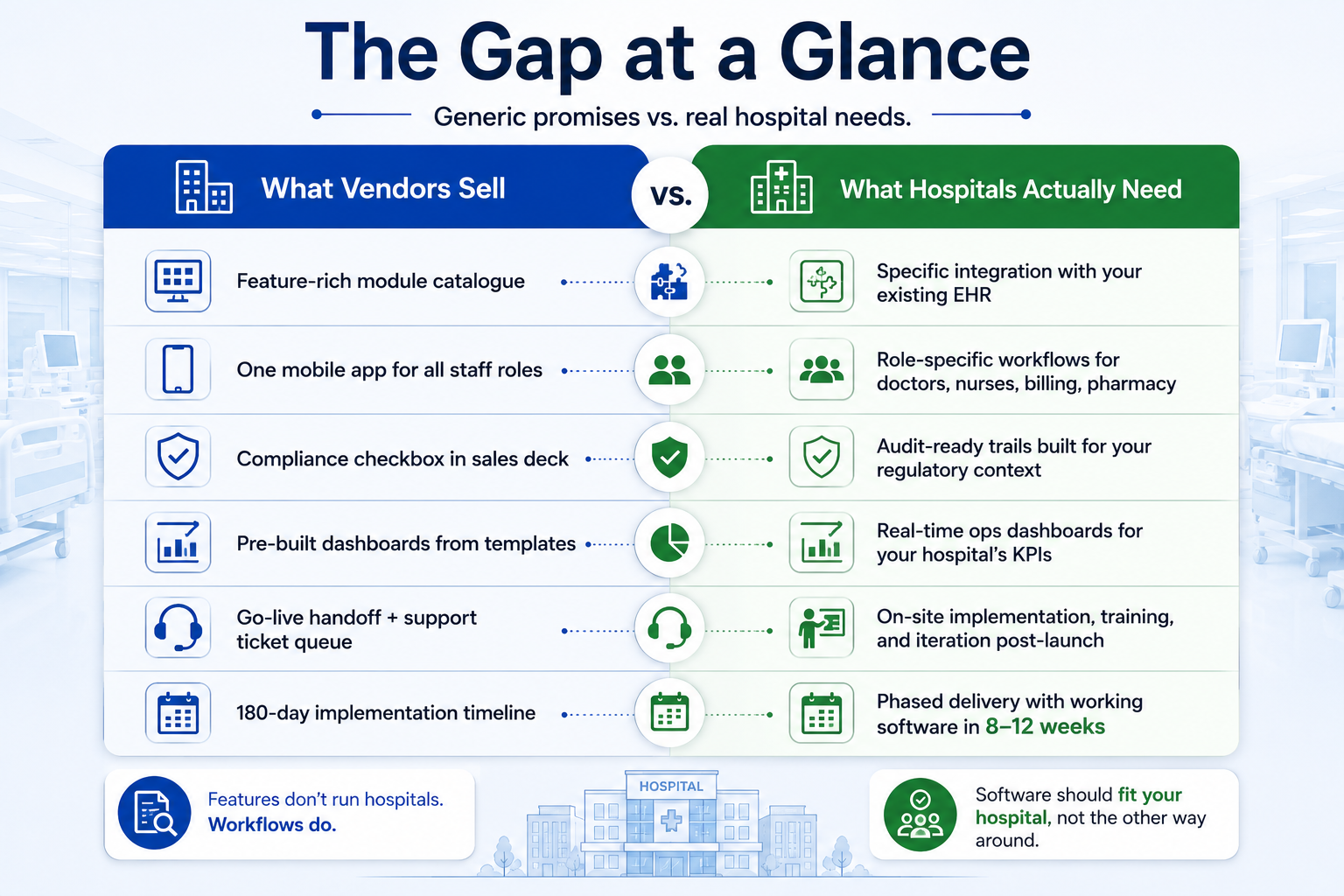
What Vendors Sell
What Hospitals Actually Need
Feature-rich module catalogue
Specific integration with your existing EHR
One mobile app for all staff roles
Role-specific workflows for doctors, nurses, billing, pharmacy
Compliance checkbox in sales deck
Audit-ready trails built for your regulatory context
Pre-built dashboards from templates
Real-time ops dashboards for your hospital’s KPIs
Go-live handoff + support ticket queue
On-site implementation, training, and iteration post-launch
180-day implementation timeline
Phased delivery with working software in 8–12 weeks
The Cost of the Wrong Software
The ₹2.4 crore EHR platform mentioned at the start? The hospital eventually commissioned a custom integration layer on top of it — at an additional ₹60 lakh. Then a separate mobile app for clinical staff. Then a reporting module for the compliance team.
Three years and three vendors later, they had a patchwork that cost more than a purpose-built platform would have from day one.
This is not an edge case. Healthcare software decisions made from feature catalogues rather than operational requirements consistently result in:
• Low adoption rates among clinical staff
• Shadow systems (WhatsApp groups, Excel files, paper logs) running alongside the official platform
• Failed audits because compliance features weren’t configured for the specific regulatory environment
• Vendor lock-in that makes course correction expensive
What the Right Build Looks Like
A hospital in the Middle East came to Accucia after their vendor EHR failed to handle their mix of local insurance payers and Ministry of Health reporting requirements. Their go-live had been delayed six months.
Accucia mapped their actual patient intake workflow — across three departments, with four staff roles — before writing a single line of code. The build took 14 weeks. The system handled local payer integrations natively, generated Ministry reports in the required format, and had a mobile interface tested with clinical staff before launch.
Adoption at 90 days: above 85% across all departments. No parallel paper system.
The difference was not technology. It was starting from the hospital’s actual operations rather than from a feature catalogue.
Questions to Ask Before Buying Healthcare Software
If you are evaluating software for a hospital, diagnostic centre, or healthcare network — ask these before signing:
• "Will this integrate with [your specific EHR] bidirectionally — and who builds and maintains that integration?"
• "Can I see a workflow demo for our specific patient intake process, not your standard demo?"
• "What does your post-go-live support look like in month 3, month 6, and month 12?"
• "Which hospitals in our regulatory context have you deployed in — can we speak to them?"
• "What happens when we need a workflow change that is not in your standard configuration?"
If the answers are vague, the software is built for demos. Not for operations.
Hospital software that works is not the one with the longest feature list. It is the one built around how your hospital actually runs.
That requires a technology partner who maps your workflows before writing code, stays through adoption, and builds for your regulatory environment — not for an average hospital that does not exist.
Accucia has delivered 730+ projects across healthcare, pharma, manufacturing, financial services, logistics, and government. We stay through implementation. The team trains yours. Adoption happens under our watch.
Ready to talk about what your hospital actually needs?