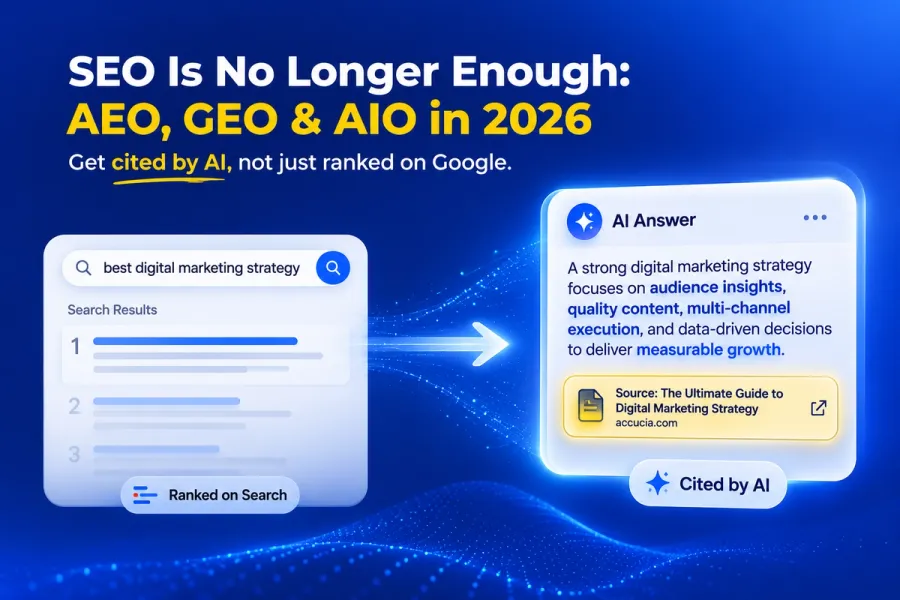
AEO, GEO & AIO Explained: Get Cited by AI Search in 2026
Quick Answer
AEO (Answer Engine Optimization), GEO (Generative Engine Optimization) and AIO (AI Optimization) are overlapping practices for getting your brand cited by AI answer engines — ChatGPT, Perplexity, Gemini and Google AI Overviews — rather than just ranked in traditional search. The shift matters because the goal is no longer to win one of ten blue links; it's to be one of the 1–5 sources the AI quotes in its answer. You win it with front-loaded answers, FAQ/Q&A schema, original data, named entities and third-party citations.
Key Takeaways
- Google AI Overviews now appear in roughly 55% of searches; ChatGPT is past ~883M monthly users.
- The unit of success shifts from “a ranked page” to “a sentence the AI quotes.”
- FAQ/Q&A schema + question-format headings + front-loaded answers are the highest-impact levers.
- Overlap between top Google links and AI-cited sources has fallen below ~20% — optimise for both deliberately.
- The honest play: make your own site AI-citable first, then offer it as a service.
What are AEO, GEO and AIO?
They describe the same shift under different labels. AEO structures content to be the answer. GEO makes your content quotable by generative engines. AIO is the broader umbrella — entity, authority and citation signals that make AI models treat your brand as a credible source. Most practitioners use AEO and GEO interchangeably, with GEO as the larger umbrella.
Why this matters now
Your buyers increasingly ask an AI before they ask Google — and the AI hands back a synthesised answer citing a few sources. If you're not one of them, you're invisible at the exact moment of research, even if you rank on page one. With AI Overviews in the majority of searches and a third of people expected to use generative AI search in 2026, “rank only” is a shrinking strategy.
How AI search is different from SEO
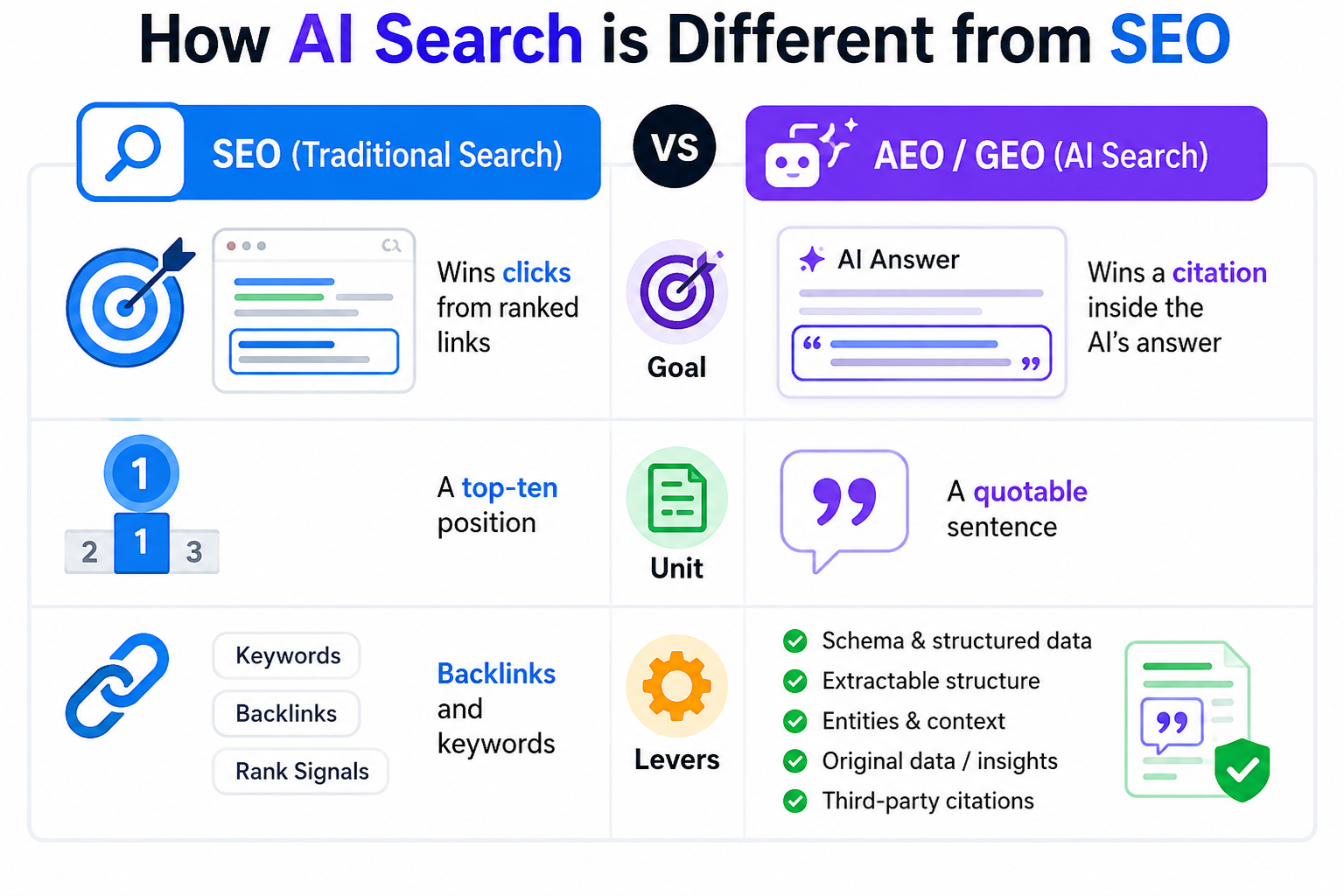
- Goal: SEO wins clicks from ranked links; AEO/GEO wins a citation inside the AI's answer.
- Unit: a top-ten position vs a quotable sentence.
- Levers: schema, extractable structure, entities, original data and third-party citations — not just backlinks and keywords.
The levers that actually get you cited
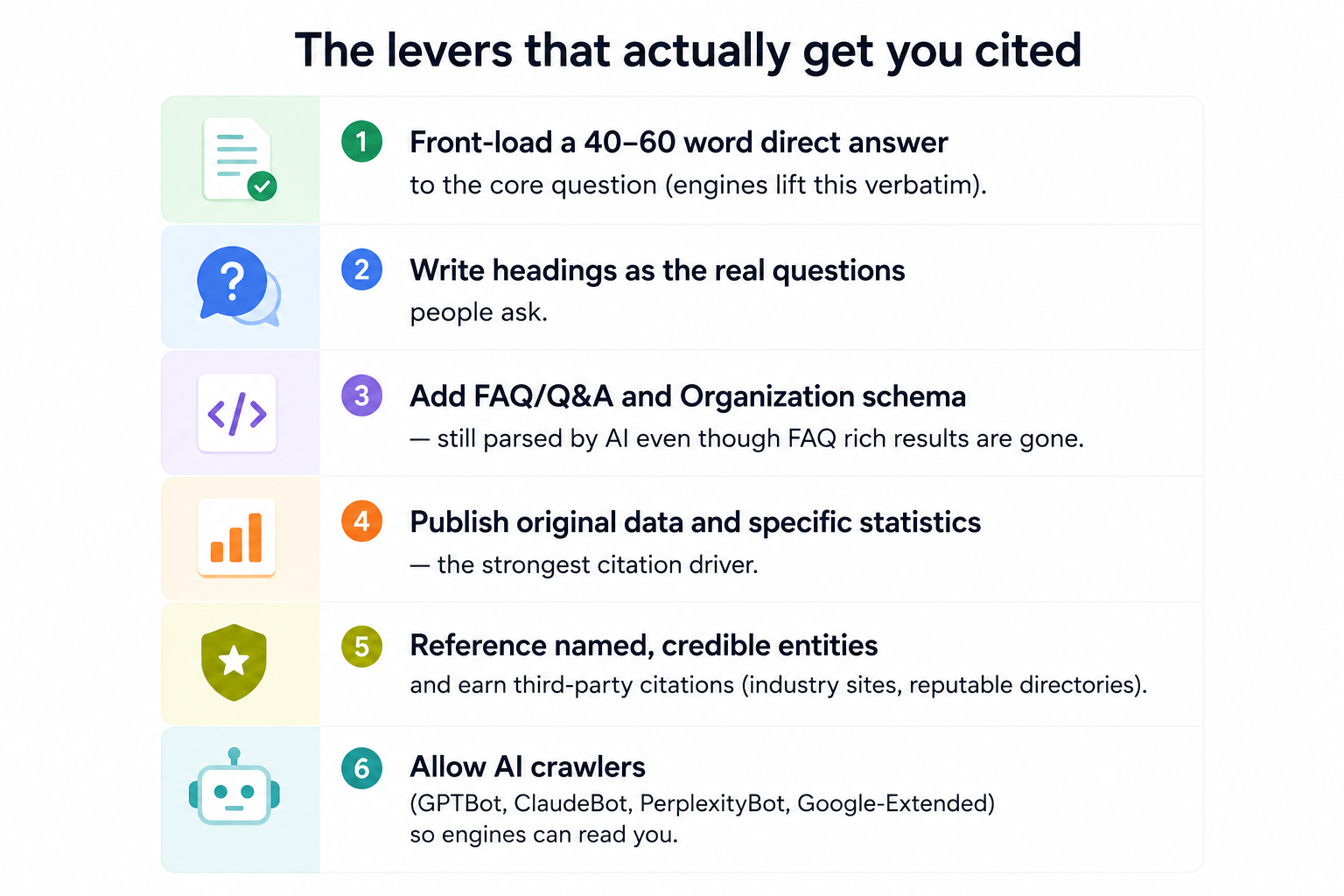
- Front-load a 40–60 word direct answer to the core question (engines lift this verbatim).
- Write headings as the real questions people ask.
- Add FAQ/Q&A and Organization schema — still parsed by AI even though FAQ rich results are gone.
- Publish original data and specific statistics — the strongest citation driver.
- Reference named, credible entities and earn third-party citations (industry sites, reputable directories).
- Allow AI crawlers (GPTBot, ClaudeBot, PerplexityBot, Google-Extended) so engines can read you.
How to measure it
Forget rankings alone. Track citation frequency: ask ChatGPT, Perplexity and Google AI Overviews the questions your buyers ask, and check whether your brand is quoted or linked. Most teams see initial citation improvements in 4–8 weeks and meaningful results in 3–6 months.
The honest way to offer this
AEO/GEO is a real opportunity — and a buzzword magnet. The credible move is to prove it on your own site first: structure accucia.com to be citable, record a baseline, and show before/after citation data. We're doing exactly that, which is why this very article is written the way it is. Once the proof exists, it becomes a premium tier of website work — not an empty service page.
Frequently Asked Questions
What are AEO, GEO and AIO?
Overlapping practices for getting your content cited by AI answer engines, rather than just ranked in traditional search.
How is AI search optimization different from SEO?
SEO targets clicks from ranked links; AEO and GEO target being the cited source inside an AI-generated answer.
Will this replace SEO?
No — it complements it. Strong fundamentals still help; AEO/GEO adds the structure and signals AI engines need.
How long until results?
Most brands see initial citation improvements in about 4–8 weeks, with meaningful results in 3–6 months.
What's the single highest-impact change?
FAQ schema plus question-format headings with front-loaded answers — the most reliable way to get cited.
Stop chasing rankings. Start earning citations.