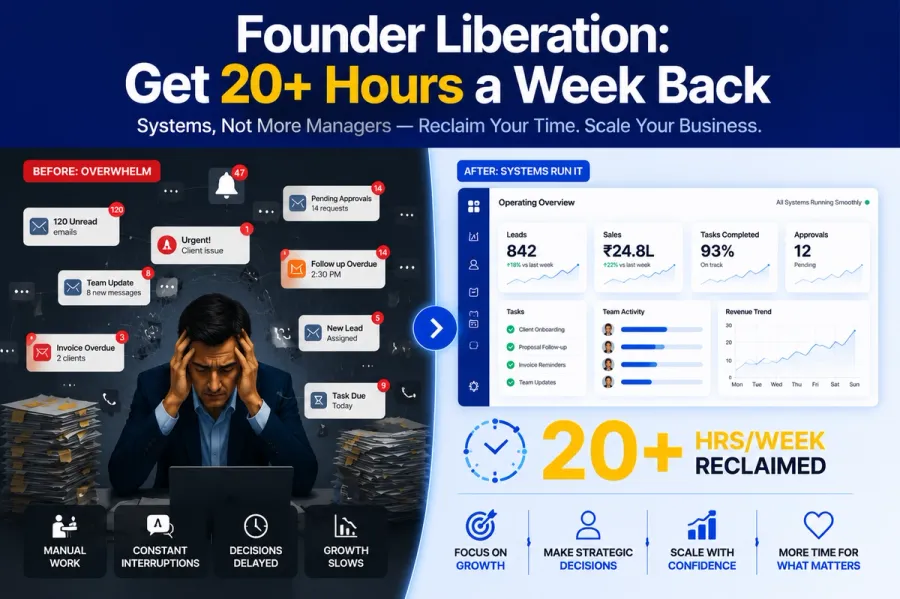
Scale Without Chaos: Operations That Hold as You Grow
Quick Answer
> Scaling business operations without chaos means adding a branch, client or geography while operations keep holding — because the systems were built to absorb the load before it arrived, not patched after they broke. The bottleneck to clean growth is rarely demand; it's the operating model. Businesses that expand smoothly build operating capacity just ahead of need, unify on one platform, and make each new location plug-and-play. Those that 'fix the systems after we grow' end up doing emergency surgery on a business running at full speed. By Mr. Sumeet Katariya, CEO Accucia Softwares
Key Takeaways
- More clients shouldn't mean more chaos — if it does, the operating model is the bottleneck.
- Controlled expansion beats raw 'scale': operations that hold under load.
- Build operating capacity just before you need it, not after it breaks.
- On one platform, a new branch becomes plug-and-play, not a fresh project.
What does 'scale without chaos' mean?
Scaling without chaos means growth that your operations can absorb. You say yes to the bigger client, the new branch, the new country — and the business holds, because the systems underneath were built to take the load. It's the opposite of the familiar pattern where every bit of growth multiplies the firefighting.
Why growth breaks operations
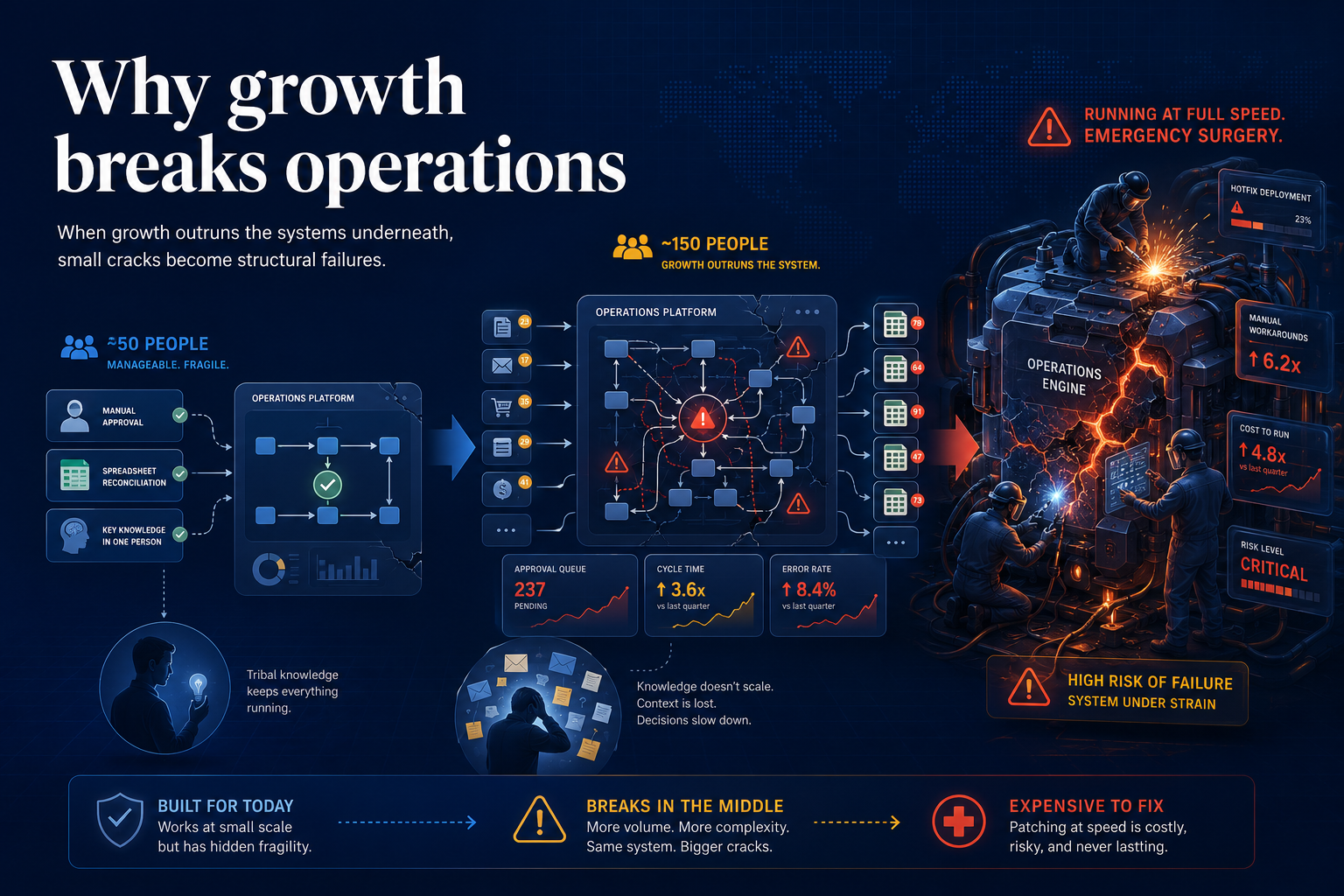
Growth doesn't wait for your systems to catch up. The cracks you can ignore at 50 people — a manual approval here, a spreadsheet reconciliation there — become structural failures at 150. The work that one person held in their head no longer fits. Without systems built for the next stage, expansion turns into emergency surgery on a business running at full speed: more expensive, more disruptive, and riskier than doing it early.
Controlled expansion vs raw scale
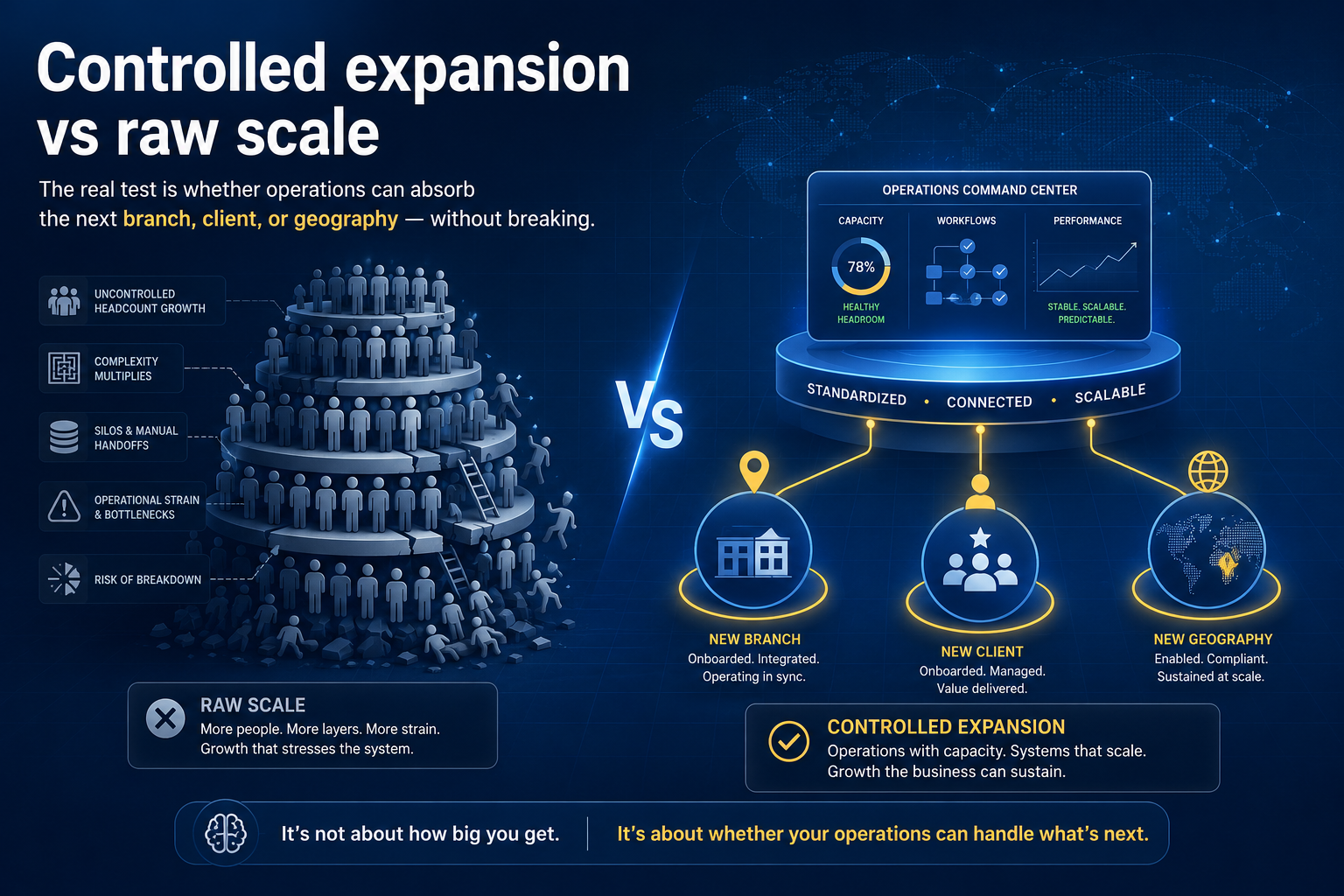
'Scale' as a buzzword usually means headcount and size. That's the wrong frame for mid-market. The useful frame is controlled expansion — operational holding capacity. The question isn't 'how big can we get?' but 'can our operations absorb the next branch, client or geography without breaking?' That's a systems question, and it's answerable in advance.
The Scalable Architecture Test
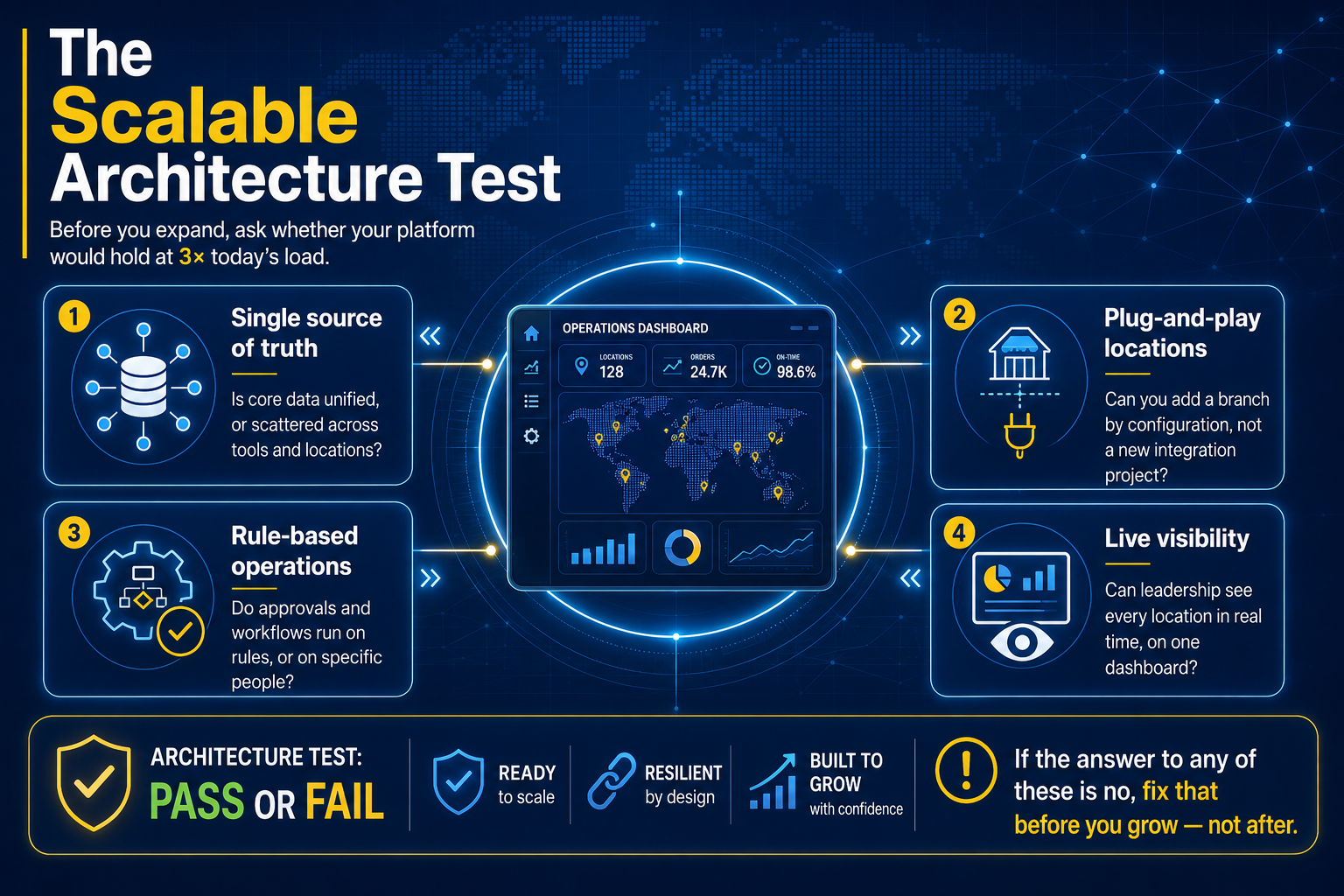
Before you expand, ask whether your platform would hold at three times today's load:
- Single source of truth — is core data unified, or scattered across tools and locations?
- Plug-and-play locations — can you add a branch by configuration, not a new integration project?
- Rule-based operations — do approvals and workflows run on rules, or on specific people?
- Live visibility — can leadership see every location in real time, on one dashboard?
If the answer to any of these is no, that's the thing to fix before you grow — not after.
Proof: operations that held
The pattern shows up across very different businesses. Lotus Imaging Clinic in Panvel went from one clinic to six on a single unified platform — 80% less manual coordination, and the next clinic now plug-and-play. Utech Waterproofing expanded across multiple US locations on the same system, which kept holding as they grew, anchoring a 7+ year partnership. And a Mumbai housing authority ran 10–15 connected projects on a connected digital ecosystem, with continuity maintained even through officer changes. Different sectors, same lesson: expansion is cheap and calm when the systems were built to absorb it.
Build capacity just before you need it
The founders who scale cleanly don't digitise everything overnight, and they don't wait until something breaks. They build the one or two workflows that will break first — before the load hits them. 'We'll fix the systems after we grow' is the most expensive sentence a founder says. The best time to build operating capacity is just before you need it; the second best time is now, while you still have the breathing room to do it properly.
Frequently Asked Questions
What does it mean to scale a business without chaos?
To add a branch, client or geography while operations keep holding — because the systems were built to absorb the load in advance, not patched after they broke.
Why does growth break operations?
Because manual workarounds and people-dependent processes that work at small scale become structural failures under higher load. Growth exposes whatever the systems couldn't hold.
How do I know if my business can scale cleanly?
Apply the Scalable Architecture Test: single source of truth, plug-and-play locations, rule-based operations, and live cross-location visibility. Gaps there are what to fix before expanding.
Should I fix systems before or after we grow?
Before. Fixing the one or two workflows that break first — ahead of the load — is far cheaper and safer than emergency rebuilds while running at full speed.
Build Before You Scale.