Generative AI Development: From Demo to Production (2026)
Quick Answer
Generative AI development is the work of building applications on large language and multimodal models — then integrating, governing and operating them in production. The hard part isn't the demo; it's everything after: choosing the right model, grounding it in your data, adding guardrails and evaluation, controlling cost, and driving adoption. Most GenAI projects stall in the gap between an impressive prototype and a reliable, used product. Closing that gap is what separates a science experiment from business value.
Key Takeaways
- A GenAI demo is easy; a production GenAI product is hard — and the gap is where most projects die.
- The real work is integration, grounding, guardrails, evaluation and cost control — not the prompt.
- Be model-agnostic: pick GPT, Gemini, Claude or open models per accuracy, privacy and cost.
- RAG grounds answers; fine-tuning shapes behaviour — many production systems use both.
- Like any system, GenAI only delivers ROI once it's adopted — so we stay on-site until it is.
Why “demo to production” is the whole game in 2026
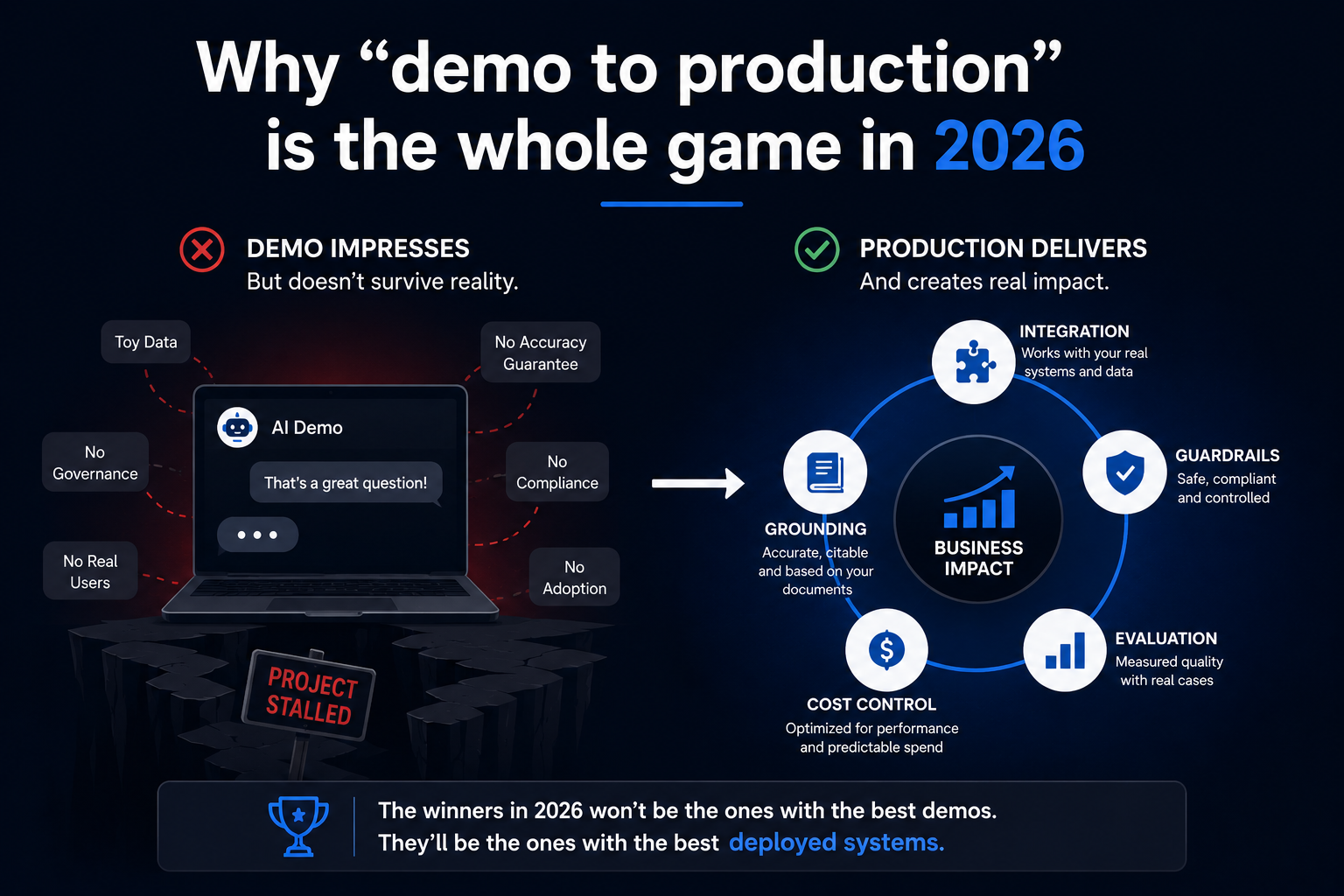
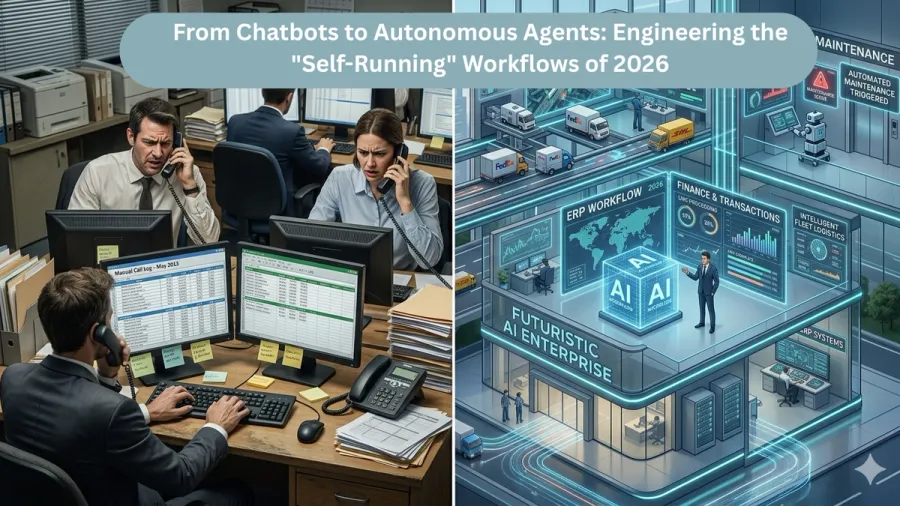
Anyone can wire an API to a chat box and get a wow moment. The companies winning with GenAI this year aren't the ones with the flashiest prototype — they're the ones who got it into production with governance, accuracy and adoption. That transition is exactly where projects stall: the demo impresses a room, then never survives contact with real data, real users, real compliance.
What production-grade generative AI actually requires
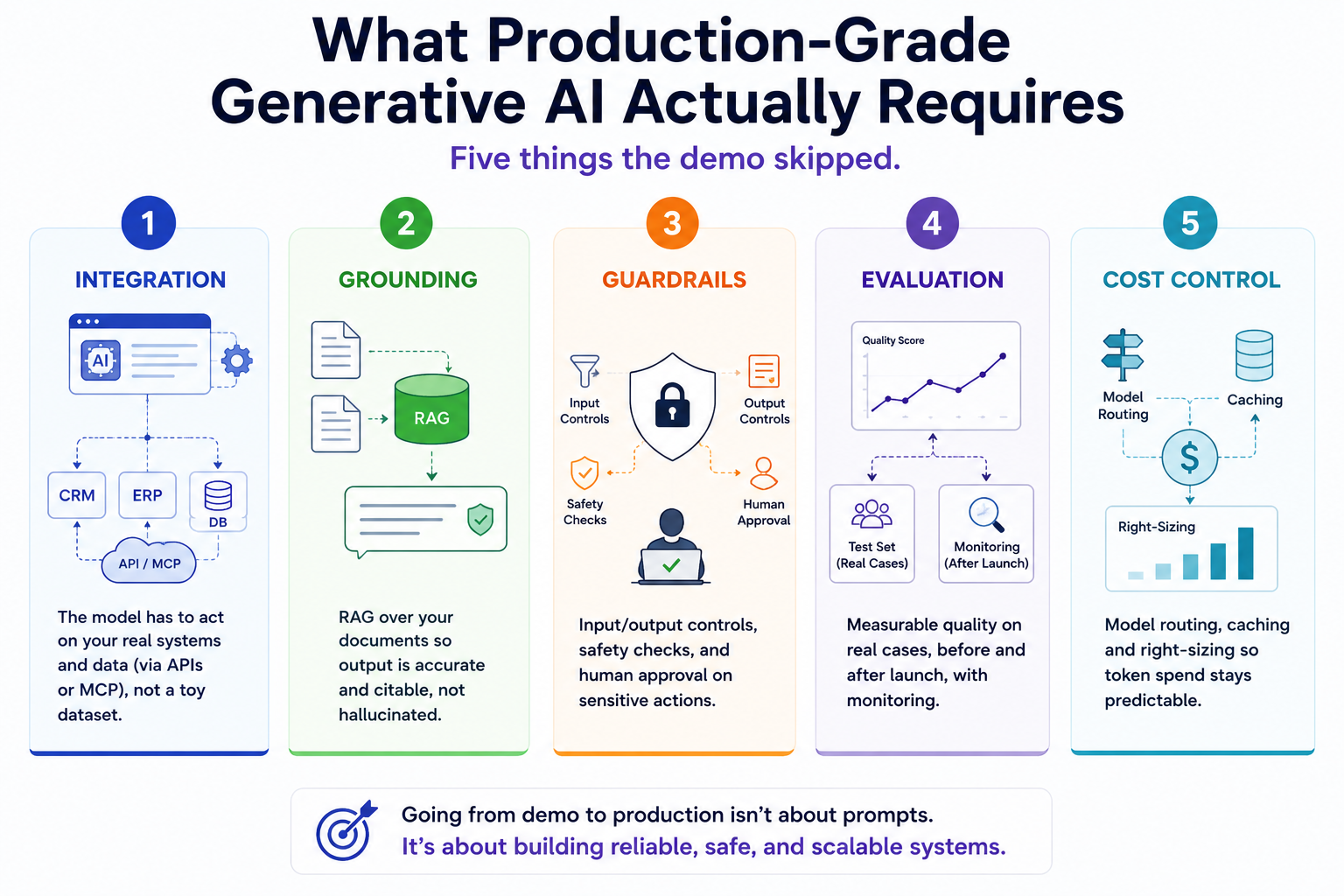
Five things the demo skipped:
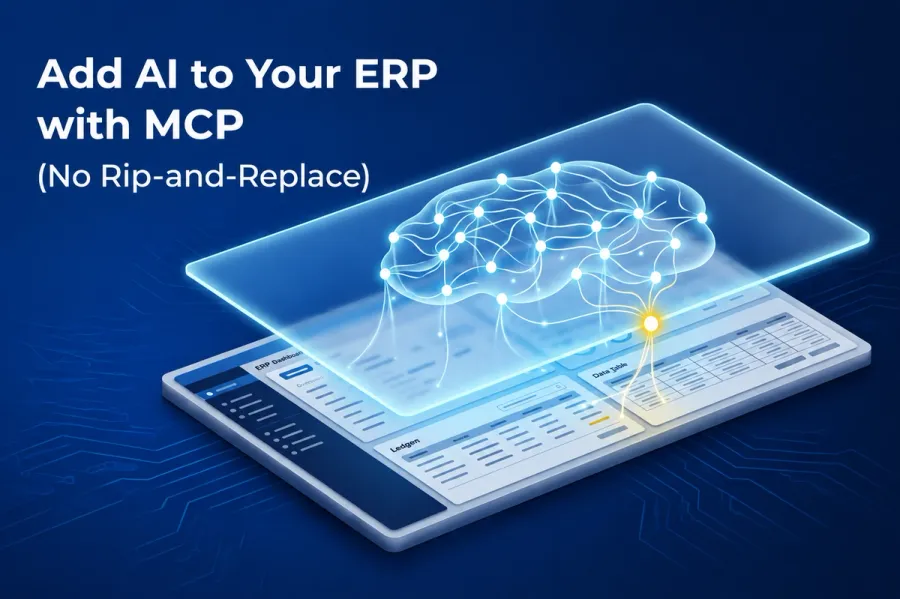
- Integration — the model has to act on your real systems and data (via APIs or MCP), not a toy dataset.
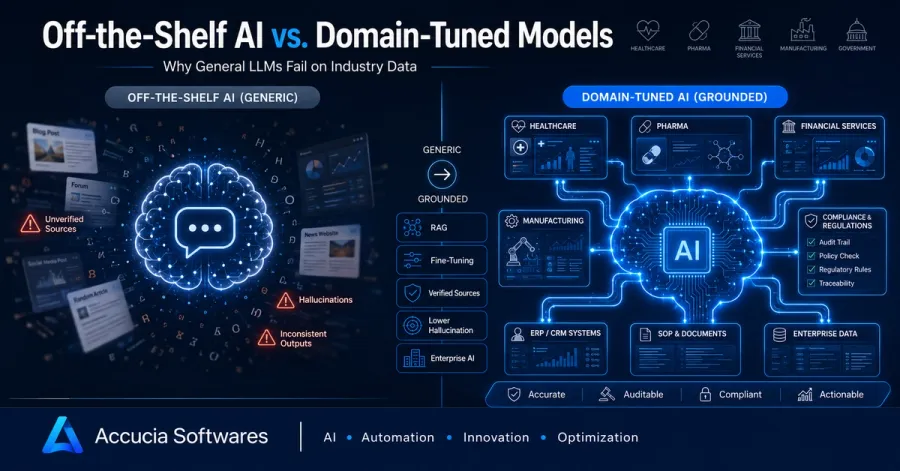
- Grounding — RAG over your documents so output is accurate and citable, not hallucinated.
- Guardrails — input/output controls, safety checks, and human approval on sensitive actions.
- Evaluation — measurable quality on real cases, before and after launch, with monitoring.
- Cost control — model routing, caching and right-sizing so token spend stays predictable.
What we build
LLM applications and copilots embedded in your product; content and document systems (drafting, summarisation, classification, extraction); multimodal text-and-image understanding; and custom model selection or fine-tuning — all integrated into your existing stack. The common thread is production discipline, not novelty.
Build custom, fine-tune, or just use an API?
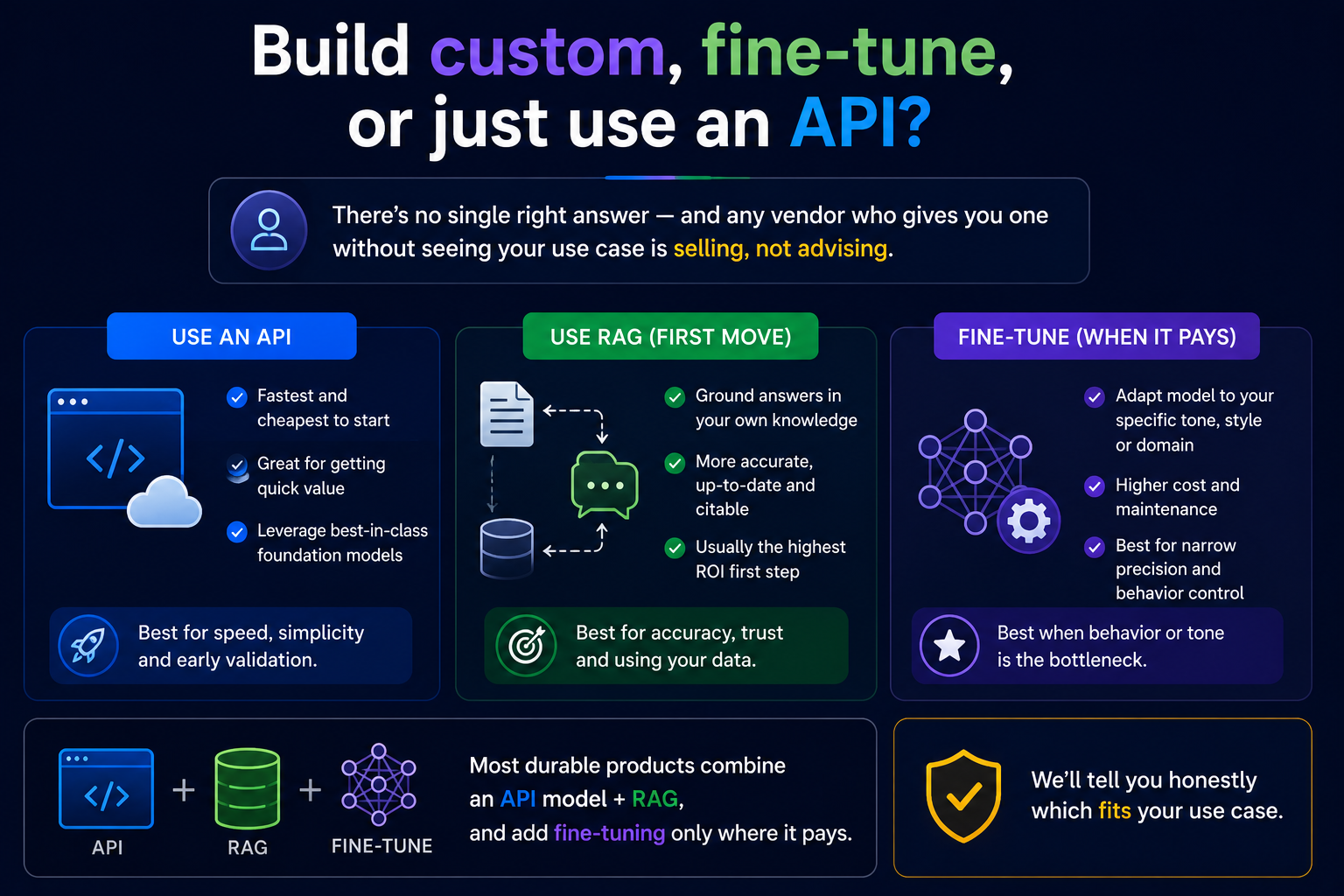
There's no single right answer — and any vendor who gives you one without seeing your use case is selling, not advising. APIs are fastest and cheapest to start. RAG is usually the first move for grounding answers in your own knowledge. Fine-tuning earns its cost when you need a specific tone or narrow precision. Most durable products combine an API model + RAG, and add fine-tuning only where it pays. We'll tell you honestly which fits.
RAG vs fine-tuning, briefly
RAG retrieves your live documents at query time — easy to update, easy to cite. Fine-tuning bakes knowledge and behaviour into the model — powerful but costly to refresh. For most enterprise knowledge use cases, start with RAG; reach for fine-tuning when behaviour or style is the bottleneck.
Keeping it private and affordable
Two recurring worries, both solvable. Privacy: your data stays in your environment where required, with least-privilege access and no unintended training on it; on-prem options exist for sensitive workloads. Cost: route simple queries to cheaper models, cache repeated calls, and evaluate so you're not paying for quality you don't need.
How to start
Define one use case with a clear success metric. Prototype, then harden it — grounding, guardrails, evals, cost. Integrate, deploy, and budget for the adoption phase, because a GenAI product nobody uses is just an expensive demo. We've shipped exactly this pattern, including a GenAI voice-and-chat system in production on Gemini.
Frequently Asked Questions
What is generative AI development?
Building applications on large language and multimodal models — then integrating, governing and operating them in production, beyond a prototype.
Which LLMs should we use?
It depends on your accuracy, privacy and cost needs. We're model-agnostic — GPT, Gemini, Claude or open models — and select per use case.
Should we build a custom model or use an API?
Whichever fits. APIs are fastest to start; RAG grounds answers in your data; fine-tuning helps with tone or precision. Many production systems combine them.
What is the difference between RAG and fine-tuning?
RAG retrieves your live documents at query time and is easy to update and cite; fine-tuning adapts the model itself and is costly to refresh.
How do you keep generative AI accurate and safe?
Grounding (RAG), guardrails, evaluation sets and human review on sensitive flows — plus monitoring after launch.
How do you control generative AI costs?
Model routing, caching and evaluation keep quality high while keeping token spend predictable.
Start Your AI Journey