Custom ERP vs. SAP/NetSuite: How to Choose (2026 Guide)
Quick Answer
Custom ERP fits when your operations are complex enough that configuring SAP or NetSuite becomes its own multi-year project. SAP or NetSuite fits when your workflows are standard and you want faster deployment with built-in support. The real question isn't which platform is better, it's how much of your competitive advantage lives inside your operational workflow. By Mr. Sumeet Katariya, CEO Accucia Softwares
What's the real difference between custom ERP and platforms like SAP or NetSuite?
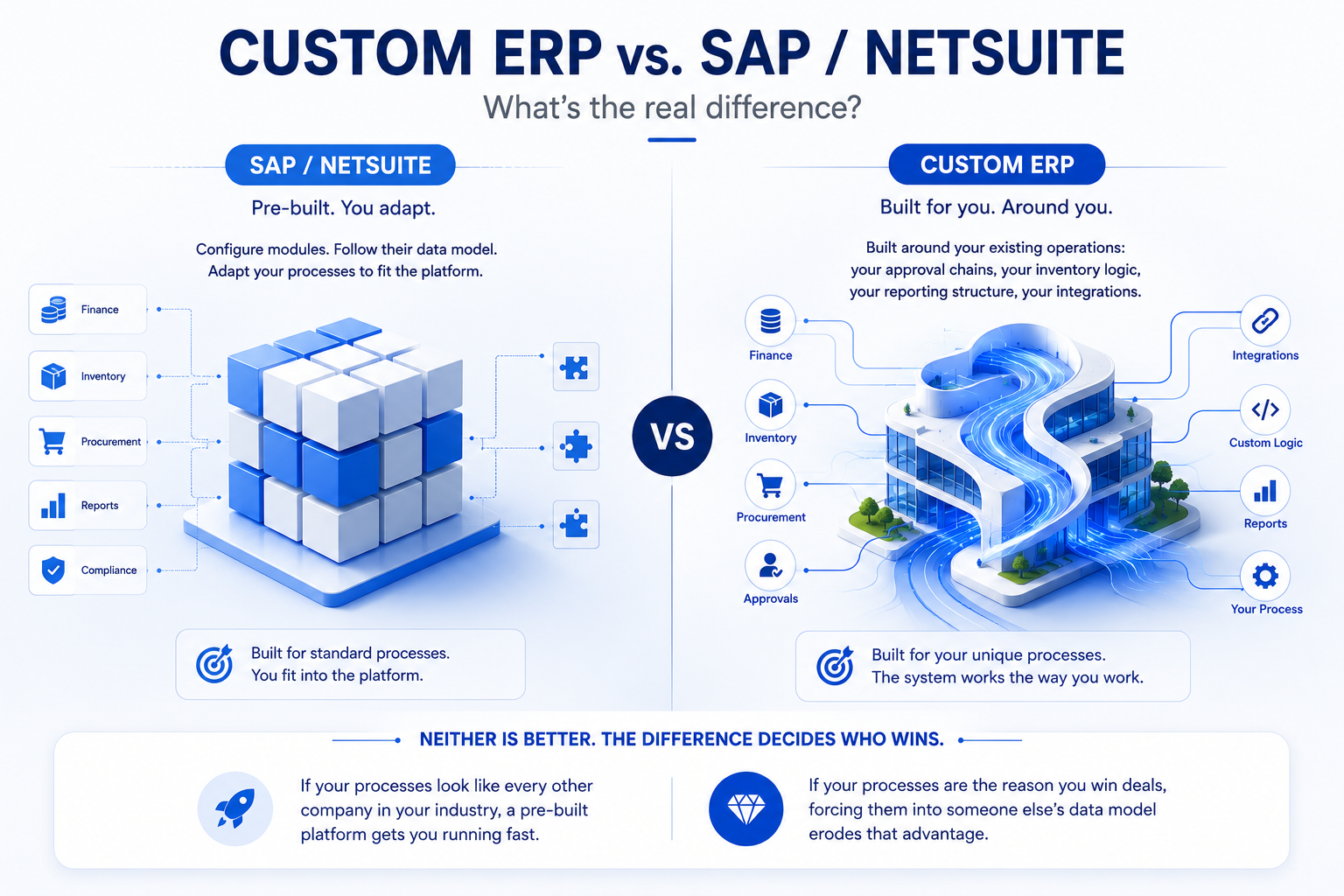
SAP and NetSuite are pre-built systems. You configure modules, follow their data model, and adapt your processes to fit the platform. A custom ERP is built around your existing operations: your approval chains, your inventory logic, your reporting structure, your integrations.
Neither is better as a category. The difference decides who wins:
- If your processes look like every other company in your industry, a pre-built platform gets you running fast.
- If your processes are the reason you win deals, forcing them into someone else's data model erodes that advantage.
When does SAP or NetSuite make more sense than custom ERP?
Three signals point toward an off-the-shelf platform:
- Your finance, inventory, and procurement workflows follow standard practice, with no unusual approval logic or compliance handling.
- You need built-in modules (payroll, tax compliance, multi-currency) that would take months to replicate custom.
- Your team wants a large support ecosystem and a bench of consultants who already know the platform.
NetSuite suits mid-market companies wanting cloud-first deployment without heavy IT overhead. SAP suits larger enterprises with complex, multi-entity finance and global compliance needs.
When does custom ERP make more sense?
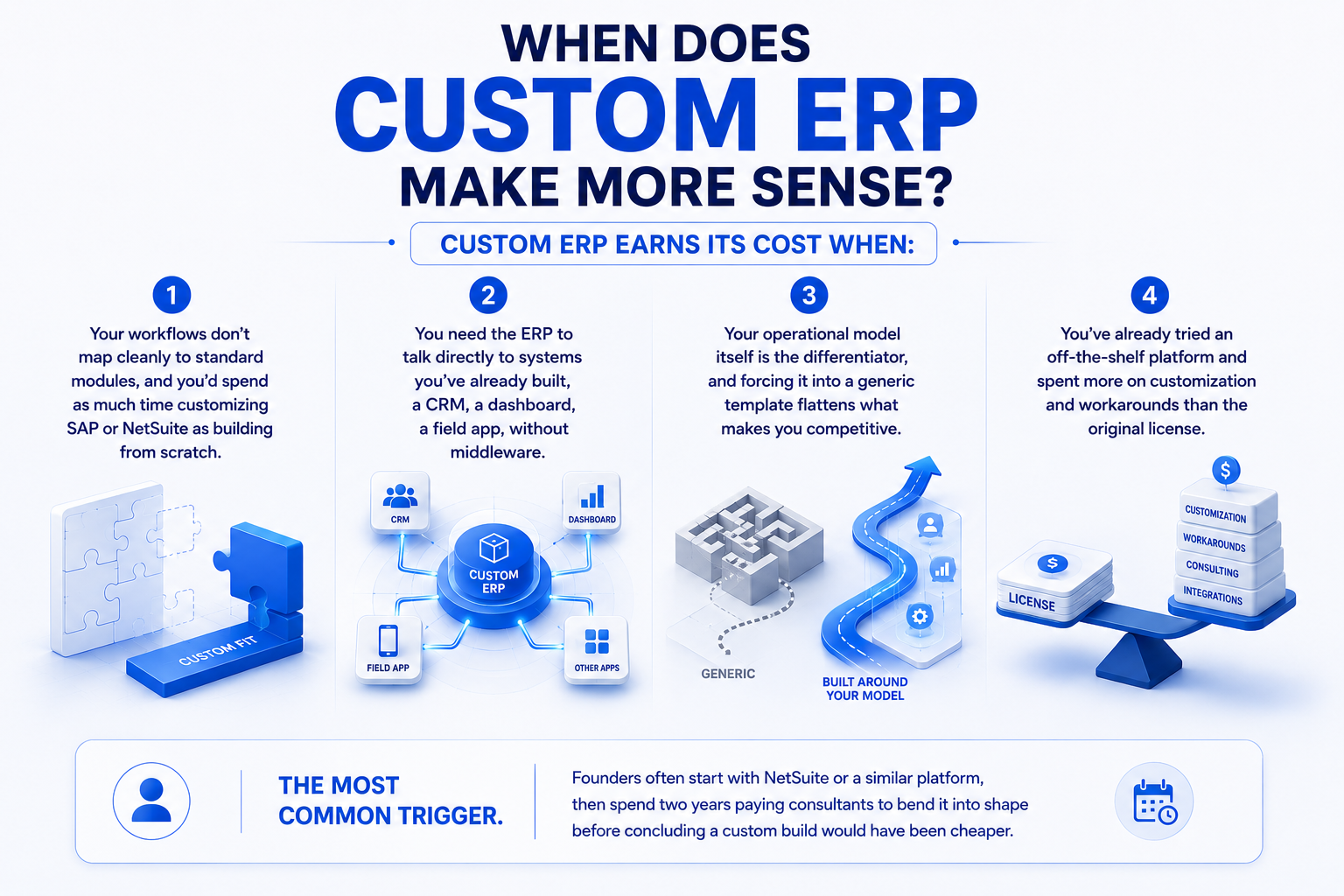
Custom ERP earns its cost when:
- Your workflows don't map cleanly to standard modules, and you'd spend as much time customizing SAP or NetSuite as building from scratch.
- You need the ERP to talk directly to systems you've already built, a CRM, a dashboard, a field app, without middleware.
- Your operational model itself is the differentiator, and forcing it into a generic template flattens what makes you competitive.
- You've already tried an off-the-shelf platform and spent more on customization and workarounds than the original license.
That last point is the most common trigger. Founders often start with NetSuite or a similar platform, then spend two years paying consultants to bend it into shape before concluding a custom build would have been cheaper.
What does each option actually cost, upfront and over time?
Rough ranges, not quotes:
- SAP: licensing plus implementation typically starts in the low hundreds of thousands for mid-size deployments and rises fast with modules and users. Ongoing costs include license renewals, module fees, and consultant hours for every process change.
- NetSuite: lower entry cost, often tens of thousands to start, subscription-based. Costs grow with add-on modules and customization work as process complexity increases.
- Custom ERP: higher upfront build cost, generally comparable to a mid-tier SAP or heavily customized NetSuite deployment, but no per-seat licensing and no module fees. Ongoing cost is maintenance and iteration, not license renewal.
The number that matters isn't the sticker price. It's total cost of ownership over 3-5 years once customization, licensing, and consultant hours are included.
How long does implementation take for each path?
- NetSuite: 3-6 months for standard deployments.
- SAP: 6-18 months depending on scope and number of entities.
- Custom ERP: 4-9 months depending on complexity, but the timeline buys a system that matches your workflow from day one rather than one you'll spend the next year reconfiguring.
What happens when your business outgrows the platform you chose?
This is the question most founders skip. Off-the-shelf platforms scale in users and transaction volume, but not always in workflow complexity. Businesses that start on NetSuite because it's fast often hit a wall two or three years in, once their processes have diverged too far from what the platform natively supports.
Custom ERP scales differently: the cost of change is a development sprint, not a re-implementation project. That matters most for founders whose businesses are still actively changing shape, not just growing in volume.
A decision framework: 5 questions to ask before choosing
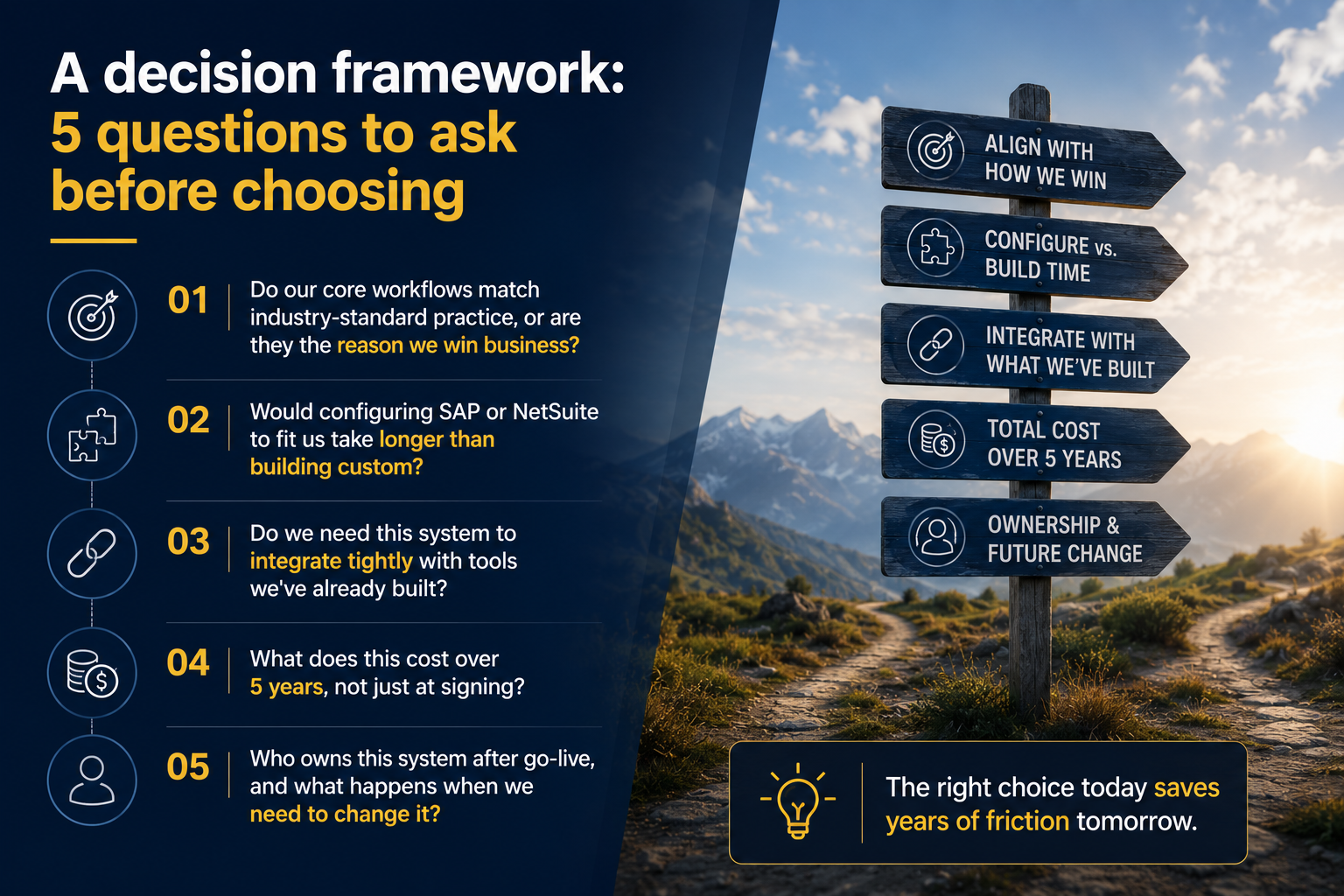
- Do our core workflows match industry-standard practice, or are they the reason we win business?
- Would configuring SAP or NetSuite to fit us take longer than building custom?
- Do we need this system to integrate tightly with tools we've already built?
- What does this cost over 5 years, not just at signing?
- Who owns this system after go-live, and what happens when we need to change it?
How Accucia approaches this
Accucia builds tailored platforms, CRMs, ERPs, dashboards, and AI-driven automation, for mid-to-large enterprise founders whose business has outgrown its current systems. The team stays through implementation, training, adoption, and iteration, not just delivery. 730+ projects delivered across 8 sectors, including manufacturing, financial services, and logistics, where standard ERP modules rarely matched the actual workflow.
FAQ
Is custom ERP more expensive than SAP or NetSuite?
Not necessarily. Custom ERP has a higher build cost but no ongoing license or per-seat fees. Off-the-shelf platforms have lower entry cost, but total cost rises with modules, customization, and consultant hours over time.
Can a custom ERP integrate with SAP or NetSuite instead of replacing it?
Yes. Some founders keep SAP or NetSuite for finance and compliance while building custom modules for operations that don't fit the standard platform, connected through APIs.
How do I know if my workflows are standard or custom?
If a consultant can configure your process using existing platform modules without writing custom code, it's standard. If you need workarounds, spreadsheets on the side, or manual steps to bridge gaps, your workflow is custom, whether or not you've built for it yet.
Which is faster to implement, SAP, NetSuite, or custom ERP?
NetSuite is typically fastest for standard deployments (3-6 months). Custom ERP timelines (4-9 months) sit between NetSuite and SAP, but the result matches your workflow without a second reconfiguration phase.
Choose the right ERP for long-term growth.