
AI Automation for Indian Businesses: Where to Start
Quick Answer
AI automation is the use of AI to perform routine business tasks answering queries, processing documents, routing approvals, generating reports with minimal human intervention. For Indian businesses, the highest-return starting points are high-volume, rules-based processes with clean data; the riskiest are judgement-heavy or poorly-documented workflows, which is why most AI pilots fail before reaching production. The prerequisite nobody advertises is a clean workflow and clean data underneath the automation. Automate a mess and you simply get a faster mess. By Mr. Sumeet Katariya, CEO Accucia Softwares
Key Takeaways
- Automate high-volume, rules-based tasks with clean data first.
- Leave judgement-heavy and undocumented processes alone — for now.
- Most AI pilots fail because there's no clean process or data underneath.
- For established businesses, an AI layer on existing systems is the fastest, lowest-risk start.
What is AI automation?
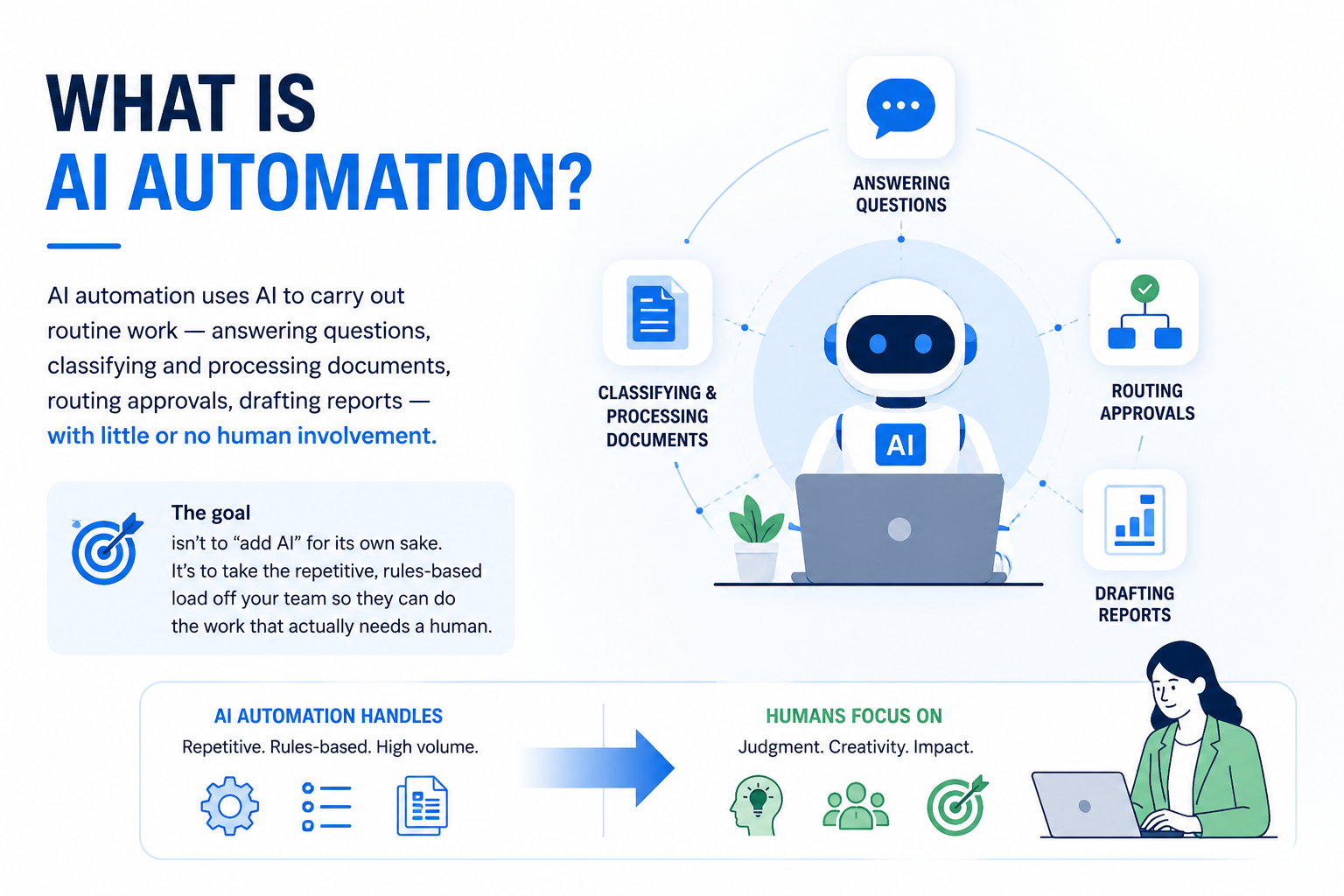
AI automation uses AI to carry out routine work — answering questions, classifying and processing documents, routing approvals, drafting reports — with little or no human involvement. The goal isn't to "add AI" for its own sake. It's to take the repetitive, rules-based load off your team so they can do the work that actually needs a human.
The 3 processes to automate first
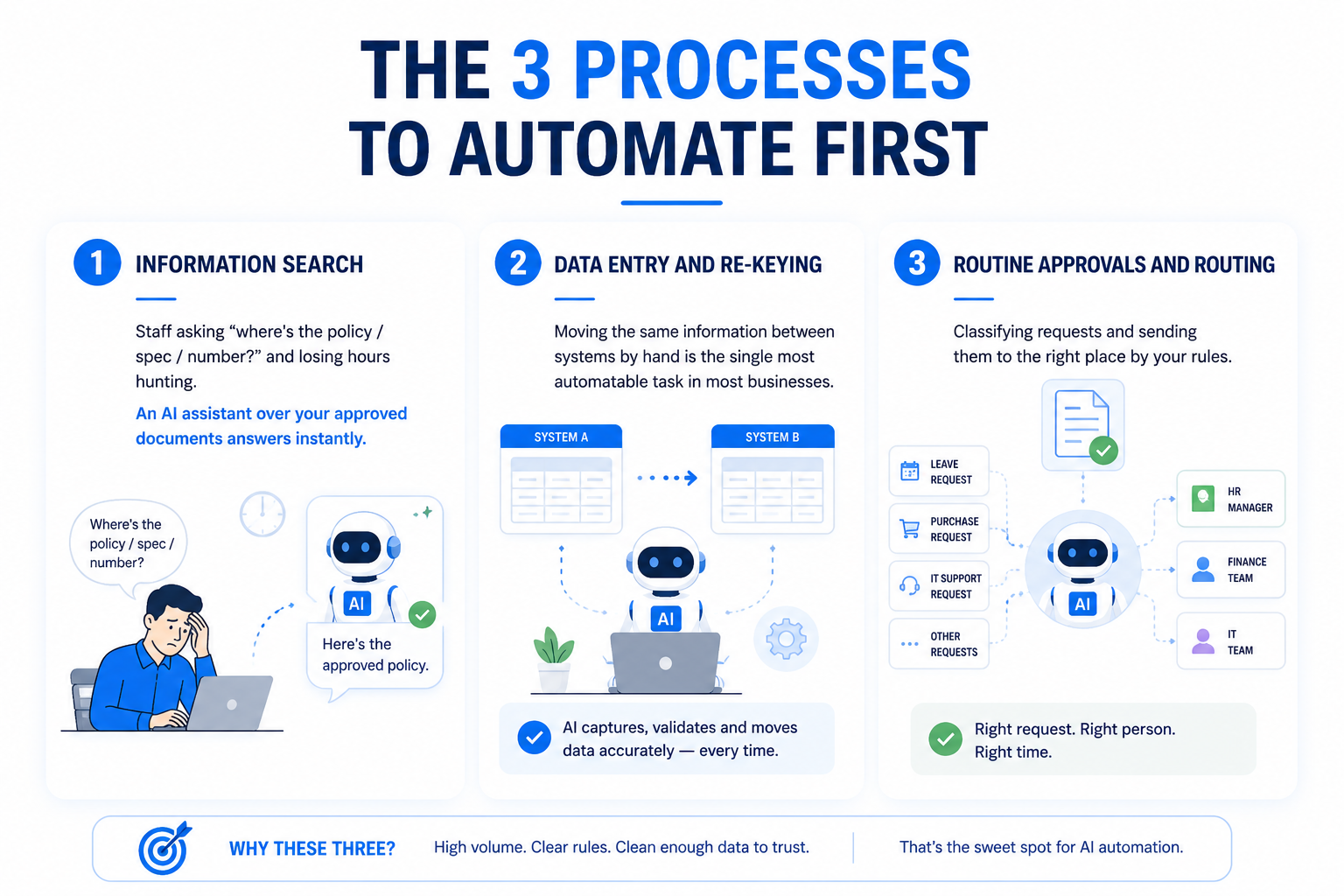
- Information search — staff asking "where's the policy / spec / number?" and losing hours hunting. An AI assistant over your approved documents answers instantly.
- Data entry and re-keying — moving the same information between systems by hand is the single most automatable task in most businesses.
- Routine approvals and routing — classifying requests and sending them to the right place by your rules.
These share three traits: high volume, clear rules, and data clean enough to trust. That's the sweet spot.
The 3 to leave alone (for now)
- Judgement-heavy decisions — anything requiring nuance, context or accountability a machine shouldn't own yet.
- Undocumented processes — if no human can explain the rules, AI can't follow them. Document first.
- High-risk, low-volume edge cases — the effort to automate rarely pays back, and the cost of an error is high.
Why most AI pilots fail before production
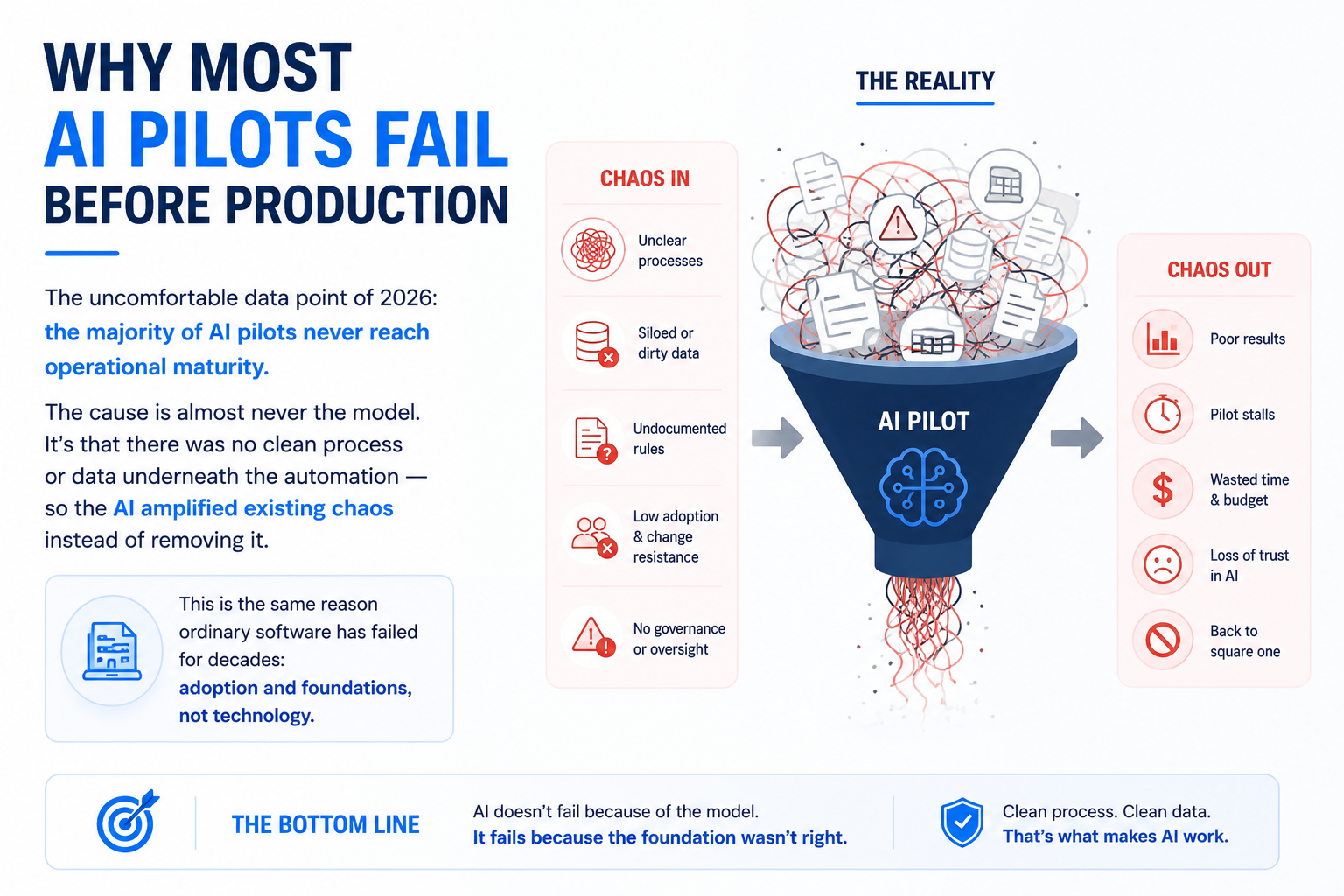
The uncomfortable data point of 2026: the majority of AI pilots never reach operational maturity. The cause is almost never the model. It's that there was no clean process or data underneath the automation — so the AI amplified existing chaos instead of removing it. This is the same reason ordinary software has failed for decades: adoption and foundations, not technology.
The prerequisite nobody talks about
Clean workflow plus clean data is the prerequisite for every successful automation. Before automating, ask: can a human describe this process step by step? Is the data it relies on accurate and in one place? If the answer is no, fix that first. Automating a broken process just makes it break faster.
Build vs buy vs add-a-layer
- Buy a point tool for a commodity automation a vendor has already solved well.
- Build custom automation where your process is specific to your business.
- Add a layer — for most established companies, the fastest and lowest-risk route is an AI layer on top of the systems you already run, so there's nothing new for the team to adopt.
A large Indian pharmaceutical company proved the point: rather than a new tool, we embedded an AI assistant inside their existing app and cut document-search time by 75%, with 95% accuracy. No new system, no adoption fight.
Frequently Asked Questions
What should a business automate first with AI?
High-volume, repetitive, rules-based tasks with clean data — typically information search, data entry, and routine approvals.
Why do AI pilots fail?
Because there's no clean process or data underneath. Automation amplifies whatever it sits on; automate a mess and you get a faster mess.
Do I need to replace my systems to automate with AI?
Usually not. An AI layer on top of your existing systems is faster, cheaper and lower-risk than a rip-and-replace.
How do I know if a process is ready to automate?
If a human can describe the rules step by step and the underlying data is clean and in one place, it's a strong candidate. If not, document and clean first.
Ready to automate smarter?