Agentic AI for Mid-Market Enterprise (2026 Buyer's Guide)
Quick Answer
Agentic AI is artificial intelligence that decides what action to take next based on a goal and context, rather than answering questions or following rigid rules. It's one of four distinct AI capability categories most mid-market founders confuse: Agentic AI (autonomous multi-step decisions), RAG (Retrieval-Augmented Generation, document Q&A), Workflow Automation (rule-based action triggering), and AI Copilots (in-tool action suggestions for human users). Mid-market businesses typically need 2-3 of these in different parts of their operation — almost never agentic AI alone. Gartner predicts 40% of enterprise apps will include task-specific AI agents by end of 2026, but most mid-market AI value in 2026 still comes from RAG and workflow automation, not agentic AI which remains unreliable for long-running workflows. This guide decodes all four categories and the buyer questions to ask.
Every AI vendor in 2026 is selling "agentic AI."
Most mid-market founders nod along, scared to admit they can't tell agentic AI from RAG from workflow automation from AI copilots. They're not alone — even the tech press blurs the categories.
Here's the 2026 buyer's guide that decodes all four. Plus the buyer questions to ask any AI vendor before signing a contract — and the architectural pattern that works for mid-market businesses in 2026.
The Agentic AI Moment
Three launches in the last 60 days made agentic AI the dominant AI category conversation in enterprise:
- OpenAI Frontier (May 2026) — enterprise AI agents "like human employees"
- Google Gemini Enterprise Agent Platform (May 2026) — agent templates for retail, healthcare, financial services
- Anthropic Claude with agent restrictions (May 2026) — tightening third-party agent tool usage
Gartner predicts 40% of enterprise apps will include task-specific AI agents by end of 2026. Enterprise AI investment crossed USD 600 billion in 2026.
The hype is real. The capability is real. The mid-market buyer reality is more nuanced.
The 4 AI Categories Decoded
RAG (Retrieval-Augmented Generation)
What it does: AI retrieves relevant chunks of text from your documents, then uses an LLM to generate an answer grounded in those chunks. Every answer can cite its source.
Best for: knowledge search, employee onboarding, internal Q&A, customer support that requires accuracy.
Real example: a pharma RAG chatbot embedded in the company's mobile app — 75% reduction in document search time, 95% answer accuracy, 8-month payback.
Mid-market readiness: HIGH. RAG is production-grade in 2026 for any mid-market business with organised internal documents.
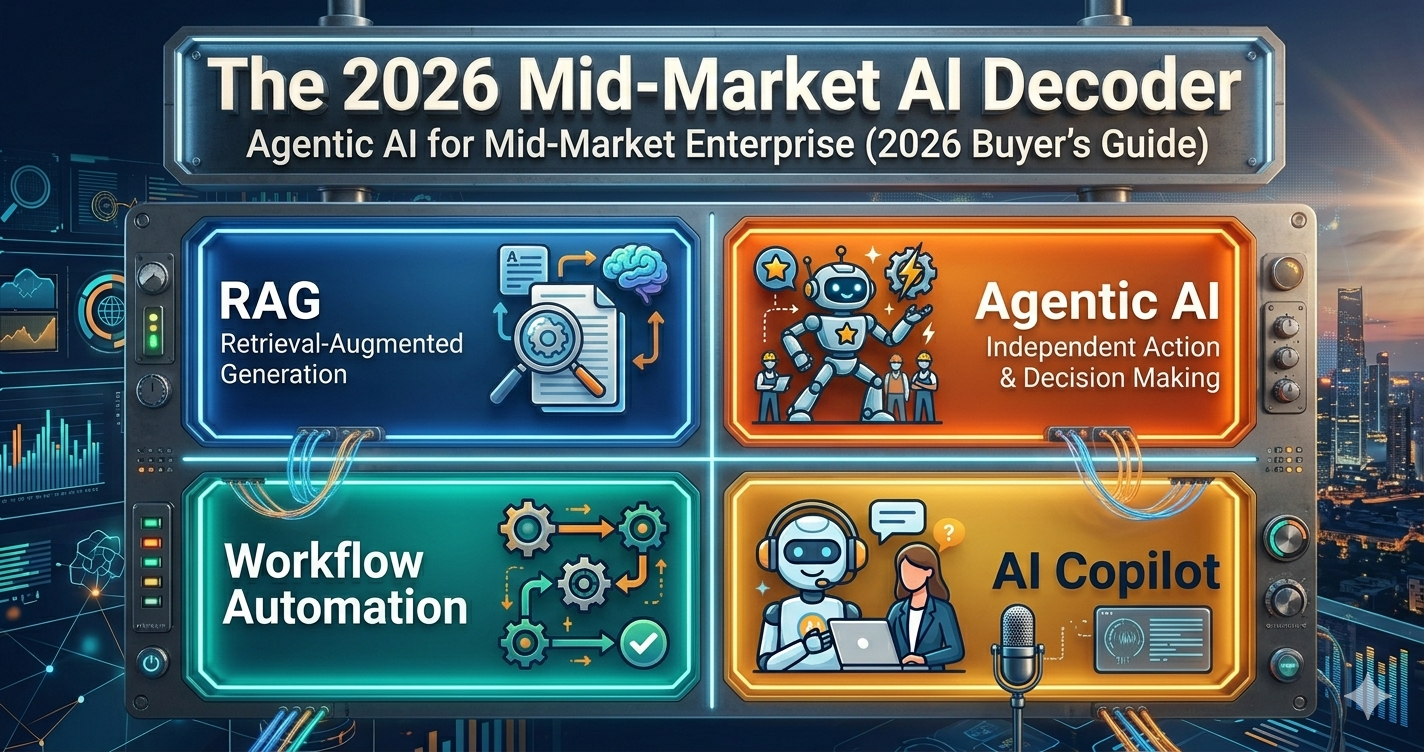
Workflow Automation
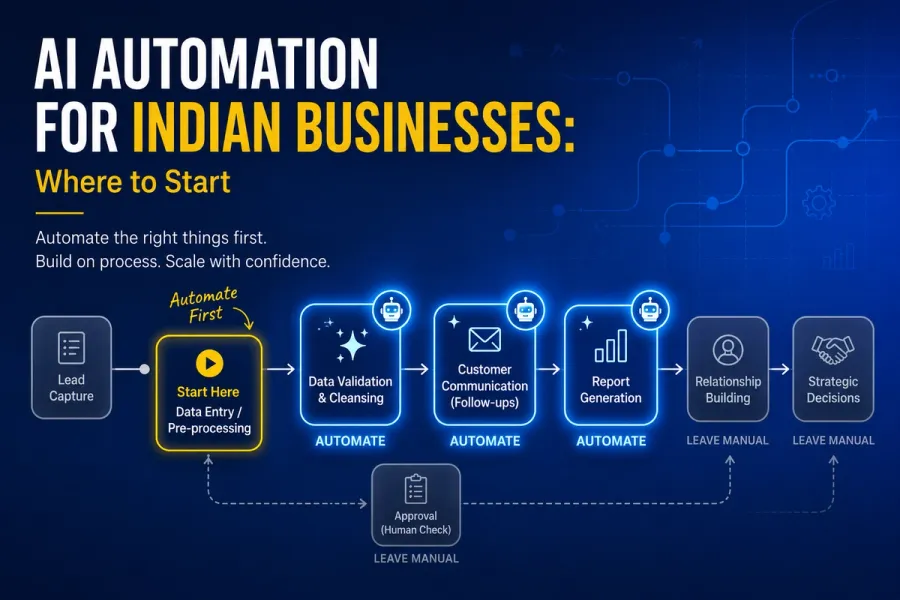
What it does: AI triggers actions across systems based on rules and context. Less "decide what to do" and more "do this when that happens."
Best for: invoice processing, approval routing, data entry, customer follow-up sequences, supplier coordination.
Real example: invoice received → AI extracts vendor/amount/PO → routes for approval to right manager → updates accounting system once approved → notifies vendor of payment.
Mid-market readiness: HIGH. Workflow automation has been production-grade for 2-3 years. The 2026 evolution is AI making the rule-execution more flexible and context-aware.
Agentic AI
What it does: AI decides what action to take next based on a goal and context. Multi-step, autonomous, sometimes long-running. Can chain together retrievals, computations, and external API calls.
Best for: multi-step analysis ("reconcile this month's revenue with bank statements and flag anomalies"), autonomous research ("find me 5 potential acquisition targets matching these criteria"), complex coordination across systems.
Real example: an MCP server connected to a live ERP, allowing leadership to ask "what's our cash position next 90 days projected against current order book?" in Claude — the agent queries the ERP, runs the calculation, returns a structured answer with citations.
Mid-market readiness: MEDIUM. Agentic AI works well for narrow, well-scoped tasks with human oversight. Microsoft's own researchers warned in May 2026 that AI agents remain unreliable for long-running autonomous workflows. Use with caution; deploy with checkpoints.
AI Copilot
What it does: AI embedded inside an existing tool that suggests the next action to a human user. The human stays in the loop; the AI accelerates their work.
Best for: augmenting expert users — sales reps drafting follow-up emails, finance teams categorising transactions, developers writing code (GitHub Copilot), executives summarising long documents.
Real example: a finance team using a copilot inside their accounting tool to suggest transaction categories, with the human reviewing and approving each suggestion.
Mid-market readiness: HIGH. AI copilots from Microsoft (Copilot), Google (Workspace AI), and GitHub (Copilot) are mature and immediately deployable for most knowledge work roles.
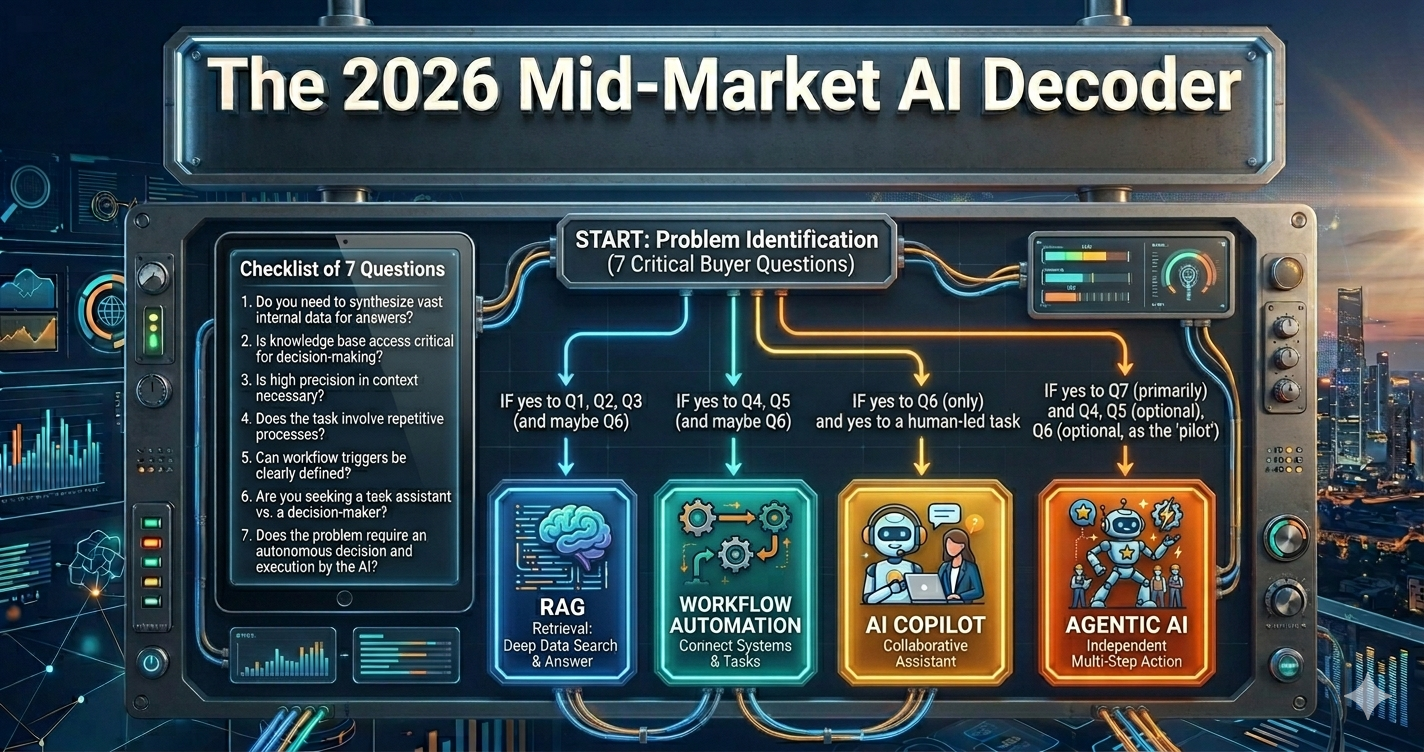
Decision Tree: Which AI Category for Which Problem
For each business problem, ask:
Is the problem "find the right answer from our documents"?
→ RAG
Is the problem "do this action automatically when that condition is met"?
→ Workflow Automation
Is the problem "make a multi-step decision based on goal and context"?
→ Agentic AI (with human oversight, narrow scope)
Is the problem "help an expert user do their work faster"?
→ AI Copilot
Most mid-market businesses need 2-3 of these in different parts of their operation. The single biggest mid-market AI mistake in 2026 is buying "one AI platform for everything" — usually marketed as agentic AI — when the actual operational need is a mix of RAG, workflow automation, and copilot deployments.
Buyer's Questions to Ask Any AI Vendor in 2026
Before signing any AI agreement, demand answers to these 7 questions:
- "Which category of AI is this — RAG, workflow automation, agentic, or copilot?" Vendors who can't answer cleanly are selling jargon, not capability.
- "What's your 6-month utilisation rate on past deployments?" Adoption is what matters, not features.
- "Will this AI work if we switch model providers (OpenAI to Claude to open-source) in 18 months?" Vendor lock-in is the 2026 enterprise risk.
- "Does every AI-generated answer cite its source?" Non-negotiable for compliance, audit, and trust.
- "What's the role-based access control architecture?" AI assistants should never have broader data access than the human triggering them.
- "Who from your team is on-site during the first 45 days post-launch?" Adoption fails when implementation isn't on-site.
- "What's the prerequisite checklist before we start?" Vendors skipping prereqs are selling a pilot that will never go live.
Case Studies: Each AI Category in Mid-Market Practice
RAG: the pharma client chatbot — 75% time reduction, 95% accuracy, 8-month payback (anonymised).
Workflow Automation: Multiple mid-market clients using AI-enhanced approval routing, invoice processing, customer follow-up sequences integrated with custom ERP systems.
Agentic AI: Mumbai real estate retainer client — MCP server in active development allowing leadership to query live ERP data inside Claude for business projections and analysis. First-of-its-kind for Indian mid-market real estate.
AI Copilot: Most Accucia engineering, design, and operations teams now use AI copilots (Cursor, GitHub Copilot, Claude in IDE) for their own internal work. Productivity gains 20-40% on knowledge work.
What This Costs for a Mid-Market Business
Typical first-year engagement costs by category:
- RAG deployment: USD 30-80K (custom-built for your documents and workflows)
- Workflow Automation: USD 20-60K (depends on number of workflows automated)
- Agentic AI deployment: USD 50-150K (narrow scope, with checkpoints and human oversight)
- AI Copilots: USD 20-60 per user per month (mostly off-the-shelf — Microsoft, Google, GitHub)
A mid-market business deploying RAG + Workflow Automation + selective AI Copilot across the team typically invests USD 80-200K in the first year. ROI typically within 8-14 months.
FAQ: Agentic AI for Mid-Market
What's the cost of agentic AI for a mid-market business?
USD 50-150K for the first year, narrow-scope deployment. Plus ongoing model API costs (variable based on usage). Mid-market businesses should not expect Tier-1 enterprise AI costs (USD 500K+) for a focused deployment.
Build vs buy for mid-market agentic AI?
For narrow agentic workflows tied to your specific business operations: build custom (or have a partner build for you). For commodity agentic capabilities (general research agents, basic data analysis): buy off-the-shelf where possible. Most mid-market businesses use a hybrid.
What skills do we need internally to deploy agentic AI?
At minimum: someone who understands your business workflows in detail, someone with light technical literacy (to evaluate vendor proposals), and someone to own change management. Most mid-market businesses don't need internal AI engineers — they need a delivery partner with that expertise.
What are the risks of mid-market agentic AI deployment?
Three main risks: (1) agent makes wrong autonomous decision (mitigated by narrow scope + human checkpoints), (2) vendor lock-in to one model provider (mitigated by model-agnostic architecture), (3) adoption failure (mitigated by 5 prerequisites: clean data, documented workflows, role-based access, change management, on-site delivery partner).
Will agentic AI replace mid-market employees?
Not in any near-term horizon. Microsoft research from May 2026 explicitly cautioned that AI agents remain unreliable for long-running autonomous workflows. Best framing: agents take the boring, repetitive parts of work, freeing humans for higher-value activities. The mid-market businesses seeing real value treat AI as augmentation, not replacement.
What To Do Next
For mid-market founders evaluating AI in 2026:
- Map your specific business problems to the 4 AI categories before any vendor evaluation
- Apply the 7 vendor questions to any AI partner you're considering
- DM "AI DECODER" on LinkedIn for our 4-category decision framework as a 1-page PDF
Turn AI hype into business ROI.