Why 2026 Is the Cheapest Time in History to Modernise Mid-Market Operations
Quick Answer
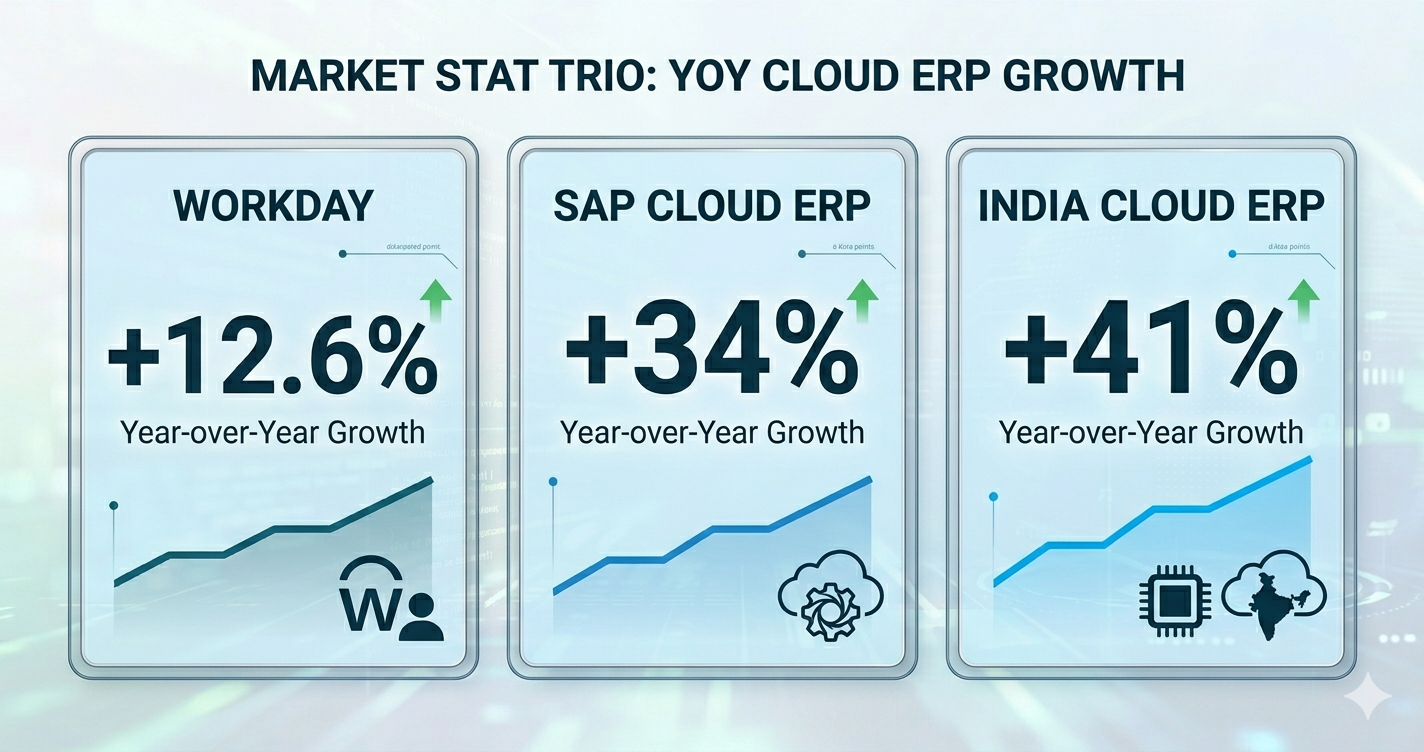
What used to be enterprise-only software features in 2023 — real-time dashboards, role-based access controls, custom workflows, embedded AI agents — is now available to mid-market businesses (30-500 employees) at SaaS price points. Indian cloud ERP adoption grew 41% year-on-year in 2025. Workday Q1 FY26 reported +12.6% revenue growth driven primarily by mid-market adoption. SAP cloud ERP suite revenue was up 34%. The combination of mature platforms, declining unit economics, and the AI capability layer means 2026 is the cheapest moment in history to modernise mid-market operations. Mid-market businesses that consolidate and modernise this year will compound for the next decade; those that wait will buy from a position of weakness in 2027 when AI agent contracts complicate every procurement.
What was enterprise-only software 3 years ago is now mid-market-ready.
What was a ₹5-crore implementation 5 years ago is now a ₹50-lakh engagement.
India's cloud ERP adoption grew 41% year-on-year in 2025. Workday's Q1 FY26 reported +12.6% revenue, +13.4% subscription growth — driven almost entirely by mid-market adoption. SAP's cloud ERP suite revenue was up 34% in the same quarter.
The combination of mature platforms, declining unit economics, and a maturing AI capability layer means 2026 is the cheapest moment in history to modernise mid-market operations. Here's why — and what mid-market founders should do about it.
The Market Shift Driving This Moment
Three structural forces have converged in 2026:
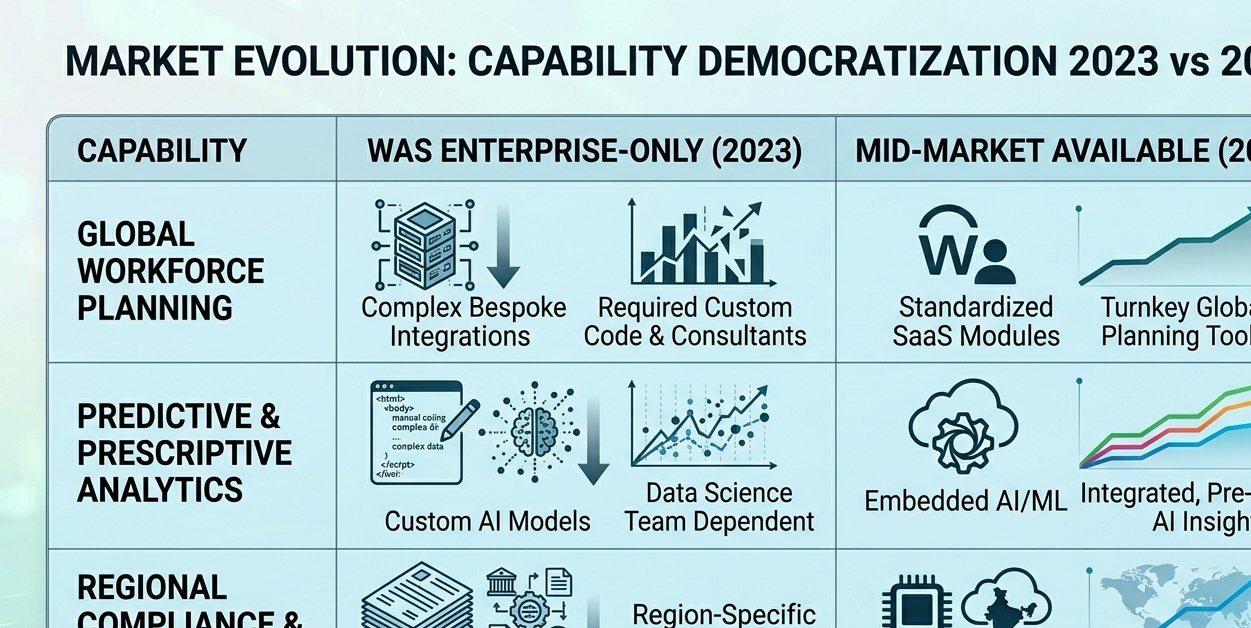
1. Mid-market features at SaaS price points. Capabilities that required enterprise budgets in 2023 — real-time multi-source dashboards, fine-grained role-based access controls, custom workflow engines, embedded AI assistants, multi-location data synchronisation — are now standard features in mid-market software. The pricing has dropped 40-60% for equivalent capability.
2. Cloud-native architecture is mature. The infrastructure layer is now reliable enough that mid-market businesses don't need to host their own servers, manage their own backups, or hire their own DevOps team. AWS, GCP, and Azure mid-market tiers make the underlying compute cost a rounding error.
3. The AI capability layer is now real. Embedded AI for document search, workflow automation, predictive analytics, and customer support has moved from demo to production-grade. JB Pharma's chatbot achieving 75% time reduction is not exotic in 2026 — it's the new baseline.
What Mid-Market Businesses Can Now Afford
The list of capabilities that were enterprise-only in 2023 and are now mid-market-affordable:
- Real-time consolidated dashboards across sales, operations, finance, and HR (was ₹15-30 lakh, now ₹3-6 lakh)
- Role-based access controls with audit logs (was enterprise add-on, now baseline)
- Custom workflow engines that match your specific business (was ₹40-80 lakh, now ₹10-20 lakh)
- Embedded AI assistants for internal knowledge search (was experimental, now production-ready at ₹15-30 lakh)
- Multi-location data synchronisation for businesses with 2+ branches (was ERP-tier, now standard)
- Live mobile apps for field teams that work offline (was bespoke development, now templated)
- WhatsApp Business API integration for customer engagement (was special integration, now standard)
- Three-level access control for sensitive data (HR, finance, executive) (was enterprise security, now standard)
The capability lift available to a mid-market business spending ₹50 lakh in 2026 is roughly equivalent to a ₹2-crore enterprise spend in 2023.
Why "Wait and See" Is the Expensive Choice
Many mid-market founders are still in a wait-and-see posture on modernisation. Three reasons that posture compounds expensively:
1. The Operational Tax Compounds Monthly
A mid-market business running on Excel, WhatsApp, and 14 disconnected SaaS tools is paying an operational tax every month:
- 20+ hours per week of founder time on coordination and reporting
- Lost revenue from missed follow-ups and customer churn
- Hiring costs to compensate for productivity gaps
- Decisions made on stale or wrong data
Conservatively, this is ₹15-30 lakh per year for a 50-person business. Waiting another 12 months means paying another year of that tax.
2. Competitor Advantage Is Real
Indian mid-market competitors who modernised in 2024-25 are now compounding. They have real-time visibility, faster decision cycles, customer experiences mid-market peers can't match. The gap widens monthly.
This is not hypothetical. Our case study work across healthcare, financial services, and logistics consistently shows the competitor who modernised first has 30-50% advantage on operational metrics that compound over years.
3. AI Agent Contracts Will Complicate 2027 Procurement
OpenAI Frontier, Google Gemini Enterprise Agents, and the rest of the AI agent platform wave will make 2027 enterprise procurement more complex, not less. AI vendor lock-in concerns (76-81% of enterprises worried per 2026 CIO surveys) will tighten contract terms. Modernising on top of a clean operational foundation in 2026 is easier than retrofitting AI into a chaotic operation in 2027.
Build vs Buy Decision Tree for Mid-Market in 2026
The framework I'd recommend any mid-market founder run before any procurement:
Buy off-the-shelf when:
- The capability is commodity (email, accounting basics, simple CRM, video conferencing)
- Your workflow matches the off-the-shelf product's assumptions
- The data volume is low enough that integration debt is manageable
- You have a clear exit path if the vendor disappears
Build custom when:
- The workflow is specific to your business or industry
- You need data captured at point-of-action across departments
- You need real-time multi-source dashboards leadership actually uses
- You need embedded AI that knows your specific business context
- You're consolidating 8-15 disconnected tools
For most mid-market businesses, the right answer is a hybrid: buy commodity, build custom for the operational core. The mid-market software wave of 2026 makes both choices cheaper than ever before.
The Honest Cost Numbers for Mid-Market Modernisation in 2026
For a typical Indian mid-market business (50-200 employees, single or multi-location):
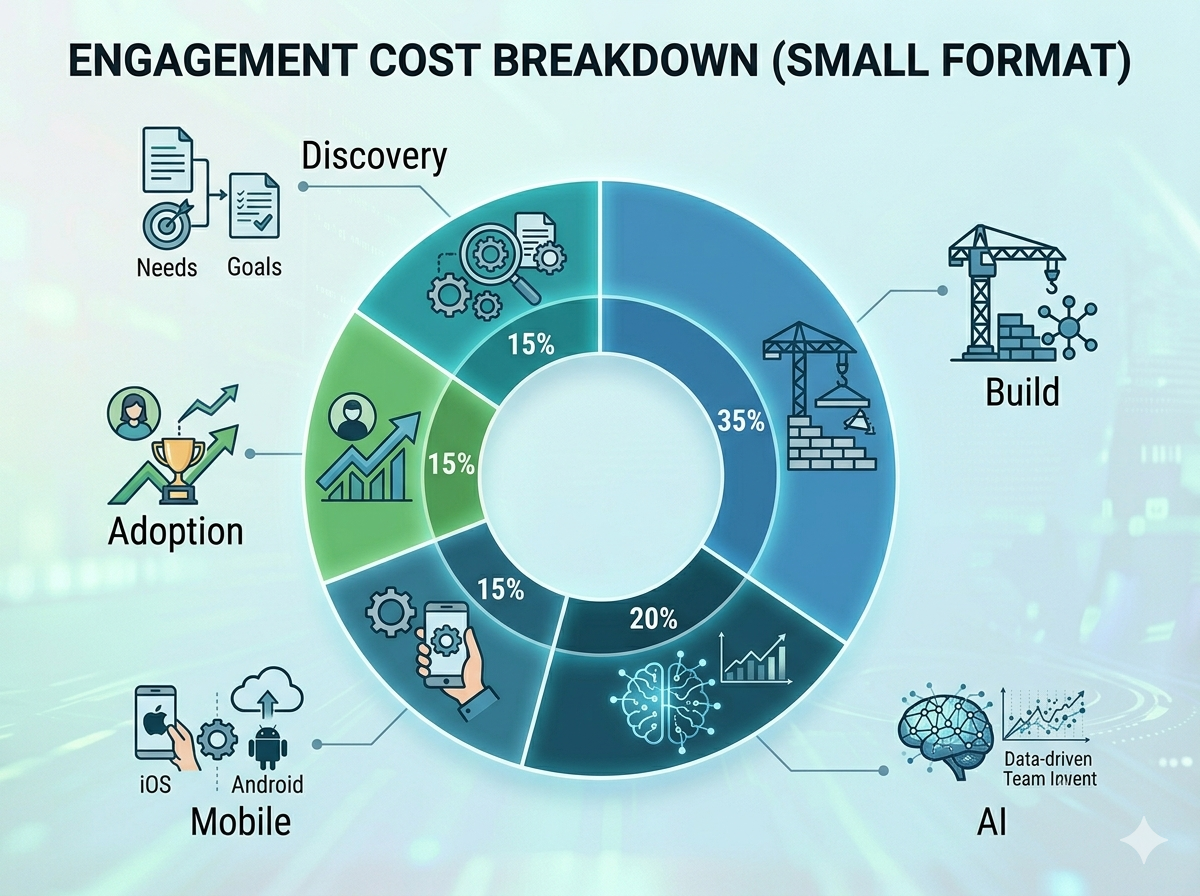
- Discovery + workflow mapping: ₹3-6 lakh (4-6 weeks)
- Custom platform build (core ERP + workflows + dashboards): ₹30-60 lakh (12-16 weeks)
- AI assistant layer (RAG-based internal knowledge bot): ₹15-30 lakh
- Mobile app for field teams: ₹15-25 lakh
- On-site adoption support (4-6 weeks post-launch): ₹6-10 lakh
Total first-year engagement: ₹70 lakh to ₹1.3 crore depending on scope. ROI typically within 8-14 months based on operational tax recovered.
For international mid-market clients (US, GCC, Singapore, Australia) the equivalent engagement scope runs at roughly 30-40% of US/UK domestic vendor pricing while delivering 80%+ utilisation — the structural reason Indian IT services firms are now winning international mid-market work.
FAQ: Mid-Market ERP Modernisation in 2026
How much does mid-market ERP cost in 2026 for a 50-200 employee business?
Total first-year engagement for a custom-built mid-market ERP (including discovery, build, integration, AI layer, and on-site adoption support) runs ₹70 lakh to ₹1.3 crore depending on scope and complexity. ROI is typically realised within 8-14 months from the operational tax recovered (20+ founder hours per week, reduced manual work, faster decisions).
Should mid-market businesses build custom or buy off-the-shelf?
Buy commodity (email, accounting basics, simple CRM, video conferencing). Build custom for the operational core where your business has workflow specificity. For most mid-market businesses, hybrid is the right answer — and 2026 pricing makes the custom side affordable for the first time.
Cloud or on-prem in 2026 for mid-market?
Cloud, almost always. The infrastructure cost has dropped 40-60% versus on-prem TCO, and the security/compliance posture of major cloud providers now meets or exceeds what most mid-market businesses can manage in-house. Exceptions: regulated industries with explicit data residency mandates, or businesses with existing significant on-prem capital investment.
How long does a mid-market modernisation engagement actually take?
Discovery + workflow mapping: 4-6 weeks. Build: 12-16 weeks. UAT: 2 weeks. Adoption support: 4-6 weeks. Total: 5-7 months from contract signing to fully adopted production. Anyone promising "3-month full deployment" for a custom mid-market ERP is overselling.
Will the AI agent wave (Frontier, Gemini Enterprise) change this math in 2027?
Yes — and not in the buyer's favour. AI agent contracts in 2027 will come with more vendor lock-in, tighter exit terms, and procurement complexity. Modernising in 2026 on top of a clean operational foundation means AI agents become an additive capability later. Waiting until 2027 means trying to retrofit AI into chaos.
What To Do Next
For mid-market founders considering modernisation in 2026:
- Run a workflow mapping audit (4-6 weeks) before any vendor selection
- Get 3 build-side and 3 buy-side quotes — the pricing variance will surprise you
- Tie vendor contract payment to 6-month utilisation thresholds
- DM "MODERNISE" on LinkedIn for our 1-page mid-market modernisation cost benchmark
The cost of waiting is rising. Modernise now.