
India IT Services AI Opportunity for Mid-Market (2026)
Quick Answer
NASSCOM's 2026 Strategic Review confirms India's IT services industry has shifted decisively from AI experimentation to AI industrialisation. While Tier-1 Indian IT giants (TCS, Infosys, Wipro, HCLTech) continue to chase Fortune 500 deals, the most underserved global opportunity is the mid-market — businesses with USD 10-200 million annual revenue across the Middle East, US, Singapore, and Australia. These markets are too small for Tier-1 attention and too sophisticated for low-cost freelancers. Indian mid-tier IT firms with senior delivery talent, English business fluency, 4-6 hour timezone overlap, and on-site delivery models are structurally positioned to win the next decade. The window is open through 2027-28; by 2029, Tier-1 firms will likely move down-market and the opportunity will close.
NASSCOM's 2026 Strategic Review confirmed what we've been seeing in the market for 18 months.
India's IT services industry has shifted decisively from AI experimentation to AI industrialisation. The experiments are over. The model providers and consultancies are now competing for production-grade enterprise AI deployments.
But here's what NASSCOM doesn't say loudly enough: the biggest opportunity isn't Fortune 500. It's the mid-market — globally.
For Indian IT services firms in the right size range and with the right delivery posture, 2026 is the start of a 3-4 year window where mid-market international expansion is both unprecedented and structurally underserved. After 730+ projects at Accucia, including continuing engagements across India, the US, UK, UAE, Saudi Arabia, Australia, Singapore, and Malaysia, this is the opportunity I see most clearly.
The NASSCOM 2026 Frame: From Experimentation to Industrialisation
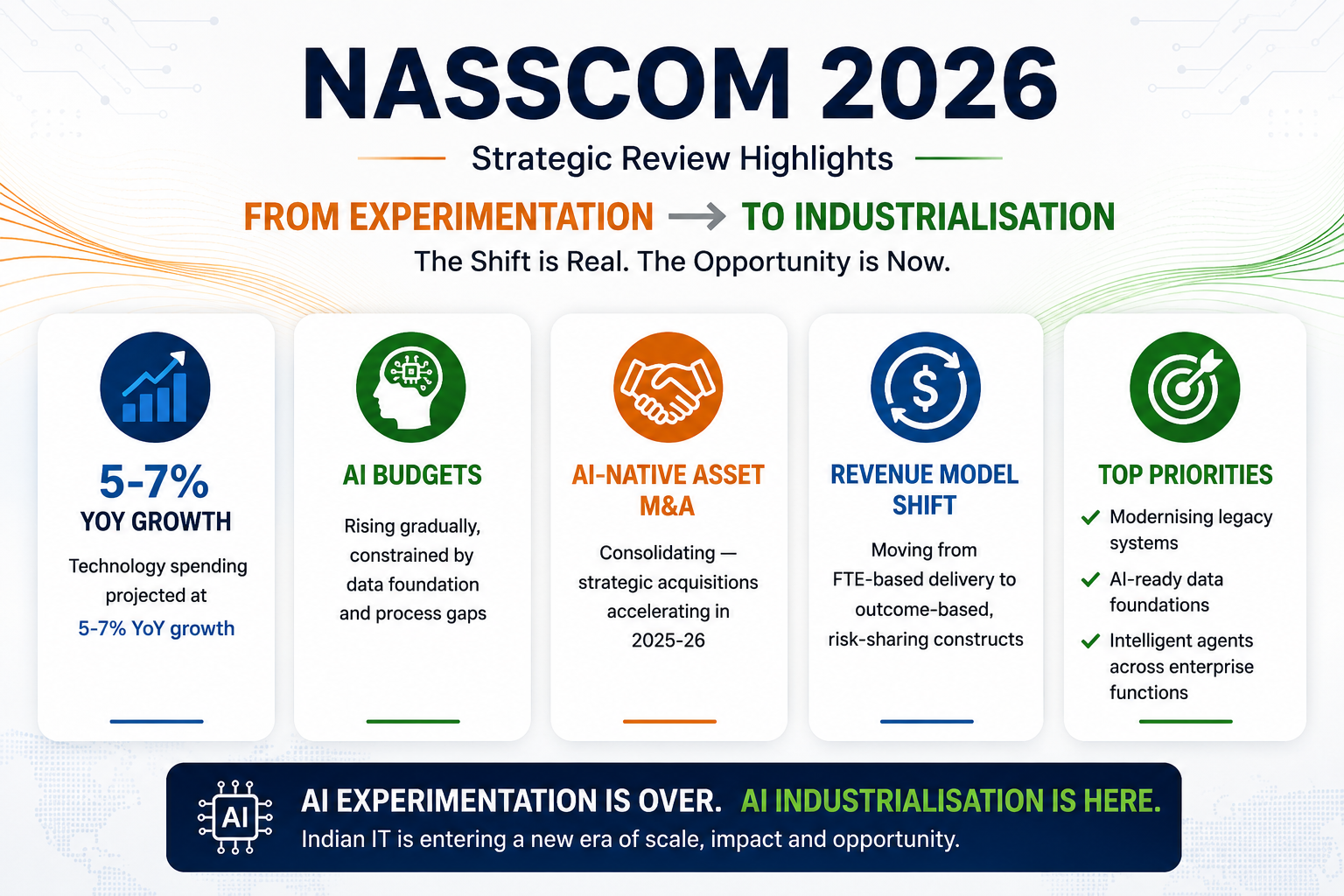
NASSCOM's 2026 Strategic Review put concrete numbers on what most Indian IT operators have been observing:
- Technology spending projected at 5-7% YoY growth
- AI budgets rising gradually, constrained by data foundation and process gaps
- AI-native asset M&A consolidating — strategic acquisitions accelerating in 2025-26
- Revenue model shift — moving from FTE-based delivery to outcome-based, risk-sharing constructs
- Top priorities identified: modernising legacy systems, AI-ready data foundations, intelligent agents across enterprise functions
The shift is real and irreversible. The question for Indian IT firms isn't whether to embrace it — it's where to compete.
Why Mid-Market Is Underserved
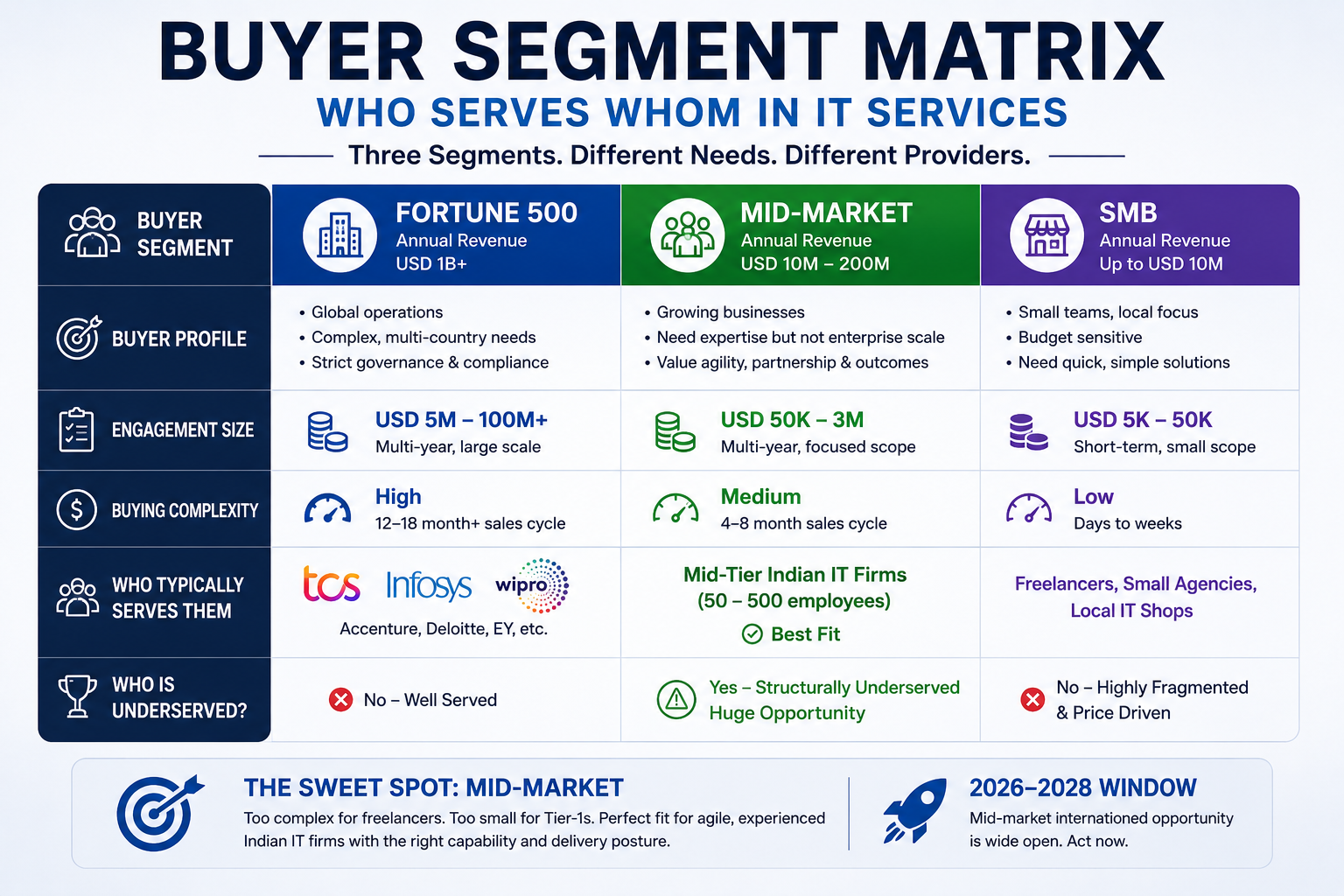
Tier-1 Indian IT firms (TCS, Infosys, Wipro, HCLTech, Tech Mahindra): built for Fortune 500 procurement processes, headcount-driven pricing, multi-year engagements with enterprise-scale governance. Their unit economics don't work below USD 5M annual contract value.
Global Tier-1 consultancies (Accenture, Deloitte, EY): similar — focused on Fortune 500 and large enterprise.
Low-cost freelancers and small Indian agencies: insufficient depth for sophisticated mid-market needs.
Local IT shops in the Middle East, US, Australia: limited talent depth and high cost structure relative to capability.
This leaves the mid-market — businesses with USD 10-200 million annual revenue, complex enough to need real expertise but small enough that Tier-1 firms don't pursue them — structurally underserved across the Middle East, US, Singapore, Australia, and parts of Europe.
Indian mid-tier IT services firms with the right posture sit in the sweet spot.
What Mid-Market AI Actually Looks Like (Not What the Slides Say)
Retrieval-Augmented Generation (RAG)
AI that pulls from a business's own documents and answers questions with citations. Best for: knowledge search, employee onboarding, customer support that needs to be accurate. Real example: a pharma chatbot deployment that produced 75% reduction in employee search time, 95% answer accuracy, 8-month payback.
Workflow Automation
AI that triggers actions across systems based on rules and context. Best for: invoice processing, approval routing, data entry, customer follow-up sequences.
Embedded AI Copilots
AI built into existing tools (ERP, CRM, mobile app) that suggests next actions to users. Best for: augmenting expert users in finance, sales, operations.
Model Context Protocol (MCP) for Live Business Data
The newest pattern: AI assistants that can query a business's live operational data via MCP servers. Real example: a fast-growing Mumbai real estate company on a current Accucia retainer is having an MCP server built so management can do data analysis and business projections inside Claude on their own live ERP data — without engineering involvement.
Agentic Workflows (Still Maturing)
Multi-step autonomous AI that decides what action to take next. Promising but still unreliable for long-running workflows.
The mid-market right answer is usually 2-3 of the above in different parts of the operation. Almost never "one enterprise AI agent platform" as a single purchase.
The 5 Verticals Leading Mid-Market AI Adoption
1. Manufacturing. Predictive maintenance, quality control, supply chain optimisation.
2. Healthcare. RAG-based document search, clinical decision support with citations. Indian clinician AI adoption tripled in the last year.
3. Retail and E-commerce. Dynamic pricing, demand forecasting, customer LTV scoring, returns fraud detection.
4. Financial Services. Risk scoring, fraud detection, customer onboarding automation.
5. Logistics. Route optimisation, delivery prediction, warehouse efficiency, customer status communication.
Mid-market businesses in all five verticals across India, the GCC, the US, Singapore, and Australia are now ready buyers.
Why Indian Mid-Tier IT Wins on This
Six structural reasons:
- Cost structure: senior delivery talent at 30-40% of US/UK rates, without quality compromise
- Timezone overlap: 4-6 hour daily overlap with both GCC and US East Coast
- English business fluency: zero translation friction
- Track record depth: 8+ year Indian IT firms with 500+ project track records have the operational maturity mid-market buyers need
- Engagement model fit: on-site delivery, embedded staff, multi-year partnerships
- Right size: mid-tier Indian IT firms (50-500 employees) match mid-market buyer expectations
The Window: 2026-2028
The mid-market international opportunity is wide open today. Three forces will close it over the next 3-4 years:
Force 1: Tier-1 Indian IT firms will move down-market as their large-deal pipeline matures. By 2028, expect TCS / Infosys / HCLTech to be competing for USD 1-3M deals they ignore today.
Force 2: Local US, UK, Australian, GCC IT firms will build offshore Indian delivery centres, eroding the cost advantage of independent Indian mid-tier firms.
Force 3: AI consultancies acquired by model providers (OpenAI/Tomoro, etc.) will reshape the implementation services market.
Indian mid-tier IT firms that establish strong mid-market international positions in 2026-27 will compound through the rest of the decade.
FAQ: India IT Services for Mid-Market International AI
Why India specifically for mid-market AI services?
The combination of senior talent at 30-40% of US/UK rates, 4-6 hour timezone overlap with both GCC and US, English business fluency, mature operational track records, and mid-market-fit engagement models. No other geography matches this combination at scale.
What are typical costs for mid-market AI engagements with Indian firms?
For a mid-market business (50-500 employees) implementing a custom AI deployment (RAG + workflow + integration), total first-year engagement runs USD 80-300K depending on scope. The equivalent US-based engagement typically runs 2.5-4x higher.
What about timezone challenges for international clients?
4-6 hour daily overlap is real — enough for live collaboration sessions, daily standups, and rapid response. Our current engagements span US East Coast, GCC, Singapore, Australia successfully.
How do mid-market buyers evaluate Indian IT services quality?
Same criteria as any IT services partner: track record, client references in their geography, engagement model (on-site? embedded?), 6-month utilisation rate on past deployments, vendor lock-in posture.
Will the mid-market opportunity close before my business can act on it?
The window is 2026-2028 for first-mover advantage. After 2028, the competitive environment becomes harder as Tier-1 Indian firms move down-market and global firms expand offshore.
What To Do Next
For mid-market businesses in GCC, US, Singapore, Australia evaluating AI services partners in 2026:
- Add Indian mid-tier IT firms to your shortlist alongside local providers
- Apply the same evaluation rigour: track record, references, engagement model, utilisation rates, lock-in posture
- DM "INTERNATIONAL" on LinkedIn for our 1-page partner evaluation framework
Discover the AI opportunity before the market catches up.