How the pharma client's AI Chatbot Cut Search Time by 75% — The Full Case Study
Quick Answer
A large Indian pharmaceutical organisation cut employee document-search time by 75% by deploying a Retrieval-Augmented Generation (RAG) AI chatbot embedded inside their existing mobile app. The chatbot was trained only on approved internal documents (SOPs, policies, incentive structures), enforced three-level role-based access control, cited the source document for every answer, and was deployed with 6 weeks of on-site adoption support. Outcomes after 18 months: 75% reduction in search time, 95% answer accuracy across departments, 40% faster new-hire onboarding, full investment payback in 8 months, and zero security incidents. The architectural choices — embedded inside an existing tool, RAG on internal-only documents, citations mandatory, three-level access — were what made the numbers possible. The LLM choice itself was secondary.
the pharma client's workforce was losing hours every week searching for SOPs, policies, and incentive documents scattered across departments.
12 months later, that time was down by 75%. Accuracy was at 95%. New-hire onboarding was 40% faster. The entire investment paid back in 8 months. Zero security incidents.
Here's exactly how — the architectural choices, the prerequisite work, what we'd do differently in 2026, and what other mid-market enterprises can take from it.
The Problem We Were Asked to Solve
Thousands of internal documents — Standard Operating Procedures, departmental policies, incentive structures, training materials, regulatory guidance — were scattered across departments at the pharma client. Some lived on shared drives. Some in email attachments. Some in printed manuals. Some only in the head of one senior staff member.
Every time an employee needed something — a quick policy lookup, a regulatory reference, an incentive calculation — they faced three bad options:
- Dig through folders for 20-40 minutes
- Email or message a colleague (who often took hours to reply)
- Make an educated guess and risk being wrong
Senior staff were burning hours every week answering the same questions for new hires. New hires were taking 4-6 weeks to feel productive because basic information was so hard to find. The cost wasn't a dramatic ERP failure — it was a quiet, expensive productivity tax that compounded every day.
The Architectural Choices That Worked
Choice 1: Embed inside the existing app — never introduce a new tool
the pharma client already had an internal mobile app the workforce opened daily for HR, attendance, and operational tasks. We embedded the AI chatbot inside that app.
This single decision eliminated 80% of the typical AI adoption friction. No new login. No new password. No new place to remember to check. The bot lived where the team already lived.
Most AI vendors push for a standalone product because it's easier for them to position and price. The right architectural choice for a mid-market enterprise is almost always the opposite — embed inside the workflow people already use.
Choice 2: Train ONLY on approved internal documents
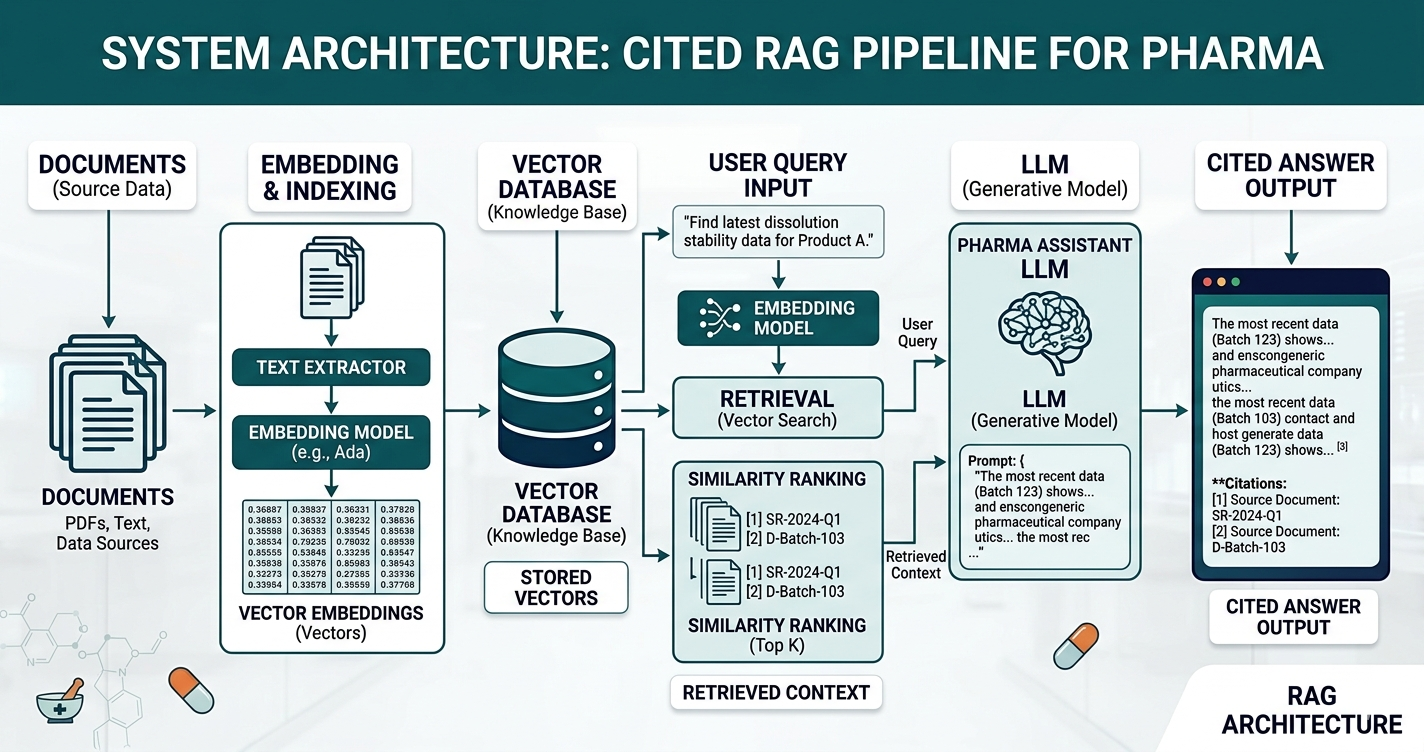
The chatbot never accessed the public internet. Every answer came from the pharma client's own SOPs, policies, and training materials — vetted and approved by the relevant department before being added to the training set.
This eliminated hallucination risk for a regulated industry where a wrong answer about, say, an SOP could have compliance consequences. RAG (Retrieval-Augmented Generation) made this possible — the LLM retrieved relevant document chunks before generating an answer, grounding every response in real internal source material.
Choice 3: Source citation mandatory on every answer
Every answer the bot generated included a citation to the specific source document — page number, section, last-updated date. Employees could click through to verify the source themselves. Auditors could trace any AI-generated answer back to the originating SOP.
This single feature — citations — turned the chatbot from "a black box that sometimes hallucinates" into "a faster way to find the document you would have found anyway, but with the answer summarised." Adoption shot up once employees realised they could trust the answers.
Choice 4: Three-Level Role-Based Access Control
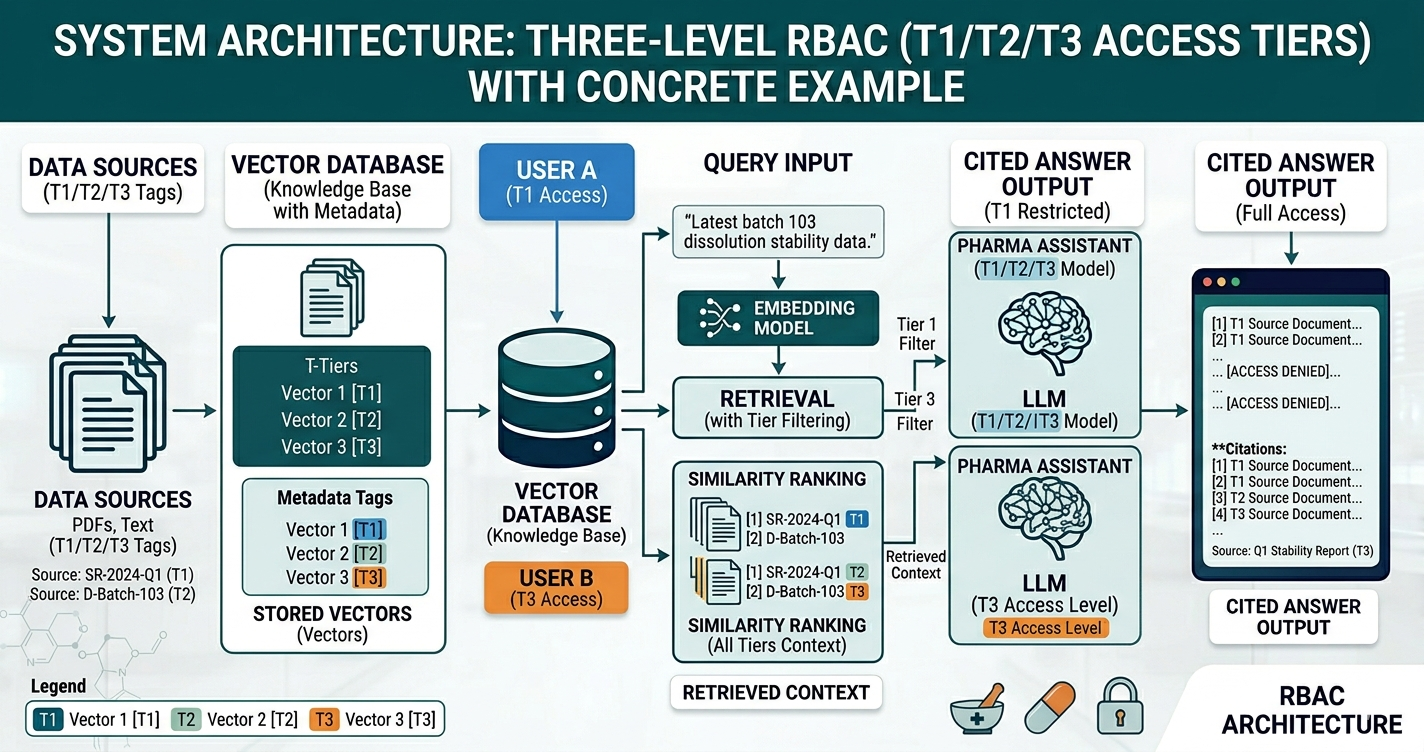
- Tier 1: General operational documents — visible to all employees
- Tier 2: Department-specific (HR policies, finance procedures, commercial pricing) — visible only to those department members
- Tier 3: Executive/strategic documents — visible only to senior leadership
The chatbot enforced this at the retrieval layer, not the answer layer. That means the bot literally couldn't retrieve restricted documents for unauthorised users — there was no path to leak sensitive information even through clever prompt engineering.
This is what passed the pharma client's security review, what kept the deployment compliant with internal data governance, and what produced the zero-security-incident record.
Choice 5: Tech stack chosen for cost discipline
MERN stack (MongoDB, Express, React Native, Node.js) for the chatbot layer. ChatGPT APIs (with internal data routing) for the generation. Standard cloud hosting. Nothing exotic.
The right tech stack for a mid-market enterprise is the one that's maintainable by mid-market engineers, not the one that requires a PhD to debug. We picked accordingly.
The Prerequisite Work That Made the Build Possible
Before writing a line of bot logic, the Accucia team spent 6 weeks doing prerequisite work:
- Document audit — what documents exist, where they live, who owns them, who's authorised to update them
- Workflow mapping — what questions employees actually ask, what answers they currently get, what time they currently spend
- Access policy design — three-level RBAC mapped to actual department structure
- Training data preparation — converting unstructured documents into RAG-ready chunks with metadata
- UAT script design — what success looks like, who tests, what we'd consider go-live ready
Without this prerequisite work, the bot would have failed in production within 30 days. With it, the deployment held.
The Build — 12 Weeks
Discovery and prerequisite: 6 weeks. Build: 12 weeks. UAT: 2 weeks. Launch: 1 day. Embedded adoption support: 6 weeks. Total from contract signing to fully adopted production: ~6 months.
Most enterprise AI vendors promise 30-day deployments. They deliver demos, not adopted production systems. The honest timeline is 4-6 months for any AI deployment that actually changes how the team works.
The Numbers After 18 Months
- 75% reduction in time spent searching for information across the workforce
- 95% answer accuracy measured by random sample audit
- 40% faster new-hire onboarding (time-to-productivity for new recruits)
- 8-month full investment payback
- Zero security incidents since launch
- Continued usage at 80%+ weekly active rate 18 months in
The 8-month payback number is the one that matters most for mid-market CFOs. AI deployments are not a 3-year ROI proposition when done right. They can produce measurable financial return inside a year.
What We'd Do Differently in 2026
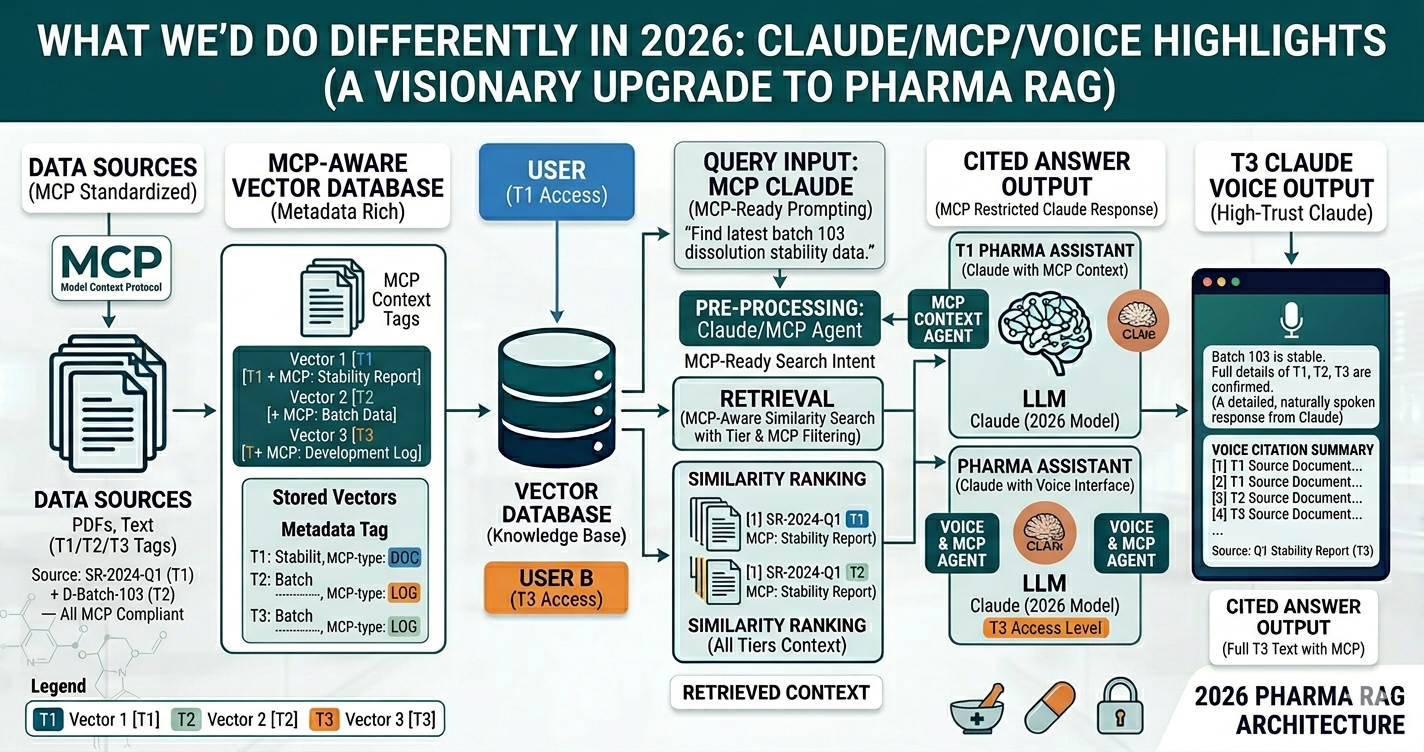
If we were building this today, three architectural updates:
- Multi-model option — Claude / Anthropic API as an alternative to OpenAI for the generation layer, giving flexibility on model provider lock-in (rising concern in 2026)
- MCP server for live operational data access (so the bot can answer questions about current inventory, not just static policies)
- Voice-note input so senior leadership can query the bot hands-free
We're currently building exactly this stack for a fast-growing Mumbai real estate retainer client (8-10 dedicated Accucia engineers, MCP server in active development). The pharma chatbot architecture from 2023 is now the foundation we extend from.
What Mid-Market Enterprises Can Take From This
You don't need to be a pharma company to apply these lessons. Any mid-market enterprise with a workforce drowning in information search — healthcare, financial services, manufacturing, logistics, retail — can use the same architectural pattern:
- Embed the AI inside the tool your team already uses
- Train only on your approved documents
- Require source citations on every answer
- Enforce three-level role-based access at the retrieval layer
- Plan for 6 weeks of on-site adoption support after launch
FAQ: Pharma AI Chatbot Deployment
How long does pharma AI take to deploy?
4-6 months from contract signing to fully adopted production. Anyone promising 30 days is selling you a demo. Discovery and prerequisite work alone needs 6 weeks; the build itself is 10-12 weeks; on-site adoption support is 6 weeks.
What does pharma AI cost?
For a mid-sized pharma organisation, total first-year engagement cost (discovery + build + integration + adoption support) is typically ₹50 lakh to ₹1.2 crore depending on scope, data complexity, and integration depth. The the pharma client deployment saw 8-month payback — meaning the financial return inside 12 months exceeded the entire investment.
What about pharma regulatory compliance (CDSCO, USFDA, DISHA)?
The architectural choices required: source citation on every answer (so any output can be traced back to vetted source documents), role-based access at the retrieval layer (no clever prompt can extract restricted information), audit logs for every interaction, data residency on Indian soil for India-applicable data. All of this needs to be designed in from day one, not retrofitted.
Will pharma AI replace pharma staff?
No. The right framing is "AI takes the search work, your team takes the decision work." the pharma client did not reduce headcount post-deployment. The 75% time savings went into higher-value activities — clinical training, customer engagement, compliance work — that staff had previously been too busy for.
Can other industries use this same architecture?
Yes. The pattern is industry-agnostic: embed inside existing app, RAG on internal documents, mandatory citations, three-level RBAC, embedded adoption support. We've now adapted this same pattern for healthcare diagnostics, real estate ERP, government internal knowledge banks, and financial services. The architectural discipline transfers; the documents and workflows change per industry.
What To Do Next
For pharma, healthcare, or any enterprise CIO considering an internal AI deployment:
- Run the prerequisite work first — document audit, workflow mapping, access policy
- Demand source citations and three-level RBAC as non-negotiable architectural requirements
- Plan for 4-6 months total deployment timeline
- DM "PHARMA AI" on LinkedIn for our 1-page case study brief
Want a conversation, not a brief? Mr. Sumeet Katariya (CEO Accucia) takes most enterprise AI discovery calls personally. 30 minutes, no slides — an honest assessment of whether your business is ready to deploy.
Want secure enterprise AI that teams actually use? Connect with Accucia today.