
How On-Site Software Delivery Actually Works (The Accucia Engagement Model)
Quick Answer
On-site software delivery means physically stationing senior delivery staff inside the client's office during active rollout — typically for 4-6 weeks post-launch — rather than handing over code and switching to remote AMC support. At Accucia, on-site delivery includes 2-3 team members embedded at the client site, weekly iteration based on real usage, sign-off gates at every project phase, multiple training rounds per role, and a single delivery team that stays from discovery through 12-month adoption rather than handing the engagement to a separate "support" desk. This model costs more than remote AMC + quarterly visits — and produces 6-month utilisation rates above 80% versus the industry average of 25-35%.
"On-site support" is the most over-promised phrase in enterprise IT.
Every vendor says it. Most of them mean: a remote team in another city, an AMC email address, and a junior engineer who visits once a quarter to ask if everything's fine.
At Accucia, on-site means something specific — and it's the engagement model that produced 10-15 connected projects inside one Maharashtra government authority, an award at the Chief Minister level, and continuing partnerships measured in years rather than project cycles.
Here's exactly what on-site software delivery looks like in practice — for any enterprise CIO evaluating vendors in 2026.
The Over-Promised Phrase
Walk into any vendor presentation in 2026 and you'll hear the phrase "on-site support" within the first 10 minutes. Almost never does the vendor specify what it actually means.
When pressed, most vendors mean one of these things:
- A remote team that's available on email during business hours
- A "dedicated success manager" who's actually managing 30+ accounts
- Quarterly site visits from a junior engineer for a half-day each
- An AMC contract that activates if you log a ticket
None of these are on-site delivery. They're remote delivery with occasional visits.
Real on-site delivery is structurally different — and the difference shows up in the only metric that matters: the 6-month utilisation rate of the software the vendor delivered.
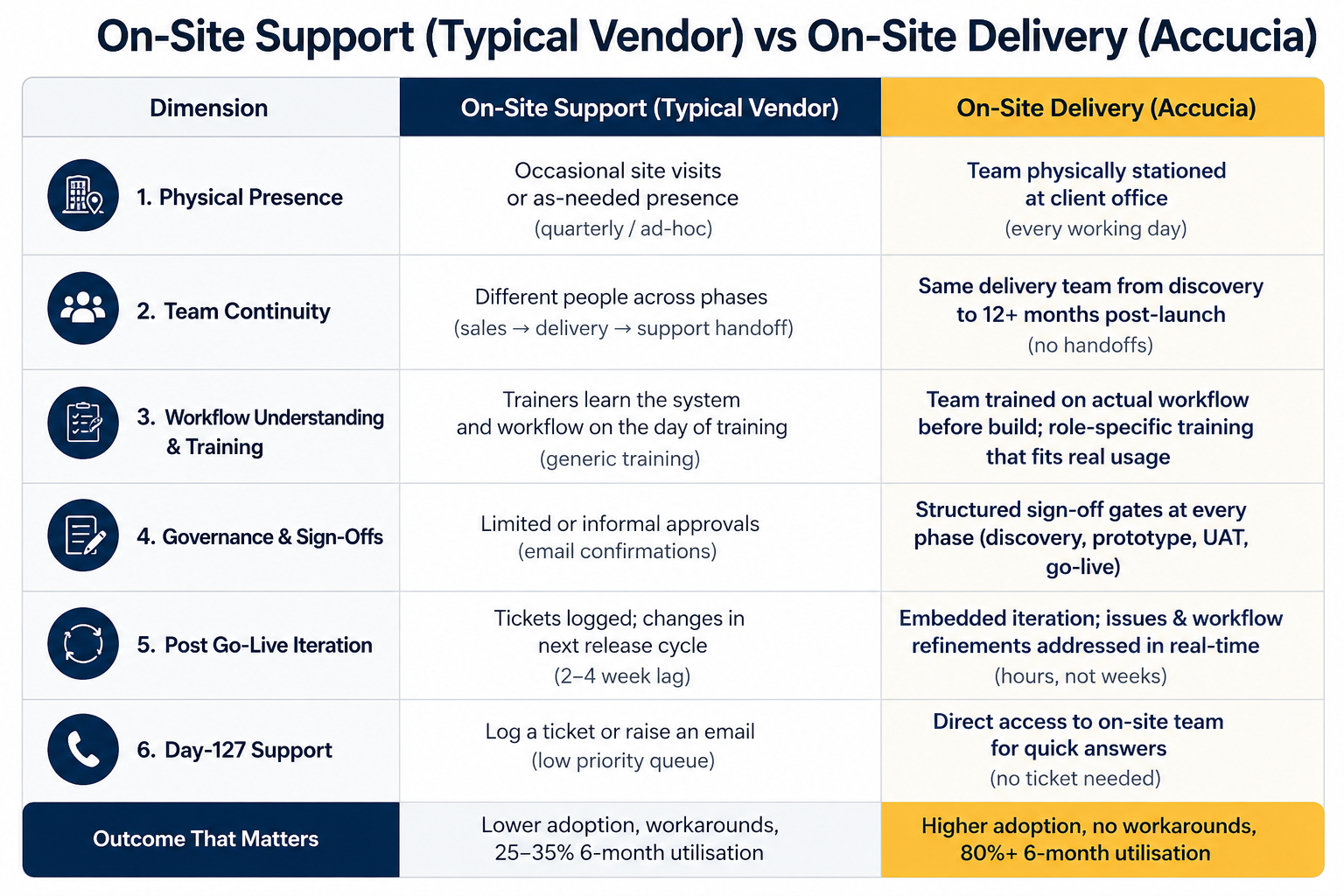
What On-Site Means at Accucia (With Examples)
1. Staff Physically Stationed Inside the Client's Office
Two team members sit at the client's own premises — at desks inside their IT department or operations floor — during every active rollout phase. Not visiting. Stationed. Every working day.
For the a Mumbai government housing authority engagement in Mumbai, two Accucia staff have been stationed inside the housing authority's offices for the duration of the active rollout phases across 10-15 projects. This isn't an emergency response posture — it's the default operating model.
The on-site team isn't there for crises. They're there for the small things — the section officer who has a question that doesn't feel "important enough" to log a ticket, the workflow tweak that the original spec didn't cover, the training refresher that one team member needs for the third time.
2. Same Delivery Team — Not a Rotating Bench
The people who designed the workflow stay with it through build, UAT, go-live, and iteration. No "handover to support" after sign-off. The on-site team and the remote development team are one unit — not two organisations passing tickets to each other.
This continuity is what allows the team to make small product decisions based on real usage. A typical mid-market software vendor has 3-4 different teams involved across a project lifecycle: sales, discovery, development, support. Each handoff loses context. Accucia keeps the same senior delivery person engaged from discovery through 12-month adoption.
3. Trained on the Department's Actual Workflow Before They Touch the System
Before any officer or employee touches the new system, the on-site team has already shadowed sections, watched the real approval paths, and mapped where data gets lost. Training sessions are run by people who know the department — not by trainers flown in from outside who learned the system that morning.
This is what turns training from a one-hour Zoom call into a real adoption mechanism. When the trainer can say "I know your role uses this differently from the spec — let me show you the path that actually works for you," the training lands.
4. Sign-Off Gates at Every Project Phase
Discovery document signed off before prototyping. Prototype signed off before build. UAT signed off before go-live. Every phase has a written, dated, officer-signed record.
For government clients, this is non-negotiable — government files demand that rigour. For private mid-market clients, it's just as valuable: it prevents the "we never agreed to this" conversation that destroys most vendor relationships at month 9.
5. Embedded Iteration Post Go-Live
The first 6 weeks after go-live are where adoption either holds or fails. During this period, bugs, change requests, and workflow refinements get triaged at the client's premises — not routed through a ticketing portal to be addressed at next quarter's release.
The on-site team is contractually committed to make the system fit, not to defend the original scope. This is why the engagement model produces high utilisation: the system that goes live in week 1 is not the same system being used in week 8 — it's been tuned weekly based on real usage.
6. Day-127 Phone Call
The day a field officer or branch manager has a question that doesn't feel "priority enough" to log — we answer.
This is the unwritten part of the engagement, and it's what separates the clients who stay for years from the clients who leave at the first AMC renewal. Adoption lives or dies in the moment of a quiet, unlogged question — and only an embedded delivery posture catches it.
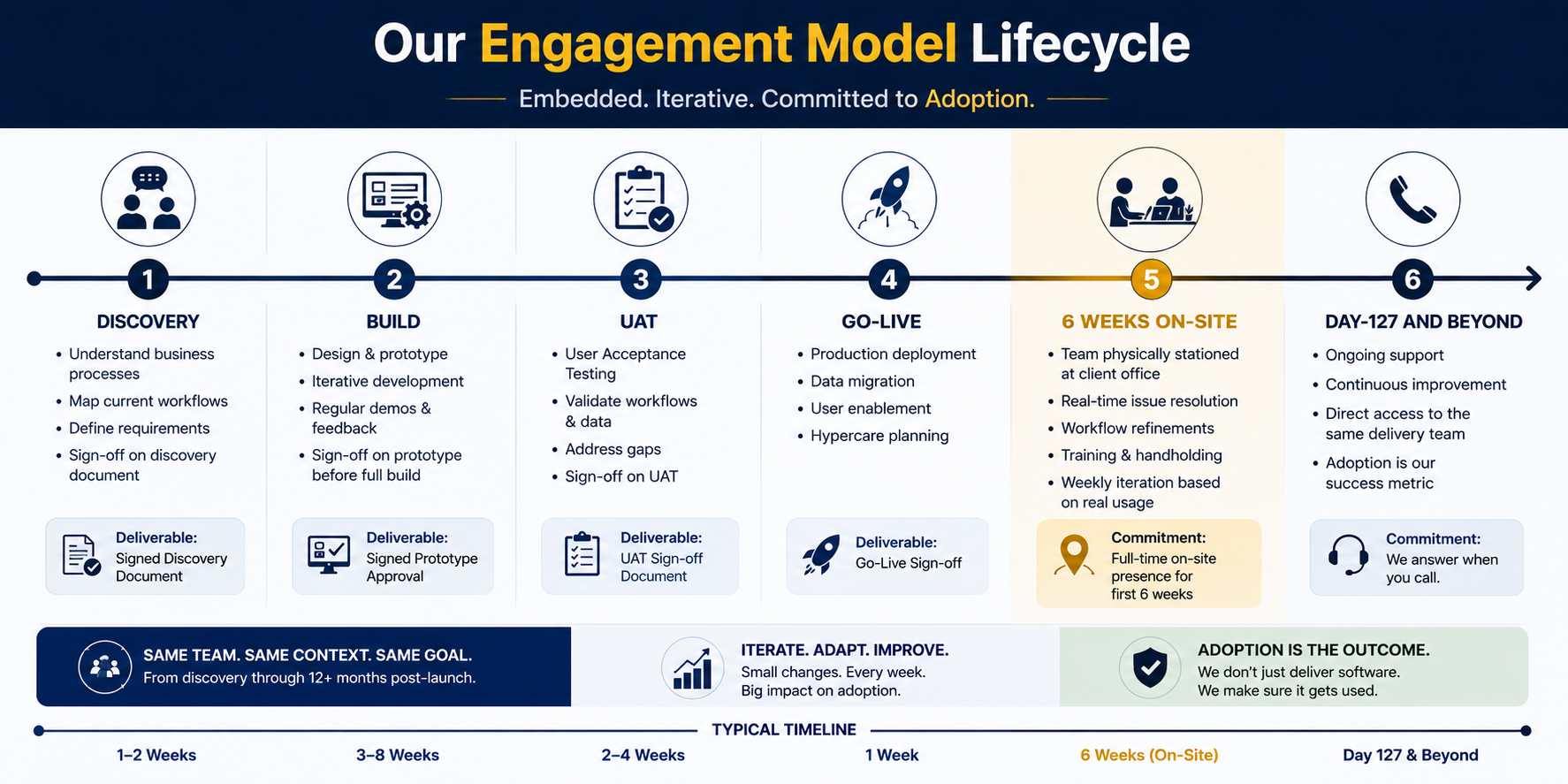
Why On-Site Delivery Produces Higher 6-Month Utilisation
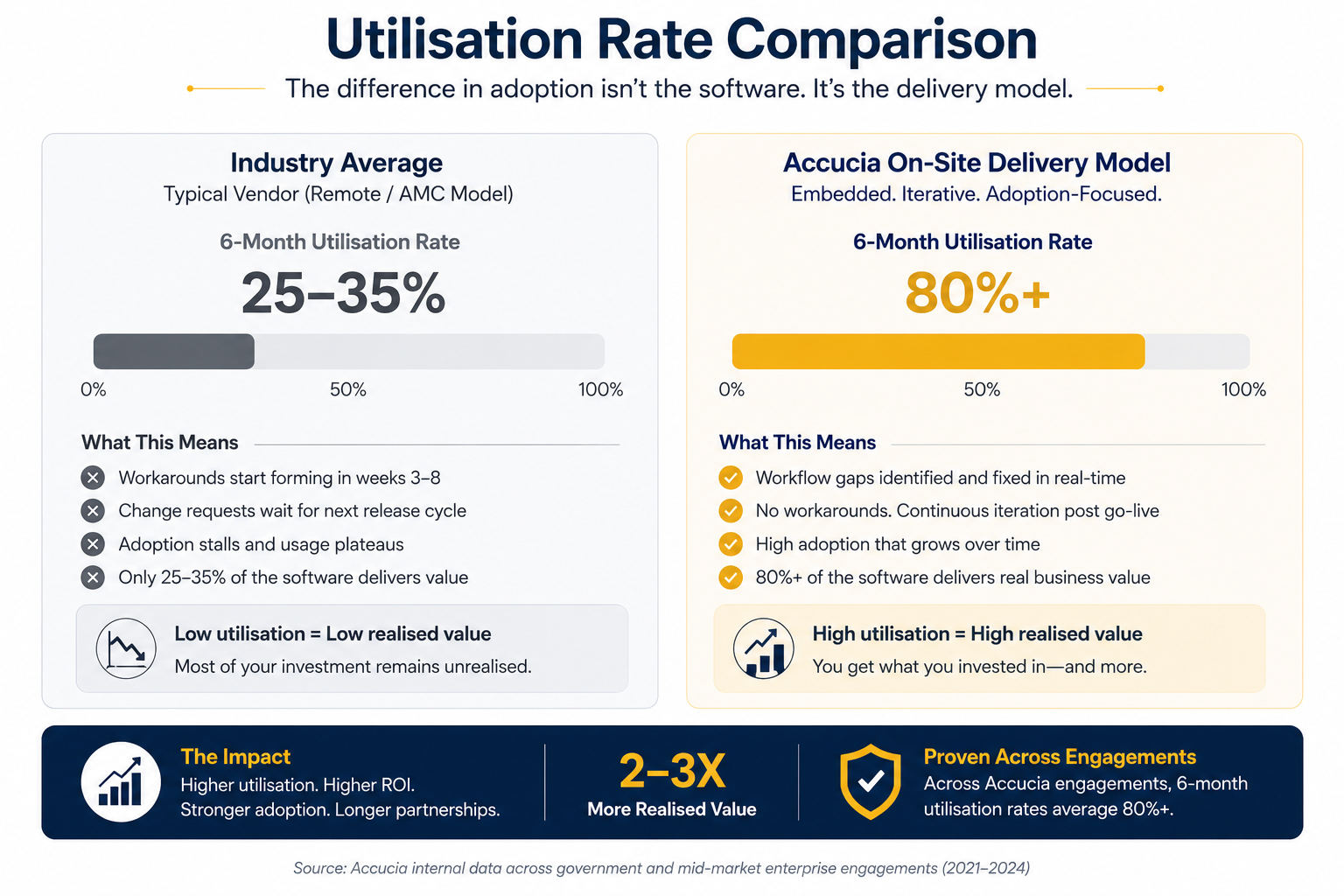
Industry-average 6-month utilisation for enterprise software sits around 25-35%. Across Accucia engagements where the on-site delivery model is applied properly, the average is north of 80%.
The mechanism is straightforward:
- Most adoption failure isn't a software bug — it's a workflow gap the original spec didn't catch
- Workflow gaps surface in week 3-8 of real usage, not in UAT
- An on-site team catches them in real-time — within hours, not the next quarterly release
- Catching them in real-time means the team doesn't develop workarounds before the fix arrives
- Workarounds are how software gets abandoned — once a team develops a workaround, returning to the system becomes harder than continuing the workaround
Remote support catches workflow gaps too — but with a 2-4 week lag, by which time the workaround has set. On-site delivery closes this lag.
What Real On-Site Delivery Costs (And Why It's Worth It)
On-site delivery costs more than remote AMC + quarterly visits. The cost premium is typically 15-25% of project value over a 12-month engagement.
The ROI math:
- A typical mid-market enterprise software deployment costs ₹40-90 lakh
- At industry-average 25-35% 6-month utilisation, the realised value of that deployment is 25-35% of what the business case projected
- At 80%+ 6-month utilisation (on-site model), the realised value is 2-3x higher
- The 15-25% delivery cost premium pays back via 2-3x utilisation lift inside 12 months
Every honest mid-market CFO who's run this math arrives at the same answer: the on-site model is cheaper than the remote model when measured by realised value, not by line-item cost.
What to Ask Any Vendor About "On-Site Support"
If a vendor uses the phrase "on-site support" in their pitch, ask these five questions:
- How many of your team will be physically stationed at our office, and for how long? (If the answer involves "as needed," walk away.)
- Will the same person be involved from discovery through 12 months post-launch? (If they describe a handoff to a separate support team, you're getting a sales-build-support relay, not a delivery partnership.)
- Who do I call at day 127 when something quietly breaks? (If the answer is "log a ticket," you have your answer.)
- What's your 6-month utilisation rate across past clients? (If they can't quote it, they don't measure it. If they don't measure it, they're not built for adoption.)
- What do you commit to if 6-month utilisation falls below 70%? (If they have a remediation plan in writing, they're confident in their model. If they don't, you've learned what you needed.)
FAQ: On-Site Software Delivery
Why does on-site delivery cost more than remote AMC?
Senior delivery staff stationed at a client's premises for 4-6 weeks post-launch costs the vendor real money — that staff member is not available for other engagements during that period. The cost premium is typically 15-25% of project value over a 12-month engagement. The ROI math: higher 6-month utilisation produces 2-3x more realised value from the original investment, far exceeding the cost premium.
How long does the on-site delivery period actually last?
At Accucia, the default is 4-6 weeks of full-time on-site presence post-launch, then a tapered model (2-3 days per week on-site for the next 2-3 months) until adoption is confirmed. For complex government or multi-location engagements, on-site presence may continue for 6-12 months. The decision is adoption-driven, not calendar-driven.
What if I'm an international client (US, GCC, Singapore, Australia) — can Accucia still do on-site?
Yes. For international clients, the on-site model includes either dedicated delivery staff flown in for the initial rollout period (typical for first engagements) or local hires managed by the Accucia delivery team (typical for ongoing retainer engagements). The principle stays the same: someone from the delivery team is physically present until adoption holds. Our current US, UK, and Australia clients have all used variations of this model.
Can on-site delivery work for software-as-a-service (SaaS) rollouts where Accucia isn't the original vendor?
Yes, with limits. We do on-site adoption support for clients who have already purchased third-party SaaS (Salesforce, Microsoft Dynamics, Workday, custom in-house systems) and need help with adoption that the vendor isn't providing. The model is the same: stationed staff, weekly iteration, embedded training. The output is the same: 6-month utilisation lifts from industry-average to 80%+.
Is the on-site delivery model viable for smaller mid-market businesses (30-100 employees)?
Yes — at a slightly reduced footprint. Smaller engagements may not need 2 full-time staff stationed for 6 weeks, but they still benefit from 2-3 weeks of dedicated on-site presence and weekly iteration in the first 6 weeks post-launch. The adoption mechanics are the same regardless of business size.
What To Do Next
For mid-market enterprise CIOs evaluating vendors in 2026:
- Demand specifics on "on-site support" — the 5 questions above are diagnostic
- Tie 15-20% of vendor contract payment to 6-month utilisation thresholds
- DM "ENGAGEMENT" on LinkedIn for our 1-page engagement model brief
Real adoption starts on-site.