
Healthcare CRM Compliance in India: HIPAA & DPDP Act Guide
Quick Answer
A healthcare CRM operating in India must comply with the DPDP Act 2023 for patient consent and data-fiduciary duties, follow ABDM standards (FHIR R4, SNOMED CT, ICD-10/11, LOINC) for interoperability, and meet HIPAA requirements under a Business Associate Agreement if it touches any US patient data. DPDP penalties reach ₹250 crore per violation; HIPAA penalties reach $50,000 per violation. None of these are optional add-ons — they are structural requirements the software has to be built around. By Mr. Sumeet Katariya, CEO Accucia Softwares
Most healthcare software in India is built for features first and compliance second. That order gets reversed the first time a data protection board asks for an audit trail, or a US client asks for a signed Business Associate Agreement before onboarding. This guide covers what a healthcare CRM actually has to handle — not what the marketing page for the CRM says it handles.
Why Compliance Isn’t a Checkbox for Healthcare Software
Healthcare data carries more legal weight than almost any other category a CRM stores. A single patient record can include diagnosis history, prescriptions, lab results, imaging, genetic data, mental health notes, and biometric identifiers. Under India’s DPDP Act, this is classified data that triggers stricter consent and security obligations than ordinary personal data.
Three frameworks now shape what compliant healthcare software in India looks like, and each one governs a different layer:
- DPDP Act 2023 — governs consent, patient rights, and breach response for any Indian citizen’s data.
- ABDM (Ayushman Bharat Digital Mission) — governs interoperability: how patient records move between hospitals, labs, and pharmacies.
- HIPAA — governs any Indian vendor or software touching US patient data, through the Business Associate relationship.
A CRM that only handles one of these is compliant on paper and exposed in practice.
What the DPDP Act 2023 Requires From Healthcare CRMs
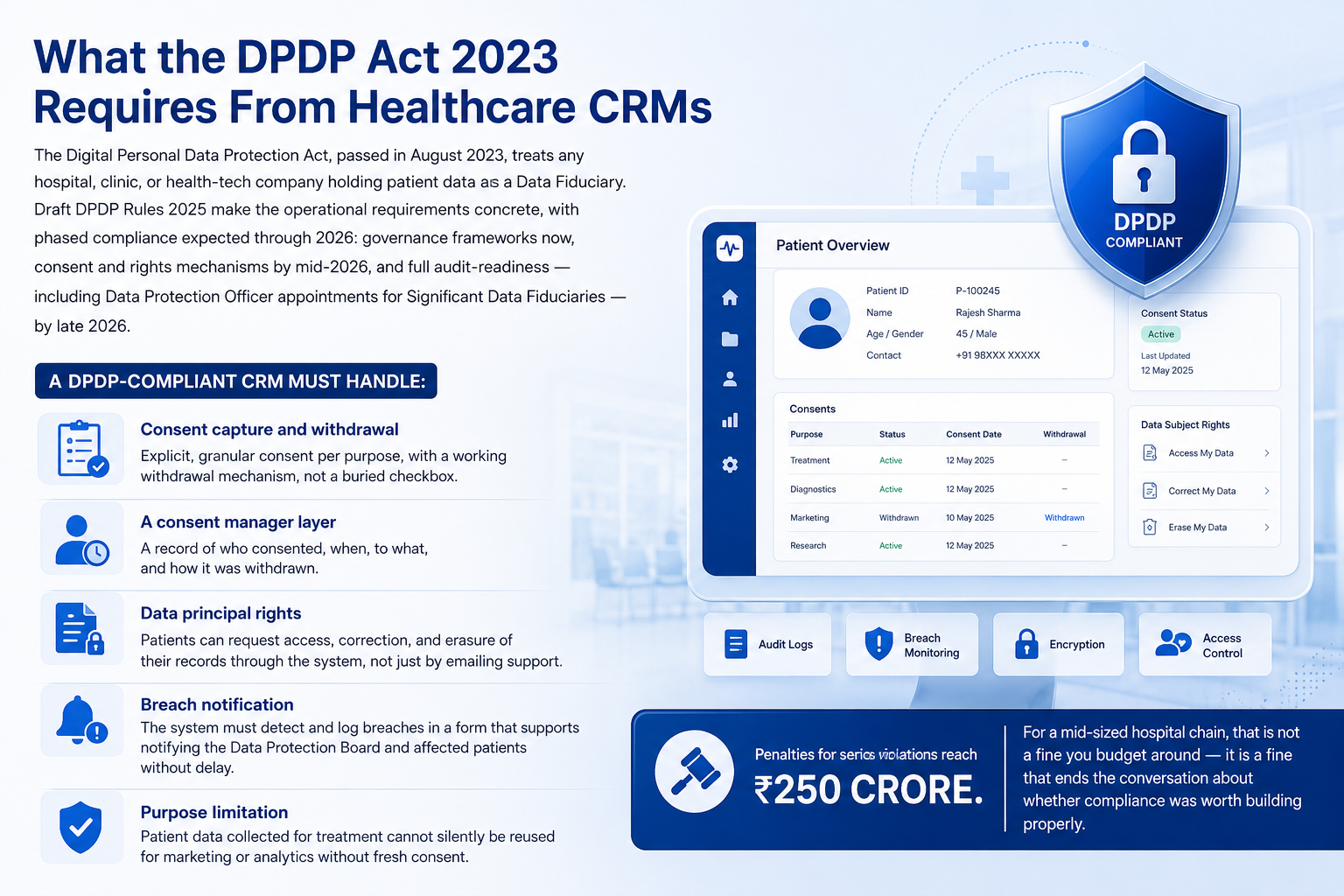
The Digital Personal Data Protection Act, passed in August 2023, treats any hospital, clinic, or health-tech company holding patient data as a Data Fiduciary. Draft DPDP Rules 2025 make the operational requirements concrete, with phased compliance expected through 2026: governance frameworks now, consent and rights mechanisms by mid-2026, and full audit-readiness — including Data Protection Officer appointments for Significant Data Fiduciaries — by late 2026.
A DPDP-compliant CRM must handle:
- Consent capture and withdrawal — explicit, granular consent per purpose, with a working withdrawal mechanism, not a buried checkbox.
- A consent manager layer — a record of who consented, when, to what, and how it was withdrawn.
- Data principal rights — patients can request access, correction, and erasure of their records through the system, not just by emailing support.
- Breach notification — the system must detect and log breaches in a form that supports notifying the Data Protection Board and affected patients without delay.
- Purpose limitation — patient data collected for treatment cannot silently be reused for marketing or analytics without fresh consent.
Penalties for serious violations reach ₹250 crore. For a mid-sized hospital chain, that is not a fine you budget around — it is a fine that ends the conversation about whether compliance was worth building properly.
Where ABDM Fits — and Where It Doesn’t
ABDM is not a data protection law. It is India’s national digital health interoperability programme, run by the National Health Authority, and it solves a different problem: making sure a patient’s record from one hospital can be read by another.
ABDM mandates specific technical standards for any system that wants to participate in the national health ecosystem:
- HL7 FHIR R4 for structured health record exchange.
- SNOMED CT and ICD-10/11 for clinical terminology.
- LOINC for laboratory result coding.
- DICOM for medical imaging.
As of mid-2026, ABDM participation is not universally mandatory for private facilities — but government guidance is moving toward making it a condition for government health schemes (AB-PMJAY and similar). A hospital CRM that can’t generate FHIR-compliant records or link to ABDM Health IDs today will be retrofitting under deadline pressure within the next few review cycles.
When HIPAA Applies to Indian Healthcare Software
HIPAA is a US law, but it reaches Indian companies the moment they touch US patient data — regardless of where the servers are located. This is the part founders most often get wrong: they assume HIPAA is someone else’s problem because the company is based in India.
HIPAA applies to an Indian vendor when the company falls into the Business Associate category — common scenarios include:
- Health-tech platforms serving US hospitals or clinics.
- Medical billing or claims processing for US providers.
- Software development teams building healthcare applications under a US client contract.
- BPO or support teams handling US patient calls.
In every one of these cases, a signed Business Associate Agreement (BAA) is the contractual anchor. Without it, the US Covered Entity cannot legally share Protected Health Information (PHI) with the Indian vendor. Penalties from the US Office for Civil Rights run up to $50,000 per violation — and a single unprotected PHI record can count as one violation.
DPDP Act vs ABDM vs HIPAA: Quick Comparison
DPDP Act 2023
ABDM
HIPAA
Type of law
Data protection law
Interoperability standard
US federal data protection law
Applies to
Any Indian citizen’s data
Hospitals/labs joining the national health ecosystem
Any entity touching US PHI, including Indian vendors
Mandatory?
Yes, nationally
Encouraged; increasingly required for government schemes
Yes, if handling US patient data
Core requirement
Consent, rights, breach notification
FHIR R4, SNOMED CT, ICD-10/11, LOINC, DICOM
Business Associate Agreement, PHI safeguards
Penalty
Up to ₹250 crore
Loss of scheme eligibility / integration access
Up to $50,000 per violation
What Your Healthcare CRM Software Must Actually Handle
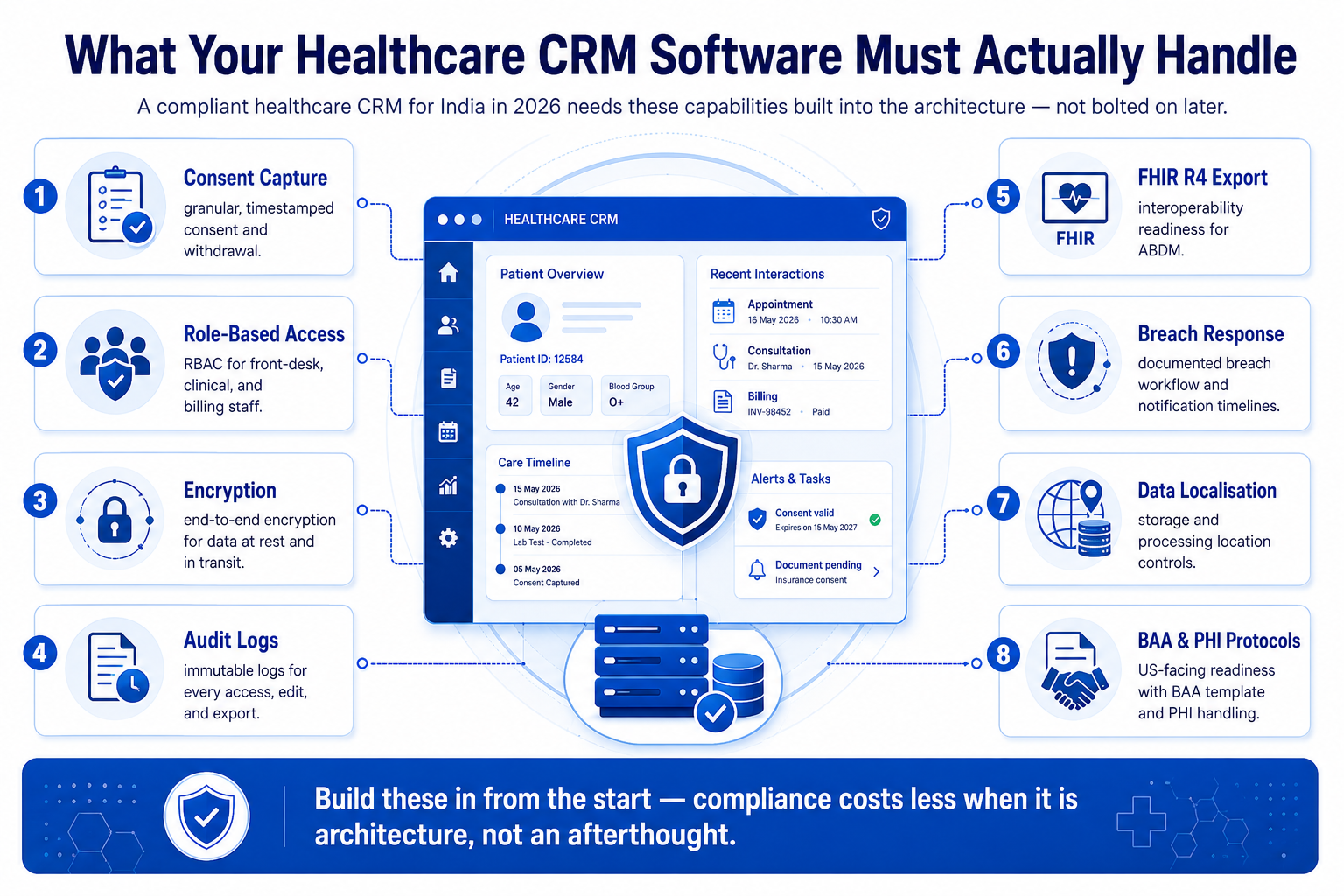
Strip away the acronyms and the requirement is the same across all three frameworks: prove who accessed what data, when, with what consent, and how it was protected. A healthcare CRM built for the Indian market in 2026 needs these capabilities as core architecture, not bolt-ons:
- Granular, timestamped consent capture with an accessible withdrawal flow.
- Role-based access control (RBAC) so front-desk, clinical, and billing staff see only what their role requires.
- End-to-end encryption for data at rest and in transit.
- Immutable audit logs covering every access, edit, and export of a patient record.
- FHIR R4 export capability for ABDM interoperability, even if ABDM integration isn’t active yet.
- A documented breach-response workflow with defined notification timelines.
- Data localisation controls, where required, for storage and processing location.
- A signed BAA template and PHI-handling protocol, ready for any US-facing engagement.
Software that has these built in from the start costs less to make compliant than software where they are added after a client, auditor, or regulator asks for them.
Frequently Asked Questions
Does the DPDP Act apply to a small clinic, or only large hospital chains?
It applies to any entity processing personal data, including small clinics. The scale of obligations — such as DPO appointment — scales with how much and what kind of data is processed, but core consent and rights obligations apply regardless of size.
Is ABDM registration mandatory for private hospitals in India?
Not universally, as of mid-2026. It is mandatory for facilities under government schemes like AB-PMJAY, and strongly encouraged elsewhere, with government direction pointing toward broader mandates over time.
Does an Indian healthcare software vendor need to be HIPAA certified?
There is no official US government HIPAA certification. What’s required is a demonstrable compliance programme — risk assessments, safeguards, and a signed BAA — that a US Covered Entity is willing to contract under.
Can one CRM be compliant with DPDP, ABDM, and HIPAA at the same time?
Yes, and for any healthcare software company operating across Indian and US markets, this is the practical requirement rather than a special case. The three frameworks overlap heavily on core controls: consent, access logging, encryption, and breach response.
Building Compliance In, Not Bolting It On
Compliance requirements change what a healthcare CRM needs to do at the architecture level — consent management, audit logging, and interoperability aren’t features you add in a later sprint. They’re decisions made before the first line of code.
Accucia builds tailored platforms that take daily operations off the founder’s desk. 730+ projects delivered.
Build compliance into your CRM from day one.