Enterprise Software Development India: 2026 Guide
Quick Answer
> Enterprise software development in India means building custom applications ERP, CRM, workflow and AI tools around how a specific business actually operates, instead of forcing teams onto generic, off-the-shelf products. In 2026, mid-market Indian companies (30–500 employees) increasingly choose custom builds because the biggest cause of failed software isn't bad code it's poor fit and low adoption. A focused custom module typically starts in the low lakhs and a full multi-module platform runs higher; an MVP usually ships in 8–16 weeks. Judge any build on one number above all: the 6-month utilisation rate. By Mr. Sumeet Katariya, CEO Accucia Softwares
Key Takeaways
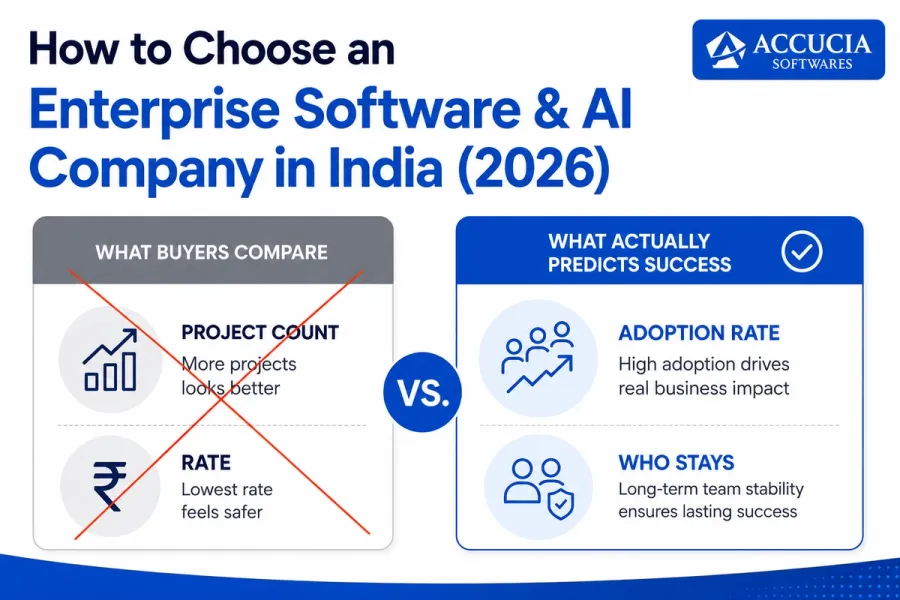
- Enterprise software fails at adoption, not code most teams use under 30% of what they buy.
- Choose custom when your workflow is your edge or no off-the-shelf tool fits; buy for commodity needs.
- Cost is driven by clarity of workflow, not lines of code.
- The right partner maps your process first and stays on-site through go-live.
- Demand the 6-month utilisation rate before you sign.
What is enterprise software development?
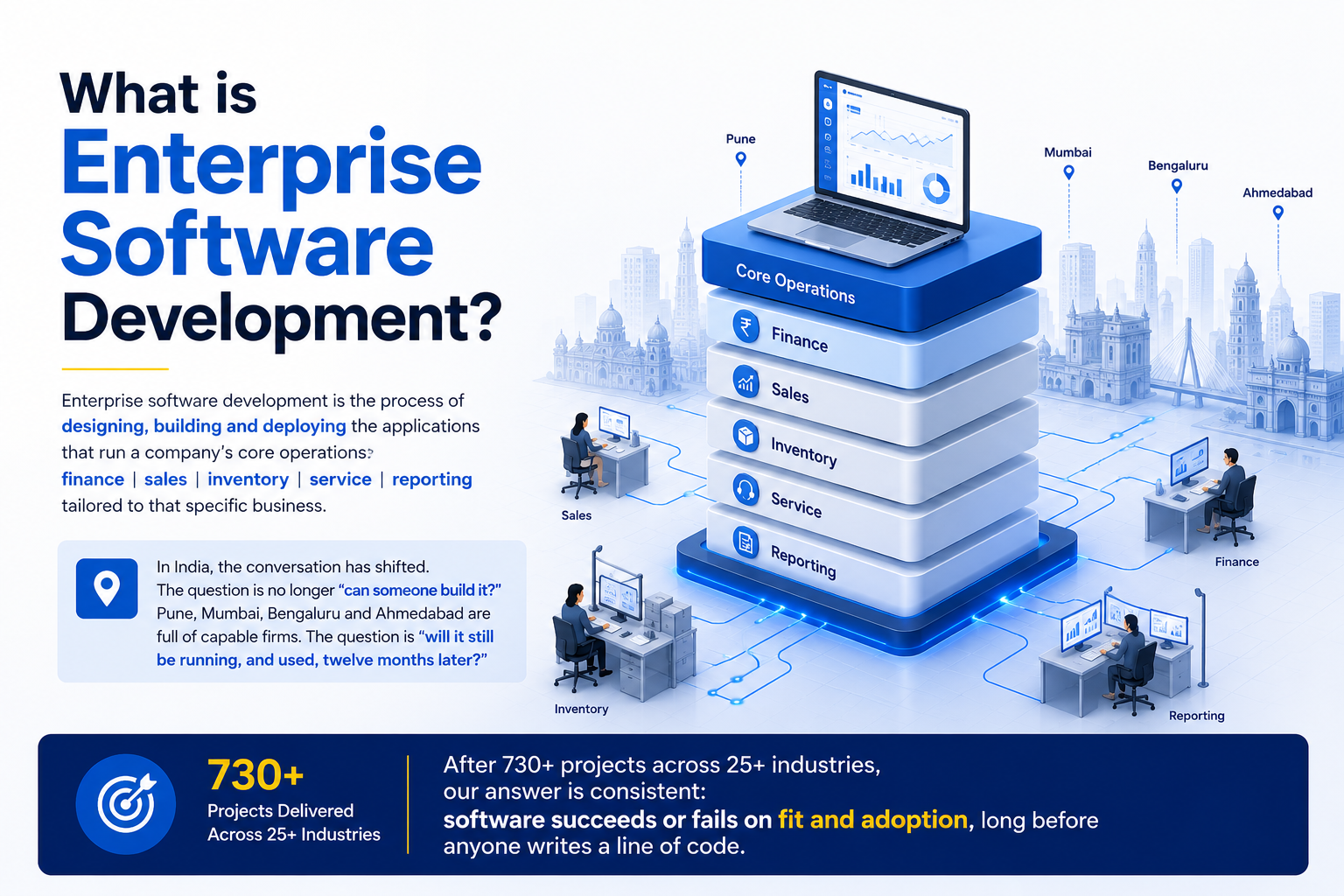
Enterprise software development is the process of designing, building and deploying the applications that run a company's core operations finance, sales, inventory, service, reporting tailored to that specific business. In India, the conversation has shifted. The question is no longer "can someone build it?" Pune, Mumbai, Bengaluru and Ahmedabad are full of capable firms. The question is "will it still be running, and used, twelve months later?"
After 730+ projects across 25+ industries, our answer is consistent: software succeeds or fails on fit and adoption, long before anyone writes a line of code.
Off-the-shelf vs custom: a decision framework
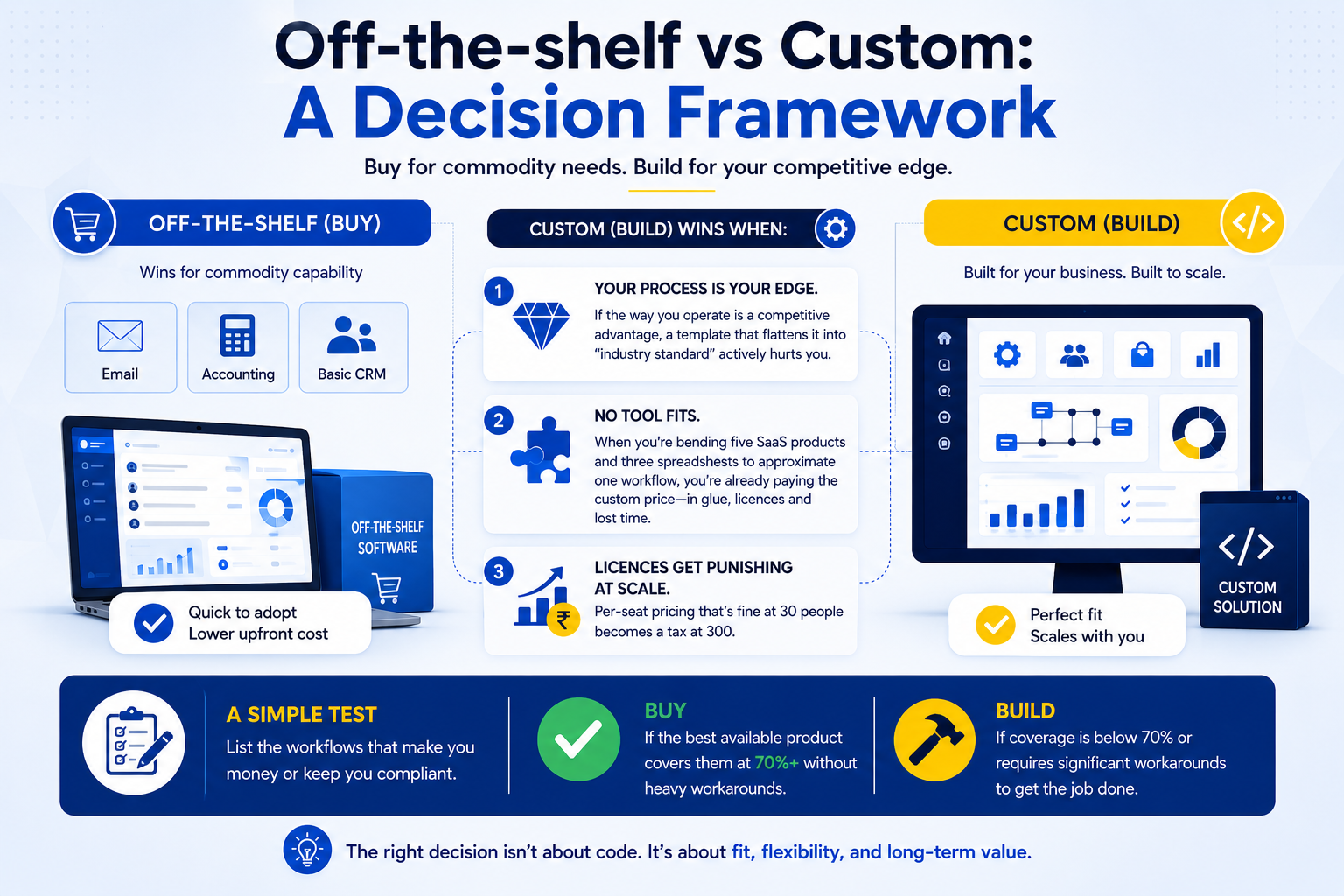
Off-the-shelf wins for commodity capability email, accounting, basic CRM. Custom wins in three situations:
- Your process is your edge. If the way you operate is a competitive advantage, a template that flattens it into "industry standard" actively hurts you.
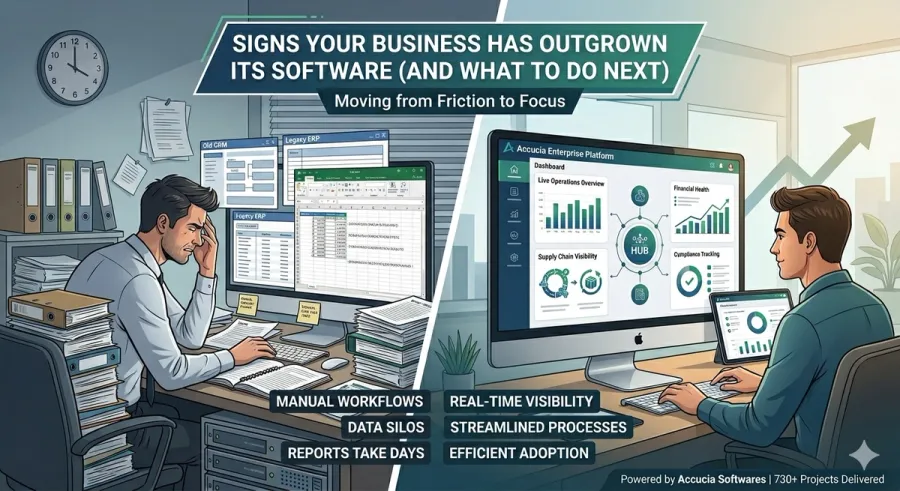
- No tool fits. When you're bending five SaaS products and three spreadsheets to approximate one workflow, you're already paying the custom price in glue, licences and lost time.
- Licences get punishing at scale. Per-seat pricing that's fine at 30 people becomes a tax at 300.
A simple test: list the workflows that make you money or keep you compliant. If the best available product covers them at 70%+ without heavy workarounds, buy. Below that, build.
What custom enterprise software costs in India
The honest answer is "it depends" but the variable that matters most is rarely technical. A focused module (say, a quotation-and-approval system) typically starts in the low lakhs. A multi-module operating platform with dashboards, role-based access and embedded AI runs higher and is best delivered in phases.
The real cost driver is clarity of workflow. A business that can describe exactly how work flows today gets a faster, cheaper, better build than one that discovers its own process mid-project. That's why we spend the first weeks mapping, not coding.
The 5-step build process
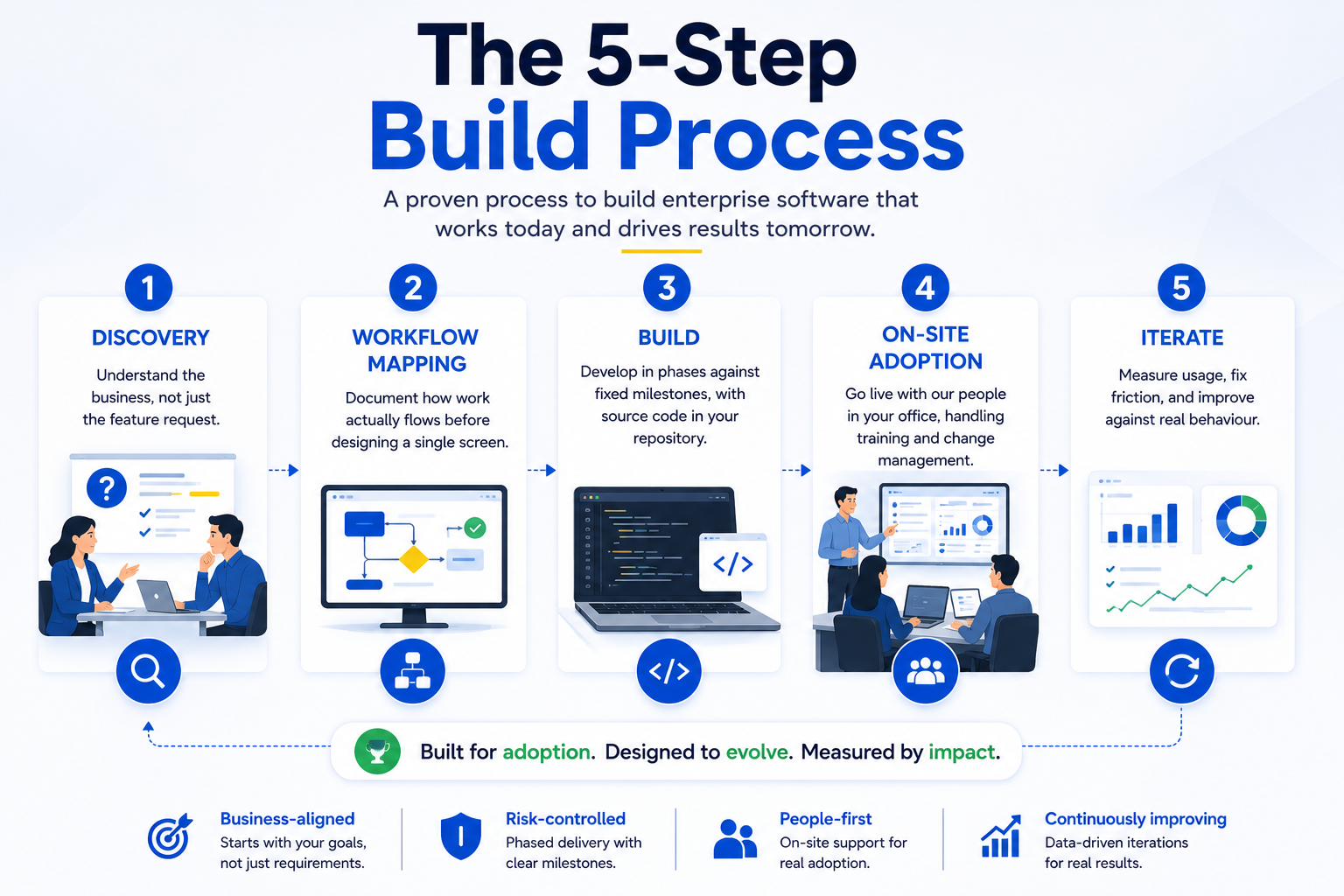
- Discovery — understand the business, not just the feature request.
- Workflow mapping — document how work actually flows before designing a single screen.
- Build — develop in phases against fixed milestones, with source code in your repository.
- On-site adoption — go live with our people in your office, handling training and change management.
- Iterate — measure usage, fix friction, and improve against real behaviour.
Why most builds fail and the metric that prevents it
Most enterprise teams use less than 30% of what they paid for. The build works, the login works and six months later everyone has drifted back to spreadsheets and WhatsApp. The failure is almost never the code. It's that nobody planned for adoption: no change management, no clean data, a "one-hour demo and a login" handover.
The fix is structural a workflow-first build plus a team that stays until the system is genuinely in use and it should be measured. Before you sign, ask any partner for the 6-month utilisation rate of their last three deployments. If they don't track it, they don't optimise for it.
How to choose a development partner (7 questions)
- Who is physically on-site during the first 45 days after go-live?
- What was the 6-month utilisation rate of your last three builds?
- Who owns the code and the data?
- What happens when a key person on our team leaves?
- How do you handle change management?
- Can you show me a client you've kept for five or more years?
- What will you tell us not to build?
A quick case in point
A large Indian pharmaceutical company was sitting on 30,000+ documents nobody could find quickly. Rather than sell them a new system to learn, we embedded an AI assistant inside the app they already used. The result: 75% less time spent searching, 95% accuracy, and payback in eight months because the build was designed for adoption, not for a demo.
Frequently Asked Questions
How much does enterprise software development cost in India?
A focused custom module typically starts in the low lakhs; a full multi-module platform runs higher. The biggest cost driver is clarity of workflow, not lines of code.
How long does a custom enterprise build take?
A focused MVP usually ships in 8–16 weeks. Larger platforms roll out module by module so daily operations are never disrupted.
Custom or off-the-shelfwhich is better?
Buy for commodity needs; build when your workflow is a competitive advantage or no product fits without heavy workarounds.
Why do enterprise software projects fail?
Almost always at adoption, not code teams use under 30% of what they buy. Demand a 6-month utilisation metric and a partner who stays through go-live.
Book a Free Consultation