Building Maharashtra Government Digital Programs Leadership Can Defend at Every CM Review — The 2026 Department Playbook
Quick Answer
Maharashtra government digital programs that earn Chief Minister-level recognition share three architectural traits — UX4G-compliant citizen channels that work on the day a Mantri or the CM opens them, leadership dashboards that show live department-wide status without anyone chasing officers for numbers, and a delivery model that produces measurable citizen-facing outcomes auditable to specific dates. The CM-recognised UX4G website built for a Mumbai government housing authority (anonymised per NDA) is one example of this approach in production. This playbook covers what separates dashboard-worthy programs from PR-only programs, the UX4G design discipline most agencies retrofit too late, and the leadership dashboard pattern that survives Minister-level visits without anyone scrambling at the gate.
Every Maharashtra government IT Officer lives with the same quiet pressure.
The sister department two floors away just got a Chief Minister appreciation note for their citizen portal. The CM office has been asking when your department's digital story will be ready. The next CM review is in 6 weeks. And the website your team launched last year still fails the basic accessibility audit.
This is the CM-visible win economy — the unspoken competitive dynamic between Maharashtra state departments, authorities, and municipal bodies. Every IT Officer is measured not just on uptime, but on whether their department's digital story is one the CM office can point to.
After delivering 10-15 connected digital projects inside one Mumbai government housing authority (anonymised per NDA) — including a citizen-services website that did earn recognition at the Chief Minister of Maharashtra level under UX4G standards — we've seen what separates the digital programs the CM office promotes from the ones that quietly close. This is the playbook.
The CM-Visible Win Economy in Maharashtra
Maharashtra state departments operate with a unique dynamic: sister-department comparison drives every IT review.
When one authority launches a WhatsApp citizen service, every other authority's IT Officer gets asked when theirs will launch. When one department's website wins recognition, every other HOD's Commissioner asks why theirs hasn't. The CM office doesn't issue formal benchmarks — but the comparison happens informally, constantly, across every quarterly review.
The departments that win in this economy don't win because their CMs are friendlier. They win because their digital programs are demonstrable on demand — the website works the day the CM clicks it, the dashboard shows live numbers when the Mantri asks, the citizen channel responds in seconds rather than days.
What Separates Dashboard-Worthy Programs from PR-Only Programs
Most Maharashtra government digital programs fall into one of two categories:
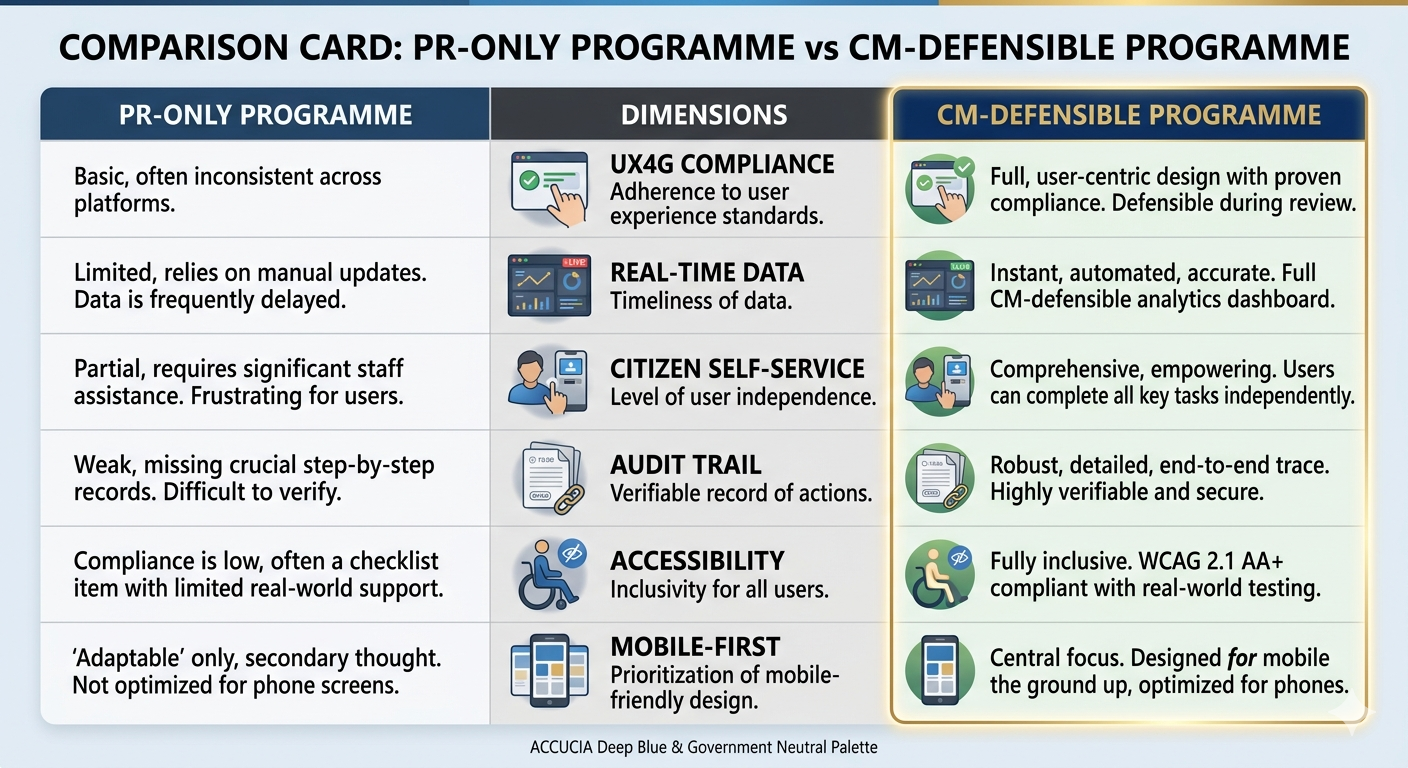
PR-only programs: launched with great fanfare, photo with the Minister, press release in the local papers. Three months later the website is broken in mobile view, the WhatsApp bot doesn't respond, the dashboard hasn't been updated since launch. When the next CM review arrives, the IT Officer scrambles.
CM-defensible programs: launched quietly, accessibility audit cleared from day one, leadership dashboard live and current, citizen channels handling real volume. When the CM opens it during a review, it works — because it works every day.
The difference isn't budget. It's architectural discipline.
UX4G as the New Design Discipline (And Why Most State Portals Still Fail)
UX4G — 'User Experience for Government' — is the design standard pushed by the Government of India to make digital services genuinely usable for citizens. It includes:
- Accessibility (works for users with visual, motor, cognitive disabilities)
- Mobile-first responsive design (works on a 6-year-old smartphone, not just a new laptop)
- Plain-language content (citizen-readable, not bureaucratic Hindi or English)
- Navigation reachable in 3 clicks
- Performance on 3G networks
- Multi-language support (Marathi at equal weight to English and Hindi)
The catch: most agencies retrofit UX4G compliance under pressure at audit stage. That's why so many Maharashtra state portals still fail accessibility checks two years after launch.
Departments that win CM recognition build to UX4G from the first wireframe — not from the last audit. Mobile-first design, accessibility-first content, multi-language from day one. When the Minister opens the site on their phone in the back of the car, it works.
The Leadership Dashboard Pattern (CM-Ready, Minister-Ready)
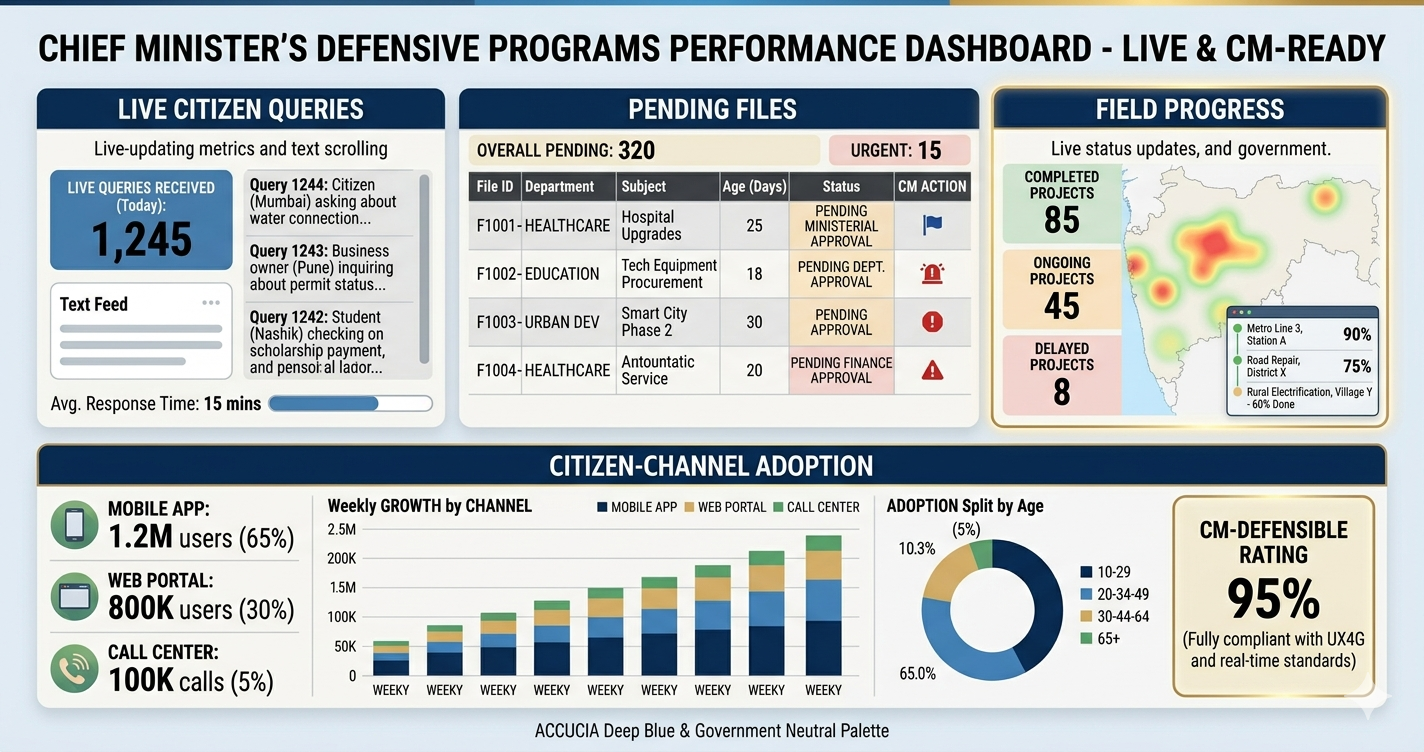
The leadership dashboard is the single artefact most likely to be in front of a CM or Minister during a review. It needs to be designed for that audience.
Dashboard-worthy programs share five dashboard design rules:
- Live data, never stale — every metric is from a real-time source, not yesterday's overnight refresh
- Department-wide visibility on one screen — leadership shouldn't need to click into 6 different views to understand the state of the department
- Citizen-facing metrics prominent — active citizen queries, pending services, response times, citizen feedback scores all visible at glance
- Trend lines, not just point-in-time numbers — a Minister wants to see 'getting better' or 'getting worse,' not just 'currently 247'
- Defensible at audit — every number on the dashboard should be auditable back to the source transaction with a timestamp
Most government dashboards in production today fail 3 of these 5. The CM-ready dashboard is the one that meets all 5 — and it's the architectural difference that produces public recognition.
Live Citizen Channels That Hold Up on Review Day
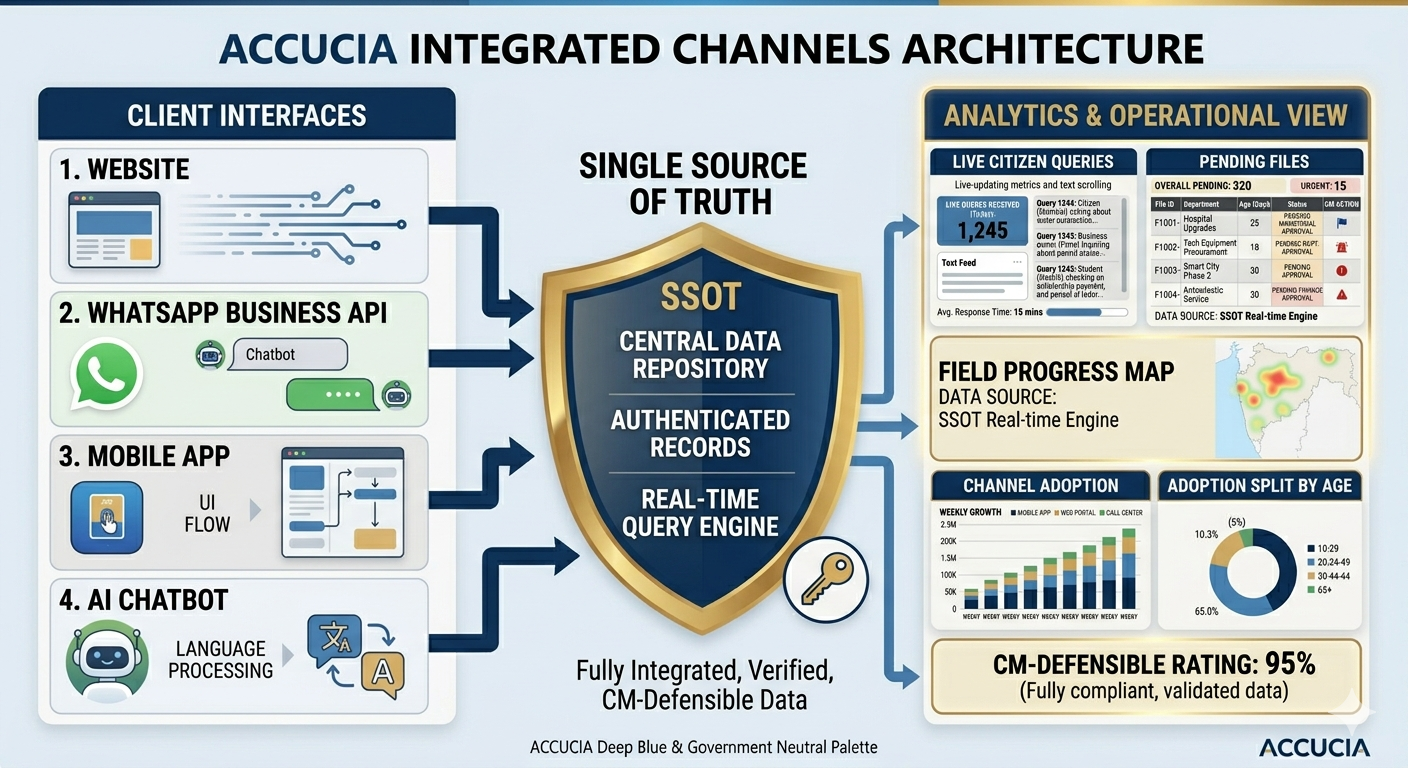
The second artefact most likely to be in front of a CM during a review is a citizen channel — the WhatsApp bot, the mobile app, the AI chatbot on the website. These must work on the day they're tested. If they don't, the entire digital programme loses credibility.
Three channels every Maharashtra department should plan for 2026:
WhatsApp Business API integration — official API (not unofficial workarounds) integrated into the department's existing applications. Citizens get policy updates, lottery decisions, e-governance announcements directly on their phone, at any hour, without walking in.
AI chatbot trained only on approved internal documents — the bot must answer only from material the department has signed off on. Every answer cites its source. Any wrong answer is auditable. The CM should be able to ask the bot a citizen question and get an accurate response, with citation.
Mobile app + QR-code appointment booking — citizens book online, enter via QR scan, skip the queue. Reduces premises footfall dramatically (in one Mumbai government housing authority case study, from 2,000+ daily walk-ins to under 700).
Anonymised Case Study: The CM-Recognised UX4G Website
One major Mumbai government housing authority (name withheld per NDA) commissioned a full digital transformation across 10-15 connected projects between 2019 and 2026.
The centrepiece: a citizen-services website built to UX4G standards from the first wireframe. Mobile-first design. Marathi + English + Hindi at equal weight. Accessibility-compliant from day one. Performance optimised for 3G connections. Plain-language content rewritten from bureaucratic source documents.
The website went on to win recognition at the Chief Minister of Maharashtra level under UX4G standards.
What made it work wasn't the design — the design was solid but not unique. What made it work was the architectural discipline: UX4G baked in from day one, leadership dashboard live across all departments, WhatsApp citizen bot and mobile app integrated, audit trails for every citizen interaction.
The authority's IT Officer publicly credited the team. Over 10-15 projects, the engagement model held. CM-recognition followed.
This is what dashboard-worthy programs look like in production.
FAQ: Maharashtra Government Digital Programs
What is UX4G and why does it matter for Maharashtra departments specifically?
UX4G is the Government of India's design standard for digital services — accessibility, mobile-first, plain language, 3-click navigation, 3G performance, multi-language. Maharashtra departments need it because the state's citizen base is digitally diverse — mobile-first users on older smartphones across Marathi, Hindi, and English. UX4G compliance is what makes a website usable for an average Maharashtra citizen, not just the head office staff.
How long does it take to build a CM-ready leadership dashboard for a Maharashtra department?
For a department that already has digital data flowing through some systems, 8-14 weeks for the dashboard layer alone. For a department starting from paper, dashboard work is part of the full digital transformation — typically 5-9 months end-to-end depending on scope. Plan accordingly: CM reviews come on their own schedule.
What does this cost for a Maharashtra state authority?
Full digital transformation engagements with leadership dashboard, citizen channels, mobile app, AI bot, and on-site delivery support typically run ₹50 lakh to ₹1.5 crore depending on scope, complexity, and number of connected departments. Government-appropriate commercial terms — not enterprise pricing.
Does this approach meet DISHA, ABDM, and Maharashtra-specific compliance requirements?
Yes. The CM-defensible architecture pattern — audit trails, role-based access at retrieval layer, citation-first AI, government-grade cloud hosting on Indian soil — exceeds typical DISHA/ABDM requirements. Most Maharashtra state authorities also have additional compliance from MahaIT and departmental audit committees; the same architecture satisfies those too.
Will this approach work for other Indian states, central government, or municipal bodies?
Yes. UX4G is a national standard, not Maharashtra-specific. The leadership dashboard pattern and citizen channel architecture apply identically to other state governments, central government departments, and municipal bodies. We've applied variations across multiple government engagements.
What To Do Next
For Maharashtra IT Officers, HODs, and Commissioners scoping a digital programme in 2026:
- Audit your current portal against UX4G — most state portals fail at least 3 of the 6 principles today
- Map your current leadership dashboard against the 5 dashboard rules — most fail at least 2
- Plan citizen channel rollout (WhatsApp + mobile + AI bot) as part of the same digital initiative, not separately
- DM 'CM-READY' on LinkedIn for our 1-page CM-readiness checklist
Planning a 2026 government digital initiative? Let’s make it CM-ready.