Anthropic Just Shipped MCP Tunnels for Enterprise. We Shipped Production MCP for Mumbai Real Estate in 10 Days — Before the Feature Had a Name.
Quick Answer
On 19 May 2026, Anthropic launched MCP tunnels — a public-beta feature inside Claude Managed Agents that lets enterprises keep sensitive data and tool execution inside their own security perimeter while still using Anthropic's managed orchestration. For mid-market enterprises that have been waiting for an "official" enterprise-grade way to deploy Claude, this matters. But the underlying capability — self-hosted MCP servers, scoped tool access, audit-logged agent calls — has been buildable for months. Accucia shipped a production Claude + Model Context Protocol (MCP) system for a Mumbai-based residential real estate platform in 10 working days, with full data residency inside the client's own infrastructure. The architecture, the timeline, and what the Anthropic announcement actually changes for buyers in 2026 are documented below.
What Anthropic Actually Shipped on 19 May 2026
The May 19 update to Claude Managed Agents introduced two enterprise features:
- Self-hosted sandboxes — letting enterprises run agent tool execution inside their own infrastructure rather than Anthropic's managed environment.
- MCP tunnels (research preview) — a managed-mode feature where the agent orchestration stays in Anthropic's cloud, but tool calls route through a tunnel back to a self-hosted MCP server that the enterprise controls.
For enterprise security teams in India, UAE, US, and Singapore, the message is clear: sensitive data — customer records, transaction history, internal documents — no longer has to leave the security perimeter for an AI agent to act on it.
This is the right architectural direction. It's also not the only way to get there.
The Mid-Market Enterprise Problem That MCP Was Always Going to Fix
Every enterprise CTO we have talked to in the last 6 months has had a version of the same problem:
- The team wants to deploy AI agents on top of internal data — customer records, pricing rules, inventory, transaction history.
- Compliance says "sensitive data can't leave our infrastructure."
- The off-the-shelf AI offerings either (a) need the data sent to a vendor cloud, or (b) require a procurement cycle measured in quarters.
- Meanwhile the founder or commercial head is asking why the team is taking 8 months to ship something the competition seems to have shipped in 8 weeks.
The Model Context Protocol — open-sourced by Anthropic in late 2024 — was designed exactly for this shape of problem. A small server runs inside the enterprise perimeter, exposes specific tools (database queries, internal API calls, document retrieval) with scoped permissions, and the AI client calls only what's been explicitly allowed. Data residency is preserved by architecture, not by policy.
For an Accucia delivery team, this was not a new constraint. It was the default constraint we've been engineering around for 8 years.
The Mumbai Real Estate Brief
A Mumbai-based residential real estate platform (anonymised per NDA) came to us with a defined scope:
- Goal: an AI agent that could answer buyer questions about projects, available inventory, pricing tiers, and project comparisons — and route qualified leads to the sales team.
- Constraint 1: Property data, pricing, and lead records had to stay inside the client's own cloud (data residency was a board-level requirement, not just a compliance note).
- Constraint 2: The agent had to integrate with the existing CRM, the existing project database, and the existing pricing engine — without replacing any of them.
- Constraint 3: Production deployment in 2 weeks. Not a prototype. Not a demo. Production.
The brief landed on a Friday. Production traffic went live the following Friday + one week. 10 working days.
The Architecture Choices That Made 10 Days Possible
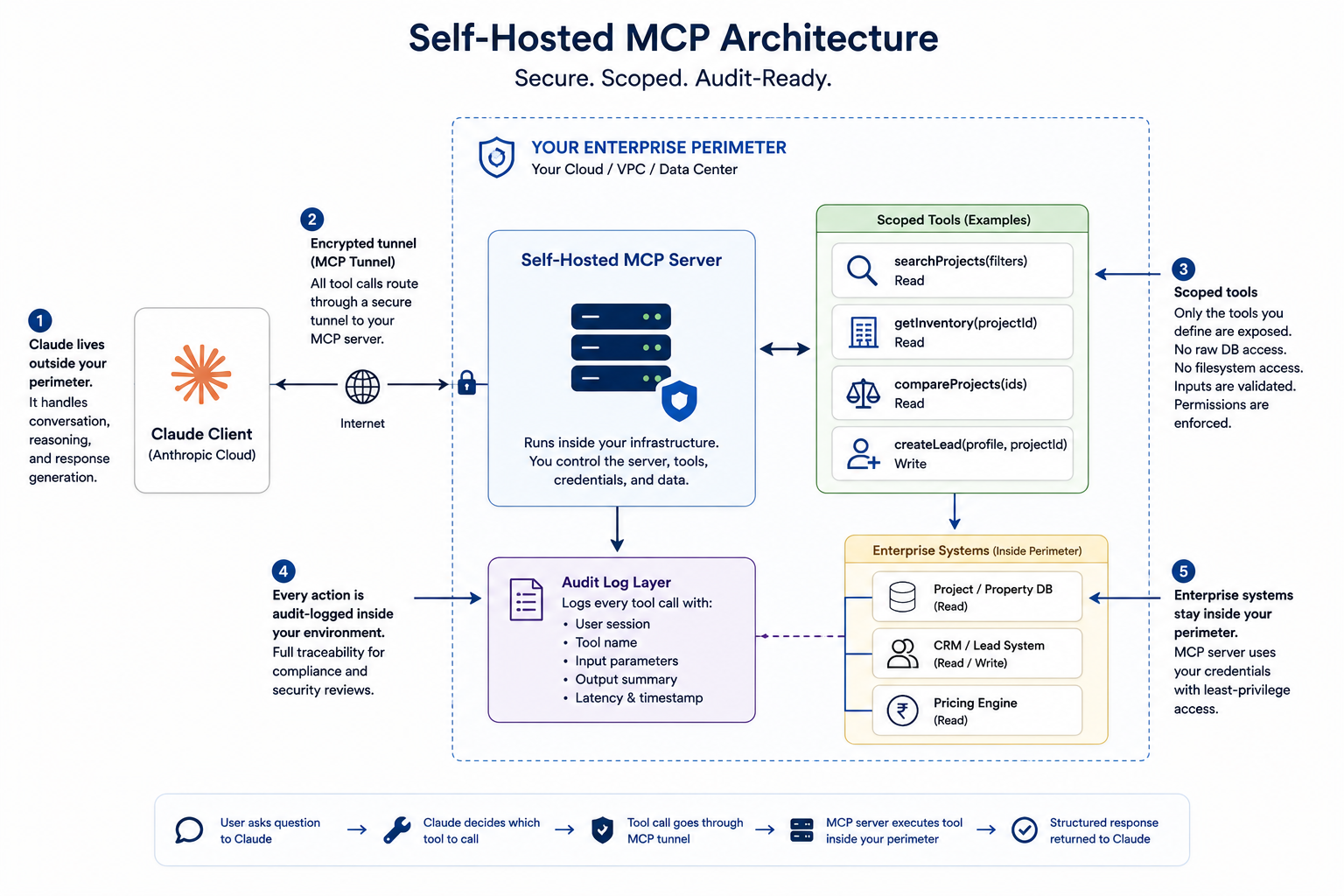
Self-hosted MCP server inside the client's perimeter
We built a thin MCP server that ran inside the client's existing cloud account. It exposed four scoped tools to the Claude client:
searchProjects(filters)— returns project summaries from the project databasegetInventory(projectId)— returns current available units with pricingcompareProjects(projectIds)— runs a structured comparisoncreateLead(buyerProfile, projectId)— writes a lead into the CRM with attribution
No other tools. No raw database access. No file system access. The Claude client could only do those four things.
Scoped tool access, not raw API exposure
Every tool call validated inputs before executing. The searchProjects tool, for example, would not accept a SQL fragment — only the structured filter parameters we'd defined. This eliminated an entire class of injection risk before the system ever went near production.
Audit logging at the tool layer
Every agent tool call was logged: user session, tool name, input parameters, output summary, latency, timestamp. The audit log lived in the client's own logging stack. When a buyer asked the agent something sensitive (e.g., "do you have a unit available in a specific tower?"), the client's compliance team could see exactly what data the agent had retrieved on whose behalf.
Claude Sonnet as the orchestrator
The Claude client (running outside the client perimeter) handled conversation flow, query interpretation, and response generation. It never saw raw database rows. It only ever saw the structured tool responses we'd defined.
Functionally, this is the same architecture pattern Anthropic just shipped as "MCP tunnels." The difference is that we built it 8 months earlier as a custom integration — because mid-market enterprises don't have time to wait for an official feature.
The 10-Day Delivery Cadence
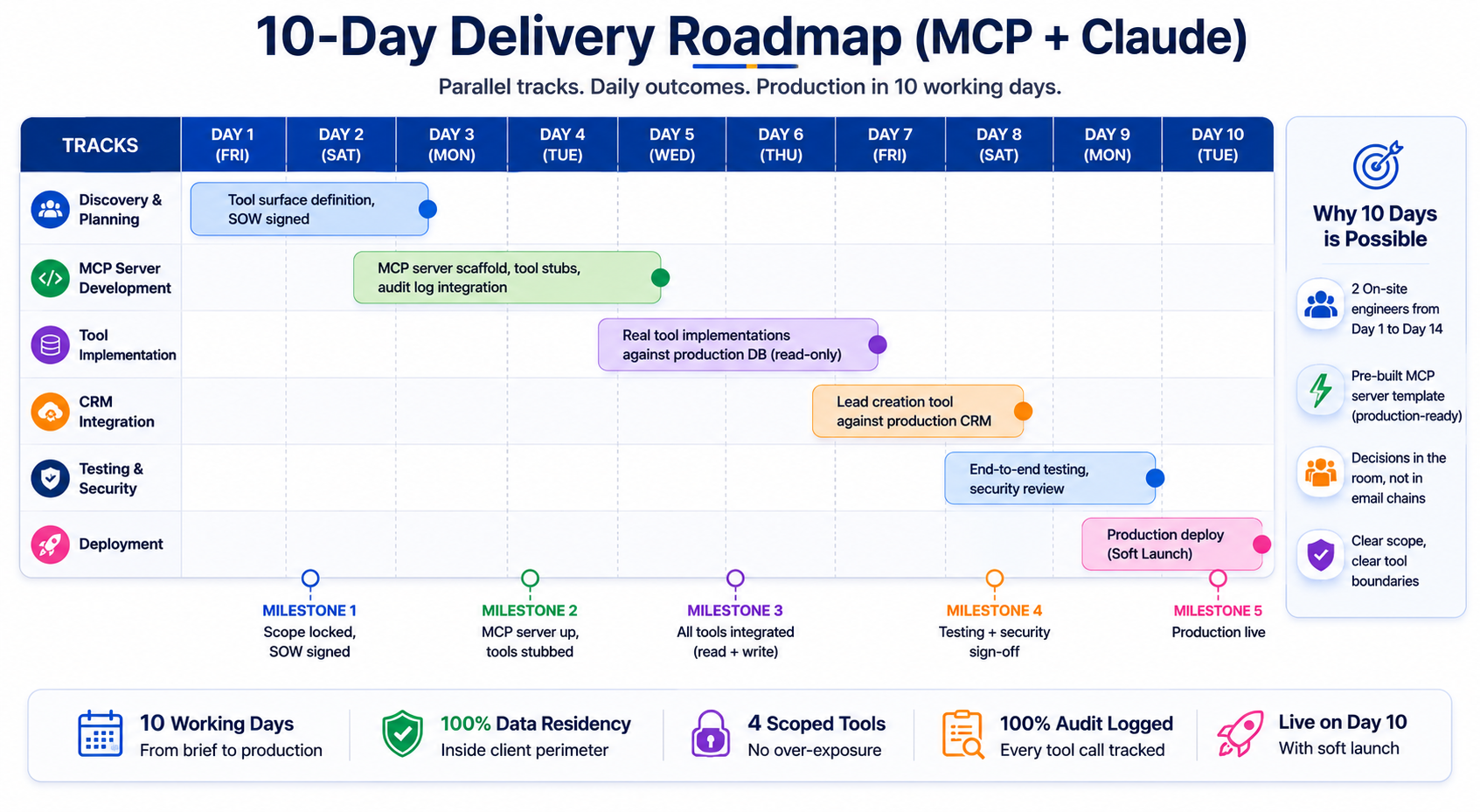
For any enterprise CTO sizing similar work, here is what the 10 working days actually looked like:
- Day 1-2: Discovery — tool surface definition with the client's CRM and database teams. SOW signed Day 2.
- Day 3-4: MCP server scaffold, tool stubs, audit log integration with the client's existing logging.
- Day 5-6: Real tool implementations against the production project database (read-only credentials, scoped).
- Day 7: Lead creation tool against the production CRM (write scope, attribution rules wired in).
- Day 8: End-to-end testing with the client's QA team. Conversation flow tuning.
- Day 9: Security review with the client's IT head — log audit, scope review, failure mode walkthrough.
- Day 10: Production deployment behind a feature flag. Soft launch to a small buyer cohort.
The 10-day window worked because of three Accucia conventions:
- Two delivery staff on-site at the client's Mumbai office from Day 1 through Day 14.
- A pre-existing MCP server template that was already production-hardened from prior builds.
- Decisions taken in the room, not in email chains.
This is the delivery cadence we have been running for 8 years. AI is a new tool. The discipline is not new.
What This Means for Mid-Market Enterprises in 2026
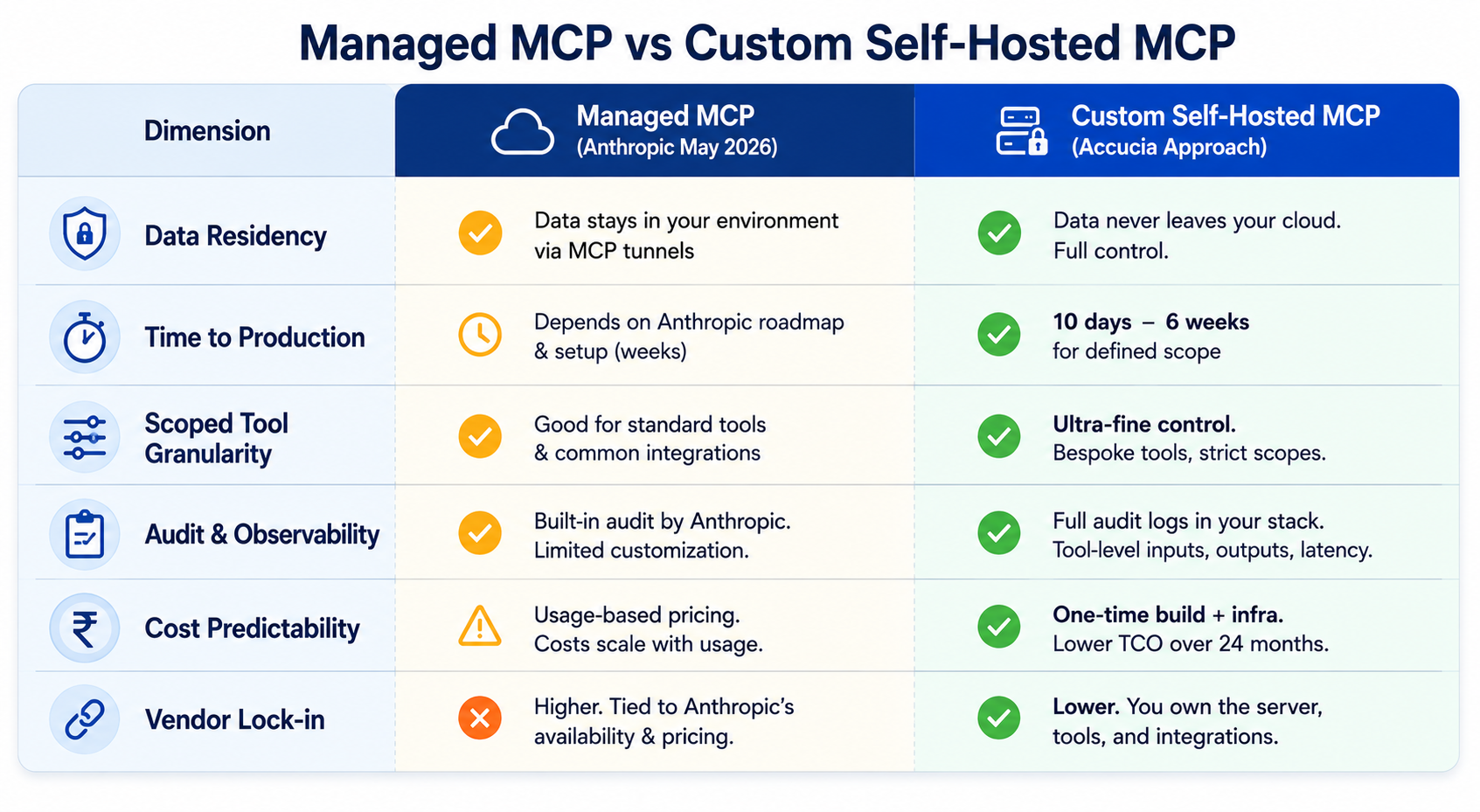
With MCP tunnels now a managed Anthropic feature, the buyer decision is no longer "managed or nothing." Mid-market enterprises now have three credible paths:
Path
When it fits
Anthropic managed MCP tunnels (May 2026)
Standard tool integrations, predictable scope, willing to live with Anthropic's pricing curve and roadmap
Custom self-hosted MCP (Accucia approach)
Bespoke tool surface, strict data residency, India/UAE/Singapore deployment, 10-day to 6-week delivery target
Microsoft Copilot Studio / Google Vertex Agent Builder
Already deep in the Microsoft or Google enterprise stack, willing to compromise on AI model choice
The right answer depends on three questions:
- Do you control the tool surface? Managed MCP works for standard integrations. Custom MCP wins for bespoke ones.
- Where does data have to live? If the answer is "inside our cloud, in our region, audit-traceable" — custom or self-hosted is faster than negotiating with a vendor.
- How fast do you need production? A 10-day custom build beats a 12-week procurement cycle every time.
FAQ: Claude MCP Enterprise Deployment
What is the Model Context Protocol (MCP)?
MCP is an open standard, originally published by Anthropic, that lets AI agents call external tools (databases, APIs, document stores) through a structured, permissioned interface. Tools live in a server, the AI client requests actions, the server executes within scope and returns structured responses. It separates AI reasoning from data access cleanly enough to satisfy enterprise compliance reviews.
Do enterprises need Anthropic's new MCP tunnels feature, or can custom MCP integrations meet the same security bar?
Custom MCP integrations have been meeting the same security bar since MCP was open-sourced in late 2024. The new managed feature simplifies the operational overhead for standard scenarios but is not required. For bespoke tool surfaces or strict data residency, custom self-hosted MCP is often faster and more controllable.
How fast can a production Claude + MCP integration ship for a mid-market enterprise?
For a defined scope with clear tool boundaries and decision-makers available, 10 working days is achievable — as in the Mumbai real estate build referenced above. More complex integrations (multi-system, regulated industry, multi-tenant) typically run 4-8 weeks. Anything beyond that is a sign the scope hasn't been bounded properly.
What about data residency for India, UAE, and Singapore deployments?
Self-hosted MCP architecture preserves data residency by design — the MCP server runs inside the client's cloud account, in the client's chosen region, with the client's own credentials. Tool responses are structured summaries, not raw data, and they only leave the perimeter to the extent the response itself requires.
How does the cost of a custom MCP build compare to Microsoft Copilot Studio or Google Vertex Agent Builder for the same use case?
For a single, scoped use case, custom MCP delivery costs are typically 40-60% lower over a 24-month horizon — primarily because there's no per-seat or per-call vendor markup. For broad horizontal deployments across many use cases, the managed platforms can be more cost-effective. Most mid-market enterprises in 2026 sit in the first category.
What To Do Next
For CTOs and VPs of Engineering scoping a Claude or MCP deployment in 2026:
- Map your tool surface — what 4-8 specific actions does the agent actually need to take? If the list is longer than 12, the scope isn't bounded yet.
- Decide your data residency posture in writing — not in a meeting. Compliance, board, and engineering need to agree.
- Pick the delivery path — managed MCP tunnels, custom self-hosted, or platform-tied. Each is correct in different contexts.
- DM 'MCP' on LinkedIn for our 1-page MCP scoping checklist used on the Mumbai build.
Planning MCP? Let's talk.