Agentic AI vs. RPA: Where Each One Wins (2026 Guide)
Quick Answer
RPA runs fixed, rule-based scripts on structured, repetitive tasks fast and auditable, but it breaks when interfaces or inputs change. Agentic AI uses large language models to reason, handle unstructured data, and adapt to exceptions without being reprogrammed. RPA wins on stable, high-volume, rule-based processes. Agentic AI wins where judgment, unstructured inputs, or cross-system decisions are involved. Gartner expects 40% of enterprise apps to carry task-specific AI agents by the end of 2026 most running alongside RPA, not replacing it. By Mr. Sumeet Katariya, CEO Accucia Softwares
Agentic AI and RPA solve different problems, and treating them as competitors costs you either speed or adaptability. RPA still runs the fixed, high-volume processes it was built for — payroll runs, data entry, invoice matching. Agentic AI takes over where those processes hit judgment calls, unstructured data, or systems that do not talk to each other. The enterprises getting real ROI in 2026 are not picking one. They are routing work to whichever one fits the task.
What Is RPA?
Robotic Process Automation (RPA) is software that mimics a fixed set of clicks and keystrokes across an application, following the exact same steps every time. It needs structured inputs, breaks when a screen layout or field changes, and requires a developer to rebuild the script when the process changes. Its strength is deterministic execution: the same process, run the same way, audited the same way, at scale.
Where it lives today: invoice processing, data migration between two known systems, payroll runs, compliance report generation, claims data entry.
What Is Agentic AI?
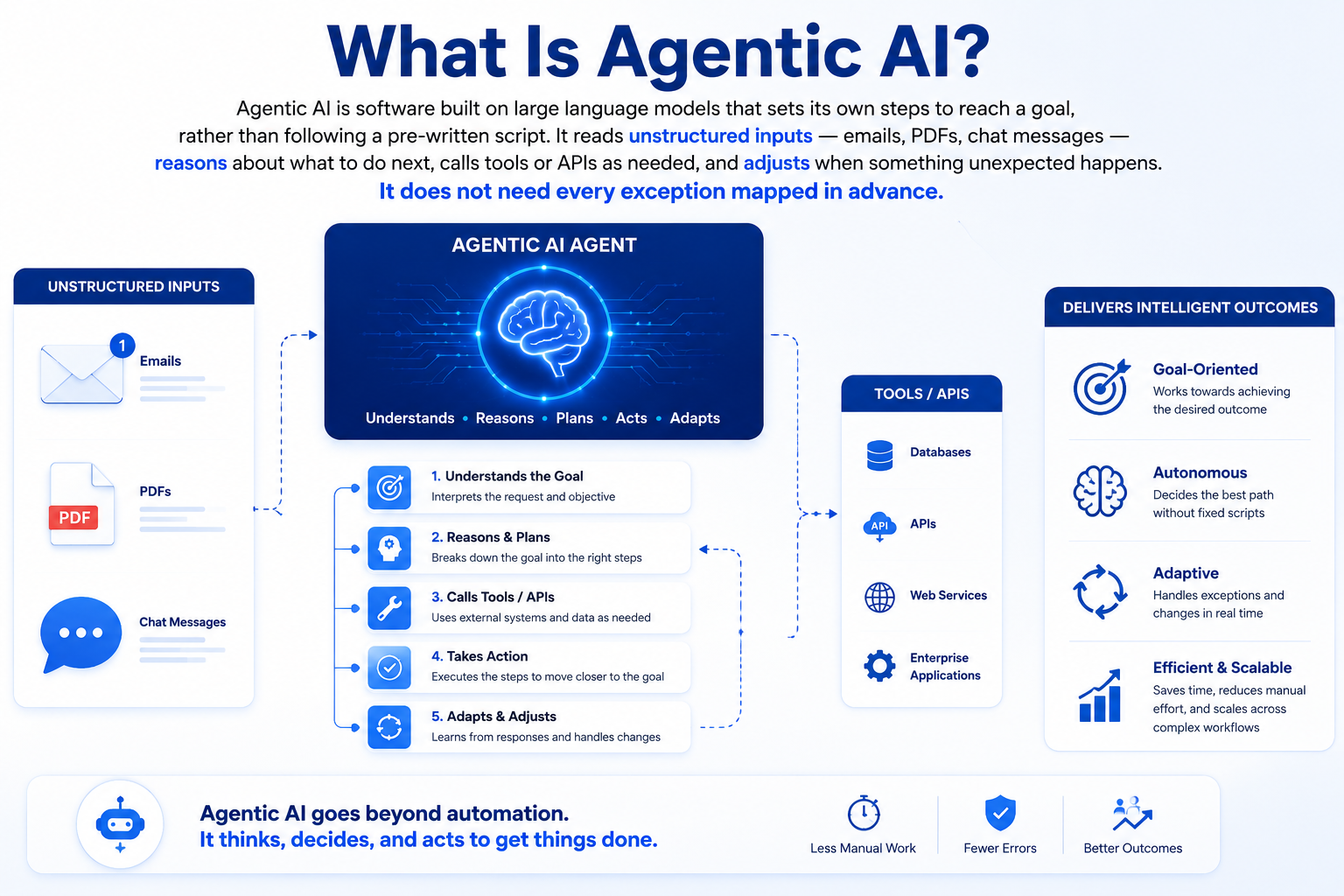
Agentic AI is software built on large language models that sets its own steps to reach a goal, rather than following a pre-written script. It reads unstructured inputs — emails, PDFs, chat messages — reasons about what to do next, calls tools or APIs as needed, and adjusts when something unexpected happens. It does not need every exception mapped in advance.
Where it lives today: triaging inbound customer emails across multiple intents, reconciling exceptions RPA scripts cannot handle, drafting first-pass responses to non-standard vendor queries, coordinating a task across five disconnected systems.
Where RPA Wins
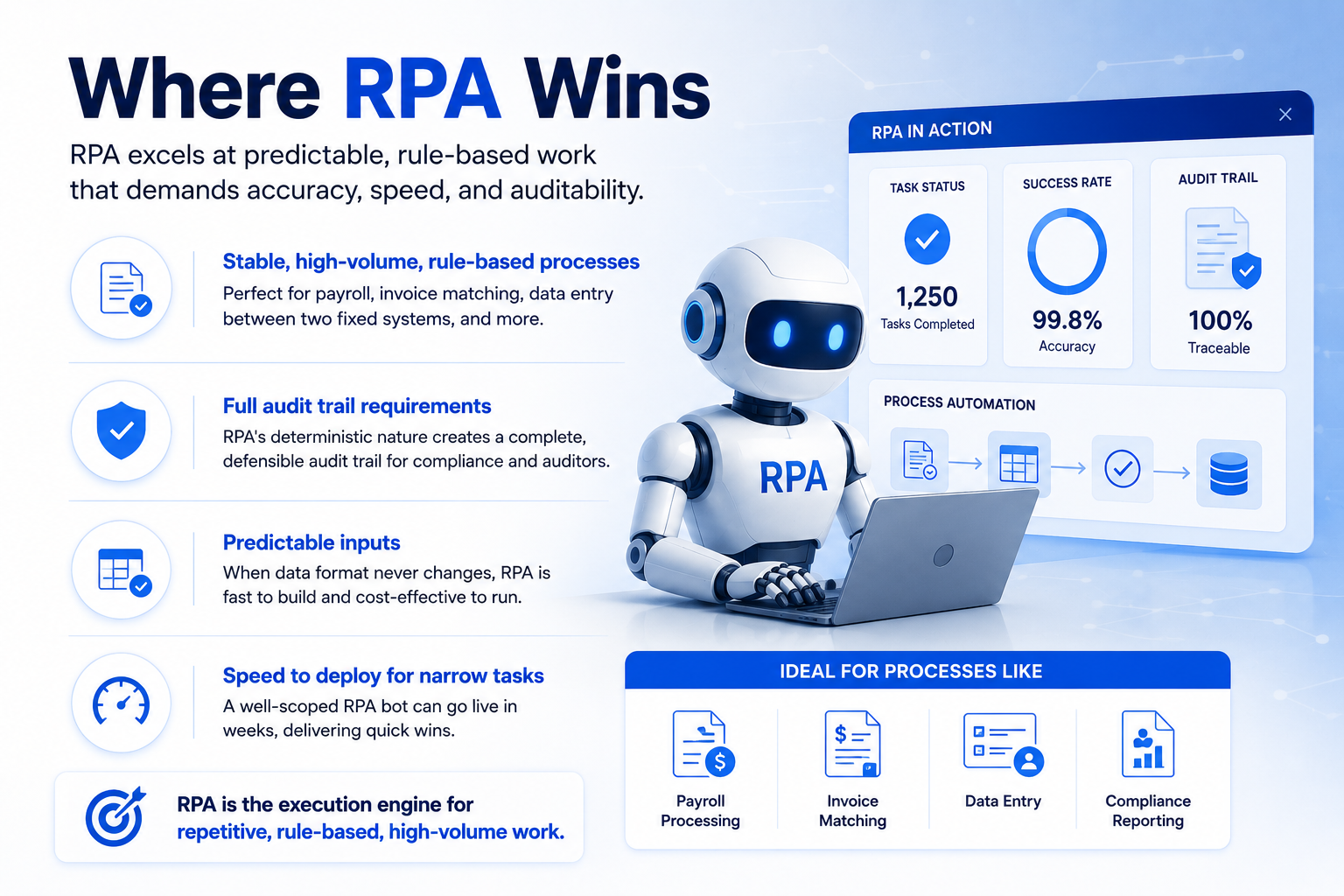
• Stable, high-volume, rule-based processes — payroll, invoice matching, data entry between two fixed systems.
• Full audit trail requirements — RPA's deterministic nature makes it defensible to auditors.
• Predictable inputs — when the data format never changes, RPA is fast to build and cheap to run.
• Speed to deploy for narrow tasks — a well-scoped RPA bot can go live in weeks.
Where Agentic AI Wins
• Judgment calls — deciding how to respond to an unusual vendor query.
• Unstructured inputs — reading a scanned PDF, an email thread, a WhatsApp message.
• Cross-system reasoning — coordinating a task across five disconnected tools with no API glue between them.
• Evolving processes — when the process itself changes often, agentic AI adapts without a developer rewriting the script.
Agentic AI vs. RPA: 5 Key Differences
- Decision-Making RPA: Follows fixed rules Agentic AI: Makes dynamic decisions
- Data Handling RPA: Works with structured data Agentic AI: Handles structured and unstructured data
- Exceptions RPA: Stops when something changes Agentic AI: Adapts to unexpected situations
- Best Use RPA: Repetitive, rule-based tasks Agentic AI: Complex, judgment-based workflows
- Maintenance RPA: Frequent updates required Agentic AI: Lower maintenance with proper oversight
Why Most 2026 Enterprises Run Both
Gartner projects up to 40% of enterprise applications will carry task-specific AI agents by the end of 2026, up from under 5% in 2025. The same research flags real risk: more than 40% of agentic AI projects will be shelved by the end of 2027 over unclear ROI, escalating costs, or missing risk controls. Only 17% of organizations have deployed AI agents so far, though more than 60% plan to within two years, according to recent industry surveys.
The pattern among enterprises actually seeing returns: RPA handles the execution layer — fast, cheap, auditable. Agentic AI handles the reasoning layer — routing exceptions, handling unstructured inputs, deciding what needs a human. Neither replaces the other outright.
How to Decide Which One You Need
1. Does the process change more than once a quarter? Agentic AI adapts faster than a rebuilt RPA script.
2. Are the inputs structured (fixed fields, forms) or unstructured (emails, PDFs, chat)? Structured favors RPA; unstructured favors agentic AI.
3. Does the task require a judgment call, or does it follow the same steps every time? Judgment calls favor agentic AI.
4. Do you need a full deterministic audit trail for compliance? RPA is easier to defend to an auditor today.
5. What is your appetite for a longer build with oversight versus a faster deploy with rigid limits? Agentic AI needs more upfront governance; RPA needs more long-term maintenance.
If the honest answer is “some of each,” that is the correct answer for most processes above a certain complexity.
Frequently Asked Questions
Q: Is agentic AI going to replace RPA?
A: No. RPA still runs 2026's highest-volume, most stable, most auditable processes cheaper than agentic AI can. Agentic AI extends automation into the exceptions and judgment calls RPA was never built to handle.
Q: Can RPA and agentic AI work together?
A: Yes. The common pattern in 2026: agentic AI reads the case, decides what needs to happen, and hands the deterministic steps to an RPA bot to execute — reasoning layer plus execution layer.
Q: What is the biggest risk with agentic AI projects?
A: Gartner expects over 40% of agentic AI projects to be canceled by end of 2027, largely from unclear ROI and missing governance, not from the technology failing. Scope a narrow, measurable use case before scaling.
Q: Is agentic AI more expensive than RPA?
A: Usually more expensive to build well, since it needs data access, guardrails, and testing across edge cases. Maintenance costs tend to run lower over time because it does not break every time a screen or process changes.
Q: How do I start if I have never used either?
A: Map your highest-volume process first. If it is stable and rule-based, start with RPA. If it is full of exceptions and judgment calls, pilot agentic AI on a narrow, well-defined slice of it, not the whole process at once.
Discover the right automation strategy.