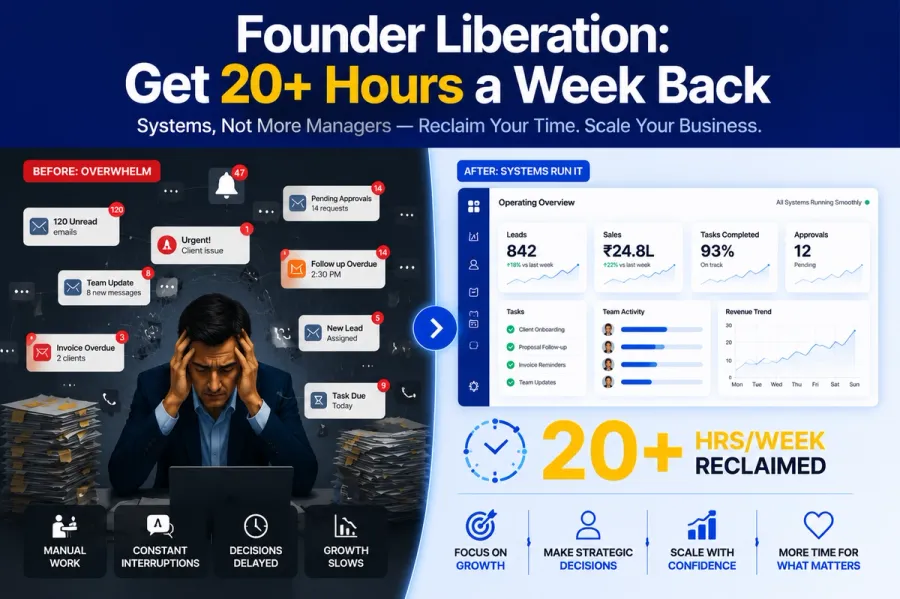
How Automation Frees 30–40% of a Founder’s Time
And Why Smart Businesses Are Shifting from Manual Control to Intelligent Systems
For most founders, time is the most valuable — and the most misused — asset.
Despite long working hours, constant follow-ups, and endless decision-making, many business owners still feel stuck in daily firefighting rather than strategic growth. If this sounds familiar, you’re not alone.
The good news? Businesses that adopt intelligent automation consistently reclaim 30–40% of a founder’s time — without hiring more people or compromising control.
Let’s understand how.
The Founder’s Time Trap
In growing organizations, founders often become the default problem-solver:
- Approving routine decisions
- Tracking operations manually
- Following up on teams
- Managing reports from multiple tools
- Fixing process gaps instead of building strategy
None of these tasks are wrong — but they are low-leverage activities for a founder.
Over time, this leads to:
- Decision fatigue
- Slower business growth
- Overdependence on the founder
- Burnout masked as “being busy”
Automation breaks this cycle.
What Automation Really Means (And What It Doesn’t)
Automation is often misunderstood as “replacing people with software.”
In reality, business automation is about replacing repetition, not responsibility.
It ensures that:
- Routine tasks happen automatically
- Data flows seamlessly across departments
- Decisions are supported by real-time insights
- Teams operate with clarity, not confusion
Automation doesn’t remove control — it returns control to leadership.
Where Founders Lose the Most Time (And How Automation Fixes It)
1. Decision Bottlenecks → Automated Workflows
When every approval, escalation, or update requires the founder’s involvement, growth slows down.
Automation enables:
- Pre-defined workflows
- Rule-based approvals
- Clear ownership at every stage
Result: Founders step out of micromanagement without losing visibility.
2. Manual Tracking → Real-Time Dashboards
Many founders still rely on:
- Excel sheets
- WhatsApp updates
- End-of-day reports
This creates fragmented information and delayed decisions.
- Centralized dashboards
- Live operational metrics
- Instant visibility into performance
Result: Faster decisions, fewer follow-ups, less mental load.
3. Repetitive Follow-Ups → System-Driven Execution
Whether it’s sales follow-ups, service reminders, internal tasks, or customer communication — repetition consumes a massive chunk of leadership time.
Automation handles:
- Scheduled reminders
- Status updates
- Task triggers
- Customer notifications
Result: Processes move forward even when the founder is not involved.
4. Firefighting → Predictive & Proactive Operations
Manual systems are reactive. Problems are noticed after they occur.
Automated systems introduce:
- Predictive alerts
- Early warnings
- Exception-based reporting
Result: Founders focus on prevention and strategy, not damage control.
The Real Impact: Time, Clarity & Scalability
When automation is implemented correctly, founders experience:
- 30–40% time recovery from operational tasks
- Improved leadership bandwidth
- Better team accountability
- Data-driven decision-making
- A business that runs with them, not because of them
Most importantly, automation enables founders to return to their core role:
Building vision, driving growth, and shaping the future of the business.
Automation Is a Leadership Decision, Not an IT Upgrade
The most successful businesses don’t adopt automation because they are struggling — They adopt it because they want to scale without chaos.
At Accucia Softwares, automation is approached as a business transformation exercise, not just a technology project. The focus is on understanding workflows, identifying time leaks, and designing systems that support leadership — not burden it.
Reclaim Your Time Today