Why Mid-Market Enterprises Don't Need More Software — They Need Less

Accucia Softwares ·

Quick Answer

Mid-market businesses now run on an average of 106 SaaS applications, but their teams actively use only 12 of them daily. The other 94 are operational tax — annual subscriptions, integration debt, and security risk. The 2026 consolidation play isn't about buying more capable software; it's about replacing 8-12 disconnected tools with one unified platform built around the actual workflow. Companies that consolidate now can cut SaaS spend 30-50%, reclaim 20+ hours of leadership time per week, and reduce vendor lock-in risk before AI agent contracts compound the problem in 2027.

The average mid-market business runs on 106 different SaaS applications in 2026.

Your team uses about 12 of them daily.

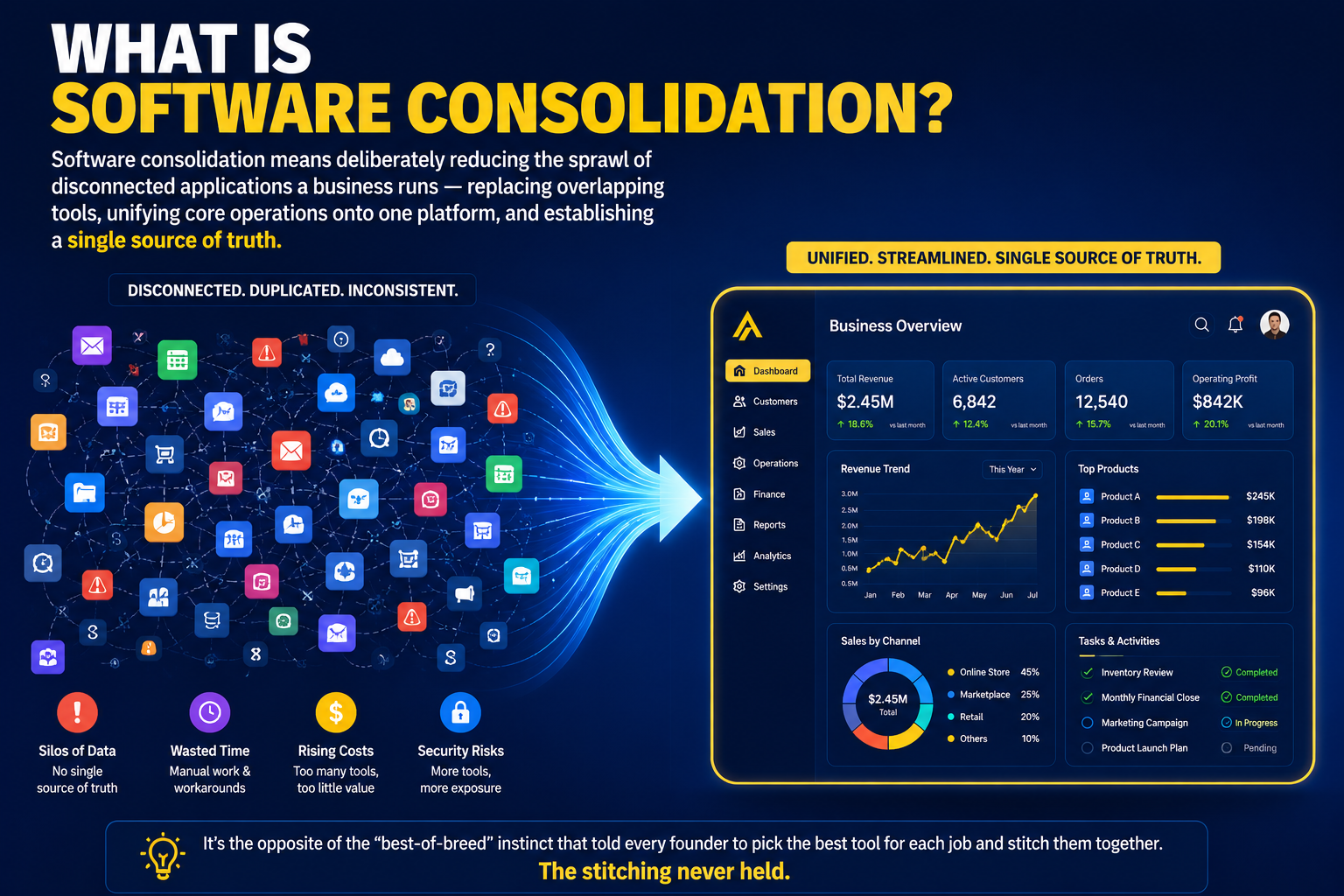
The other 94 are tax — annual subscriptions you forgot you were paying for, integration debt that compounds every quarter, login fatigue, security risk, and the slow erosion of any single source of truth.

Mid-market founders have been told for a decade to "stitch best-of-breed tools together." The bill is now due. And 2026 is the year the smartest mid-market operators stop collecting software and start consolidating it.

This is the consolidation playbook — built from 730+ enterprise software projects across healthcare, pharma, manufacturing, financial services, logistics, retail, and government.

The 106 SaaS App Reality

The data is consistent across multiple 2026 industry reports:

  • 106 SaaS apps per company average (BetterCloud's 2026 enterprise survey)
  • 42% of organisations cutting SaaS budgets in 2026 (Zylo's 175+ SaaS Statistics)
  • 76-81% of enterprises worried about AI vendor lock-in (CIO Magazine, May 2026)
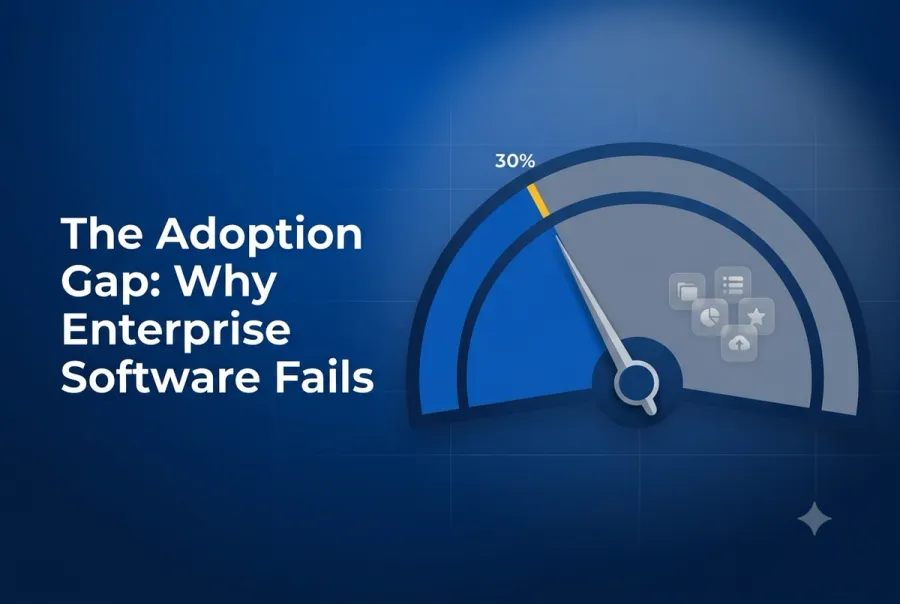
  • Less than 30% of features in purchased software actually get used (industry consensus)
  • 55% of employees adopt SaaS applications without security team involvement

For mid-market businesses specifically — the 30 to 500 employee bracket — the numbers are tighter but the pattern is identical: too many tools, fragmented data, and a CFO who can't tell you what 40% of the SaaS spend is for.

In our work across mid-market clients, the common picture looks like this:

  • 3-4 communication tools (Slack, Teams, Zoom, WhatsApp Business)
  • 5-7 project management tools (Asana, Trello, ClickUp, Jira, Linear, Notion, Monday)
  • 4-6 sales tools (HubSpot, Salesforce, Apollo, Outreach, ZoomInfo, LinkedIn Sales Navigator)
  • 3-5 finance tools (QuickBooks, Tally, ERPNext, Razorpay, custom Excel)
  • 2-4 HR tools (BambooHR, Keka, Darwinbox, Greythr)
  • 4-6 analytics tools (Google Analytics, Mixpanel, Power BI, Tableau, custom reports)
  • 6-10 industry-specific tools depending on vertical

That's already 25-40 tools. Add document management, customer support, marketing automation, design tools, security tools, infrastructure tools, and you're at 106 before the founder has finished their first coffee.

How Mid-Market Got Here

The "best of breed" decade — roughly 2014 to 2023 — sold every mid-market founder the same story: pick the best tool for each job, integrate them together, and you'll get enterprise-grade capability at SaaS prices.

The story was half right.

Each individual tool got better. But the integration layer never worked the way the demos suggested. Data sat in silos. Workflows broke across handoffs. The "integrations" that did exist were one-way data dumps that needed engineering attention every time a vendor updated their API.

Mid-market founders ended up with the worst of both worlds: enterprise-level complexity without enterprise-level support, paying SaaS subscriptions in 25 different currencies, and a team that still ran the actual business on Excel and WhatsApp because that's the only thing everyone could agree on.

The 2026 Economic Reset

Three forces are converging in 2026 to make this year the inflection point:

1. CFOs are cutting SaaS budgets. 42% of organisations are actively reducing SaaS spend. The era of "we'll figure out ROI later" is over.

2. AI vendor lock-in is the new enterprise risk. With OpenAI launching Frontier, Google's Gemini Enterprise Agent Platform, and Anthropic restricting third-party agent tool usage, the AI category is consolidating around 3-4 platforms. Mid-market businesses that bolt AI onto an already-fragmented tool stack will face a second wave of vendor lock-in by 2027.

3. Mid-market features at SaaS prices. What used to be enterprise-only ERP and CRM functionality (real-time dashboards, role-based access control, custom workflow engines, embedded AI) is now available at mid-market price points. Workday's Q1 FY26 reported +12.6% revenue and +13.4% subscription growth — almost entirely driven by mid-market adoption. SAP's cloud ERP suite revenue was up 34%.

The window to consolidate cheaply, before AI agent contracts complicate things, is roughly 12-18 months.

The 5-Step Consolidation Framework

This is the framework we run with every mid-market client before we recommend a single line of code. Founders can run it themselves in 4-6 weeks.

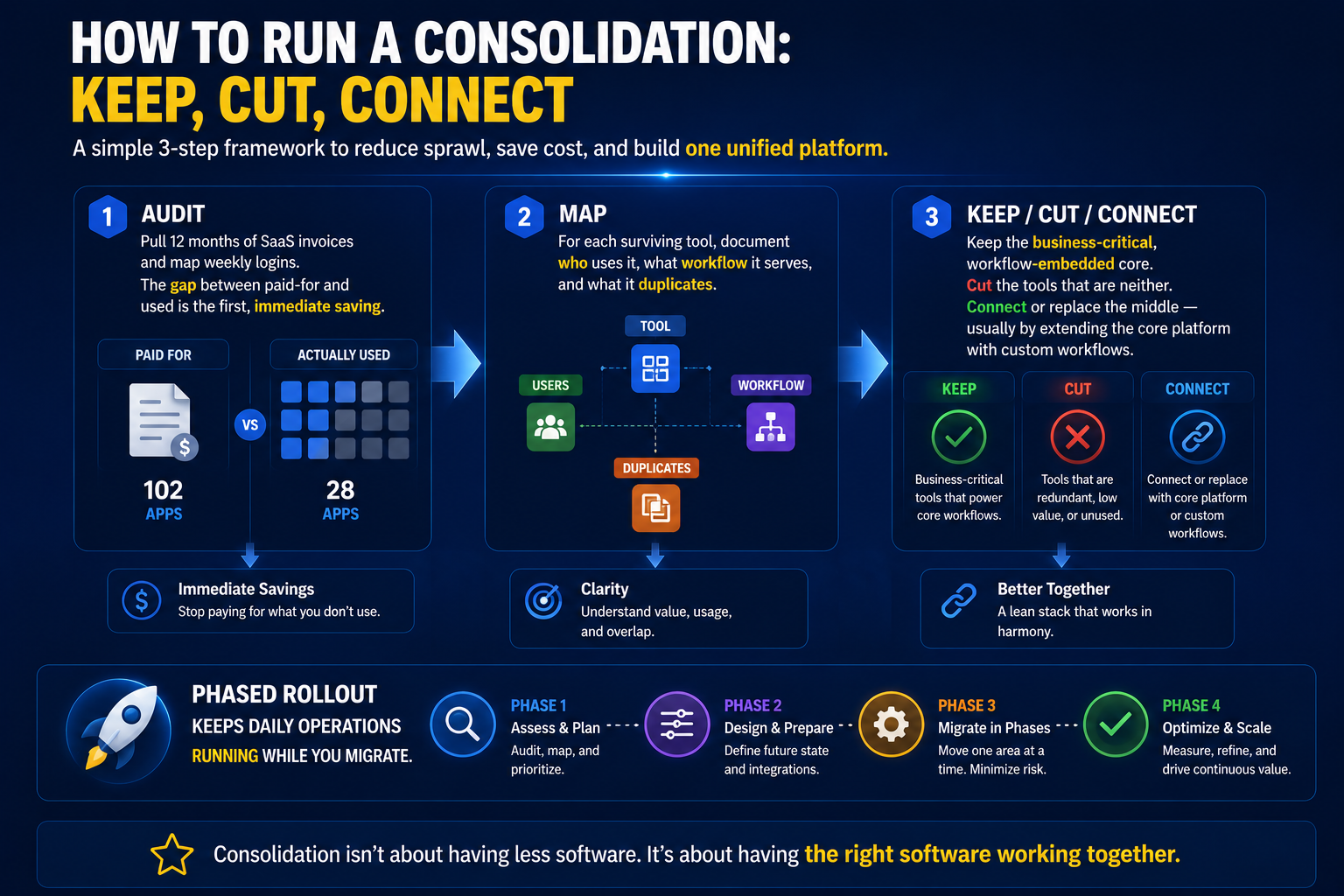
Step 1: Audit

Pull every SaaS subscription invoice from the last 12 months. Map every login your team uses weekly. Cross-reference. The gap between "what we pay for" and "what we use" is the first surprise.

For most mid-market businesses, this exercise alone identifies 20-30% of immediate spend reduction.

Step 2: Map

For each tool that survives the audit, document:

  • Who actually uses it (by role, not by license count)
  • What workflow it serves
  • Where its data flows in and out
  • What it duplicates with another tool you also pay for

You'll find at least 3-5 tools doing the same job, paid for by different departments because nobody centralized the buying.

Step 3: Prioritise

Score each remaining tool on two axes:

  • Business-critical: Does the company stop functioning without it for 24 hours?
  • Workflow-embedded: Is the data captured here used by 3+ other tools or roles?

The top-right quadrant (business-critical AND workflow-embedded) becomes the foundation of your consolidated platform.

The bottom-left quadrant (neither business-critical nor workflow-embedded) gets cut in the next renewal cycle.

Step 4: Replace

This is where most mid-market businesses stop. Don't.

The middle quadrants — tools that are business-critical but not workflow-embedded, or vice versa — are the consolidation opportunity. Most can be replaced by extending the foundation platform with custom workflows, dashboards, or AI assistants that match how your business actually runs.

This is what custom software development should mean in 2026: not building everything from scratch, but consolidating the 20-40 tools your business shouldn't be paying for separately into one unified operating layer.

Step 5: Retire

The hardest step. Tools your team is emotionally attached to but that don't pass the audit need to be turned off. Schedule retirement dates. Communicate them. Provide alternatives. Measure what breaks (almost always less than expected).

A typical mid-market business completes Steps 1-3 in 4-6 weeks, makes the replace decisions over the following 8-12 weeks, and finishes retirement within 6 months. Total SaaS spend reduction in well-executed consolidations: 30-50%.

What "Less Software" Actually Looks Like

The consolidated state isn't sparse. It's coherent.

  • One platform that captures data at the point of action — sales calls, customer support tickets, inventory movements, delivery updates, financial transactions
  • One dashboard that leadership opens instead of asking three managers for three different numbers
  • One delivery partner that stays through implementation, training, and adoption — not 14 SaaS vendors who disappear after the renewal email
  • One source of truth for customer data, financial data, operational data, and team workflows

In practice, this often looks like a custom-built ERP + workflow platform with embedded AI (RAG-style internal chatbots, workflow automation for approvals, real-time analytics) replacing 8-15 disconnected SaaS subscriptions.

Case Study: A Pune Relocation Business

A 17-year-old relocation services business in Pune was running on:

  • An old custom CRM that nobody used
  • 4 different spreadsheets for inventory tracking
  • WhatsApp groups for daily field coordination
  • A consignment photo system stored on individual mobile phones (which created its own retrieval crisis)
  • A separate billing tool
  • A separate quotation tool
  • 3 different communication apps

We replaced all of it with Relotech — a relocation-industry ERP built specifically around their workflow. Centralised photo storage at the core. Live location tracking for delivery teams. Inter-department workflow clarity that the business had never had in 17 years.

The result:

  • Zero disputes from missing photos (the single biggest operational problem solved)
  • Live customer tracking that cut status calls dramatically
  • A consolidated SaaS bill that reduced monthly software spend by approximately 40%
  • A 17-year-old business finally running on a system that fits how it actually operates

The bigger lesson isn't about Relotech. It's about the methodology: software fails when it's adapted from a template. It works when it's built around the actual workflow on the ground.

The Mid-Market AI Angle

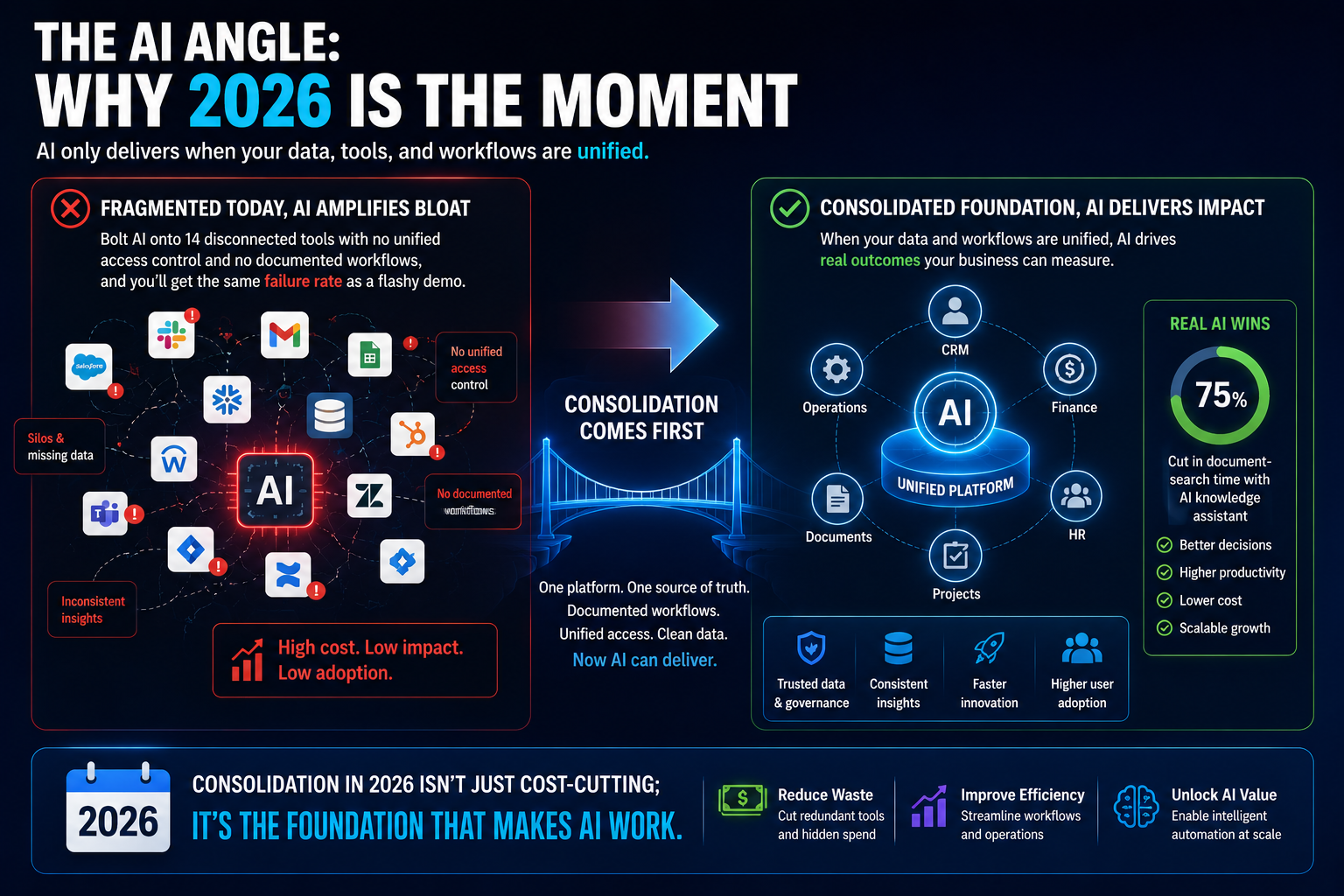
Here's why 2026 specifically is the inflection point: AI amplifies bloat if your data is fragmented.

The pharma chatbot we built (75% time reduction, 95% answer accuracy, 8-month payback) worked because we did the prerequisite consolidation first. The AI sat on top of one organised document repository, with role-based access, embedded in the one app the team already used.

If you bolt AI onto a fragmented stack — pulling data from 14 disconnected tools, with no unified access control, no documented workflows — you'll get the same failure rate as a consultant's PowerPoint demo. Most enterprise AI pilots still fail before reaching production. The model is rarely the cause.

This is why consolidation in 2026 isn't just about cutting SaaS spend. It's about preparing the data foundation that makes AI work in 2027.

FAQ: Mid-Market SaaS Consolidation in 2026

How much can mid-market businesses typically save through SaaS consolidation?

30-50% of total SaaS spend is the realistic range. The first 20-30% comes from cutting unused subscriptions identified in Step 1 (audit). The remaining 20-30% comes from replacing fragmented tools with consolidated workflows.

How long does SaaS consolidation take for a mid-market business?

Steps 1-3 (audit, map, prioritise) take 4-6 weeks. Steps 4-5 (replace, retire) take 4-6 months depending on how aggressive you are. Most mid-market businesses see meaningful spend reduction within 90 days.

Should mid-market businesses build custom software or buy off-the-shelf?

Buy for commodity capability (email, accounting, basic CRM). Build for anything workflow-specific to your business — the parts where your operation actually differs from the template version your industry uses. This is where the 80/20 of operational tax sits.

What's the risk of consolidating too quickly?

The biggest risk is team adoption failure. If you cut tools faster than the team can transition to the replacement, you lose productivity. Phased rollout with on-site training and embedded support is how we avoid this in every Accucia engagement.

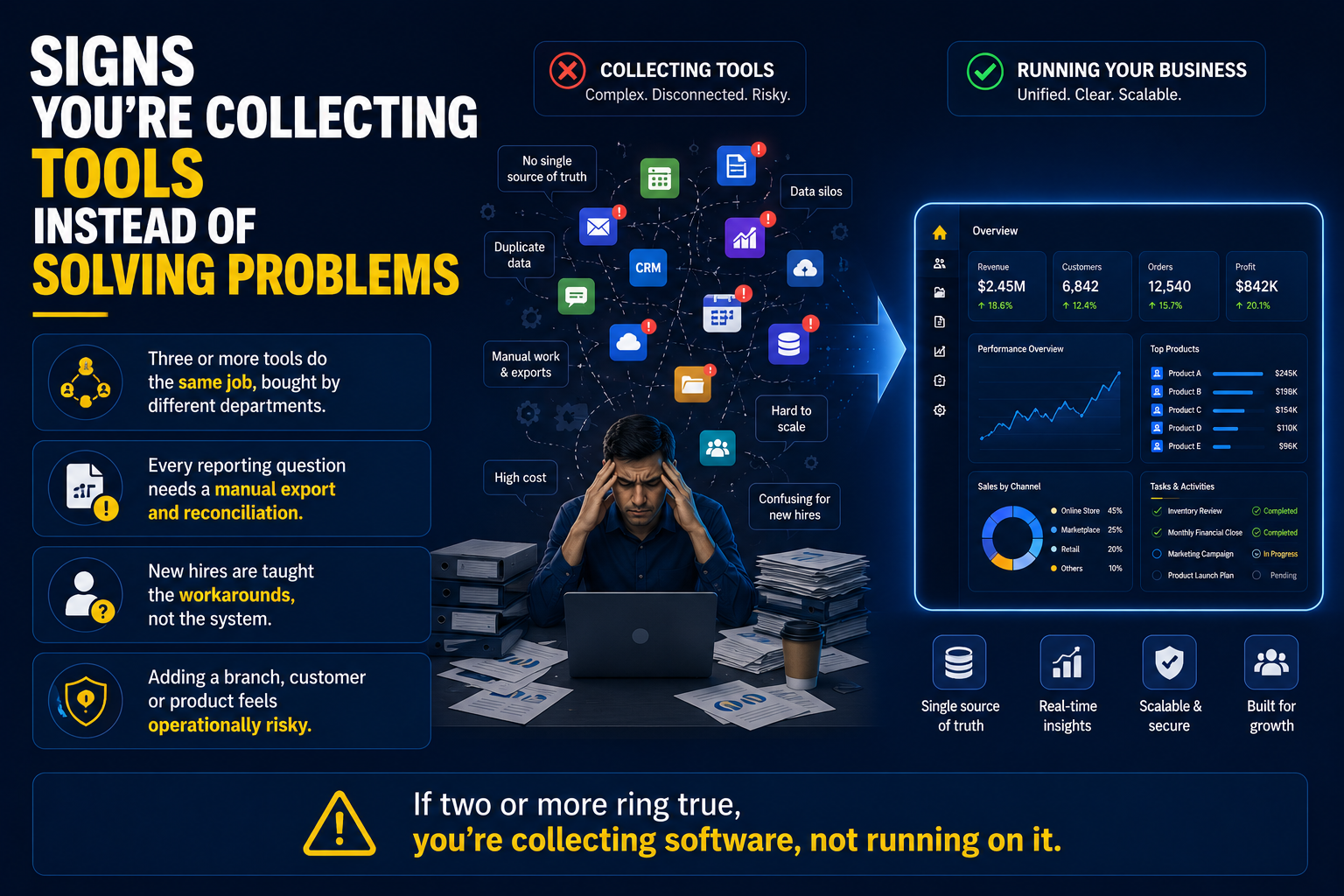
How do I know if my business is ready to consolidate?

Three signals: (1) Your CFO can't tell you what 40% of the SaaS budget is for. (2) Your team uses Excel or WhatsApp to coordinate work that's "supposedly" in a tool. (3) Adding a new branch, customer, or product feels operationally risky rather than exciting. If 2+ of these are true, you're ready.

Cut SaaS chaos. Build one unified workflow.

Chat With Us