
Government IT Continuity: Surviving Officer Transfers (2026 Department Guide)
Quick Answer
Indian government officers transfer every 2-4 years. Most digital programs in Indian government departments don't survive the handover because institutional knowledge lives in those officers' heads, not in the system. The 5 architectural patterns that make a department transfer-proof are: (1) SOPs documented inside the platform, not in separate Word documents; (2) role-based onboarding so a new officer sees the full state of the department on day one; (3) embedded delivery partners that survive officer changes; (4) leadership dashboards designed as a handover tool, not just a reporting tool; (5) audit-traceable workflows where every approval is dated and signed in the system. Departments that lock these patterns can survive 3-4 officer transfers without losing operational momentum or institutional context.
Every Indian government department lives with one quiet reality.
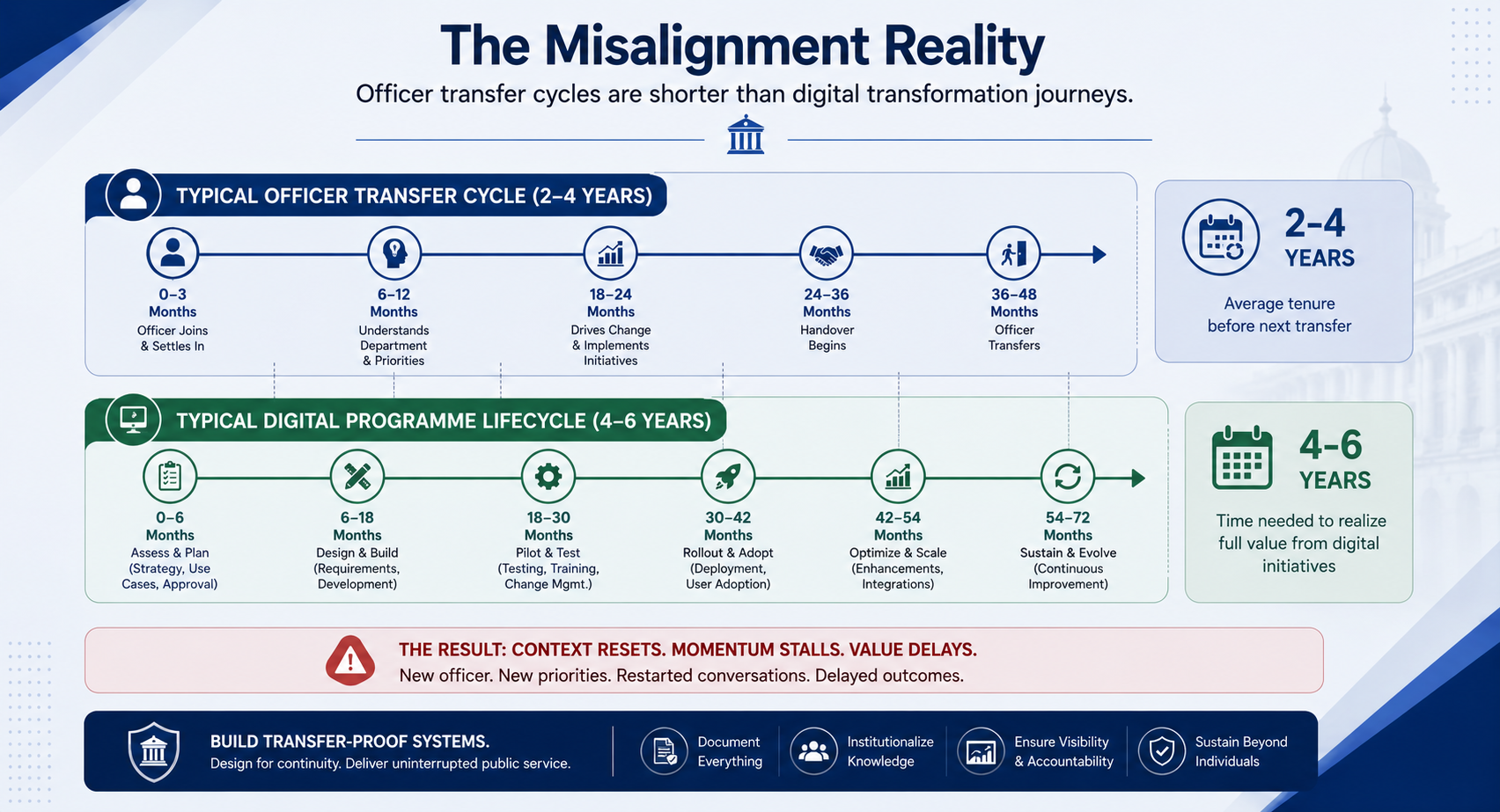
The officer driving the digital agenda today will be transferred in 2-4 years. Their replacement will arrive with no shared context, no documented workflows, no understanding of which vendor relationships matter, and no sense of what was decided in which meeting.
In most departments, the digital programme stalls for 4-8 weeks while the new officer rebuilds context. Sometimes it stalls indefinitely. The vendor disappears. The dashboards go dark. The team reverts to paper.
This is the continuity trap — and it's the single biggest cause of failed government digital transformation in India.
After 10-15 connected projects inside one major Mumbai government housing authority (anonymised per NDA), and continuing engagements across other Maharashtra state authorities, we've seen this pattern resolved — with five specific architectural patterns. Here's the playbook.
Why Officer Transfers Are Structurally Inevitable
Indian government postings follow a predictable cadence:
- IAS and senior administrative officers: typically 2-3 year tenures, often shorter
- IT Officers and Assistant IT Officers: 2-4 years
- HODs and Commissioners: 3-5 years
- Section officers and field heads: 4-7 years
Transfers aren't a failure of the system — they're a feature. They prevent capture, distribute experience across departments, and bring fresh perspectives.
The problem isn't the transfer. It's that most digital programs are built as if the current officer will stay forever.
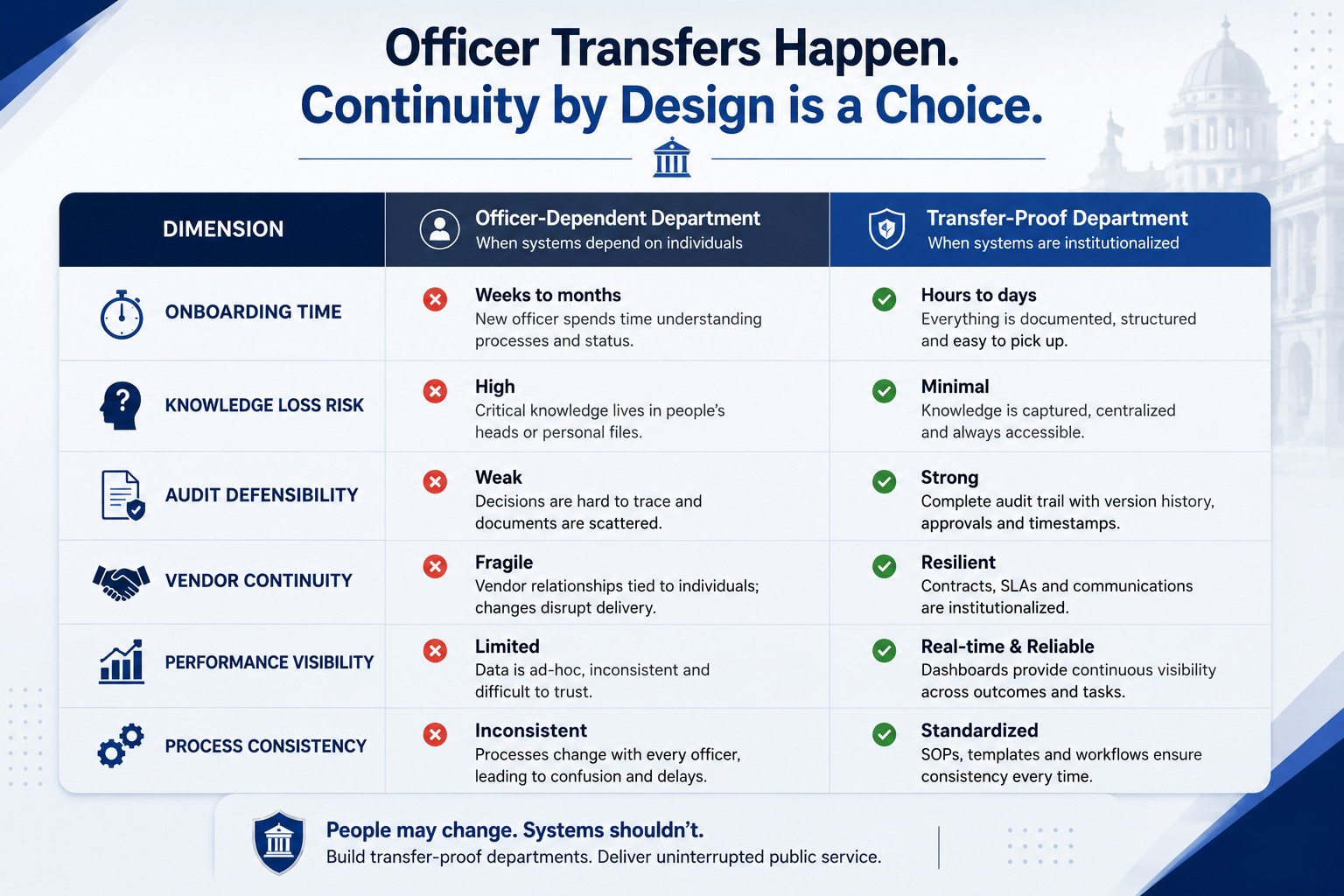
Why Most Digital Programs Don't Survive Officer Changes
The common failure pattern across the Maharashtra departments we've audited:
- Workflows live in one officer's head. The current IT Officer knows which approvals route to whom, which SOPs are actually followed (vs the official version), which vendors deliver and which don't. None of this is documented in the system.
- Vendor relationships are personal, not institutional. The current officer trusts a specific vendor's senior delivery person. The new officer doesn't know who to call when something breaks.
- SOPs live in Word documents on a shared drive. Not in the system. Not searchable. Not version-controlled. Often outdated.
- Dashboards are designed for the current officer's mental model. When the new officer opens them, they don't know what the numbers mean or where to dig.
- Audit trails are spotty. Who approved what, when, on what data — not consistently captured. The new officer can't reconstruct the decision history.
The result: the digital programme stalls during transition. Sometimes it never recovers.
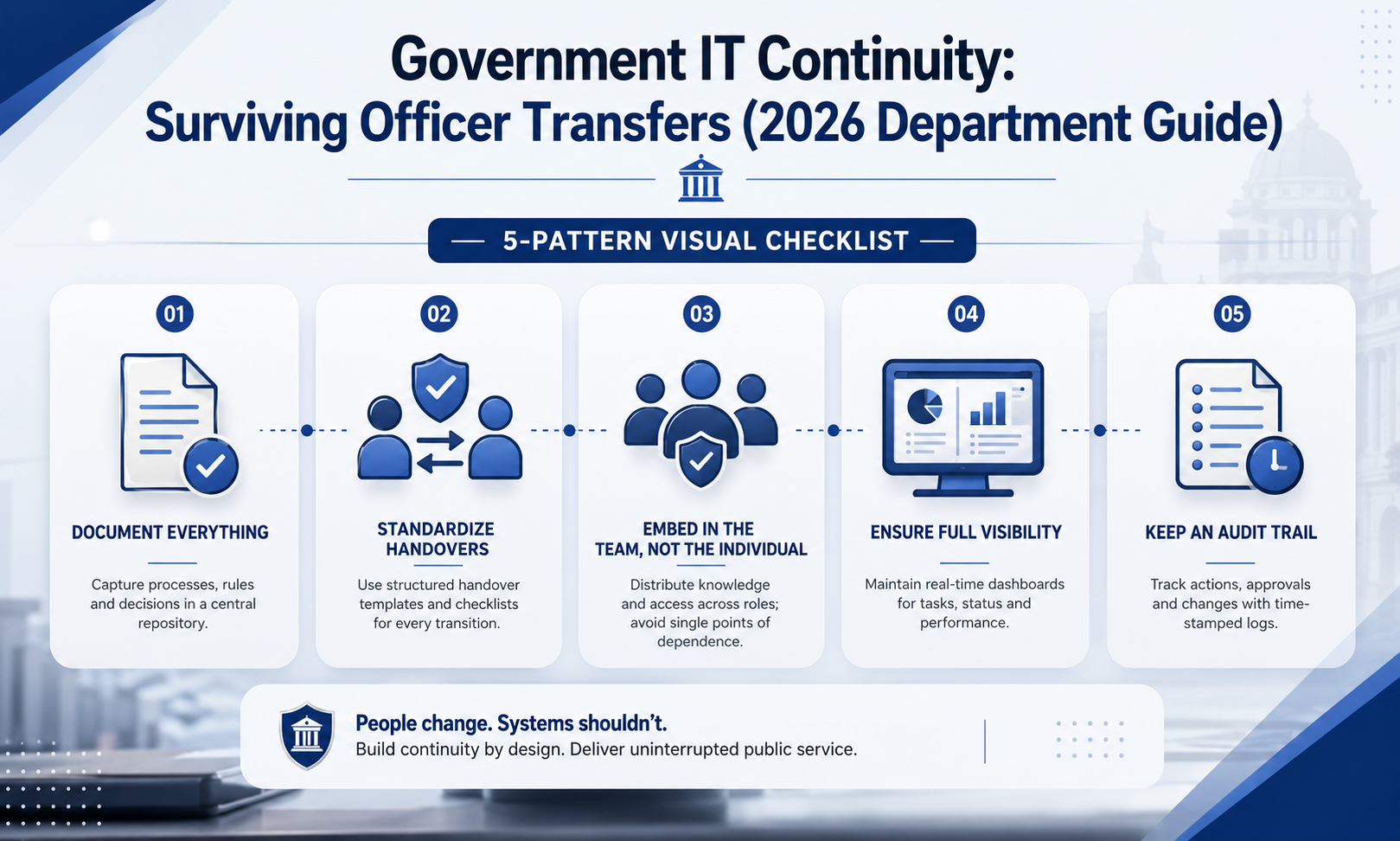
The 5 Patterns That Make a Department Transfer-Proof
Pattern 1: SOPs Documented Inside the Platform, Not in Word Documents
Every workflow the system handles should have its SOP embedded — visible inside the screen where the work happens. Not in a separate Word document on a shared drive that the new officer has to discover.
The practical implementation: workflow cards in the platform include the SOP text, the approval authority, the escalation path, and the audit policy. When a new officer opens the workflow, the policy is right there.
This single pattern eliminates 60-70% of the post-transfer context loss.
Pattern 2: Role-Based Onboarding Built Into the Platform
When a new IT Officer or HOD joins, their first day should produce a structured tour of the department's digital state: pending files, active citizen escalations, in-flight projects, recent decisions, vendor engagements, audit pending items.
We build this as a 'New Officer Onboarding' screen baked into the platform. The platform shows the new officer everything they need to know to take over within their first 30 minutes — instead of taking 4-6 weeks to reconstruct context from filing cabinets.
Pattern 3: Embedded Vendor Continuity
The vendor relationship needs to be institutional, not personal. That means: documented engagement model, written escalation paths, multiple delivery contacts (not just one person), and on-site presence that survives officer changes.
For our continuing engagements at Maharashtra state authorities, two delivery staff are stationed at the client site. When officers change, those delivery staff become the institutional memory — they brief the new officer on what's been built, what's pending, and where the issues are.
This pattern is what's allowed our engagements at a Mumbai government housing authority to survive multiple IT Officer changes over the past several years without losing momentum.
Pattern 4: Leadership Dashboard as a Handover Tool
Most government leadership dashboards are designed for the current officer's mental model. When the new officer opens them, they're disoriented.
The transfer-proof dashboard design: every metric on the dashboard includes a 'What this measures' tooltip, a historical trend line, and a link to the SOP that drives it. Filterable by date range so the new officer can see what happened in the 6 months before their joining.
This turns the dashboard from a reporting tool into an active handover tool.
Pattern 5: Audit-Traceable Workflows
Every approval, every decision, every workflow execution gets logged with: who approved, when, on what data, with what reasoning (free text field). The new officer can audit-trail backward through 6-12 months of decisions and understand the rationale.
This pattern also satisfies departmental audit requirements — a happy bonus that often pays for itself in the first audit cycle post-deployment.
Anonymised Case Study
A Mumbai government housing authority (name withheld per NDA) commissioned 10-15 connected digital projects with us between 2019 and 2026. During that period:
- The IT Officer changed twice
- The HOD changed once
- The departmental Commissioner changed once
- The CM-level leadership changed twice
At every transition, the platform survived. The new officers opened the dashboards on their first week and were operational within days. The vendor relationship (Accucia) held — the on-site delivery team provided continuity. Audit trails let the new leadership understand decision history.
The department's CM-recognised citizen-services website remains in active use, the visitor management platform (reducing daily footfall from 2,000+ to under 700) continues to operate, and 10-15 connected modules run smoothly across all departments.
This is what transfer-proof looks like in production. It wasn't accidental. It was architected.
FAQ: Government IT Continuity
How long does it take to make an existing government department transfer-proof?
For a department already operating on a digital platform, applying the 5 patterns takes 8-16 weeks depending on platform maturity. The biggest work is documenting SOPs inside the platform and building the onboarding screen. For a department still on paper, transfer-proofing happens naturally as part of the initial digital transformation — the patterns get baked into the build from day one.
Can existing digital systems be retrofitted to be transfer-proof, or do we need to rebuild?
In most cases, retrofitting works. The SOP-in-platform pattern is the heaviest lift but can be done module-by-module. The onboarding screen is typically a 3-4 week build. Audit trails can be added incrementally. Full retrofit timeline: 4-6 months for a mid-sized department. Far cheaper than rebuilding.
What if our current vendor is the problem — our digital programme is dependent on a single vendor contact who could leave?
This is the most common version of the continuity trap. The fix: insist your vendor station multiple delivery staff at your premises, document the engagement model in writing, and require institutional knowledge transfer protocols in the contract. If the vendor won't agree, find another vendor — the risk is too high.
Does the transfer-proof model meet DISHA, ABDM, and government audit requirements?
Yes — in fact, it exceeds typical requirements. The audit-traceable workflow pattern produces exactly the kind of evidence trail that DISHA and ABDM expect. Departments that adopt the full 5-pattern model typically pass audits with significantly less preparation time.
Will this approach work for non-Maharashtra government departments — e.g., other states, central government, municipal bodies?
Yes. The patterns are governance-agnostic and apply to any department where officer transfers happen on a regular cadence. We've applied variations of this approach to municipal bodies, regional development authorities, and statewide service departments.
What To Do Next
For IT Officers and HODs scoping a digital programme in 2026:
- Audit which of the 5 patterns your current system has in place — most departments score 1 of 5 or 0 of 5
- Plan continuity work as part of the next digital initiative, not as an afterthought
- Demand vendors commit to institutional continuity — not just personal relationships
- DM 'CONTINUITY' on LinkedIn for our 1-page department continuity audit checklist
Make your department transfer-proof.