
Building an AI-Enabled CRM: Lessons from Real-World Implementation
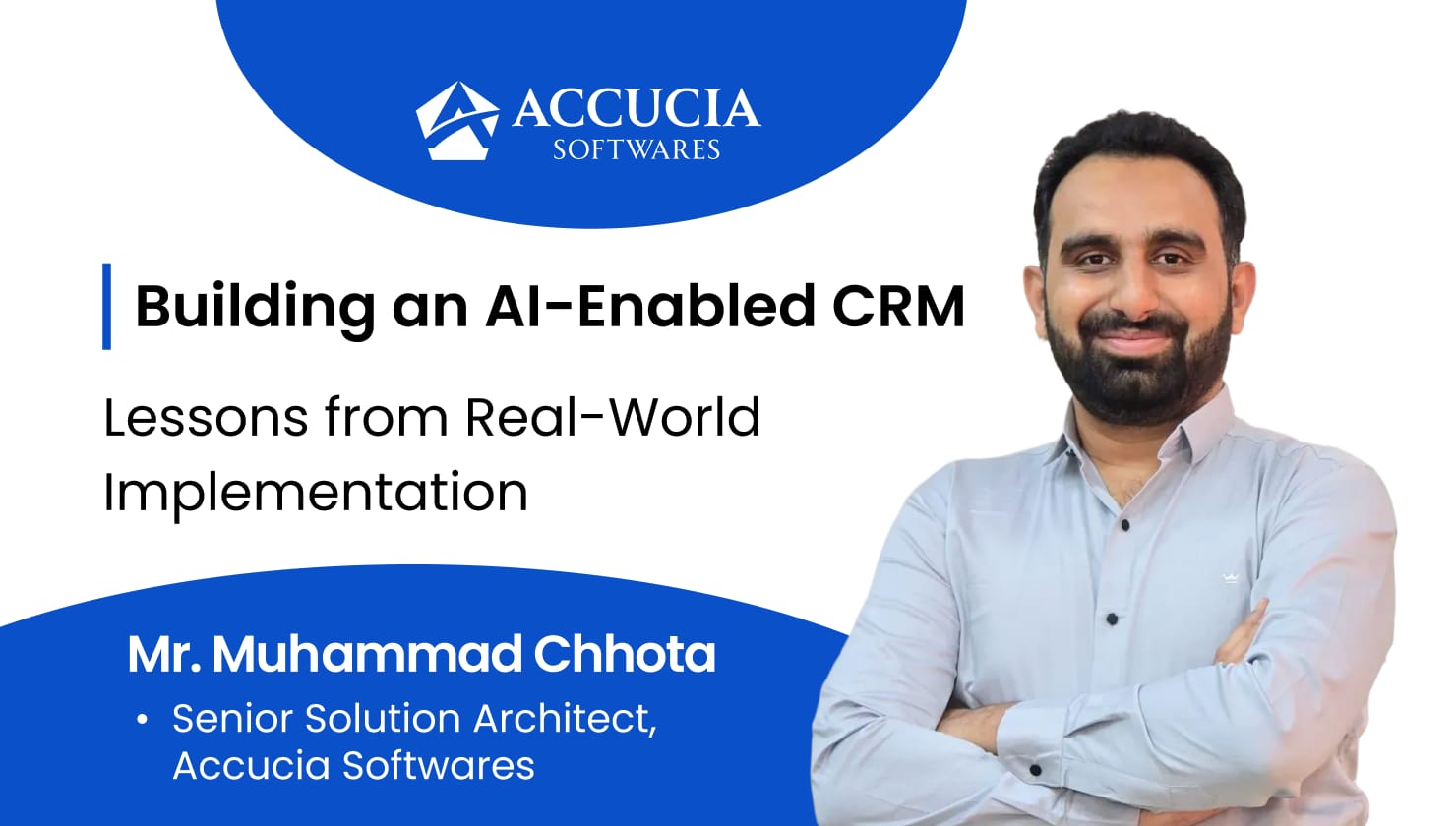
Muhammad ChhotaSenior Solution Architect, Accucia Softwares
Over the last few years, AI has shifted from being an experimental concept to an expected capability—especially in customer-facing platforms like CRMs. As a solution architect, I’ve had the opportunity to design and deliver multiple CRM platforms with AI capabilities, built from the ground up and deployed into real production environments across different industries.
These systems were never built as AI showcases. They were created to solve practical, day-to-day problems such as missed leads, delayed responses, scattered sales data, and sales teams spending more time managing tools than engaging with customers. This article reflects on what I learned while architecting AI-enabled CRMs, the challenges we faced, and the principles that consistently worked in real-world usage.
Why Traditional Sales Systems Break Down
Across most sales-driven businesses, one pattern repeats itself: customer interest does not follow office hours, but sales processes usually do. Leads often arrive late at night or during weekends, while responses are delayed until the next working day. By then, intent has weakened—or disappeared entirely.
This became very clear while working on a mobile-first sales CRM built for a large distributed field sales team, where thousands of customer calls happened daily. Despite high activity, tracking and follow-ups were fragmented because teams relied on disconnected tools and personal devices.
A similar pattern emerged in a loan distribution CRM built for financial services workflows, where leads moved through complex stages such as eligibility checks, approvals, and disbursement. Even with structured processes, visibility and ownership were still managed through spreadsheets and messaging apps.
Different industries. Different workflows.But the same outcome: slow engagement led directly to lost opportunities.
Where AI Added Real Value
AI became effective only when applied with restraint. Instead of trying to automate the entire sales journey, we focused on moments where human teams were unavailable or overloaded.
AI-powered chat and voice assistants were introduced to handle first-level engagement—responding instantly, capturing intent, and maintaining conversation context until a sales executive could step in. These systems were integrated directly into the CRM so that conversations, call logs, and customer behavior flowed into a single source of truth.
The goal was never for AI to close deals. Its role was to ensure that every inquiry received immediate attention, especially outside working hours, and that no lead went cold due to delayed response.
Grounding AI with Real Implementations
To make this practical, I’ll reference two representative CRM implementations that shaped many of these decisions.
In a mobile-first CRM built for a large electric vehicle sales operation, the scale was significant—hundreds of sales executives and thousands of daily customer interactions. The core challenges included disconnected tools, lack of centralized lead tracking, use of personal phones for calling, and inconsistent test-ride scheduling.
The solution focused on simplicity and mobility:
- Integrated calling, WhatsApp, scheduling, and pipeline tracking in a single mobile app
- Real-time dashboards for managers to track performance
- Offline support to ensure productivity in areas with poor connectivity
Once the foundation was stable, AI was layered in gradually to improve response time and engagement. The impact was measurable: faster follow-ups, shorter sales cycles, improved conversion rates, and a significant drop in missed or forgotten customer interactions.
In another implementation, a loan distribution CRM designed for mortgage workflows, the challenge was not volume but complexity. Traditional CRMs failed to handle conditional stages like approval, rejection, reprocessing, and disbursement. Leads arrived from multiple channels, but routing and visibility were inconsistent, and sales teams relied heavily on manual tracking.
Here, the focus was on:
- A custom pipeline aligned with real loan-processing stages
- Centralized lead capture across sources
- Dynamic workflows that adapted based on loan status
AI in this context supported faster initial engagement and better prioritization, while humans retained ownership of critical decision points.
These were just two examples—similar patterns and learnings emerged across other CRM builds as well.
Architectural Responsibility and Early Trade-offs
Most of these platforms were greenfield implementations, which meant architectural decisions made early had long-term consequences. As a solution architect, my responsibility was to balance business expectations with technical reality.
One early lesson was that AI performance is tightly coupled with data quality. In many organizations, data was incomplete, inconsistent, or spread across systems. AI did not hide these gaps—it exposed them. Improving workflows and data discipline became just as important as selecting the right models.
Cost was another critical constraint, especially for voice-based AI. Running AI at scale without control quickly becomes expensive, which forced careful decisions around when AI should engage, when to escalate, and when human intervention made more sense.
Adoption Is a Human Problem, Not Just a Technical One
Introducing AI into sales workflows naturally created hesitation. Stakeholders were cautious about AI engaging customers directly, particularly through calls. Concerns around trust, customer perception, and the role of sales teams were common.
This reinforced a key insight: AI adoption is a change-management challenge.
The most successful implementations followed a human-in-the-loop approach. AI handled first-level engagement, qualification, and follow-ups, while sales teams remained responsible for high-value conversations. Over time, as teams saw AI reducing workload rather than competing with them, acceptance grew naturally.
Why Incremental Rollout Worked Best
From an architectural perspective, deploying AI incrementally proved far more effective than a big-bang rollout. Instead of adding intelligence everywhere, we focused first on the most painful bottlenecks—response time, follow-up consistency, and lead visibility.
Each phase was monitored closely in real usage. Decisions were refined based on actual behavior rather than assumptions. This approach improved system stability, user trust, and long-term adoption.
A Misconception Worth Challenging
One assumption I strongly disagree with is the idea that AI will replace sales teams. Sales is fundamentally about trust, relationships, and judgment—areas where human skills remain essential.
AI’s real value lies in ensuring that no opportunity is lost due to delay, inconsistency, or lack of availability. Customers engage when it suits them, not when systems are ready. AI helps bridge that gap.
Closing Perspective
Building an AI-enabled CRM is not about adding intelligence everywhere. It is about adding intelligence where it matters most.
From my experience, the most effective AI-driven CRMs are grounded in business reality, realistic expectations, and disciplined architecture. When designed with intent, AI does not replace teams—it strengthens them, making sales systems more responsive, reliable, and resilient.
That principle continues to guide how I design AI-driven systems today: practical, scalable, and aligned with real business needs.
Build an AI-enabled CRM that works in the real world.